Showing posts with label Canada's Performance. Show all posts

February 27, 2010

2010 Olympics Week 2

I've been a negligent blogger this week due to other committments; but to be honest I've been enjoying my role as an Olympic spectator a lot more since I stopped writing about my medal prediction every day.

I promise (threaten?) that I'll have lots more to say when the Games are over about Own the Podium, the team's overall performance, and the post-mortem on my medal prediction. For the moment I am just going to give the last remnant of the prediction.

Now that we're down to the last two days of competition, and with Canada's (medal or non-medal) fate already decided in a few of the events, I don't really have the statistics of "large numbers" on my side. As a result, some of the numbers here are a bit meaningless.

Nevertheless, here they are. With teams already in the men's curling gold medal game, the men's hockey gold-medal game, and the men's speed skating team pursuit, team Canada is guaranteed to take at least 24 medals. I am showing the most likely number as 25 (45%), followed by 26 (30%). (The two best chances are in the four-man bobsleigh, and the men's snowboard parallel giant slalom, both today.) Altogether, there is an 83% chance that Canada will set a new national record for total number of medals at a Winter Olympics.

Canada has already set a new national record for the most gold medals won at the Winter Olympics, with 10. The previous best was 7 in Salt Lake City and Torino. I have not been able to confirm this, and I have not seen it written anywhere else — but as far as I have been able to determine, Canada has never won more than 10 gold medals in any Olympic Games, summer or winter. The previous highest total was 10 at the boycotted 1984 Olympic Games in Los Angeles.

February 19, 2010

2010 Olympics Day 6: Defiant Fatigue

The COC issued this flash quote from Canadian biathlete Megan Tandy after the 15 km race on Day 6:

I felt pretty decent on the ski trails, defiantly fatigued on the last loop though.

To all my friends on the Mission Team: I wish you defiance in your fatigue as you start Day 7!

On another somewhat superficial note, Canada witnessed another one of Maëlle Ricker's talents tonight. If you didn't hear it, the Snowboardcross Olympic champion stepped into the CTV broadcast booth for a chat and started giving great commentary on the half-pipe competition she was watching. She sounded like a pro.

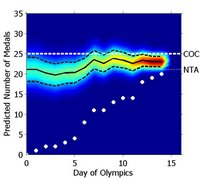
The usual medal table and picture are presented below. Day 7 is looking like a great chance to get on the "plus" side of my original prediction, and also a great chance for the Whistler team's first medal. For those of you in North America who are supposed to be working today, I'll point you to the great Vancouver 2010 official web site, where (for example) you can monitor live race splits in progress in the Men's Super G this afternoon.

I also love the GeoView presentation of the 2010 Athletes.

Sport Event Athlete Category Result Impact
Initial Prediction         27.05
Day 1         -0.75
Day 2         +0.45
Day 3         -0.50
Day 4         +0.00
Day 5         -0.70
Speed Skating - LT 1,000 m - W Nesbitt, Christine Lock GOLD +0.10
Speed Skating - LT 1,000 m - W Groves, Kristina Outside 4th -0.10
Figure Skating Singles - M Chan, Patrick Possibility 5th -0.35
Snowboard Halfpipe - W Nicoll, Mercedes Outside 6th -0.10
Alpine Ski Super Combined Brydon, Emily Outside 14th -0.10
Day 6         -0.55
Current         25.00

February 18, 2010

2010 Olympics Day 5

Unnoticed Noteworthy Performance for Day 5

For Day 5 I had a tough time finding an unexpected, non-medal, overachieving performance for Canada. It was one of those days. Due congratulations to Marianne St. Gelais for her silver in the short track 500 m yesterday, but the medal disqualifies her from consideration.

I'm going to name two co-recipients for yesterday. Both of them probably had dreams of getting on the podium, and missed; nevertheless I think that the performances were noteworthy and overshadowed.

Whistler native Britt Janyk finished sixth in the women's downhill yesterday, the best Canadian result in the premier alpine event since 1994. American Lindsey Vonn absolutely dominated the field, with her teammate Julia Mancuso the only competitor to come within a second of her time.

The second co-recipient for Day 5 is short track speedskater Jessica Gregg. Gregg did not have a great race in the 500 m final last night, but she got into the final by being great in the preliminary rounds. She finished fourth after a restart. Gregg will turn 22 in March, and is in her first Olympic Games.

Medal Prediction

Alright, I know I'm falling behind! It's nice to know that somebody's reading … even if it is to nag.

Canada "lost" another 0.7 medals yesterday, compared to my prediction. The short track women's 500 m was a good chance for two medals, so to win one was not enough to boost us back over my predicted pace.

I suspect that there are a number of Canadians starting to think that reaching the top of the medal table is going to be very tough. I agree. In fact, I agreed from the outset. To add to that feeling, the US team has exceeded my expectations a bit. However, there is still lots of reason to think that the highly-publicized Own the Podium goal can be achieved.

First of all, let's look at my own prediction. It's true that so far the team is tracking a little bit under my initial prediction, as shown in the figure at the end of this post. But don't forget that I have tended (in the past) to be pessimistic about Canada's chances. And even according to my prediction, after the results of day 5 our chances of reaching 30 medals or more has decreased from about 25% to about 9%. A couple of days of winning two medals per day would recover essentially all of what's been "lost."

Second, let's look at some of the other predictions that were made before the Games. As previously noted, the Associated Press predicted that Canada would win 30 medals, and that they would have won 7 by the end of day 5. So we're only "down" by one on that front. Sports Illustrated also predicted 30 medals, but only six by the end of day 5, so we're even on that one. And the Canadian Press predicted a ridiculous 37 medals for Canada — remember that nobody won more than 29 in Torino — so the fact that we're "only" at six compared to the 10 predicted by Day 5 is not that disturbing.

In short, there are still lots of ways that Team Canada can get to 30 medals. I don't know for sure if that will be enough. As I said above, the US team is lapping the field at the moment. In Torino they "only" won 25 medals and they are going to have more than 15 medals after Day 6 this time. But I can say that Canadian experts fully expected to get their biggest medal surge in the last few days of the games.

Sport Event Athlete Category Result Impact
Initial Prediction         27.05
Day 1         -0.75
Day 2         +0.45
Day 3         -0.50
Day 4         +0.00
Alpine Ski Downhill - W Brydon, Emily Possibility 16th -0.35
Alpine Ski Downhill - W Janyk, Britt Outside 6th -0.10
Speed Skating - ST 500 m - W Roberge, Kalyna Strong 6th -0.65
Speed Skating - ST 500 m - W Gregg, Jessica Outside 4th -0.10
Speed Skating - ST 500 m - W St. Gelais, Marianne Outside SILVER +0.90
Speed Skating - LT 1,000 m - M Morrison, Dennis Outside 13th -0.10
Cross Country Ski Sprint - W Renner, Sara Outside 34th -0.10
Cross Country Ski Sprint - W Crawford, Chandra Outside 26th -0.10
Snowboard Halfpipe - M Lamoureux, Justin Outside 7th -0.10
Day 5         -0.70
Current         25.55

February 16, 2010

2010 Olympics Day 4

Svein Tuft of the Day for Day 4: JP Le Guellec

It was a bit tricky to find an unnoticed noteworthy performance today, but in the end I had to give it to Jean Philippe Le Guellec for the second time.

I didn't see any of it, but it sounds like Le Guellec had a very weird day. He officially finished eleventh — a very respectable finish on its face. But in fact, Le Guellec was fifth to cross the finish line. As I discussed on Sunday, Le Guellec was supposed to be the sixth athlete to leave the start line in today's 12.5 km pursuit. Instead, due to a starter's mistake, he left fifth, about 30 seconds before he was supposed to. He crossed the finish line in fifth place, but after a post-race adjustment to correct for the error, he ended up eleventh.

"The guys just let me out too soon. Why, I don’t know," said LeGuellec, 24, of Quebec City. "I was just like, well, if worse comes to worse I’ll be disqualified or there’ll be a time adjustment. Whatever, do your race, have fun and that’s what happened."

After 2.5 kilometres and five-out-of-five shooting, LeGuellec appeared to be in second place. But his coaches were scrambling to make sure he knew he really wasn’t, that 30 seconds had to be added to his score. At the end of the race, with a decent 18-for-20 shooting, LeGuellec seemed solid for fifth, with no one in his sights behind him. He slowed down at the end to acknowledge the boisterous crowd.

But when he crossed the finish line and organizers added the 30 seconds to his time, he dropped to 11th.

"I am upset," said LeGuellec. "I came in fifth and I’m 11th. There’s nothing much we can do, it’s done."

LeGuellec forgave the official who let him go early. "You can’t blame the guy. With the hype of the Olympics and everything, there’s things that can happen," said LeGuellec.

Jean Philippe gets extra credit for handling the offical's error with such equanimity.

Medal Prediction

Nothing much happened to my medal prediction today. Maëlle Ricker's gold medal gave my prediction a boost of 0.35, but Dominique Maltais' fall took it away. My prediction still stands at 26.25 medals (the update table is at the end of this post).

Since there's nothing that interesting to report about my prediction today, I thought I might look at progress so far in a different (and more optimistic) way. As I noted in my original prediction, there were three major media organizations that also made medal predictions on an event-by-event basis. How are they doing so far at predicting Canada's results?

The Associated Press predicted 30 medals for Canada. They were wrong about Charles Hamelin in the short track 1500 m, wrong about Manuel Osborne-Paradis in the alpine downhill, and wrong about Dominique Maltais in women's snowboardcross. They also missed Kristina Groves in the long track 3000 m, and Mike Robertson in the men's snowboardcross. So the AP predicted that Canada would have six medals by now, an overestimate of one.

Sports Illustrated also predicted 30 medals, and was also wrong about Osborne-Paradis. They also missed Mike Robertson, and Alexandre Bilodeau. So SI predicted that Canada would have four medals so far, an underestimate of one.

The Canadian Press predicted the astonishingly high total of 37 medals for Canada. They were wrong about Hamelin, Osborne-Paradis, and Maltais. They missed Mike Robertson, too. The CP predicted that Canada would have seven medals so far, an overestimate of two.

Sport Event Athlete Category Result Impact
Initial Prediction         27.05
Day 1         -0.75
Day 2         +0.45
Day 3         -0.50
Snowboard Snowboardcross - W Ricker, Maëlle Strong GOLD +0.35
Snowboard Snowboardcross - W Maltais, Dominique Possibility 20th -0.35
Day 4         +0.00
Current         26.25

February 15, 2010

2010 Olympics Day 3

Svein Tuft of the Day for Day 3: Ivan Babikov

My pick for Team Canada's unnoticed noteworthy performance of the day is cross-country skier Ivan Babikov.

Babikov finished eighth in the men's 15 km free this morning. He was eighteen seconds (in a thirty-three minute race) behind the bronze medallist. Canada's previous best result in the 15 km event was a fourteenth place by Pierre Harvey in 1988.

Harvey's son, twenty-one-year-old Alex Harvey, finished 21st in his first Olympic start.

Medal Prediction Update

I had a few complete misses in today's results — the first of these Games. I had pegged Rob Fagan as having an outside chance at a medal in snowboard cross, but I had not identified Mike Robertson, today's silver medalist. A few more of those surprises will probably have to happen over the next two weeks if Canada is going to get to the top of the medal table.

Conversely, I had picked Devon Kershaw with an outside chance at a medal in the men's 15 km cross country race. It appears that he didn't enter the event. Oops.

I had picked the men's downhill as a strong medal chance for Canada, and the pairs figure skating as a possibility. So despite Robertson's great result, my predicted total has gone down again today.

As a brief editorial comment, I should say that I loved watching the snowboard cross today. The course seemed to be set up to enable lots of passing and lead changes, unlike what I remember from Torino. I was on the edge of my seat through every round.

Canada's great medal chance for Day 4 is in women's snowboard cross. Of course, if today proved anything, it's that anything can happen in snowboard cross. It should be exciting!

Sport Event Athlete Category Result Impact
Initial Prediction         27.05
Day 1         -0.75
Day 2         +0.45
Alpine Ski Downhill - M Osborn-Paradis, Manual Strong 17th -0.65
Alpine Ski Downhill - M Guay, Erik Outside 5th -0.10
Alpine Ski Downhill - M Dixon, Robbie Outside 60th -0.10
Cross Country Ski 15 km Free - M Kershaw, Devon Outside DNS -0.10
Snowboard Snowboard Cross - M Robertson, Mike None SILVER +1.00
Snowboard Snowboard Cross - M Fagan, Rob Outside 5th -0.10
Speedskating - LT 500 m - M Gregg, Jamie Outside 8th -0.10
Figure Skating Pairs Davison and Dubé Possibility 6th -0.35
Day 3         -0.50
Current         26.25

February 14, 2010

2010 Olympics Day 2

Svein Tuft for Day 2: Jean Philippe Le Guellec

Jean Philippe Le Guellec, ranked 33rd in the World Cup sprint standings in biathlon, finished sixth in today's 10 km sprint event. The previous best-ever for Canada at the Olympics was an eighth-place finish by Steve Cyr in 1992.

It seems that Le Guellec was considerably smarter about his chances in this event than most of the pundits. Here's his take on the Whistler course, taken from an interview in the Province that ran this morning:

Just the trail here and the whole way the system is set up is that anything can happen. When you look at results, even on the World Cup, you can see the top 60 athletes and if three-quarters had shot one more target, they'd be on the podium or in the top 10. It's that drastic.

Le Guellec missed one of ten targets today. The order of finish in the sprint now determines the start order and interval in the 12.5 km pursuit event, which runs on Tuesday. In the pursuit event, racers are assigned staggered start times — in this case, based on the results of today's sprint — and the first competitor past the finish line is the winner. If you've never seen this, its very dramatic. Le Guellec will start in sixth position, 50 seconds behind the leader. Many of the event's biggest names will be starting behind him.

Honourable Mention: Sam Edney

When I first heard about Jean Philippe Le Guellec's result today, I thought the Svein Tuft for today would be a no-brainer. But luger Sam Edney had a great day, too.

Edney was 11th after run 1, 10th after run 2, and 8th after run 3. On run 4, he had the third-best time, behind only the powerhouse Germans, to vault into seventh place. That's a best-ever Olympic result for Canada in men's luge.

Medal Prediction

Of course Canada had a good day today overall. Kristina Groves picked up a bronze medal in the women's 3,000 m, and Clara Hughes finished 5th. And it was a super night at Cypress, with Alexandre Bilodeau winning Canada's first gold medal of these Games — or of any "home" Olympic games. Joining Bilodeau in the top 5 were Vincent Marquis and Pierre-Alexandre Rousseau, who were sitting 1-2 with four skiers to go.

The medal prediction has shifted upward since yesterday, and is still down slightly overall. The data are in the table and figure below.

Sport Event Athlete Category Result Impact
Initial Prediction         27.05
Day 1         -0.75
Freestyle Ski Moguls - M Bilodeau, Alexandre Strong GOLD +0.35
Freestyle Ski Moguls - M Marquis, Vincent Possibility 4th -0.35
Freestyle Ski Moguls - M Rousseau, Pierre-Alexandre Outside 5th -0.10
Speed Skating - LT 3,000m - W Groves, Kristina Possibility BRONZE +0.65
Speed Skating - LT 3,000m - W Hughes, Clara Outside 5th -0.10
Day 2         +0.45
Current         26.75

February 13, 2010

2010 Olympics Day 1

I don't have a lot of editorial comment to make about Day 1 of the 2010 Winter Olympics. I watched a lot of it on television, I followed team media announcements on Twitter, and I enjoyed myself. There was a great variety of stuff going on, covering many of my favourite Winter Olympic things.

Canada didn't have a great day, but it wasn't terrible either. Jennifer Heil won a medal in moguls, which will unfortunately fall into the disappointed-not-to-get-the-gold category. Our short track speed skating team didn't win a medal in the men's 1500 m, along the way making a pretty good case for the usefulness of a statistical approach to prediction. Charles Hamelin, considered a very strong contender, ended up in the same semifinal with the eventual gold and silver medalists and failed to advance to the final. Olivier Jean, who I gave an outside chance at a medal, was "advanced" to the final after a crash, and ended up fourth.

Those events have had a detrimental effect on my medal prediction, but not an unrecoverable one. Overall the mean of my predicted medal total has decreased from 27.05 to 26.30, with a small decrease in the standard deviation. The prediction is also impacted by the delay of the men's downhill until Monday.

Sport Event Athlete Category Result Impact
Freestyle Ski Moguls - W Heil, Jennifer Lock SILVER +0.10
Freestyle Ski Moguls - W Richards, Kristi Outside 20th -0.10
Speed Skating - ST 1,500m - M Hamelin, Charles Strong 8th -0.65
Speed Skating - ST 1,500m - M Jean, Olivier Outside 4th -0.10
TOTAL         -0.75

You can see from the figure below that I am predicting Canada will bring in a steady 1-2 medals per day until Day 9.

February 10, 2010

Amateur Medal Prediction for 2010

If I was a journalist writing for a newspaper or sports magazine, I'd have to open this story like this: Canada will win 27 medals at the upcoming 2010 Winter Olympics.

The nice thing about that kind of prediction is that it's easy to encapsulate the result in a single sentence. The bad thing is that the single number '27' doesn't really tell the whole story.

Back in 2006, you'll recall, I took a different approach at predicting Canada's medal haul. I predicted that Canada would win 21±3 medals at the 2006 Winter Olympic Games in Torino. Canada ended up winning 24 medals, overshooting my predicted total but well within my assessment of the uncertainty.

I repeated the exercise for Beijing in 2008, but didn't publish my prediction since I was using the Canadian Olympic Committee's internal assessment of our athletes. The results were actually quite similar. My pre-games prediction was for 15.5±2.5 medals, and the final total was 18.

The "±" part of my predictions comes from the statistical approach. To predict the total number of medals, I first assign each Canadian entry a probability of winning a medal in their event. Through some fairly straightforward math, that leads to a probability distribution for all the possible medal totals for Canada. The only parameters you can fiddle with are the medal probabilities you assign to each Canadian entry up front.

I've done the same thing for the upcoming 2010 Winter Olympics. I put Canadian entries into one of five probability categories: "Lock" (90% chance); "Strong Possibility" (65% chance); "Possibility" (35% chance); "Outside Possibility" (10% chance); and "No Possibility" (0% chance). I should comment at this point that for 2010 I do not have access to any COC evaluation of the team — I'm back in my armchair for these games. My assessment comes from a few days of looking over World Cup and World Championship standings and results from 2010. So in detail, the probabilities are only as good as my abilities as an analytical winter sports fan, and its probable that I've missed some things. Past evidence also suggests that I tend to have a pessimistic bias against Canada's chances, so my probability assessments may be too low.

My probability assessments are presented in the table at the end of this post. The table identifies the day of each event, the sport, the event, and the athlete, with my medal category and the corresponding probability for that event. (I have left the "No Possibility" entries out of the table.) I have also included the predictions that three major media outlets have released in the last couple of weeks. The Associated Press (AP) and Sports Illustrated (SI) have predicted all the medal winners in every event, and the Canadian Press (CP) has predicted all the Canadian medals. The Associated Press and Sports Illustrated both predict 30 Canadian medals, and the Canadian Press predicts 37.

It is clear that my (independent) assessment of the medal probability lines up qualitatively with the three media predictions, although there are some quantitative differences. The Canadian Press, for example, predicts that every single one of the "Strong Possibilty" Canadian medalists will actually win a medal.

With the probability values above, I can calculate a probability distribution for the total number of medals Canada will have won after each day of competition, including the final total after Day 16. The results are shown in the figure below.

The left-hand plot in this figure shows my prediction (today) of how Canada's medal total will evolve over the 16 days of the Games, assuming all events go as scheduled. The image shows the probability distribution, and the green lines show the mean and standard deviation of the probability distribution. The right-hand plot shows the full probability distribution for the medal count at the end of the games.

If I had to encapsulate this picture with a single number, I would have to say … 27. But I don't have to do that, so let's put it this way: the most likely total number of medals for Canada, assuming that my characterization of individual probabilities is not biased in one direction or the other, is 27. The probability that Canada will win between 24 and 31 medals is about 75%. The probability that Canada will win 30 or more medals is about 24%.

One of the reasons to be especially interested in Canada's medal total this year is that the COC has a well-publicized goal for its athletes to win more medals in 2010 than those of any other National Olympic Committee. On the face of it, my prediction makes that unlikely; it will probably take at least 30 medals to finish atop the medal table, and I am putting that at three-to-one odds. But then again, I've got a history of getting that wrong.

I'll plan to update my prediction after each day of competition, and post thoughts about the Games here as well.

Day Sport Event Athlete Athlete Probability AP SI CP
1 Freestyle Ski Moguls - W Heil, Jennifer Lock 0.90 GOLD GOLD GOLD
6 Speed Skating - LT 1,000m - W Nesbitt, Christine Lock 0.90 GOLD GOLD GOLD
9 Speed Skating - LT 1,500m - W Nesbitt, Christine Lock 0.90 GOLD GOLD GOLD
13 Ice Hockey Ice Hockey - W Team Lock 0.90 GOLD GOLD GOLD
15 Speed Skating - LT Pursuit - W Groves, Klassen, Nesbitt, Schussler Lock 0.90 GOLD GOLD GOLD
1 Alpine Ski Downhill - M Osborne-Paradis, Manuel Strong 0.65 GOLD SILVER SILVER
1 Speed Skating - ST 1,500m - M Hamelin, Charles Strong 0.65 SILVER   BRONZE
2 Freestyle Ski Moguls - M Bilodeau, Alexandre Strong 0.65 GOLD   BRONZE
4 Snowboard Snowboardcross - W Ricker, Maëlle Strong 0.65 BRONZE GOLD GOLD
5 Speed Skating - ST 500m - W Roberge, Kalyna Strong 0.65 SILVER SILVER SILVER
7 Skeleton Skeleton - W Hollingsworth, Mellisa Strong 0.65 GOLD SILVER GOLD
8 Speed Skating - ST 1,000m - M Hamelin, Charles Strong 0.65   BRONZE SILVER
9 Speed Skating - LT 1,500m - W Groves, Kristina Strong 0.65 SILVER SILVER SILVER
9 Freestyle Ski Ski Cross - M Del Bosco, Christopher Strong 0.65 SILVER SILVER GOLD
10 Figure Skating Dance - Mixed Moir, Virtue Strong 0.65 BRONZE SILVER SILVER
11 Freestyle Ski Ski Cross - W McIvor, Ashleigh Strong 0.65 GOLD SILVER SILVER
12 Bobsleigh Two-Man - W Humphries (Pilot) Strong 0.65   BRONZE SILVER
12 Speed Skating - ST 3,000m Relay - W Gregg, Maltais, Roberge, St.Gelais, Vicent Strong 0.65 BRONZE BRONZE BRONZE
14 Curling Team - W Bartel, Bernard, McRorie, Moore, O'Connor Strong 0.65 GOLD GOLD BRONZE
14 Speed Skating - ST 5,000m Relay - M Bastille, Hamelin, Hamelin, Jean, Tremblay Strong 0.65 SILVER SILVER GOLD
14 Speed Skating - ST 500m - M Hamelin, Charles Strong 0.65 GOLD GOLD GOLD
15 Curling Team - M Enright, Hebert, Kennedy, Martin, Morris Strong 0.65 GOLD SILVER GOLD
15 Snowboard Parallel Giant Slalom - M Anderson, Jasey-Jay Strong 0.65 GOLD GOLD SILVER
16 Ice Hockey Ice Hockey - M Team Strong 0.65 SILVER GOLD SILVER
2 Freestyle Ski Moguls - M Marquis, Vincent Possibility 0.35      
2 Speed Skating - LT 3,000m - W Groves, Kristina Possibility 0.35   BRONZE BRONZE
3 Figure Skating Pairs - Mixed Davison, Dubé Possibility 0.35      
4 Snowboard Snowboardcross - W Maltais, Dominique Possibility 0.35 GOLD   SILVER
5 Alpine Ski Downhill - W Brydon, Emily Possibility 0.35     BRONZE
6 Figure Skating Singles - M Chan, Patrick Possibility 0.35 BRONZE SILVER BRONZE
7 Alpine Ski Super G - M Guay, Erik Possibility 0.35      
7 Skeleton Skeleton - M Montgomery, Jon Possibility 0.35 GOLD BRONZE SILVER
8 Speed Skating - LT 1,500m - M Morrison, Dennis Possibility 0.35 SILVER SILVER BRONZE
8 Speed Skating - ST 1,000m - M Hamelin, Francois Possibility 0.35      
9 Bobsleigh Two-Man - M Rush (Pilot) Possibility 0.35     BRONZE
11 Freestyle Ski Ski Cross - W Serwa, Kelsey Possibility 0.35   BRONZE BRONZE
12 Bobsleigh Two-Man - W Upperton (Pilot) Possibility 0.35 BRONZE    
12 Speed Skating - LT 5,000m - W Hughes, Clara Possibility 0.35     BRONZE
13 Figure Skating Singles - W Rochette, Joannie Possibility 0.35   BRONZE BRONZE
14 Speed Skating - ST 500m - M Tremblay, François-Louis Possibility 0.35 BRONZE   BRONZE
15 Snowboard Parallel Giant Slalom - M Lambert, Michael Possibility 0.35      
15 Speed Skating - LT Pursuit - M Giroux, Makowsky, Morrison, Parrot (Turgeon) Possibility 0.35 BRONZE BRONZE BRONZE
1 Alpine Ski Downhill - M Dixon, Robbie Outside 0.10      
1 Alpine Ski Downhill - M Guay, Erik Outside 0.10      
1 Freestyle Ski Moguls - W Richards, Kristi Outside 0.10      
1 Speed Skating - ST 1,500m - M Jean, Olivier Outside 0.10      
2 Alpine Ski Super Combined - W Brydon, Emily Outside 0.10      
2 Freestyle Ski Moguls - M Rousseau, Pierre-Alexandre Outside 0.10      
2 Speed Skating - LT 3,000m - W Hughes, Clara Outside 0.10      
3 Cross-Country Ski 15km Free - M Kershaw, Devon Outside 0.10      
3 Snowboard Snowboardcross - M Fagan, Rob Outside 0.10      
3 Speed Skating - LT 500m - M Gregg, Jamie Outside 0.10      
5 Alpine Ski Downhill - W Janyk, Britt Outside 0.10      
5 Cross-Country Ski Sprint (Classic) - W Crawford, Chandra Outside 0.10      
5 Cross-Country Ski Sprint (Classic) - W Renner, Sara Outside 0.10      
5 Snowboard Half Pipe - M Lamoureux, Justin Outside 0.10      
5 Speed Skating - LT 1,000m - M Morrison, Dennis Outside 0.10   BRONZE BRONZE
5 Speed Skating - ST 500m - W Gregg, Jessica Outside 0.10      
5 Speed Skating - ST 500m - W St.Gelais, Marianne Outside 0.10      
6 Snowboard Half Pipe - W Nicoll, Mercedes Outside 0.10      
6 Speed Skating - LT 1,000m - W Groves, Kristina Outside 0.10      
7 Alpine Ski Super G - M Dixon, Robbie Outside 0.10      
7 Alpine Ski Super G - M Osborne-Paradis, Manuel Outside 0.10      
7 Skeleton Skeleton - M Pain, Jeff Outside 0.10      
8 Alpine Ski Super G - W Janyk, Britt Outside 0.10      
8 Speed Skating - LT 1,500m - M Makowsky, Lucas Outside 0.10      
8 Speed Skating - ST 1,500m - W Maltais, Valérie Outside 0.10      
9 Freestyle Ski Ski Cross - M Duncan, David Outside 0.10      
9 Freestyle Ski Ski Cross - M Hayer, Stanley Outside 0.10      
9 Speed Skating - LT 1,500m - W Schussler, Brittany Outside 0.10      
10 Cross-Country Ski Team Sprint - W Gaiazova, Renner, Webster Outside 0.10      
11 Freestyle Ski Ski Cross - W Murray, Julia Outside 0.10      
12 Cross-Country Ski 4 x 10km Relay - M Goldsack, Jewett, McMurtry (??) Outside 0.10      
12 Speed Skating - LT 5,000m - W Groves, Kristina Outside 0.10 SILVER    
13 Freestyle Ski Aerials - M Omischl, Steve Outside 0.10      
13 Freestyle Ski Aerials - M Shouldice, Warren Outside 0.10      
14 Snowboard Parallel Giant Slalom - W Loo, Alexa Outside 0.10      
14 Speed Skating - ST 1,000m - W Roberge, Kalyna Outside 0.10      
15 Alpine Ski Slalom - M Cousineau, Julien Outside 0.10      
15 Alpine Ski Slalom - M Janyk, Michael Outside 0.10      
15 Bobsleigh Four-Man - M Rush (Pilot) Outside 0.10      

December 12, 2008

Medal Table Moves

Quick quiz: what was Canada's final rank, in terms of total medals won, at the 2008 Beijing Olympic Games?

The correct answer is: check back in 2016 and we'll let you know. As specified in Article 6.5 of The IOC Anti-Doping Rules applicable to the Games of the XXIX Olympiad, Beijing 2008:

Samples shall be stored in a secure manner at the laboratory or as otherwise directed by the IOC and may be further analysed. Consistent with Article 17 of the [WADA] Code the ownership of the samples is vested in the IOC for the eight years. During this period, the IOC shall have the right to re-analyse samples (taken during the Period of the Olympic Games). Any anti-doping rule violation discovered as a result thereof shall be dealt with in accordance with these Rules.

The reason I bring this up is that on Thursday, the IOC ruled on three doping cases arising from positive tests in Beijing. Two of those were medalists in the men's hammer throw from Belarus (both, incidentally, tested positive for exogenous testosterone). Belarus won 19 medals in Beijing, including the silver and bronze in question; the IOC ruling will reduce their total to 17. The two medals in question will pass to Hungary and Japan. Canadian James Steacy moves up from 12th to 10th.

Once the IAAF strips the Belorussian athletes of their medals, Canada — with 18 medals — will move from a tie for fourteenth place into a tie for thirteenth place, nearly four months after the Beijing Closing Ceremony.

May 14, 2006

Summer Sport Report Cards 2005

In the past few years, the agencies that fund high-performance sport in Canada have made a change to their basic philosophy. Instead of stretching the available funding until it's thin enough to cover every sport, there has been a trend toward concentrating financial resources on sports with the greatest probability of international success. I've previously touched quite a bit on the winter sport Own the Podium program. Today I want to talk about summer sports.

The 2005 Report of the Canadian Sport Review Panel was finally completed and released last month. The CSRP is an arm's length group of technical experts that reports to Canada's high performance sport funding partners: Sport Canada, the Canadian Olympic Committee (COC), and the Canadian Paralympic Committee (CPC). The CSRP was created with a mandate to assess the high performance programs of Canada's summer sports, and the potential for repeatedly winning medals at the summer Olympic, and the summer and winter Paralympic Games. The report contains summaries of those assessments, and funding recommendations for each sport from the CSRP.

Before I get into the data, it is important to note that the CSRP evaluation is based on the high performance programs of the various sports, and doesn't address the broader goals of Canada's sports organizations, such as participation or outreach.

(I should also disclose the fact that my brother is one of the members of the CSRP. He has never discussed any confidential information with me, and all of the information I am going to discuss here is in the official report linked to above.)

The CSRP defines several categories of Olympic summer sports, from 1A through 6B. Category 1A/1B is for Olympic individual/team sports with high probability of podium success, category 2A/2B is for sports with moderate probability of podium success, and so on. Sports are ranked on the basis of their athlete development systems, technical leadership and authority, organizational commitment and the capacity to implement, and sport science development.

There are three 1A sports, two 2A sports, three 2B sports, and four 3A sports. Altogether, these sports garnered 55% of the CSRP funding, and account for 17 of the 20 medals that the CSRP predicts Canada will win at the 2008 Olympic Games. I will focus on these twelve sports.

As part of the CSRP evaluation process, each Canadian NSO was asked to provide detailed information to the panel. This information included a budget submission, and an assessment of potential Olympic medal performances in 2008 and 2012. The CSRP then performed its own evaluation of the submissions, and used them to provide recommendations to the funding partners. The table below attempts to capture some information about the NSO inputs, the CSRP evaluation, and the sport performance in 2005, for each of the sports in categories 1A through 3A.

Table 1 — Summary of CSRP inputs, outputs, and 2005 performance.
Olympic Sport
(Discipline)
CSRP Support 2005-06 2004 Olympic Medals 2008 Medal Prediction 2005 Worlds (Olympic Events)
CategoryReqst. ($K)Recmd. ($K) SportCSRP Top 3Top 8Top 12
Canoe-Kayak (Sprint) 1A 1420 987 3 5 3 4 6 9
Aquatics (Diving) 1A 515 377 2 4 2 2 5 8
Rowing 1A 994 898 1 3 3 1 3 3
Athletics 2A 766 823 0 6 2 1 5 12
Cycling (all) 2A 803 562 2 7 1 0 5 6
Soccer (women) 2B 140 140 0 1 0 N/A N/A N/A
Softball (women) 2B 480 229 0 0 1 N/A N/A N/A
Waterpolo (women) 2B 666 468 0 1 1 1 0 0
Gymnastics (Artistic, men) 3A 501 299 1 1 1 1 1 1
Aquatics (Swimming) 3A 1462 688 0 4 1 4 9 13
Gymnastics (Trampoline) 3A 493 150 1 1 1 0 1 1
Wrestling (women) 3A 240 259 1 1 1 1 3 4

The list of sports follows CSRP terminology; in many cases they identified one discipline governed by an NSO as a distinct "sport" separate from other disciplines. It is significant that "men" and "women" are listed as different disciplines in some sports. The CSRP has obviously decided that in many cases one gender should be supported more than the other. The support money in the table is only the portion for Olympic funding, which is separate from Paralympic allocations. The "Requested" column shows the budget presented by the NSO, and the "Recommended" column indicates the CSRP recommendation to the funding partners. The next column lists 2004 Olympic medals — the twelve sports in the table accounted for all but one of Canada's 12 medals in Athens. The 2008 Medal Prediction column indicates the number of medals predicted by the NSO, and the number of medals predicted by the CSRP after an evaluation of the NSO submission. The last three columns show Canada's performance in each discipline at the 2005 World Championships.

It is amusing to note that the sports, when asked to predict their own success at the 2008 Olympics, came back with a "bottom-up" estimate of 68 medals — more than three times the total in 1996, which was the best non-boycott result ever. The CSRP has refined that estimate to 20, with a "top end" of 30. The top 12 sports included in Table 1 — presumably the best-managed of the bunch — thought that they could contribute 34 medals in 2008. The CSRP reduced this by "only" a factor of two.

The lion's share of that reduction came from Athletics, Cycling, and Swimming, which together predicted 17 medals in 2008. That story didn't wash with the CSRP, who reduced the number to 4. That mistrust of the medal predictions didn't necessarily translate into a loss of sport funding; Athletics, in fact, was recommended for a larger allocation than they asked for.

All three of these "over-confident" sports had relatively good years in 2005, putting a large number of athletes into top-8 and top-12 positions at the 2005 World Championships. The top 12 sports are otherwise living up to CSRP expectations, with sprint canoe/kayak and diving leading the way. It will be interesting to follow progress leading up to the next summer Olympics.

April 11, 2006

Canada's 2006 Performance, Part 3

In Part 1 of this post, I reviewed some predictions of Canada's medal performances at the 2006 winter Olympics. In Part 2, I discussed the overall performance of the team by sport, and assessed progress toward achieving the goals of the Own the Podium 2010 program. In this final segment, I want to take a quick look at two other aspects of the Canadian team's performance.

Conversion

Way back when I started this blog, my first "left-brain special" was an analysis of Canada's performance at the 2004 summer Olympic Games; specifically, the number of 2003 World Champions and World Championship medallists who won Olympic medals in 2004. What I found was that Canada did very poorly in that regard, converting only one out of every three medal favourites. I took a similar measure for five other countries and found that 2003 World Championship medals were converted to Olympic medals at about a 60% rate, and 2003 World Champions won Olympic medals about 90% of the time.

The Own the Podium 2012 plan, which I discussed in Part 2, makes a similar point. The 2002 "success rate" is quoted as 27%, with a goal of 50% by 2010. I don't know exactly what those numbers are based on, but it has something to do with the percentage of Canadian medal favourites who actually win medals at the Olympics. To the best of my knowledge it is based on results at World Championships and World Cups, but I don't know the details of the algorithm.

The COC did release a lot of information on past results, and 2006 performances. This document contains some very interesting breakdowns of Canada's performance, including a table showing the number of top-5 finishes at the 2001 and 2005 World Championships, compared to the number of Olympic medals in 2002 and 2006. In 2001, Canada had 27 top-5 World Championship results; by 2005, Canada had increased that number to 41. In both cases Canada's year-after Olympic medal total was about 60% of this number. If the percentage is meant to increase as a result of Own the Podium, it hasn't worked so far. On the other hand, Canada's results are similar to the world's other winter powers; among the top 12 medal-winning nations in 2006, only Austria, Switzerland, Sweden, and Korea exceeded 70%.

At any rate, that statistic isn't really about "conversion," since it doesn't address medal favourites specifically. Since I don't have access to the COC's definition of success rate, I'll have to repeat my own. Table 1 below shows the athletes and teams that won World Championship medals in 2005, with their 2006 results.

Table 1 — Canadian conversion from 2005 World Championship medals to 2006 Olympic medals (source: COC).
Athlete or TeamEvent2005 Placing2006 Placing
Emily Brydon Women's Alpine Combined 3 13
Leuders/Brown 2-man Bobsleigh 1 2
Canada-1 4-man Bobsleigh 3 4
Sara Renner Women's Cross Country Sprint 3 16
Canada Men's Curling 1 1
Jeffrey Buttle Men's Figure Skating 2 3
Steve Omischl Men's Freestyle Aerials 1 20
Jeffrey Bean Men's Freestyle Aerials 2 19
Marc-André Moreau Men's Freestyle Moguls 2 4
Canada Men's Hockey 2 7
Canada Women's Hockey 2 1
Jeff Pain Men's Skeleton 1 2
Jasey-Jay Anderson Men's Snowboard PGS 1 20
François Boivin Men's Snowboardcross 2 10
Justin Lamoureux Men's Snowboard Halfpipe 2 21
Maëlle Ricker Women's Snowboardcross 3 4
Kristina Groves Women's Speedskating 3000m 3 8
Canada Women's Speedskating Team Pursuit 2 2
Clara Hughes Women's Speedskating 5000m 3 1
Cindy Klassen Women's Speedskating 1500m 1 1
Cindy Klassen Women's Speedskating 3000m 1 3
Jeremy Wotherspoon Men's Speedskating 500m 3 9
Canada Men's Short Track Relay 1 2
Canada Women's Short Track Relay 1 2
François-Louis Tremblay Men's Short Track 500m 1 2
TOTAL MEDALS 25 12

There were 25 Canadian entries that went into the 2006 Olympics as defending World Championship medallists. Of these, 12 won medals, for a conversion rate of 48%. That's better than what I found at the 2004 summer Olympics, but it's tough to compare the summer and winter data directly. Eight out of ten Canadian World Champions managed to win medals, which is also significantly better than I observed in the 2004 results. I can't compare to other countries, or to Canada in 2002, without a lot more leg work than I am willing to do right now. However, it looks to me like Canada's success rate has improved somewhat.

Beyond Medals

Finally, a while back one of my commenters wrote that counting "top 8" finishes might be a better measure of NOC strength than counting medals. I responded that unfortunately that information is not easy to come by. The COC report that I mentioned above spells it all out completely.

Figure 1

Figure 1: click to enlarge

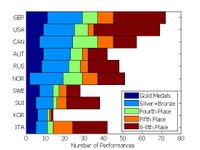
Figure 1 — National performance from the 2006 winter Olympic games. The stacked bars show gold medals, total medals, top-4, top-5, and top-8 finishes (click to enlarge).

The figure at right lays out the gold medals, total medals, top-4, top-5, and top-8 finishes for the top 10 medal-winning countries. There are a few interesting things here. First, Canada did indeed have more fourth-place finishes than any other country (13). Canada finished tied with Germany for most top-4 (37) and top-5 (45) finishes.

Korea had very few finishers in 4th to 8th position — three, compared to eleven medallists — indicating a lack of overall depth. This is of course supported by the fact that 10 of 11 medals came in a single sport. Austria and Sweden show the same effect to a lesser degree, whereas Norway's overall depth is revealed by the large number of top-8 finishes, in spite of the poor showing in the medal tables.

April 05, 2006

Canada's 2006 Performance: Part 2

In my last post I presented a recap of my own predictions of Canadian medals at the 2006 winter Olympics, and compared them to the predictions from Sports Illustrated and the Associated Press. Today I would like to look at the Canadian medal performances with an eye to the future.

A little more than a year ago, the COC initiated a performance improvement plan called Own the Podium 2010. The program aims to have Canada win more medals than any country at the 2010 winter Olympics in Vancouver. I'm going to repeat a few of the key assumptions of OTP2010 here (emphasis mine):

  • Canada needs to win approximately 35 medals to succeed at becoming the top medal winner at the Olympic Winter Games in 2010.
  • Canada can win 35 medals in 2010 if it increases the number of potential medallists (from 160 currently identified to 211) and its success rate (from 27% in Salt Lake City to 50% in Vancouver).
  • Canada has the potential to increase the number of potential medallists in the sports of speed skating, short track, freestyle skiing, snowboard and bobsleigh. It takes eight to 12 years to develop Olympic athletes in the other sports.
  • Canada's success rate can be improved through increased Games preparation, technology, research and development, and human performance research.

As an interim goal, the COC stated that Canada could finish third in the medal table in 2006, an objective that was achieved last month.

So what can we say about the progress towards a winning performance in 2010? First of all, it probably won't take 35 medals to top the medal table, unless there is a significant increase in the number of medals awarded. A mere 30 medals would have been enough in 2006, and the general trend is that the top nations are winning less and less of the medal share.

That changes things a bit. In March of last year, I considered the chances of Canada winning 35 medals, and dismissed it as an impossible goal:

I'll be accused of being "too Canadian" for saying so, but: there's almost zero chance that this is going to happen in five years.

Should I change my mind about that?

Figure 1

Figure 1: click to enlarge

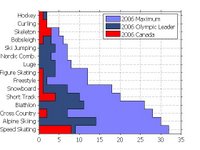
Figure 1 — Medals totals from the 2006 winter Olympic games. The three areas show the maximum possible number that could be won by a single country; the maximum number won by any single country; and the number won by Canada (click to enlarge).

My previous analysis was based on a look at the total number of medal events in each sport, and the likelihood of Canadian success. The figure inset shows the data for 2006, including the maximum possible number of medals that could be won in each sport, the number won by the leading country in 2006, and the number won by Canada. The maximum possible allows for multiple medals in a single event, and takes into account the NOC quotas in place for 2006, which can be accessed through the Torino 2006 web site. Of course, in most sports it is completely unrealistic to imagine that one country could win all of the available medals. The number won by the leading country in 2006 is probably a better indicator of what's possible. So in the plot, where there is a big gap between Canada's performance (red) and the world leader (dark blue), that indicates some room to move up in 2010.

A year ago I provided my recipe for getting to 35 medals. Here it is again, with comments from 2006:

  • Cover all the bases in ice hockey and curling (4 medals) — in 2006, Canada won three medals, missing out in men's hockey. Expect Canada to be a medal favourite for all four events again in 2010.
  • Make sure you pick up a handful of medals in figure skating, freestyle, and snowboard (4 medals) — in 2006, Canada won one medal in each discipline for a total of three. Some bad luck probably cost a couple of medals in freestyle and snowboard. On the other hand, Jeffrey Buttle could very easily have missed out. I think that 4-6 medals is probably a realistic goal for 2010.
  • Become the world's best speed skating nation, for long and short track (15 medals) — in 2006, Canada won 12 medals in the two sports combined, more than any other country. The men's team in long track didn't win an individual medal, and could do better. On the other hand, the women's team had a dream Olympics that will be difficult to repeat no matter how strong the program is. The short track team might improve if they can make some gains on Korea (10 medals). Getting three more medals, overall, would be a great accomplishment.
  • Become a top-two nation in cross-country skiing (6 medals) — in 2006, Canada won two medals, more than ever before. One of those, a gold, came from 22-year-old Chandra Crawford. Beckie Scott, Canada's most successful cross country skier, has now retired, but Crawford and Sara Renner should continue. After the Olympics, 23-year-old Devon Kershaw won Canada's first men's World Cup medal in decades. The men's team has also added 25-year-old Russian immigrant Ivan Babikov. Babikov, racing for Russia, finished 13th in the 30 km pursuit in Turin.
  • Become a top-two nation in alpine skiing (6 medals) — in 2006, Canada did not win a medal. The team continues its upward trend, however, with 3 fourth-place finishes from a relatively young team.

I don't think that I would change this recipe a whole lot. Certainly Canada has proven that some medals are available in bobsleigh and skeleton, but it remains to be seen if this four-medal performance can be repeated. A year ago I wrote:

There are Canadian contenders in bobsleigh and skeleton, but that talent pool is aging and not very deep.

I wasn't wrong about the age of the talent pool, certainly — Pierre Leuders is 35, Lascelles Brown is 31, Jeff Pain is 35, and Duff Gibson, at 39, is the oldest athlete ever to win an individual gold medal at the winter Olympics. Melissa Hollingsworth-Richards is only 26, so she might continue to improve. But if our sliders are going to win four medals in 2010, it will be because of the next crop of athletes in the system. The OTP2012 highlights quoted above imply that these athletes don't need as much development time as in other sports, so maybe there is fresh blood circulating through Bobsleigh Canada Skeleton as we speak. But the other point I should make is that there aren't that many medals to win in these sports, and nobody won more than four in 2006. There is not going to be a big increase, certainly, in the number of medals won in bobsleigh and skeleton.

Which all leaves us just about where we were a year ago, I think. In order to come out on top, Canada is going to have to win at least half a dozen medals, combined, in alpine and cross country skiing. That will get the total up to the low 30s, and that will probably be enough. Can it happen? At this point I am inclined to say yes. It isn't a sure thing, but it looks to me like the trend is pointing in the right direction, and it isn't the stretch I thought it was a year ago.

I have just a few more thoughts about the 2006 results, including a few comments about the Canadian "success rate." But I'll save those for part 3, and I'll see if I can find a few other interesting things to post about before I get to that.

April 03, 2006

Canada's 2006 Performance: Part 1

I've got a few odds and ends I wanted to tie up from the 2006 Winter Olympics, including my very early predictions about Canada's performance in 2010. First I would like to recap predictions for 2006, and see how I did and where I went wrong.

My prediction of 21.1 medals for Canada was based on assigning probabilities for the first, second, and third medal for each of the 84 events. I allowed seven different probabilities: 0, 10%, 25%, 50%, 75%, 90%, and 100% (the last of these I used only once). I admitted that I didn't do very much research, assuming that my overestimates and underestimates would more or less balance out, because I was making such a large number of guesses. Canada ended up winning 24 medals.

Figure 1

Figure 1: click to enlarge

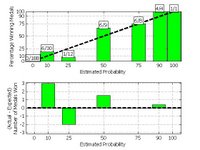
Figure 1 — Comparison of predicted and actual medals won by Canada at the 2006 Torino Winter Olympic Games (click to enlarge).

It's always useful to check your assumptions, so I took a look at the number of medals actually won by Canadians that I put into each of these seven categories. (I am going to conveniently ignore, throughout this discussion, the fact that I listed names beside some of the probabilities; I'll just assume that when a Canadian won a medal, it was the Canadian I estimated for.)

It turns out that I didn't do too badly in assigning the original probabilities, and I did very well at assessing probability for the most likely winners. The figure in the inset at right shows the actual actual percentage of winners in each of the seven categories, and the difference between the actual number of winners and the expected number of winners. For the 100%, 90%, and 75% assignments, I was as close as I could possibly be; all of the five chances I put at 90% or more won medals, and six out of eight at 75% (the exceptions were in men's hockey and women's bobsleigh).

I was also exactly right about the no-hopers; not one of the entries I assigned a zero probability won a medal. The total number of correct predictions (188) looks impressive, but of course many of those were completely obvious, so it is difficult to assess how much credit I can take for my "perfect" score.

My biggest systematic error seems to have come in the 10% category, where I put 30 Canadian athletes or teams. Six of those (20%) won medals. If I assume that I had the 10% probability correct at the outset, the likelihood of getting exactly six medals from this group is less than 1 in 20; the likelihood of six or more medals is about 1 in 14. A more likely explanation is that I underestimated the chances for this group. I am not sure what further conclusion I can draw from that, but it might help guide my future predictions.

I would like to score myself against the COC's medal predictions, but I don't have any of the details. As far as I know, they didn't release any breakdown of their prediction to the public; I did see some articles claiming that "the COC has Pierre Leuders down for two medals" and the like, but I think they wisely held that kind of thing fairly close to the vest. I know that they got closer on the total (predicting 25), and they probably did better on the individual events, too, since they have a team of researchers tracking performances throughout the season.

It's kind of fun, though, to score myself against the professionals, so I took a closer look at the predictions from Sports Illustrated and the Associated Press. Of course there is no fair way to do this comparison, since both publications predict medals on a "True of False" basis, whereas I tried to attach a confidence level to each one. (I should also point out that these two sources attempted the prediction for every medal in every event, not just for a single country.) But just for fun, let's count all of my entries with 50% or higher as "True." That gives me a prediction of 22 medals instead of 21.1; SI predicted 21, and the AP predicted 24.

Table 1 — Comparison of expert predictions for Canada at 2006 Winter Olympics
SourcePredicted MedalsCorrectly Predicted WinIncorrectly Predicted WinUnpredicted Win
Now That's Amateur 22 17 5 7
Associated Press 24 16 8 8
Sports Illustrated 21 13 8 11

So by this scoring system — which is somewhat biased in my favour — I had more correct predictions than either publication, and fewer missed as well, even though my predicted total was not as close as the AP's.

Part 2 of this post will look at the 2006 Canadian medals by sport, and assess progress with respect to the goals of the Own The Podium 2010 program.

February 26, 2006

Olympics.2006.15

Figure 1

Canadian medal prediction, 2006

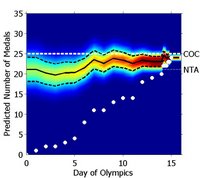
Figure 1 — Updated probability distribution for Canada's 2006 winter Olympic medal total (click to enlarge). Prediction is based on the probability assessment here, updated as events are decided.

After another four-medal day for Canada in Turin, we can safely say that one part of my medal prediction was incorrect; 25 medals will be enough to finish in the top 3 in the medal table. In fact, barring a very unlikely Austrian sweep of the medals in the men's 50 km mass start, 24 medals — Canada's current and final total — will be good enough to finish third.

The COC's Own the Podium program has achieved its interim goal. They did not reach their stated target of 25, but my prediction of 21 was proven to be a bit pessimistic. To be fair to myself, my prediction did include a "one-sigma" standard deviation of ±3 medals. I think that standard deviation probably gives a good rough idea of the uncertainty in Olympic prediction, so I will cut the COC some slack. Also, as I noted before, two other panels of experts pegged Canada's total at 21 and 24.

I've got two further analyses I want to do concerning the prediction, and the long-term goal of 35 medals. But I will save that for a slow news week.

February 24, 2006

Olympics.2006.14

Last week I made the claim that the Winter Olympics were slippery and very, very fast. Of course there is an important exception to that rule. The last two days have featured the medal games in curling, the slowest sport in the Winter Olympics.

I honestly do not mean that as an insult; curling is one of my favourite winter sports. Personally, I get more thrills from watching curling than from freestyle skiing and snowboarding put together.

The four medal games offered plenty of drama. The women's gold-medal game went to eleven ends; the men's bronze-medal game was decided on a last-shot draw in the tenth. The men's gold-medal game was a close affair until Canada blew it open with six in the sixth, following an incredible run-back take-out by third Mark Nichols.

There have been plenty of reports about how curling has captured the imagination of the television audience at these games. Why should this be so surprising? After all, curling is enormously popular in Canada, a nation otherwise obsessed with ice hockey; there is no reason why it cannot find its audience in other countries as well.

Figure 1

Canadian medal prediction, 2006

Figure 1 — Updated probability distribution for Canada's 2006 winter Olympic medal total (click to enlarge). Prediction is based on the probability assessment here, updated as events are decided.

Predictions

My medal prediction for Canada (see inset) currently sits at 23 medals, which means that they have somewhat exceeded my expectations to this point. The final outcome will be decided on Day 15, because there are only two events being contested on Day 16; the men's hockey final, and the men's 50 km mass start in cross country. Canadians have no chance of winning a medal in either event.

Saturday (Day 15) will see six events that can impact the medal total for Canada:

  • Speed Skating, Women's 5000 m. Kristina Groves, Clara Hughes, and Cindy Klassen will race for Canada. All three have already won medals at these Olympics. Klassen and Hughes will start in the last two pairs.
  • Short Track Speed Skating, Men's 500 m. Canadians Eric Bédard and Francois-Louis Tremblay advanced out of the qualifying round with fourteen other athletes.
  • Short Track Speed Skating, Women's 1000 m. Canadians Tania Vicent and Amanda Overland advanced out of the qualifying round with fourteen other athletes.
  • Short Track Speed Skating, Men's 5000 m relay. The Canadian team has advanced to a five-team final.
  • Alpine Skiing, Men's Slalom. Four Canadians will race. Thomas Grandi has an outside chance at a medal.
  • Bobsleigh, Men's third and fourth heats. Canada-1, captained by Pierre Leuders, is fourth after the first two heats, and is a tenth of a second out of a medal.

I should point out that no matter what happens tomorrow, the Canadian Olympic team has already won more medals than ever before. Incidentally Sports Illustrated, who made picks for every medal winner in every event, had Canada down for 21, and the Associated Press came up with 24 using the same strategy. Tomorrow will tell.