October 24, 2005

We're Slicker Than You

Late last week I received the latest issue of the Olympians Canada newsletter in the mail. That's the first time I've been sent a hard copy, and the eight-page bilingual foldout was noticeably slicker than previous issues. I scanned it through once before I noticed the subtitle: The Most Exclusive Club in the Nation.

Olympians Canada newsletter, Vol. 2, Issue 3

In case you don't know — and I am guessing that most of you poor excluded sods do not — Olympians Canada is sort of the COC's alumni organization for Olympic athletes. In the interests of full disclosure, I should admit that I have played a small role in (unsuccessfully, so far) trying to get the local chapter of this organization off the ground. The obnoxious slogan, however, is new.

Leaving aside the dubious factual basis for the claim (fact: Canada sent more than a thousand athletes to just the five summer Olympics between 1988 and 2004), this is simply very bad P.R. Now, I know that Olympians Canada is a very athlete-centred organization, and of course I understand that Olympic athletes love being reminded how special they are. (Otherwise, I wouldn't have mentioned it, would I?) But even if public outreach is not your primary mission, is this really the best way to keep the "Olympic spirit" alive? Hello there, I'm an Olympic athlete, and you're not, eh?

Just for fun, I did a Google search for other groups that might lay claim to the title of "most exclusive club in the nation". Of course, a really exclusive club would probably not be boasting about their exclusivity on the internet, but I was curious more about the perception than the fact. My search turned up three unique hits, all of them referring to a single body: the 100 elected representatives of the US Senate.

October 20, 2005

Is Athlete Protest Dead?

Recently I've been thinking a bit about athletes and social conscience; whether elite athletes are less likely than the general population to speak out against social injustice, and if so, why that might be; and also whether particular athletes shy away from controversy at the expense of their principles, and whether we should hold their silence against them.

In other words, I've been exercising the atrophied right side of my brain. I'm not sure yet what will come of that, but I'll get back to you. In the meantime, some new food for thought: Tommie Smith and John Carlos have been immortalized at San Jose State.

In 1968, Smith and Carlos, the gold and bronze medallists in the 200m, stood on the Olympic medal podium without shoes. During the playing of the US national anthem, they stood with heads down and black-gloved fists raised.

As with most such symbols, these gestures have come to mean many different things to different people. Clearly the protesters were speaking out against the oppression of African-Americans in the United States. Both men were very active in the civil rights movement long before the Olympics. In 1968, they became involved with the Olympic Project for Human Rights, led by a professor from SJSU named Harry Edwards. OPHR had tried to organize an Olympic boycott by black American athletes that never materialized. It is often reported that the podium protest was "inspired" by Edwards; Carlos himself discounts Edwards' influence:

Harry had nothing whatsoever to do with it. That's one of the things that needs to be straightened out and will be straightened out. It was a decision, collectively, between Tommie Smith and John Carlos … he wanted to ride on what Tommie Smith and John Carlos did.

Of course the Olympics provide a global stage, not just a national one, and to some extent the protest was part of a much larger picture and linked to the civil rights movement around the world. Just before the start of the 1968 games, several hundred students and workers were killed by security forces in Mexico City. In a strange coincidence of timing, Mexican authorities announced earlier this month that they will bring charges against interior minister (and later president) Luis Echeverria in connection with that massacre.

Justice has also been long in coming for Smith and Carlos. As a reward for their their peaceful protests, the two sprinters were suspended from all further competition and sent home by the USOC. They were not quickly forgiven. In certain quarters, their actions were even linked to the tragedy in 1972. By wordlessly expressing an uncomfortable truth, they had "politicized" the Olympic Games.

Tommie Smith has some thoughts on the questions that started this post: "What happened back then can never happen again, because the dollar bill has ruined the pride of justice." I think that this is an argument worth considering. It is also interesting to ask whether public attitudes toward this kind of protest have changed in the last 37 years. Would an athlete be sent home from a competition and publicly rebuked for making a non-violent protest of this sort today?

Has the world changed so much? Consider the case of Canadian swimmer Jennifer Carroll and the uproar (scroll down) she caused when she carried a Québec flag onto the Commonwealth Games medal podium. Dave Johnson, the team's head coach, forced Carroll to apologize to her teammates, and to him, and made a direct comparison between her action and the Smith/Carlos protest in 1968 — clearly implying that such non-conformist behaviour was unacceptable.

In my opinion, however, most of the controversy surrounded Mr. Johnson's actions; most people did not object to Carroll's gesture. Johnson has since been fired, and I do not think that Carroll's athletic career suffered as a result of her actions. Of course, those actions did not constitute a protest since Carroll denied that she was expressing any political sentiment. The connection to 1968 is tenuous indeed.

So, two more questions for me to think about: will the Olympics ever see another Tommie Smith and John Carlos? And if so, how will the world react?

October 18, 2005

Wishful Wushu

I don't know what it is about Jacques Rogge, but it seems that he can't open his mouth without being misinterpreted in the press.

In April, Rogge discussed the impending vote on the makeup of the 2012 Olympic programme:

  • Rogge said: "There should be no anxiety. The process will be a totally fair process. Reading the [IOC programme commission] report, I have only one conclusion. We have very strong federations, and strong federations should have nothing to fear."
  • The press reported: Olympics chief reassures federations that sports won't go

In September, Rogge commented on the recent elimination of softball from the 2012 Olympic programme:

  • Rogge said: "Our charter is very clear that the [executive board] cannot take an initiative to say 'we want a new vote' because that would open up the door to all kinds of re-votes." But he said there were precedents for the full IOC to reconsider a decision.
  • The press reported: A second chance? IOC may take another look at softball for 2012 Games

And last week, Rogge paid a visit to China's National Games:

  • Rogge said: "There will be a wushu competition during the Olympic Games. It's not going to be one of the official 28 sports but we will organize with BOCOG a wushu competition."
  • The press reported: Wushu to Be Part of Beijing Olympics

The Chinese have been trying to get Wushu — better-known as kung fu in North America — on the Olympic programme ever since they won the right to host the 2008 Olympics. As I understand it, the proposed Olympic version is not a combat sport but a judged demonstration of skill, somewhat like gymnastics — just what the summer Olympics needs, right? Anyway, despite the recent excitement I can assure everybody that wushu is not going to be part of the 2008 summer Olympics. It is not one of the 28 sports on the programme, and it cannot be a demonstration sport, since the IOC decided in 1989 to place a moratorium on demonstration sports at the summer and winter Olympics (they were discontinued starting in 1996).

In an effort to make things perfectly clear, Rogge made a statement clarifying what he said, for those who missed it the first time:

"We are not introducing wushu into the Olympic program. It will not be an exhibition. Not at all" … He said wushu will be neither an exhibition event nor an Olympic sport. Asked if there is any possibility of wushu’s becoming a medal event in future Olympic Games beyond 2012, Rogge said: “No one can predict the future.”

Tomorrow's headline: Rogge Promises Wushu in Future Olympic Games.

October 14, 2005

Getting the Drugs Out of My System

I've been doing a lot of writing about drugs, and especially steroids, lately; not only here, but over at SportsFilter, too, where I can't seem to talk about anything else. I have to stop, or soon everybody will hate me.

The most recent positive test has hit a little bit closer to home than most, and left me somewhat depressed. But aside from that, I have been collecting some news stories that I wanted to pass along. I'm going to use this post to collect some of these disjointed ideas, and then leave the topic of steroids alone for a while. (I do want to write something about Gene Doping, but that's really a different subject.)

Never Enough?

The Pittsburgh Post-Gazette ran a four-part series about anabolic steroids last week. The series was titled "Never Enough: Steroids in Sports" and covered the history of steroid use in amateur and professional sports.

I found parts one and two particularly interesting, as they covered the early history of steroid use among US weightlifters, and early regulation efforts and failures. Here are the links to parts three and four.

Need a Boost?

The Seattle Times has been running their own series on performance enhancement in sports, called "Getting a Boost." The series is in three parts, and there are also a number of supplemental articles. Some of the articles cover very well-worn ground (the dangers of supplements, the uncertainty in EPO test results), but the coverage is very broad and they've made room for some unusual perspectives. Take a look at this piece about Dr. Norman Frost, who questions whether anabolic steroids have any negative health effects, and this one, about the increase in steroid use among female athletes.

Erasing the GDR?

German track and field authorities have announced that they are going to review the validity of their national records — at least, those records that are still held by the German Democratic Republic. The investigation was apparently prompted by a request from one of the East German record-holders, who feels that the East German doping program renders her performances invalid.

Drug Pacifists?

World-class athletes from different sports and different eras, Bode Miller and Eddie Merckx have both spoken out against the current zero-tolerance policy on performance-enhancing drugs. Miller, an alpine ski star from the US, expressed support for legalizing EPO:

I'm surprised it's illegal, because in our sport, it would be pretty minimal health risks, and it would actually make it safer for the athletes …

You can follow the link to see Miller's logic on the last point, but he seems to suffer from the (common) misconception that drugs are banned because they are harmful to athletes. It's clear to me that substances are banned only when they are unfairly performance-enhancing — perhaps a subject for another day.

Taming the Italians?

IOC president Jacques Rogge (and WADA president Dick Pound) will ask Italian officials to make an exception to their tough anti-doping laws during the 2006 winter Olympics. Under Italian law, athletes caught in possession of performance-enhancing drugs could face criminal charges.

I'm not sure how I feel about this. On the one hand, athletes should obey the laws of the countries that they visit, and face the consequences if they don't. I don't see any reason that they should have special immunity from the law. On the other hand, I don't see that aggressive criminal prosecution of visiting athletes is really to anybody's benefit. My prediction is that Rogge will get what he wants.

New and Better Steroid Test?

Details are pretty sketchy, but Reuters reported on Wednesday that British scientists have come up with a new and better steroid test:

Thanks to our technique, in the future it will be much more difficult to escape detection when using performance-enhancing steroids.

I can unequivocally say that I'm all for that.

POSTSCRIPT

I knew I had forgotten one; for the medical specialists in the crowd, here's a review article I came across titled, Cardiovascular Toxicities of Performance-Enhancing Substances in Sports.

October 11, 2005

You Can't Practice (It's the Law!)

Is this for real? This report out of the UK is speculating that Britain's gun control laws might be relaxed just a little bit prior to the 2012 Olympics. Apparently, under current UK law, handguns are outlawed in Britain, even for licensed sport shooting. That means that would-be Olympic pistol shooters have to train in Switzerland.

Baseball's Reinstatement Plan

After months of silence, the International Baseball Federation has outlined its plan for getting back on the Olympic programme. It sounds an awful lot like softball's plan, actually, with a few key differences:

  • Softball was eliminated by one vote. Baseball was cut 54-50, which means that they have to convince three delegates to flip.
  • Nobody's claiming that delegates voted against baseball because they were confused.
  • The USOC, which is putting all of its weight behind softball's reinstatement, will definitely not be making the case for baseball.

October 07, 2005

Performance Legacy Due to Olympic Hosting: Follow-Up

A little more than three months ago I posted an analysis of the benefits of hosting the Olympic games. I don't mean the hypothetical economic benefits of hosting; my analysis considered Olympic performance, and whether hosting an Olympic games (summer or winter) has a positive impact on a nation's performance in subsequent Olympic games.

My hypothesis was that hosting, by generating revenue for the NOC, and by spurring government investment in sport facilities, would have a positive impact on performance as measured by medal fraction (medals won, as a percentage of the total number of available medals). To go even further, I proposed that the benefits from hosting either a summer or a winter Olympics would cross over to both. That is, we could speculate that Canada's summer Olympic team (for example) will receive a performance boost from the 2010 winter Olympics, to be held in Vancouver.

Unfortunately my study, which included all summer and winter Olympic games since 1948, did not support my hypothesis. Although the host nation receives a large performance benefit in the hosted Olympics, there does not appear to be a significant long-term effect.

An anonymous commenter suggested that I might be able to rescue my hypothesis if I considered the post-1984 era as distinct from the pre-1984 era. In the comments I proposed to investigate in the "next couple of weeks," which was apparently a bit optimistic. But, better late than never!

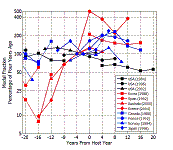
Figure 1

Host country Olympic performance, 1984-2004

Figure 1 — The effect of Olympic hosting on summer Olympic performance, 1984-2004 (click to enlarge).

Figure 1 (inset) shows the post-1984 group of host countries. The figure is basically the same format I used last time, except this time I've shown a line for each individual country. Each curve is displaced in time, so that year zero is the hosting year, and also normalized so that medal performance is on a more or less equal footing. In particular I attempted to make the scores about equal to 100% at -4 years, although I had to do some magic with some of them because I couldn't include 1980 and 1984 in the analysis.

Another change compared to last time is that I have shown both summer hosts and winter hosts on the same plot. To be clear, the vertical axis is always summer Olympic performance; I am attempting to see if there is a noticeable impact of winter hosting on summer performance.

I've divided the group of 11 hosts (from the 1984 summer Olympics through the 2004 summer Olympics) into three groups:

  • The black curves show the USA, which has been host three times (1984, 1996, and 2002). In general, the USA behaves like a non-host country (see previous analysis); there is no discernable performance improvement when they are the host nation, even in the host year. I would hypothesize that the Americans are already so dominant, have so many resources, and have hosted so often that very little benefit remains to be gained.
  • The red curves represent the (non-US) summer Olympic hosts, Korea, Spain, Australia, and Greece. Based on this small number of examples, there is indeed a noticeable improvement in summer Olympic performance in the years leading up to a hosted summer games, and that improvement is maintained in the 16 years following.
  • The blue curves represent the (non-US) winter Olympic hosts, Canada, France, Norway, and Japan. As you might expect, there is no significant "host year" effect that boosts performance in year zero. (Presumably the host effect is due to some kind of "home field advantage.") However, based again on a small number of examples, it appears that the winter hosts do show a small boost in summer performance compared to non-host nations. That is, the blue curves for years 0 and later are mostly above the 100% line, whereas you will recall that non-host nations show a steady decline in their score with time.

It is also interesting to note that the winter host that shows the smallest post-host benefit is Norway, a nation that is already a power in the winter Olympics. Similarly the non-US summer host with the smallest improvement is Australia, a summer Olympic overachiever. These observations (together with the USA results) suggest that Olympic hosting is of greatest benefit to countries that are not already strong performers.

Of course this is all based on a very small sample, so we shouldn't draw too much from it, but let's go ahead and do it anyway. If Canada is anything like the past four winter Olympic hosts, we might see summer Olympic medal fraction increase by something like 50% in the 2012 games, which is pretty exciting (to me). On the other hand, this is Canada's second kick at the can since 1984, which might put us more in the USA group. I suppose that time will tell.

October 06, 2005

My Two Favourite Sports

Well to be honest, I'm not that fond of boxing or softball, but they seem to come up quite often. I guess I write about boxing a lot because it's so screwed up, and of course softball is not on the Olympic program for 2012.

And here they are in the news, again. Don Porter, the head of the International Softball Federation, led a delegation to Switzerland this week to meet with IOC president Jacques Rogge. Apparently the purpose of the meeting was to get Rogge's support for softball's reinstatement, although Rogge has already made it clear that the decision rests with the IOC members. Rogge reiterated that point this week:

Under IOC rules, at least one-third of the 115 members would need to submit a motion [at the February meeting in Turin] to consider a new vote. If the motion passed, softball would require a majority in favor to win reinstatement.

That looks fair to me; and given that softball was eliminated in a very close vote, I don't see why it would be difficult to at least get the motion brought forward from the floor.

Boxing, meanwhile, is still thinking about adding a women's discipline. I guess that's good news if you believe in equal punching opportunities for women.

Keep Trying, Guys

How backwards is the AIBA? First, the home page still lists the notice of the cancellation of the women's world championships on September 5, right alongside the results … of the women's world championships on September 26-29. Guys, either get the cancellation notice off of there, or explain how the event was rescued.

And here's a telling quote from their home page promoting this great event: "In women's boxing, we can see some nations winning bouts that would, in men boxing, never win!" How fabulous!

There were a couple of articles on this issue in the past week. The People's Daily Online are reporting that the IOC executive will make a decision on the inclusion of women's boxing in the 2008 Olympics at their meeting on October 26-28.

The article claims that the IOC have received a proposal from the AIBA, with no description of what was proposed. Now Rogge has already made it pretty clear that he's not interested in adding women's events unless some men's weight classes are consolidated, and the AIBA has not been supportive of that idea. So I'm sticking to my story that this is mostly just for show, probably so that the AIBA can shift the blame to the IOC. I suspect that the boxing officials have submitted a proposal that they already know is going to be quickly rejected. In truth, the IOC really can't just let boxing increase their medal or athlete quotas, since they forced other sports (like wrestling and weightlifting) to remove some men's events when they added women's events.

Then, there was this odd little story in the Globe and Mail. The story starts off typically enough, describing how Canada's top female boxers really want to have a chance to compete at the Olympics. But then Robert Crête, executive director of Boxing Canada, drops a new idea:

… Canada would be willing to look at the possibility of women's boxing being part of the Winter Olympics. We're asking the international federation to look at all avenues of getting women's boxing into the Games.

It's an interesting idea, but probably destined to fail because of the giant can of worms it would open. The AIBA will probably embrace the idea, since it would allow them to make a token gesture for women without diminishing the men's program. The IOC, I suspect, is unlikely to entertain this; if they say yes to boxing, they'll have the wrestlers and weightlifters on their backs asking for the same arrangement.

October 05, 2005

Medal Predictions Part II — The Per-Capita Olympics

Hmmm, well, somebody's asking for the story about medals-per-capita. Here it is, but remember, you asked for it!

In early August, 1991, I was in Havana — I don't recommend that, by the way, Havana in August — for the Pan American Games, which had really just begun but were already over for me (aside from a few consumable souvenirs and an impending stomach ailment), and I was watching television in the common room of our cinder block dormitory in the sweltering and barely completed athletes' village — while keeping one eye on the stairway in case Annie Pelletier walked past — watching television in Spanish, and muddling through because I had taken two semesters at SFU, and also because I had spent the previous four days attempting to hold a conversation with our interpreter, Rosa, and on the news I saw that the Pan American Games were magnificent, the Cuban team was unstoppable, and the Great Leader (who I had shaken hands with, incidentally) was omnipresent, and when the anchor discussed the early medal standings he had a bar chart in the graphic over his left shoulder, and he said excitedly that "Cuba holds a slight lead over los Estados Unidos" — as I said, it was early days, and Cuba had cleaned up in canoe/kayak — "with Canada a distant third," and I thought that it was nice that the home team got to be in the lead for a couple of days, but then he raised his voice almost to a shout, "pero if we consider the number of medals per million inhabitants," and the bar graph changed to show Cuba like an enormous phallus towering over second-place Canada and third-place USA, cringing in the shadow of the superpotencia cubano, and I had to admire that, making up their own scoring system for the glory of Cuba and (more importantly) making the United States of America look like a whipped dog.

The medals-per-capita argument was not invented by the Cubans, of course, and it is actually fairly popular; I have seen Canadians use it during the Olympics — here is a great example, with a table, that shows that Tonga won the 1996 per-capita Olympics, and here's another and another that popped up in 2004 — and recently my local paper carried an article purporting to show that Nova Scotia really "won" the Canada Games based on a per-capita medal table.

Any time that you reach the conclusion that Tonga is the world's leading Olympic performer, followed by The Bahamas, and that the US is only forty-first, you might want to sit back and think a little bit about your methodology. In this case, you're assuming that the expected number of medals won should (in some ideal world) scale linearly with population. (It's a bit worse than that, even; you are assuming that the expected number of medals is directly proportional to the population, but never mind.)

So why shouldn't the medal total scale linearly with population? Here are three reasons that I can think of.

  • Olympic representation isn't proportional to population. If it was, then one Tongan athlete (pop. ~100,000) would be matched by 3,000 US athletes (pop. ~300,000,000).
  • The supply of medals is finite. For the US to match Tonga on a per-capita basis (10 medals per million inhabitants in 1996) they would have to bring home 3,000 medals, which is more than the total number of medals awarded.
  • Medals are extremely scarce. Medals are awarded only for the top three finishers. Even if your country boasts the top 50 performers in the world in any event, you can still only get three medals at most. In some events you can only get one, no matter how deep your talent pool may be.

All of this suggests that there should be a law of diminishing returns; that is, that doubling your population should not lead to a doubling in Olympic medals, and in fact the larger your population is, the more you have to increase it for the same marginal benefit.

Figure 1

Summer Olympic medals (1996-2004) versus population

Figure 1 — Summer Olympic medals (1996-2004) versus population, in three different presentations (click to enlarge).

If you really must model Olympic performance with a single-parameter model, and if population has to be the single parameter, then you probably can't do much better than to assume a power law dependence. It still doesn't predict medal performance very well, mind you, but it's better than all of the alternatives. You can see what I mean in Figure 1 (inset). That plot shows the average number of summer Olympic medals won from 1996 through 2004 versus population. The details of the calculation are in the full caption for the enlarged figure, but here's the important point: a linear dependence is a terrible fit to the data, a logarithmic dependence is somewhat better, and a log-log (power law) dependence looks like something vaguely approximating a straight line. The "power" in the best power law fit turns out to be almost exactly 1/3, which is to say that the number of medals won is roughly proportional to the cube root of the population. If you want to double the number of medals you win at the summer Olympics, you need to increase your population by a factor of 8 (presumably without diminishing your per-capita resources, too). If you want to increase your medal total by 10%, then your population has to go up by a third.

I'm sure that my anonymous commenter is, by this point, regretting that s/he brought this up, but I might as well finish my thought here. Let's use this model to normalize the number of medals by population. We can look at recent history and see if my approach gives us anything more sensible than the per-capita analysis. We can compare nations on a population-corrected basis by dividing the number of medals won by the cube root of the population. Table 1 shows the resulting top 25, again using the average medal totals in 1996, 2000, and 2004 to construct the score. The scores are scaled by 100 just so that they look a bit nicer.

Table 1 — Top 25 Summer Olympic nations, 1996-2004, by population-corrected medal score.
CountryTotal MedalsPopulation (millions)(Medals/3)/Pop.1/3 ×100
Australia 148 19.9 18.3
Russia 243 144.0 15.6
United States 301 293.0 15.2
Germany 169 82.4 13.0
Cuba 81 11.3 12.1
France 108 60.4 9.2
Italy 101 58.1 8.7
Netherlands 66 16.3 8.7
Hungary 55 10.0 8.5
South Korea 85 48.2 7.8
Romania 64 22.4 7.6
Belarus 47 10.3 7.2
Bulgaria 40 7.5 6.8
Ukraine 69 47.7 6.4
United Kingdom 73 60.3 6.2
Greece 37 10.6 5.6
China 172 1298.8 5.3
Canada 48 32.5 5.0
Norway 23 4.6 4.6
Japan 69 127.3 4.6
Spain 47 40.3 4.6
Sweden 27 9.0 4.4
Jamaica 18 2.7 4.3
Czech Republic 27 10.2 4.2
Poland 41 38.6 4.1

That's a fairly sensible list, it seems to me; there are no outrageous surprises here. The large-population Olympic powers — USA, Russia, China and Japan — all remain in the top 25. The small-population overachievers — Cuba, Hungary and others — are in the top 25, too. Two countries that come out on top in the per-capita analysis, The Bahamas and New Zealand, end up 31st and 29th, respectively, which seems reasonable. Tonga finished 61st in the three-games average, but would have cracked the top 40 in 1996 when they won their only medal.

I've glossed over a lot here, and I won't claim that this the world's best predictive model for Olympic performance by population. But as an assessment of how well a country does for its size, it's a lot more reasonable than the per-capita method, and it isn't much more difficult to calculate. On top of that, it still makes Cuba look pretty darn good. And I think Rosa would like that.

October 01, 2005

Not-So-United Kingdom

As host nation for the 2012 summer Olympics, Great Britain has an automatic spot in all of the team sport tournaments. You might expect that soccer, in particular, would be a medal hope for the UK. You'd be wrong, though — Great Britain has not even entered the Olympic tournament since 1972.

UK at the Olympics

Great Britain last competed in the Olympic soccer tournament in 1972. In 1974 the English FA abolished the formal distinction between professional and amateur soccer players. This left all English players ineligible for the Olympics, which were then only open to amateurs.

In more recent times, the various national associations have been reluctant to field a Great Britain team at the Olympics because they were nervous for their independent status within FIFA, and specifically for the World Cup.

Britain's Olympic History - The FA

The major stumbling block is that while the Olympic team competes under the British flag, England, Scotland, Wales, and Northern Ireland are fiercely separate entities in soccer.

A few weeks ago FIFA president Sepp Blatter stated that Great Britain would field men's and women's soccer teams for the 2012 Olympic Games. There are some wrinkles to be ironed out, but England coach Sven Goran Eriksson and other English soccer officials are behind the idea, and it looks ready to go ahead.

Somebody forgot to send the Scots the memo, though; now Scottish fans want their own Olympic team for 2012. Not just for soccer, mind you, but for everything — and they think they've found a loophole. The Olympic Charter states:

Although most national Olympic committees are from nations, the IOC also recognises independent territories, commonwealths, protectorates and geographical areas.

They're right, of course; Puerto Rico, for example, sends its own team, and there have been numerous other examples of "geographical areas" like the so-called Unified Team in the 1992 games.

And of course, if it's a good idea for Scotland, it must be a good idea for Wales, too. Watch for Northern Ireland's petition in the next few days.

Incidentally, the Welsh article references one of the world's most abused performance measures, the medals-per-capita scoring system:

For a small nation [Wales] have always punched above our weight at international competitions - achieving greater success per head of population than any other country in the UK at Manchester's 2002 Commonwealth Games.

That reminds me of a story, and of course begs a few good charts, but that will have to wait for another day.

September 30, 2005

More On Urinary EPO Test

Cyclingnews.com has a detailed article on some of the scientific issues surrounding the urine test for recombinant EPO, which I have touched on briefly here and here.

The article is a summary of a report by Basque physiologist Iñigo Mujika. You can see Dr. Mujika's full report here, if you prefer; it is only a little bit more technical than the summary article.

As a sort of pre-emptive declaration of conflict of interest, the cyclingnews.com article notes that Mujika is a physiologist and trainer for one of the top pro cycling teams (Euskaltel-Euskadi). He is also a coach for Virginia Berasategui, one of the triathletes who tested positive at Ironman Lanzarote in May, but was later cleared of wrongdoing based on inconsistencies in the laboratory results. So he may have some personal interest in casting doubt on the test.

His report, however, makes extensive reference to an independent evaluation commissioned by WADA, titled Evaluation report of the urine EPO test, written by G. Peltre and W. Thormann and accepted by WADA in March 2003. If you Google the title, you can find several references to the PDF version of the WADA report; unfortunately, WADA appears to have removed it from their web site, since I can't find it there now.

Referring to the WADA report, as well as other sources, Dr. Mujika does raise some alarming points about the urine test for rEPO. Among these:

  • The test is not uniformly performed at all accredited laboratories. That is, the procedure for performing the test is slightly different at different labs.
  • Laboratories do not measure protein concentration in the urine in the "preconcentration phase" of the test. In some cases intense exercise can induce a condition called proteinuria, which increases the concentration of protein in the urine. This increase in protein concentration can alter the results of the test and may lead to false positives.
  • The specificity of the antibodies used to bind to rEPO in the urine test has not been scientifically evaluated. It is possible that the antibodies bind to endogenous (naturally occurring) EPO, and even to other unrelated proteins. Again, this could lead to false positives.
  • Despite claims by WADA to the contrary, the rEPO urine test is a quantitative test, not a qualitative tests. That is, the test does not give a simple present-or-absent result, but the test results must be subjected to quantitative pass/fail criteria. Even worse, the criteria that are used are not uniform across all laboratories, and in fact the latest criteria have not been published by WADA, which means that the test cannot be peer-reviewed.

Mujika then goes on to describe several cases where positive test results were subsequently thrown out because of questions about the test.

All of this suggests, in my opinion, that the urinary EPO test should not be used. It is clear that not enough is really known about the test and its limitations; it is also clear that many people don't care that much if the test is imperfect. The managers of the Barcelona anti-doping lab are quoted by Mujika as saying that "the only direct test available on urine has the merit of existing and is definitely needed." That's a rather short list of merits!

As I have stated before, the consequences of a false positive are very severe for the victimized athlete. Any test for EPO must be held to the same strict standards as tests for anabolic agents and other banned substances.

September 28, 2005

Cutting Costs vs Winning Votes

Yesterday IOC president Jacques Rogge instructed the seven cities bidding to host the 2014 winter Olympics to keep costs down by concentrating on the essential requirements of the bid. In other words, cut the fat from your proposal, and maybe you won't bankrupt yourselves.

Good idea. Of course, to actually win the right to host the 2014 winter Olympics, the seven host cities have to impress more IOC members than everybody else, and I doubt that a restrained and cost-efficient bid is the best way to win the IOC's collective heart.

The current bid process is essentially a popularity contest, with the winner selected by majority vote of the 100+ IOC members. Until most of those voters take Rogge's suggestion to heart, and make their selection on the basis of the "essential" requirements, there's little point in preaching restraint to the bidders.

September 25, 2005

The Other Shoe?

Back in April I wrote a brief item about the Islamic Solidarity Games, a competition which does not include women as competitors or spectators. The linked article (which has now disappeared) drew a comparison between the Islamic Solidarity Games and the original Ancient Olympics. However, as Ralph Hickok pointed out in the comments, the ancient Greeks also held women-only events which men were not permitted to attend.

Now, I wouldn't say that maintaining a millenia-long tradition of discrimination against women is something to boast about, but the Islamic Games may be closer to the spirit of the ancient Greeks than the original piece suggested. The Islamic Women's Games are being held in Tehran this week.

Male coaches, referees, and spectators are banned from attending any of the competitions, except for golf, shooting, and archery. (Those three sports are exceptions because the female competitors are "modestly" dressed, presumably in the "obligatory headscarf and long coat.") Similarly no photography or video is allowed.

The Women's Games were launched in 1993, and have been hosted by Iran every four years since. They exist either as an opportunity for strict observers of Islam to participate in an elite sporting event without compromising their religious beliefs, or as a sideshow designed to placate female competitors who are not allowed to participate in "real" competitions. That interpretation, of course, depends on which side of the cultural divide you inhabit.

Other Muslim countries have offered to host the event, but the Iranians are worried that nobody else would be strict enough:

Other countries have different interpretations of Islam. I am not sure they would be able to hold the games like us with such observance of Islamic rules — Faezeh Hashemi

Even more than the Islamic Solidarity Games, this event is pretty hard for me to stomach. It may be true that many Muslim women "are absent from the international sports grounds due to their beliefs," but it must also be true that there are many Iranian Muslims who would happily compete unveiled in international competition if they were permitted by their government.

Since the Islamic revolution Iranian women have been mostly banned from international sporting events due to the obligatory headscarf and long coat that they must wear in front of men. Under the previous reformist government of the last eight years, Iran started sending women athletes to competitions abroad in the events where women are able to compete and wear the veil, such as shooting, taekwondo, fencing, canoeing, chess and horse riding.

(As an aside, I have to ask: if you can wear a veil in canoeing, then what's ruled out? Aquatics, I suppose. But I digress.)

As I wrote in the comments to my April post, I am not sure that there is anything that more progressive-minded organizations can do to discourage these competitions, since there are few obvious places to apply pressure. In general, the strictest Islamic states have only a minor interest in the Olympic Games and other international competitions, and are uninterested in sporting exchanges with non-Muslim nations.

However, there are two points raised in another news article which made me somewhat angry. The first is that IOC president Jacques Rogge has publicly endorsed the games, saying that they "will give women the chance to experience the joy of competing as well as feeling part of the global movement to promote women in sport and through sport." The second is that the USA have sent a representative in the form of Texan runner Saira Kureshi. Kureshi is the first American woman to compete in Iran since 1979.

I would have no problem with the existence of the Islamic Women's Games, if it were not the only option available to female citizens of the world's most oppressive Islamic nations. I will grant that for Muslim women who believe that it is sacreligious to appear unveiled in front of a man, the Islamic Women's Games do provide a sporting opportunity that is otherwise unavailable. There are, however, non-Muslims who live in these countries, and Muslim women who observe an interpretation of the hijab that is less strict than the official government line. The IOC and the USOC should not be endorsing the Islamic Women's Games while those citizens are denied any opportunity to pursue athletic competition on their own terms.

September 21, 2005

The Clarkson Cup

Remember when the NHL was on strike? And remember when the Governor General suggested that the idle Stanley Cup (trophy) should be awarded to the best women's hockey team in Canada?

Well the outgoing Ms. Clarkson has come up with a better idea. She's going to mint a new trophy specifically for the purpose. The trophy will be called the Clarkson Cup, and will be awarded for excellence in Canadian women's hockey.

The new trophy will share some history with the Stanley Cup, which was donated by former Governor General Lord Stanley.

September 18, 2005

More Problems With EPO Test

The urine test for recombinant EPO continues to show reliability problems. Triathlete Magazine is reporting that WADA has been forced to discard two more positive EPO tests:

Of the 10 urine samples analyzed from Ironman Lanzarote, … two were positive for r[ecombinant]EPO, one was non-detectable, three were "non-qualifiable" and four were negative. The fact that four of the samples were either non-detectable or non-qualifiable is clearly suggestive of a major issue regarding the analytical procedures.

The two nominally positive tests have been thrown out by WADA.

September 16, 2005

Damages

The German government has closed its compensation fund for former East German athletes who were drugged without their consent.

In case you are not familiar with the East German story, an investigation after the reunification of East and West Germany concluded that almost all of East Germany's top athletes were participants in a state-run doping program in the 1970s and 80s. It is estimated that perhaps 10,000 athletes were part of the program — some as young as 10 years old when they started. None of those athletes were given a choice in the matter, and most were not even informed about what they were being given.

The fund was initially created with $1.8M (US) in government funding in 2001. It has finished its business by awarding $12,700 (€10,400) to 193 athletes, for a total of about $2.4M. It is not clear where all of the money came from; the original plan called for sports organizations and the German Olympic Committee to chip in, although early news stories reported that neither group was "keen" to get involved.

Of course, as I wrote before, a few thousand dollars is ludicrously small compensation for having your body destroyed in a national chemistry experiment. One of the stories reported that the government fund received 308 claims, implying that more than 100 applicants received nothing at all.

And what about the number of applicants? If there were 10,000 people who were put on anabolic steroids in their youth, and only 308 of them made claims for compensation, what can we conclude? That 95% of those athletes are perfectly healthy today in spite of the drug abuse? That most of them are too ashamed to come clean, even though their secret is already out? That the criteria for receiving compensation were set ridiculously high?

A group of 160 athletes are also participating in a lawsuit against Jeppenharm, one of the East German drug companies that manufactured steroids for athletes. The athletes are seeking $24,000 each in damages, plus payment of medical expenses.

This is double what was reported in my previous post in March, but it still seems incredibly small to me. Again, I am not assuming that the drug company will be found guilty; but if I had been a human guinea pig for my government, without my consent, I'd be expecting a hell of a lot more than $24,000 in compensation.

There's more on the lawsuit at Ergogenics.org, including this quote from one of the athletes' lawyers:

The problem is one of German law. If you cheat on your taxes you go to jail for three and a half years and pay a very big financial penalty, but if someone rips your eye out in the street, you’ll be lucky to get 10,000 Euros. The integrity of the body is not something of high value in law here.

Sounds like a lucky break for the drug company. The Ergogenics.org article also raises the possibility that some former victims who live abroad might choose to bring their case before a court in another country. And I think if you were to bring this case to a US court, for example, you would blow by $24,000 without even breaking a sweat.

September 12, 2005

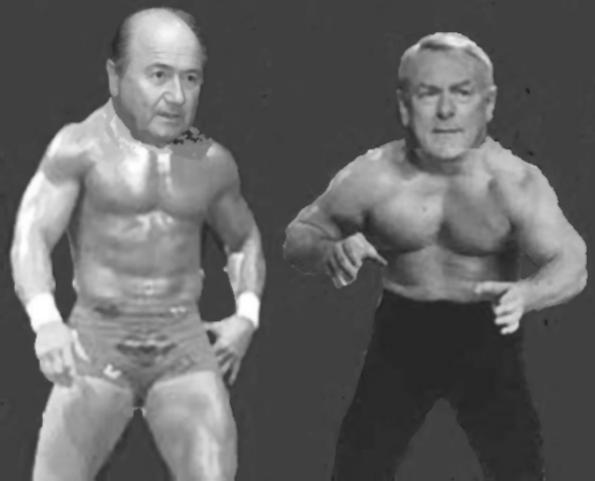
Cage Match: Pound vs Blatter

Amateur digital photo modification

Here's a shootout in the making: two guys who can't keep away from controversy, now getting all hot under the collar at each other.

Dick Pound, head of WADA, and Sepp Blatter, head of FIFA, are having a public dispute about anti-doping policy.

The dispute itself is actually a bit puzzling:

While FIFA has modified its statutes regarding doping and … signed a declaration of intent to fully sanction WADA's code, the sticking point remains WADA's insistence that a two-year ban must be imposed on first offenders. … Blatter said, "You have to take each case on its merits, starting with a warning, to a six months punishment right up to a life ban. You cannot start from a two-year ban."

Today, AFP is reporting that FIFA has dropped the explicit mention of a six-month ban, but still wants to judge each offense on its merits; Reuters thinks that WADA won't be so easily satisfied.

All of the press reports make reference to WADA's "mandatory" two-year ban. The first Reuters article mentions a case where an Italian swimmer named Giorgia Squizzato challenged a WADA-imposed two-year ban at the CAS, with CAS ruling in her favor that the two-year punishment didn't fit her crime.

A few of those facts are wrong, though. First, the WADA code does not insist on a two-year suspension for a first offense, and it does allow for some interpretation on a case-by-case basis. You can see the WADA Code (PDF) here. If an athlete commits a violation but bears "no fault or negligence," then sanctions can be dropped entirely. If an athlete commits a violation but bears "no significant fault or negligence" then suspensions can be reduced to as little as one year.

As for the Squizzato case, you can see the actual CAS decision (PDF) here. Squizzato tested positive for a low concentration of an anabolic agent called clostebol in August, 2004. She did not dispute the test results; she explained that she was using a topical cream to fight a skin infection, and that she was not aware that it contained a banned substance. The Italian federation suspended her on September 30; on December 9, FINA (not WADA) ruled that Squizzato should serve a one-year suspension, to begin on the date of the ruling. FINA ruled that Squizzato bore "no significant fault or negligence," going easy on her because she didn't gain any advantage from the substance, and also due to her relative lack of experience.

Squizzato appealed that decision to the CAS, asking that her suspension be overturned. The CAS panel denied that appeal. They ruled in her favour only in the sense that her suspension was ruled to be effective from September 30 instead of December 9.

So FINA followed the WADA code and handed out a one-year suspension, and the CAS upheld the decision. One of the things this demonstrates is that even under the WADA code, FIFA would have some leeway to hand out suspensions that are less than two years long. I guess that they want more freedom to set penalties than are afforded by the WADA code. In that sense, the Squizzato decision does offer a little support; to quote the panel,

the mere adoption of the WADA Code … by a respective Federation does not force the conclusion that there is no other possibility for greater or less reduction a sanction than allowed by [WADA]. The mere fact that regulations of a sport federation derive from the World Anti-Doping Code does not change the nature of these rules. They are still – like before – regulations of an association which cannot (directly or indirectly) replace fundamental and general legal principles like the doctrine of proportionality a priori for every thinkable case.

At any rate, Pound has been making some aggressive comments in the media, which is nothing new, but he may have met his match this time. Not too many people have the leverage to stand up to Dick Pound, since failure to bow to WADA could result in expulsion from the Olympic Games. FIFA, though, doesn't really need the Olympics as much as the IOC needs FIFA. It will be interesting to watch this develop.

September 10, 2005

Saying Nothing

IOC president Jacques Rogge is a master of speaking while saying nothing. And yet, the press seems to be pretty quick to jump to an unstated conclusion. Here's an SI.com story headlined A second chance? IOC may take another look at softball for 2012 Games. That sounds exciting — I guess they're thinking about revisiting the decision to exclude softball from the Olympic program. Well, not quite. The story reports on an interview Rogge gave to Around the Rings. Here's what Rogge said:

Rogge told Around the Rings that IOC statutes prohibit the Olympic committee's executive board from overturning "a sovereign decision by the IOC session. Our charter is very clear that the [executive board] cannot take an initiative to say 'we want a new vote' because that would open up the door to all kinds of re-votes." But he said there were precedents for the full IOC to reconsider a decision.

So Rogge didn't say anything that SI.com shouldn't have already known, but I guess it's an excuse for a story. It kind of reminds me of this. The man is a genius at getting people to hear what they want him to say.

For what it's worth, I suspect that softball does have a pretty good chance of being on the program for 2012, in the end, but that hasn't changed since this interview came out.

I wish I was an Around the Rings subscriber, though, because the teaser for the Rogge interview is intriguing: "The president of the IOC says rules governing additions to the sports program should be eased." As I predicted at the time of the cuts, Rogge never intended for the Olympic program to be decreased in size, and he wants replacements for baseball and softball.

September 07, 2005

EPO Tests Problematic

The New York Times (registration required) has an interesting article about the new test for EPO in urine samples, which is not a straightforward chemical detection and requires considerable interpretation by a skilled practitioner:

To distinguish recombinant EPO from the natural substance, the scientists used a technique that did not rely heavily on more straightforward chemical tests. To test for EPO, a preparation of urine is placed on the edge of a blotter, then subjected to the pull of an electrical field, leaving deposits in certain patterns that resemble a tiger's stripes. Some bands are more associated with recombinant EPO, some more with the natural substance. But there is considerable overlap as well. Scientists assess the patterns and the intensity of the bands. "There is a fair amount of cross-reactivity with the test, so there are certainly false positives," [Australian research scientist Nicolle] Packer ... said. "There is a lot of argument - and a lot of politics - about whether the test is good."

It should go without saying that if a positive test is going to be used to interrupt or terminate an athlete's career, invalidate past results, and ruin reputations, then the probability of false alarm (false positive rate) has to be very, very low. It doesn't sound to me like the EPO test meets that standard yet.

The story is inspired by the newest Lance Armstrong allegations, but it has broad applicability since EPO abuse for sports doping is thought to be very widespread. I found the article via Transition Game. You might also be interested in Nick's post, which is titled Dick Pound Must Go.

On Doping Rates and Sample Size

Are you ready for more fun with the IOC Programme Commission Report? In case you've forgotten, that's the document that the IOC produced this spring evaluating each of the 28 summer Olympic sports, plus five other recognized sports (Roller Sports, Golf, Rugby, Squash, and Karate), prior to the big programme review and sport elimination vote.

Of course the actual vote had almost nothing to do with the evaluation report, but it has a lot of interesting information in it, anyway. As I previously noted, one of the evaluation criteria is an assessment of each sport's anti-doping effort. At the back of the report is a table that documents the number of tests performed, and the number of confirmed positive tests, for each of the 33 IFs.

Here's a little trivia question for you: out of the 28 summer Olympic sports, plus the five recognized sports, which one had the highest rate of positive tests?

The answer would have to be athletics, right? Athletics reported that 0.64% of tests in 2003 showed doping violations, which is pretty high, but that wasn't the highest reported rate. It wasn't weightlifting (0.50%), cycling (0.49%), or aquatics (0.20%), either.

The winner was Golf, with an astonishing 1.67%. And as far as I can tell, the IF in question (the IGF) has no jurisdiction over the professional golf tours, so these would have been largely amateurs. Actually, three of the proposed sports (Golf, Karate, and Roller Sports) finished in the top 5, and Rugby was 8th. Athletics was 6th, and the third-highest among current Olympic sports. The highest among Olympic sports (and second overall) was Baseball, at 1.24%, followed by Archery, at 0.88%. These are all fairly surprising results, in my opinion. I was even somewhat caught off guard by the high rate in baseball; remember, these are tests administered by the IBAF, which has no jurisdiction over major league baseball and its steroid problems.

So what's behind these surprising results? Is drug use really rampant in amateur golf, at two and half times the rate of athletics?

Well, maybe. But I suspect that there's a more mundane reason for the odd results: small sample size. Whenever you sample a population (athletes) to calculate a rate of incidence (rate of doping), you're in fact making an estimate of the actual rate of incidence. That estimate comes from an underlying probability distribution, which implies a confidence interval associated with the estimate. If we want to convert the measured number of positive tests into a doping rate, we should also note the uncertainty in our estimate. The IOC table gives the percentage of positive tests, which is a legitimate estimate of the rate of doping in a sport; however, it does not address the issue of uncertainty.

In this case, we can estimate the uncertainty in the estimates of the doping rate by making some simplifying assumptions. Let's assume that the actual rate of doping in a given sport is p, and let's further assume that the tests are absolutely perfect — they catch every cheater, and never give any false alarms. (I'll discuss this second assumption a bit more later.)

If we test M athletes from the population, we would expect to find k = λ ≡ pM positive tests. In fact, of course, even with a perfect test we would not find exactly λ positives every time, due to the random nature of the sample; there is a non-zero probability that we would find k = λ ± 1, λ ± 2, etc. The probability distribution for k is described by the binomial distribution, which is nicely described in this Wikipedia article. We could use the binomial distribution directly to estimate the uncertainty in our estimate, but I'm going to make a few more simplifications until we get to the point where I can do the calculation on the back of the proverbial envelope.

It turns out that if positive tests are "rare," which they are, then the binomial distribution will approach the Poisson distribution (Wikipedia again). The Poisson distribution has the nice property that the mean and the variance are both equal to λ. The variance gives us a measure of the width of the distribution, or in other words, the uncertainty in our sampled estimate.

Now we can make one further simplification. If the the number of samples M is "large," then the Poisson distribution for k is well-approximated by a normal distribution, retaining the mean value (λ) and the variance (also λ). It turns out that in some of our cases the number of samples is not really large enough to completely justify this assumption, but let's go with it — this is rough work anyway. Now we really can work on the back of the envelope — we can say that the "one-sigma" uncertainty on the doping rate is equal to the square root of the number of positive tests, divided by the number of tests.

Figure 1
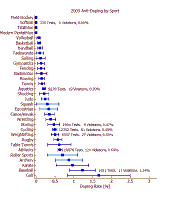
Figure 1 - 2003 positive doping test rates by sport

Figure 1 — 2003 positive doping test rates by sport (click to enlarge).

So for Golf (4 positive tests out of 240), the estimated doping rate is (1.67 ± 0.83)%, whereas for Athletics (120 positive tests out of 18,876), the estimated doping rate would be (0.64 ± 0.06)%;. Here the ± covers the one-sigma uncertainty, which is a roughly 68% confidence interval; to get a 95% confidence interval we could just double the uncertainty.

Figure 1 (inset) shows the estimated doping rates for 2003, including uncertainty, for 32 of the 33 sports (FIFA, which governs Olympic soccer, reported the largest number of tests (20,104) but did not reveal the number of violations). As you can see, the non-Olympic sports generally did not perform a large number of tests, and so their doping rate estimates are very uncertain. Other sports with high but uncertain positive test rates are Baseball, Archery, and Table Tennis. In fact, all of the truly susprising results have relatively large error bars, which tends to support the idea that the results are more due to random chance than any underlying truth.

Speaking of truth, of course we can't translate the positive test rate into a real doping rate unless we believe in the tests themselves. If the tests have a high probability of detection (near 100%), and a low probability of false alarm (near zero), then these numbers are realistic estimates of the incidence of doping among high-performance athletes. Otherwise, false positives and missed detections muddy the picture considerably. Some people will see this graph as evidence that overall doping rates are extremely low; others will conclude that the tests don't work. I've made a few arguments on this topic before, but I know I won't convince everybody, and I don't think we're ever going to know the objective truth.