Showing posts with label 2006 Torino. Show all posts

April 29, 2006

Centralize This

I've been working for some time on a hobby project to make my own Google Map. Just for fun, I've been trying to mash together a Google Map of the world and the COC 2006 Olympic Team Handbook.

I know that the Olympic boat sailed long ago, but I'm not really a web programmer, and it took me this long to get it working the way I wanted it! I do have a real job, believe it or not. Anyway, here it is. Be patient when trying to change from birthplace to hometown to residence; it takes a few seconds to place all the markers. I haven't tested it using Firefox yet, but I will tomorrow. If there are any Safari users out there who want to provide feedback, feel free.

If you're looking for a deep point to this (beyond that most human desire, to say "Look what I have created"), I'll see if I can point out just one interesting observation. Further exploration is up to you.

Centralization of Olympic Athletes in the Canadian West

The image above shows the birthplaces (top, red), hometowns (middle, blue) and residences (bottom, green) of Canada's 2006 Olympic athletes for the western provinces. There are many fewer athletes resident in the rural west than are born there. Where are they all going? It's hard to see in the image above, but here's a hint: try using my Google Map to zoom in on Calgary.

April 11, 2006

Canada's 2006 Performance, Part 3

In Part 1 of this post, I reviewed some predictions of Canada's medal performances at the 2006 winter Olympics. In Part 2, I discussed the overall performance of the team by sport, and assessed progress toward achieving the goals of the Own the Podium 2010 program. In this final segment, I want to take a quick look at two other aspects of the Canadian team's performance.

Conversion

Way back when I started this blog, my first "left-brain special" was an analysis of Canada's performance at the 2004 summer Olympic Games; specifically, the number of 2003 World Champions and World Championship medallists who won Olympic medals in 2004. What I found was that Canada did very poorly in that regard, converting only one out of every three medal favourites. I took a similar measure for five other countries and found that 2003 World Championship medals were converted to Olympic medals at about a 60% rate, and 2003 World Champions won Olympic medals about 90% of the time.

The Own the Podium 2012 plan, which I discussed in Part 2, makes a similar point. The 2002 "success rate" is quoted as 27%, with a goal of 50% by 2010. I don't know exactly what those numbers are based on, but it has something to do with the percentage of Canadian medal favourites who actually win medals at the Olympics. To the best of my knowledge it is based on results at World Championships and World Cups, but I don't know the details of the algorithm.

The COC did release a lot of information on past results, and 2006 performances. This document contains some very interesting breakdowns of Canada's performance, including a table showing the number of top-5 finishes at the 2001 and 2005 World Championships, compared to the number of Olympic medals in 2002 and 2006. In 2001, Canada had 27 top-5 World Championship results; by 2005, Canada had increased that number to 41. In both cases Canada's year-after Olympic medal total was about 60% of this number. If the percentage is meant to increase as a result of Own the Podium, it hasn't worked so far. On the other hand, Canada's results are similar to the world's other winter powers; among the top 12 medal-winning nations in 2006, only Austria, Switzerland, Sweden, and Korea exceeded 70%.

At any rate, that statistic isn't really about "conversion," since it doesn't address medal favourites specifically. Since I don't have access to the COC's definition of success rate, I'll have to repeat my own. Table 1 below shows the athletes and teams that won World Championship medals in 2005, with their 2006 results.

Table 1 — Canadian conversion from 2005 World Championship medals to 2006 Olympic medals (source: COC).
Athlete or TeamEvent2005 Placing2006 Placing
Emily Brydon Women's Alpine Combined 3 13
Leuders/Brown 2-man Bobsleigh 1 2
Canada-1 4-man Bobsleigh 3 4
Sara Renner Women's Cross Country Sprint 3 16
Canada Men's Curling 1 1
Jeffrey Buttle Men's Figure Skating 2 3
Steve Omischl Men's Freestyle Aerials 1 20
Jeffrey Bean Men's Freestyle Aerials 2 19
Marc-André Moreau Men's Freestyle Moguls 2 4
Canada Men's Hockey 2 7
Canada Women's Hockey 2 1
Jeff Pain Men's Skeleton 1 2
Jasey-Jay Anderson Men's Snowboard PGS 1 20
François Boivin Men's Snowboardcross 2 10
Justin Lamoureux Men's Snowboard Halfpipe 2 21
Maëlle Ricker Women's Snowboardcross 3 4
Kristina Groves Women's Speedskating 3000m 3 8
Canada Women's Speedskating Team Pursuit 2 2
Clara Hughes Women's Speedskating 5000m 3 1
Cindy Klassen Women's Speedskating 1500m 1 1
Cindy Klassen Women's Speedskating 3000m 1 3
Jeremy Wotherspoon Men's Speedskating 500m 3 9
Canada Men's Short Track Relay 1 2
Canada Women's Short Track Relay 1 2
François-Louis Tremblay Men's Short Track 500m 1 2
TOTAL MEDALS 25 12

There were 25 Canadian entries that went into the 2006 Olympics as defending World Championship medallists. Of these, 12 won medals, for a conversion rate of 48%. That's better than what I found at the 2004 summer Olympics, but it's tough to compare the summer and winter data directly. Eight out of ten Canadian World Champions managed to win medals, which is also significantly better than I observed in the 2004 results. I can't compare to other countries, or to Canada in 2002, without a lot more leg work than I am willing to do right now. However, it looks to me like Canada's success rate has improved somewhat.

Beyond Medals

Finally, a while back one of my commenters wrote that counting "top 8" finishes might be a better measure of NOC strength than counting medals. I responded that unfortunately that information is not easy to come by. The COC report that I mentioned above spells it all out completely.

Figure 1

Figure 1: click to enlarge

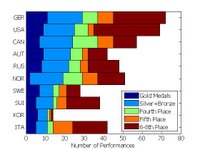
Figure 1 — National performance from the 2006 winter Olympic games. The stacked bars show gold medals, total medals, top-4, top-5, and top-8 finishes (click to enlarge).

The figure at right lays out the gold medals, total medals, top-4, top-5, and top-8 finishes for the top 10 medal-winning countries. There are a few interesting things here. First, Canada did indeed have more fourth-place finishes than any other country (13). Canada finished tied with Germany for most top-4 (37) and top-5 (45) finishes.

Korea had very few finishers in 4th to 8th position — three, compared to eleven medallists — indicating a lack of overall depth. This is of course supported by the fact that 10 of 11 medals came in a single sport. Austria and Sweden show the same effect to a lesser degree, whereas Norway's overall depth is revealed by the large number of top-8 finishes, in spite of the poor showing in the medal tables.

April 05, 2006

Canada's 2006 Performance: Part 2

In my last post I presented a recap of my own predictions of Canadian medals at the 2006 winter Olympics, and compared them to the predictions from Sports Illustrated and the Associated Press. Today I would like to look at the Canadian medal performances with an eye to the future.

A little more than a year ago, the COC initiated a performance improvement plan called Own the Podium 2010. The program aims to have Canada win more medals than any country at the 2010 winter Olympics in Vancouver. I'm going to repeat a few of the key assumptions of OTP2010 here (emphasis mine):

  • Canada needs to win approximately 35 medals to succeed at becoming the top medal winner at the Olympic Winter Games in 2010.
  • Canada can win 35 medals in 2010 if it increases the number of potential medallists (from 160 currently identified to 211) and its success rate (from 27% in Salt Lake City to 50% in Vancouver).
  • Canada has the potential to increase the number of potential medallists in the sports of speed skating, short track, freestyle skiing, snowboard and bobsleigh. It takes eight to 12 years to develop Olympic athletes in the other sports.
  • Canada's success rate can be improved through increased Games preparation, technology, research and development, and human performance research.

As an interim goal, the COC stated that Canada could finish third in the medal table in 2006, an objective that was achieved last month.

So what can we say about the progress towards a winning performance in 2010? First of all, it probably won't take 35 medals to top the medal table, unless there is a significant increase in the number of medals awarded. A mere 30 medals would have been enough in 2006, and the general trend is that the top nations are winning less and less of the medal share.

That changes things a bit. In March of last year, I considered the chances of Canada winning 35 medals, and dismissed it as an impossible goal:

I'll be accused of being "too Canadian" for saying so, but: there's almost zero chance that this is going to happen in five years.

Should I change my mind about that?

Figure 1

Figure 1: click to enlarge

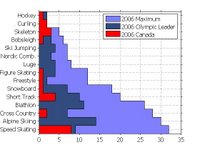
Figure 1 — Medals totals from the 2006 winter Olympic games. The three areas show the maximum possible number that could be won by a single country; the maximum number won by any single country; and the number won by Canada (click to enlarge).

My previous analysis was based on a look at the total number of medal events in each sport, and the likelihood of Canadian success. The figure inset shows the data for 2006, including the maximum possible number of medals that could be won in each sport, the number won by the leading country in 2006, and the number won by Canada. The maximum possible allows for multiple medals in a single event, and takes into account the NOC quotas in place for 2006, which can be accessed through the Torino 2006 web site. Of course, in most sports it is completely unrealistic to imagine that one country could win all of the available medals. The number won by the leading country in 2006 is probably a better indicator of what's possible. So in the plot, where there is a big gap between Canada's performance (red) and the world leader (dark blue), that indicates some room to move up in 2010.

A year ago I provided my recipe for getting to 35 medals. Here it is again, with comments from 2006:

  • Cover all the bases in ice hockey and curling (4 medals) — in 2006, Canada won three medals, missing out in men's hockey. Expect Canada to be a medal favourite for all four events again in 2010.
  • Make sure you pick up a handful of medals in figure skating, freestyle, and snowboard (4 medals) — in 2006, Canada won one medal in each discipline for a total of three. Some bad luck probably cost a couple of medals in freestyle and snowboard. On the other hand, Jeffrey Buttle could very easily have missed out. I think that 4-6 medals is probably a realistic goal for 2010.
  • Become the world's best speed skating nation, for long and short track (15 medals) — in 2006, Canada won 12 medals in the two sports combined, more than any other country. The men's team in long track didn't win an individual medal, and could do better. On the other hand, the women's team had a dream Olympics that will be difficult to repeat no matter how strong the program is. The short track team might improve if they can make some gains on Korea (10 medals). Getting three more medals, overall, would be a great accomplishment.
  • Become a top-two nation in cross-country skiing (6 medals) — in 2006, Canada won two medals, more than ever before. One of those, a gold, came from 22-year-old Chandra Crawford. Beckie Scott, Canada's most successful cross country skier, has now retired, but Crawford and Sara Renner should continue. After the Olympics, 23-year-old Devon Kershaw won Canada's first men's World Cup medal in decades. The men's team has also added 25-year-old Russian immigrant Ivan Babikov. Babikov, racing for Russia, finished 13th in the 30 km pursuit in Turin.
  • Become a top-two nation in alpine skiing (6 medals) — in 2006, Canada did not win a medal. The team continues its upward trend, however, with 3 fourth-place finishes from a relatively young team.

I don't think that I would change this recipe a whole lot. Certainly Canada has proven that some medals are available in bobsleigh and skeleton, but it remains to be seen if this four-medal performance can be repeated. A year ago I wrote:

There are Canadian contenders in bobsleigh and skeleton, but that talent pool is aging and not very deep.

I wasn't wrong about the age of the talent pool, certainly — Pierre Leuders is 35, Lascelles Brown is 31, Jeff Pain is 35, and Duff Gibson, at 39, is the oldest athlete ever to win an individual gold medal at the winter Olympics. Melissa Hollingsworth-Richards is only 26, so she might continue to improve. But if our sliders are going to win four medals in 2010, it will be because of the next crop of athletes in the system. The OTP2012 highlights quoted above imply that these athletes don't need as much development time as in other sports, so maybe there is fresh blood circulating through Bobsleigh Canada Skeleton as we speak. But the other point I should make is that there aren't that many medals to win in these sports, and nobody won more than four in 2006. There is not going to be a big increase, certainly, in the number of medals won in bobsleigh and skeleton.

Which all leaves us just about where we were a year ago, I think. In order to come out on top, Canada is going to have to win at least half a dozen medals, combined, in alpine and cross country skiing. That will get the total up to the low 30s, and that will probably be enough. Can it happen? At this point I am inclined to say yes. It isn't a sure thing, but it looks to me like the trend is pointing in the right direction, and it isn't the stretch I thought it was a year ago.

I have just a few more thoughts about the 2006 results, including a few comments about the Canadian "success rate." But I'll save those for part 3, and I'll see if I can find a few other interesting things to post about before I get to that.

April 03, 2006

Canada's 2006 Performance: Part 1

I've got a few odds and ends I wanted to tie up from the 2006 Winter Olympics, including my very early predictions about Canada's performance in 2010. First I would like to recap predictions for 2006, and see how I did and where I went wrong.

My prediction of 21.1 medals for Canada was based on assigning probabilities for the first, second, and third medal for each of the 84 events. I allowed seven different probabilities: 0, 10%, 25%, 50%, 75%, 90%, and 100% (the last of these I used only once). I admitted that I didn't do very much research, assuming that my overestimates and underestimates would more or less balance out, because I was making such a large number of guesses. Canada ended up winning 24 medals.

Figure 1

Figure 1: click to enlarge

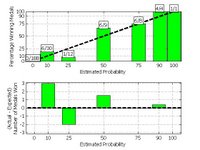
Figure 1 — Comparison of predicted and actual medals won by Canada at the 2006 Torino Winter Olympic Games (click to enlarge).

It's always useful to check your assumptions, so I took a look at the number of medals actually won by Canadians that I put into each of these seven categories. (I am going to conveniently ignore, throughout this discussion, the fact that I listed names beside some of the probabilities; I'll just assume that when a Canadian won a medal, it was the Canadian I estimated for.)

It turns out that I didn't do too badly in assigning the original probabilities, and I did very well at assessing probability for the most likely winners. The figure in the inset at right shows the actual actual percentage of winners in each of the seven categories, and the difference between the actual number of winners and the expected number of winners. For the 100%, 90%, and 75% assignments, I was as close as I could possibly be; all of the five chances I put at 90% or more won medals, and six out of eight at 75% (the exceptions were in men's hockey and women's bobsleigh).

I was also exactly right about the no-hopers; not one of the entries I assigned a zero probability won a medal. The total number of correct predictions (188) looks impressive, but of course many of those were completely obvious, so it is difficult to assess how much credit I can take for my "perfect" score.

My biggest systematic error seems to have come in the 10% category, where I put 30 Canadian athletes or teams. Six of those (20%) won medals. If I assume that I had the 10% probability correct at the outset, the likelihood of getting exactly six medals from this group is less than 1 in 20; the likelihood of six or more medals is about 1 in 14. A more likely explanation is that I underestimated the chances for this group. I am not sure what further conclusion I can draw from that, but it might help guide my future predictions.

I would like to score myself against the COC's medal predictions, but I don't have any of the details. As far as I know, they didn't release any breakdown of their prediction to the public; I did see some articles claiming that "the COC has Pierre Leuders down for two medals" and the like, but I think they wisely held that kind of thing fairly close to the vest. I know that they got closer on the total (predicting 25), and they probably did better on the individual events, too, since they have a team of researchers tracking performances throughout the season.

It's kind of fun, though, to score myself against the professionals, so I took a closer look at the predictions from Sports Illustrated and the Associated Press. Of course there is no fair way to do this comparison, since both publications predict medals on a "True of False" basis, whereas I tried to attach a confidence level to each one. (I should also point out that these two sources attempted the prediction for every medal in every event, not just for a single country.) But just for fun, let's count all of my entries with 50% or higher as "True." That gives me a prediction of 22 medals instead of 21.1; SI predicted 21, and the AP predicted 24.

Table 1 — Comparison of expert predictions for Canada at 2006 Winter Olympics
SourcePredicted MedalsCorrectly Predicted WinIncorrectly Predicted WinUnpredicted Win
Now That's Amateur 22 17 5 7
Associated Press 24 16 8 8
Sports Illustrated 21 13 8 11

So by this scoring system — which is somewhat biased in my favour — I had more correct predictions than either publication, and fewer missed as well, even though my predicted total was not as close as the AP's.

Part 2 of this post will look at the 2006 Canadian medals by sport, and assess progress with respect to the goals of the Own The Podium 2010 program.

March 18, 2006

In Spectacular Fashion (take our word for it)

It isn't too often these days that Canada enters an ice hockey game as a decided underdog. But that happened today in the sledge hockey gold medal game at the Paralympics. Canada took on top-ranked and defending Paralympic champions Norway, and defeated them 3-0. It is Canada's first ever Paralympic gold in hockey.

I can't really make any personal observations on this one, since I had no opportunity to watch; the CBC coverage in the Maritimes has been extremely sparse. I see from the broadcast schedule that there will be Paralympic coverage on three Saturdays in April, so maybe I'll see a condensed version of the game then.

March 17, 2006

Let's Pretend It's All About Sport

RICK HANSEN: "My dream back [at the 1984 summer Olympics] was that one day our athletes with a disability would have equal recognition. Today, as Canada's best competes at the ninth Paralympic Winter Games that dream remains unfulfilled. My challenge to Canadians is to see our team and indeed all the participants recognized as athletes first."

MARY ORMSBY: "You can't force people to care. You can't guilt them into cheering for athletes in sports for which they have no passion. Otherwise, we'd spend all our leisure time watching cricket and precision skating and ringette."

AMATEUR: Mr. Hansen, did you get that? We Canadians have no passion for skiing, curling, or hockey. Please stop trying to force us to care. (Also, apparently somebody is trying to make me feel guilty about not watching cricket. If it's you, please stop that also.)

MR. HANSEN: "In many ways, our acceptance of our athletes with a disability have broader socio-cultural implications, reflecting our acceptance of people with a disability in the offices, factories and boardrooms of our nation. Certainly more must be done before true equality is achieved. However, great strides have been made."

MS. ORMSBY: "There's no conspiracy. There's no deliberate attempt to ignore the country's disabled in Italy while more compelling news, such as the Maple Leafs' playoff battle, dominates sports coverage."

AMATEUR: I know, I'm totally pumped about the fact that the Leafs are going to miss the playoffs. But, uh, Mr. Hansen didn't actually say anything about a conspiracy. I like your straw man, though.

MS. ORMSBY: "These Games do not have the same worldwide involvement as the Olympics in numbers of countries and participants and therefore its heft as an event of true international scope and gravitas is diminished. There are 486 Paralympians from 39 countries in Turin, while more than 2,500 athletes from 84 nations attended the Olympics."

AMATEUR: Oh yeah, I can see your point. I knew there must be a logical reason that the Paralympics don't get more attention: not enough international scope and gravitas. And it also explains why the world junior hockey championship tournament is such a washout with Canadian audiences: there were only ten countries, and fewer than 250 athletes! No wonder those poor kids never get any credit for their success.

MS. ORMSBY: "In addition, events are divided into separate categories, a layered approach making it difficult to figure who's the true champion — is it the blind skier or the standing class skier? Or the sitting class skier?"

AMATEUR: I hate that, when you've got a layered approach that makes it difficult to figure out who's the true champion. Like the BCS system in US college football. That's a total audience killer, isn't it?

MS. ORMSBY: "Disabled sport in general also suffers from a dearth of competition. The best example of this is the remarkable success of Canadian wheelchair athlete Chantal Petitclerc. At 36 years old — an age when many athletes' best days are behind them — Petitclerc currently holds every world record from the 100 metres to the 1,500, strongly suggesting her competitive fields are shallow."

AMATEUR: FactualPS and analytical — I'm starting to like you more. Unfortunately, these facts are irrelevant to the argument! Ice hockey also suffers a dearth of competition compared to, say, soccer. A couple of years ago Canada simultaneously held the titles of men's Olympic champion, women's Olympic champion, men's world champion, women's world champion, men's junior world champion — and probably two or three more that I'm not even aware of. Think that could happen in soccer? Think again. And yet, Canadians as a group would rather watch hockey! Funny, isn't it?

MR. HANSEN: "When I participated in Los Angeles I wanted to prove to myself and to the world that being in a wheelchair would not limit my ability to achieve my goals. Today, our Paralympic athletes will once again prove that anything is possible when you believe in a dream. I would urge all Canadians that as our Paralympic athletes capture medals in Turin, their achievements are celebrated with the same kind of enthusiasm afforded to Cindy Klassen and others."

MS. ORMSBY: "Rick Hansen believes that Canadians are wrong not to embrace every Paralympic medallist with the same fervour accorded speed skater Cindy Klassen because that prevents athletes with disabilities achieving 'equal recognition.' But that philosophical stand confuses crusading for the cause with logic. You cannot create the illusion that the Paralympics are on par with the Olympics and suggest that not believing this constitutes prejudice."

AMATEUR: I don't think Mr. Hansen is the one who is confused. We're talking about sports fandom here; how does logic enter into the discussion? It's easy to prove that the Paralympics are not "on par with" the Olympics; I can similarly prove that the Winter Olympics are not "on par with" the Summer Olympics, and that the NCAA basketball tournament is not "on par with" soccer's world cup. But so what? I enjoy all of those events, and they are all capable of inspiring joy, anguish, and admiration. The connection to a sporting event is based, fundamentally, on emotion, and not on logic.

Mr. Hansen is "urging" us, as Canadian sports fans, to give our Paralympians the same recognition that we give to our Olympians. Ms. Ormsby makes it sound like just another appeal for an obscure sport; like if I wrote here that everybody should pay more attention to flatwater kayaking. Then we could have a little debate about the merits of the sport, compared to others that are more popular; we could throw some numbers around, and make comparisons, and talk about what we like and don't like in a sport.

Ms. Ormsby wants to pretend that our national lack of interest in the Paralympics is just like that, I guess. That we all really, truly, don't even think about the fact that the athletes are disabled. We just don't care as much about the Paralympics because the competition is not as broad, or as deep; or the events are too complicated to follow; or skiing's just not our cup of tea and we'd rather watch cricket. And maybe that's true. So then, what's our excuse for the way disabled people get treated in other walks of life?

I'll give the last word to the two columnists:

MS. ORMSBY: "in this country of many choices, where Canadians choose to send Olympians and Paralympians around the globe to compete, we don't need to be told whom to cheer."

MR. HANSEN: "Then, let's begin building a truly Canadian model of inclusiveness for 2010 which ensures that the Games and the benefits of hosting them are applied equally to all our athletes."

PS L-girl did the homework that I did not do, and has discovered that this claim of five world records is actually not factual. My mistake.

March 07, 2006

The Italian Job: Doping Scandal 2006

In the months before the 2006 Winter Olympic Games, there was a political dispute between the IOC and the Italian government over control of anti-doping efforts in Torino. Sports doping is a criminal offense in Italy, which is at odds with current IOC policy. The IOC and WADA have been working to have anti-doping regulations adopted in national laws, through the UNESCO International Convention Against Doping in Sport. That convention, however, follows the philosophy of the WADA Code, specifying only sports-related sanctions for doping.

In keeping with that philosophy, the IOC resisted the idea of having the Italian police involved in Olympic anti-doping activities. The dispute was only resolved about two weeks before the Opening Ceremonies. In essence, the IOC lost the battle, acknowledging that there would be no legal exemptions for Olympic participants, but maintaining control over dope testing. The Italian health ministry was given a seat on the anti-doping commission, which normally includes the IOC and WADA.

While Jacques Rogge was working to keep the Italian criminal justice system away from his Olympics, he was bragging about new "police-style" intelligence gathering in the fight against doping:

Some athletes will be targeted for testing based on tip-offs from what IOC medical director Dr. Patrick Schamasch described as a network of mostly anonymous informers around the world. "More and more we are using the same procedures as the police," he said. Just as police forces have profilers of serial killers, Schamasch said the IOC is compiling a "cheater's profile" to single out potential drug offenders. Rogge said the testers are also zeroing in on athletes who show a suspicious improvement in their level of performance. "Whenever there is a big surge in the performance that we don't consider as being normal, or a reasonable progression, then we target the athlete," he said.

Some of these "police-style" techniques were apparently on display in the days leading up to the 2006 Games, including ambush drug tests being conducted by the Torino Organizing Committee (TOROC):

Posing as an Italian couple and big fans of two-time gold-medalist Hermann Maier, sample collectors dispatched by the Torino Organizing Committee entered the athletes' village Thursday and convinced both Maier's coach and his agent to help them get an autograph and perhaps take a picture alongside the Olympic champion. Once they located Maier, the two announced they were doping officials, hustled Maier into a nearby clinic, extracted blood and urine samples and then — you can't make this stuff up — the woman actually planted a kiss on his cheek.

In the event, the 905 tests conducted prior to, during, and after the 2006 Winter Olympics ― with or without intelligence gathering ― turned up only one positive test. Russian biathlete Olga Pyleva tested positive for a stimulant that probably has little or no performance-enhancing effect in biathlon. Of course, she will still face a two-year ban from competition. On top of that, Italian authorities have announced a judicial inquiry into her case.

That positive test, though, became a minor subplot of the doping story at the 2006 Winter Olympics. Of the 904 tests that didn't turn up any adverse findings, ten in particular received special scrutiny. Ten members of Austria's nordic ski team — cross-country and biathlon — were surprised by a late-night raid at their residence on February 18 and taken for drug testing. The Italian police then searched their residences, seizing a number of suspicious items.

Let us, for the moment, leave the Italian police out of this story; we'll come back to that. The actions of the IOC in this case are within the rules in place for the 2006 Olympics. Those rules state that:

  • The NOC must tell the IOC where all athletes are training, competing, and residing for the duration of the Olympic Games (paragraph 5.5);
  • The IOC can select athletes for Doping Control based on any fact it deems relevant, at its sole discretion (paragraph 5.6);
  • All athletes shall be subject to doping control initiated by the IOC at any time or place, with no advance notice. Such doping control may include testing for all prohibited substances and all prohibited methods (paragraph 5.1); and
  • Mere possession of a prohibited substance or prohibited method is an anti-doping rule violation (paragraph 2.6).

So here, as near as I can determine, is the sequence of events in this particular intelligence-gathering operation. Doping control officers working for WADA learned that former coach Walther Mayer was in Italy with the Austrian nordic team. Mayer had been previously banned from the Olympics because of his suspected role in performing blood transfusions at the 2002 Olympics. WADA tipped off the IOC about Mayer's presence, and the IOC initiated an unannounced (no advance notice) test for ten of the members of the Austrian nordic teams.

Accounts differ about how the police got involved. At any rate, the Italian ministry of health would have known about the targeted testing, and the reports of Mayer's presence, because of their seat on the anti-doping commission.

It turns out that the Italian police had authority in this case that the IOC did not; there is nothing in the Olympic doping rules that allows the IOC to search athletes' residences, or seize their property. Law enforcement authorities confirmed that the seized materials included "blood analysis equipment," syringes, vials of distilled water, asthma medication, and "other substances." In addition, Mayer's presence in Italy was confirmed when he crashed his car into a police roadblock.

That's a pile of circumstantial evidence, and there's more where that came from. Without more details, it proves nothing, in my opinion, but it still smells bad. We shall see whether the evidence constitutes proof of "possession of a prohibited method" in the eyes of WADA and the IOC. They have announced that they will launch a disciplinary hearing, and that they will consider all of the evidence collected by Italian police. Recall that this is the same organization that made a show of trying to secure exemptions to Italian law prior to the Olympics. Now, faced with an embarrassing scandal and an absence of positive tests, they have decided that perhaps police raids and criminal investigations are not so bad after all.

I suspect that it will be difficult to tie the seized materials to any particular athlete or athletes, and even to prove that the equipment was used (or intended for use) in a prohibited method. It may come down to an argument about the burden of proof.

This leads to some difficult questions about WADA's new investigative approach to anti-doping. Most of the discussion, to date, has been framed in terms of testing. The IOC and WADA are claiming that informants, profiling, and data mining will enable them to make their drug testing program more effective. We know, though, from the Tim Montgomery / Chryste Gaines case, that the fight against doping has already moved beyond testing. We know that a positive test is not required to prove a doping violation; Dick Pound himself calls that idea "preposterous" and "nonsensical." In the Montgomery case, the CAS ruled that two athletes had violated anti-doping rules based on their alleged confessions to a third athlete. So what does that mean about the IOC's new network of informants — and about their intelligence in general? Would the testimony of an anonymous snitch be enough to pursue sanctions? What about suspicious telephone conversations? Association with known cheaters? How much (or how little) circumstantial evidence is enough? If the case against the Austrian athletes goes forward, some of these issues will come before the Court of Arbitration for Sport in the next few months.

It seems to me that we have come to a new crossroads in the effort to reduce doping in sport. The anti-doping authorities see themselves as law enforcement agencies. But what kind of law enforcement agency do we, as sports fans, want them to be?

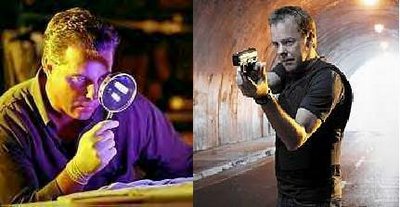
Evidence only knows one thing: the truth. It is what it is. — Gil Grissom, CSI
Where is the Nerve Gas? I'm gonna cut your right eye, then I'm gonna cut your left eye and I'm gonna keep cutting you until I get the information I need. Where is the nerve gas? — Jack Bauer, 24

Is anti-doping "police" work the kind that strikes preemptively and recklessly, assumes guilt, and uses any means necessary to enforce the rules? Or is it the kind that requires conclusive evidence of guilt and respects the rights of the innocent above all else?

I think you know where I stand. I've said it before, and I'll say it again: the vast majority of Olympic athletes are not cheaters. In my opinion, a false conviction is far more tragic than a cheater who escapes detection. After all, for all the apocalyptic talk about the end of sport as we know it, we're still talking about cheating at sports. It isn't terrorism, or organized crime, and we don't need to trample the rights of the innocent to catch the guilty.

I would never argue that we should surrender the fight by making doping legal, and I don't think we should go easy on proven cheaters. Cheating is bad, and doping is the worst kind of cheating. But let's make sure that anti-doping tactics are appropriate to the crime.

Further Reading

March 01, 2006

I Am Aster … So Play Safe

Aster, Prone, With Rifle

Anticipating the start of the 2006 Paralympic Winter Games, I wandered over to the official web site and was greeted by this image. That's Aster, the lovable cartoon mascot of the Torino Paralympics, prone on the snow with a rifle.

I know that this is supposed to depict biathlon, but does this give anybody else the creeps? It's not as creepy as the 400 brides at the Olympic closing ceremonies, but it's disturbing, don't you think?

I also wonder about the design of the mascot itself. Is it just an accident that the Paralympic mascot is named Aster and looks just like an asterisk? As in a parenthetical annotation that provides further explanation? e.g. Paralympic gold medallist, 2006, long distance biathlon*.

And of course, the term "asterisk" in sports almost always has a negative connotation: see Olympic gold medallist, 2004**. I know, I know, Aster is a snowflake, or an ice crystal, or something. But am I the only one who notices these things?


*LW10 class

**Due to judging error

February 28, 2006

One More Note on the Medal Tables

Last week I pointed out the discrepancy between what I called the "European" and "American" medal tables. The former ranks the countries by the number of gold medals won, whereas the latter ranks the countries by total number of medals, using gold medals as a tiebreaker. I should have pointed out that to many people these would be called the "right" and "wrong" medal tables, respectively.

There is a myth that the "ranking-by-gold-medals" method is the official, sanctioned way to keep the list. You will even find this myth on the official Torino 2006 web site:

The Olympic rules lay out that the Final Rank should be based on the overall number of gold medals won.

That, of course, is incorrect; as readers of this blog know already, the Olympic Charter states clearly that the Olympic Games are competitions between athletes in individual or team events and not between countries. In addition to Rule 6, I draw your attention to Rule 60, which could not be more clear on the subject:

The IOC and the [Organizing Committee of the Games] shall not draw up any global ranking per country.

Now, it is true that the IOC publishes medal tables, and it is also true that the tables are sorted by the number of gold medals. However, as you will see in the disclaimer here,

The International Olympic Committee (IOC) does not recognise global ranking per country; the medal tables are displayed for information only.

Therefore, we are free to rank the national Olympic committees as we see fit. I tend to agree with WM-K1-91 and DrJohnEvans in the comments here, that using the total number of medals gives a better idea about the relative success of the NOCs. In fact, it would be even better to keep track of fourths, fifths, etc. Alas, that information is not so easily obtained. On that note, I have seen it reported a few places that Canada had more fourth-place finishes than any other country. One wit from CBC radio, reporting on the alpine skiing results, opined that Canada "Owned pretty much all the territory right up to and surrounding the Podium." Funny stuff.

February 26, 2006

Olympics.2006.15

Figure 1

Canadian medal prediction, 2006

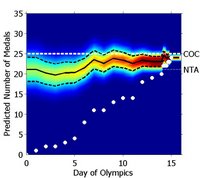
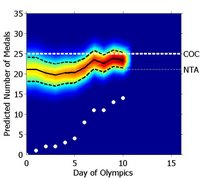
Figure 1 — Updated probability distribution for Canada's 2006 winter Olympic medal total (click to enlarge). Prediction is based on the probability assessment here, updated as events are decided.

After another four-medal day for Canada in Turin, we can safely say that one part of my medal prediction was incorrect; 25 medals will be enough to finish in the top 3 in the medal table. In fact, barring a very unlikely Austrian sweep of the medals in the men's 50 km mass start, 24 medals — Canada's current and final total — will be good enough to finish third.

The COC's Own the Podium program has achieved its interim goal. They did not reach their stated target of 25, but my prediction of 21 was proven to be a bit pessimistic. To be fair to myself, my prediction did include a "one-sigma" standard deviation of ±3 medals. I think that standard deviation probably gives a good rough idea of the uncertainty in Olympic prediction, so I will cut the COC some slack. Also, as I noted before, two other panels of experts pegged Canada's total at 21 and 24.

I've got two further analyses I want to do concerning the prediction, and the long-term goal of 35 medals. But I will save that for a slow news week.

February 24, 2006

Olympics.2006.14

Last week I made the claim that the Winter Olympics were slippery and very, very fast. Of course there is an important exception to that rule. The last two days have featured the medal games in curling, the slowest sport in the Winter Olympics.

I honestly do not mean that as an insult; curling is one of my favourite winter sports. Personally, I get more thrills from watching curling than from freestyle skiing and snowboarding put together.

The four medal games offered plenty of drama. The women's gold-medal game went to eleven ends; the men's bronze-medal game was decided on a last-shot draw in the tenth. The men's gold-medal game was a close affair until Canada blew it open with six in the sixth, following an incredible run-back take-out by third Mark Nichols.

There have been plenty of reports about how curling has captured the imagination of the television audience at these games. Why should this be so surprising? After all, curling is enormously popular in Canada, a nation otherwise obsessed with ice hockey; there is no reason why it cannot find its audience in other countries as well.

Figure 1

Canadian medal prediction, 2006

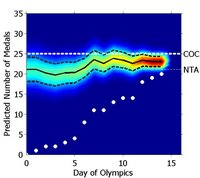
Figure 1 — Updated probability distribution for Canada's 2006 winter Olympic medal total (click to enlarge). Prediction is based on the probability assessment here, updated as events are decided.

Predictions

My medal prediction for Canada (see inset) currently sits at 23 medals, which means that they have somewhat exceeded my expectations to this point. The final outcome will be decided on Day 15, because there are only two events being contested on Day 16; the men's hockey final, and the men's 50 km mass start in cross country. Canadians have no chance of winning a medal in either event.

Saturday (Day 15) will see six events that can impact the medal total for Canada:

  • Speed Skating, Women's 5000 m. Kristina Groves, Clara Hughes, and Cindy Klassen will race for Canada. All three have already won medals at these Olympics. Klassen and Hughes will start in the last two pairs.
  • Short Track Speed Skating, Men's 500 m. Canadians Eric Bédard and Francois-Louis Tremblay advanced out of the qualifying round with fourteen other athletes.
  • Short Track Speed Skating, Women's 1000 m. Canadians Tania Vicent and Amanda Overland advanced out of the qualifying round with fourteen other athletes.
  • Short Track Speed Skating, Men's 5000 m relay. The Canadian team has advanced to a five-team final.
  • Alpine Skiing, Men's Slalom. Four Canadians will race. Thomas Grandi has an outside chance at a medal.
  • Bobsleigh, Men's third and fourth heats. Canada-1, captained by Pierre Leuders, is fourth after the first two heats, and is a tenth of a second out of a medal.

I should point out that no matter what happens tomorrow, the Canadian Olympic team has already won more medals than ever before. Incidentally Sports Illustrated, who made picks for every medal winner in every event, had Canada down for 21, and the Associated Press came up with 24 using the same strategy. Tomorrow will tell.

February 23, 2006

Olympics.2006.13

Figure 1

Canadian medal prediction, 2006

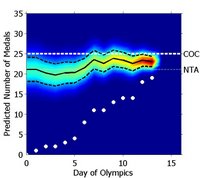
Figure 1 — Updated probability distribution for Canada's 2006 winter Olympic medal total (click to enlarge). Prediction is based on the probability assessment here, updated as events are decided. The probability has already been updated to account for the outcome of the men's curling and men's hockey, as well.

The prediction at the end of Day 13 stands at 23.0±1.3.

Let me make a confession: I do not find all winter Olympic sports equally enthralling. But talking about which winter sports you don't like is pretty dull, so I'll leave that to other people. Instead, let's go back to Day 12. It was a lot more fun.

Short Track

I wanted to make a comment about the women's short track speed skating relay on Day 12. The final was contested by Korea, Canada, China, and Italy. The race was action-packed, with plenty of contact and some aggressive skating by Canada. The Koreans finished first, Canada second, and China third. The Italians hung tough through most of the race, but over the last few laps they dropped away and finished well back in fourth place.

Or did they? Shortly after the conclusion of the race, the Chinese were disqualified for making illegal contact with the Canadians. And at that point, the Italian fans and athletes exploded in celebration.

Seamus from citius altius fortius said that the Italians actually made an appeal for the disqualification; I didn't see that part. But I sure noticed the celebration:

The Azzurri-clad Italian team leapt for joy when the final standings were posted. The crowd serenaded the four skaters with chants of "Italia! Italia!"

Indeed, it was quite a scene, flags waving, skaters jumping, and crowd chanting. Now, I don't have any problem with celebrating a bronze medal performance. In fact, I don't have any problem with celebrating a fourth-place performance. I wish I saw more of that! I don't even object to asking for a disqualification based on a foul that did not affect your performance in any way. Hey, the rules are the rules, and they should apply to everybody.

The Italian team should feel proud of what they accomplished. But there's something unseemly about that vigorous celebration, in my mind. It was clearly only about the medal. They didn't find anything to celebrate in their performance when they thought they had finished fourth, after all. A post-race decision by the officials just should not change your mood that dramatically.

Cross Country

Chandra Crawford is the first Canadian athlete to completely surprise me at the 2006 winter Olympics. Although I predicted that Canada had a good chance at a medal in the women's sprint, I did not expect Crawford to be involved. And in fact, her gold-medal performance looked … well, easy.

Canada's new status as a contender in cross country skiing is pretty remarkable, as well. Crawford becomes the third Canadian woman at these Games, and the third North American woman ever to win a medal in cross country skiing.

Speed Skating

Seamus has called Cindy Klassen's win in the women's 1500 m his "performance of the games." I don't have too much to add, except to point out the splits. In contrast with Enrico Fabris in the men's race, Klassen was second at 300 m, first after 700 m, first after 1100 m, and first at the finish. That strategy has not been a successful one at the Turin oval so far, which makes Klassen's race even more remarkable.

Hockey Post-Mortem

There will be tens of thousands of words written about the failure of the Canadian men's hockey team at these Olympics. I could add a few thousand of my own, but I am not sure that I have anything original or very informed to say. In this, I am only a fan. There are very few things in sports that can still make me feel joy or despair; the Canadian Olympic hockey team is one of them.

Very Canadian of You

Speaking of sports and national identity, see if you can name that country:

________ newspapers turned against their Olympic team on Thursday after another string of disappointments pushed the Nordic country toward their worst Winter Games in 18 years.

February 22, 2006

Olympics.2006.12

Reader Sean asked for an updated probability table based on my original prediction of Canada's medal total for the 2006 Olympics. So before it gets overtaken by events on Day 12, here it is:

Table 1 — Medal win probabilities (remaining) for Canadians at the 2006 winter Olympics
Sport Event Expected Medals
Speedskating - Long Track Women's 1500 m 1.00
Women's 5000 m 0.60
Speedskating - Short Track Women's 3000 m Relay 0.90
Men's 500 m 0.75
Women's 1000 m 0.35
Men's 5000 m Relay 0.75
Hockey Men's 0.75
Bobsleigh Men's Four-Man 0.50
Freestyle Skiing Men's Aerials 0.35
Women's Aerials 0.10
Curling Men's 0.75
Women's 0.75
Figure Skating Women's 0.10
Cross Country Ski Women's Sprint 0.60
Alpine Ski Men's Slalom 0.10
Snowboard Men's Parallel Giant Slalom 0.10
Women's Parallel Giant Slalom 0.10
TOTAL 8.55

In this table, I've only included events where I predicted a non-zero chance of winning. So to follow along at home, here's how it works: when Canada wins a medal, my "expected total" goes up by (1 - EM), where EM is the Expected Medals value in the table above; and when Canada doesn't win a medal, my "expected total" goes down by EM for that event. For events not shown above, EM is equal to zero. What happens to the probability distribution is more complicated.

As of today, my prediction stands at 22.6±1.8, that is, the 14 Canada has already won, plus the 8.6 above; the original prediction was 21.1±3.0.

February 21, 2006

Olympics.2006.11

Figure 1

Canadian medal prediction, 2006

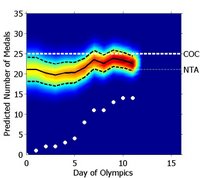
Figure 1 — Updated probability distribution for Canada's 2006 winter Olympic medal total (click to enlarge). Prediction is based on the probability assessment here, updated as events are decided.

Things You Shouldn't Say …

… when contemplating the possibility of winning your next hockey game in the qualifying round:

And of course, it is the question: Shall we win [and face Canada in the quarter-finals] or shall we play a good game to get a 0-0 result [and face Switzerland]? There are many questions going through our heads right now. — Bengt-Ake Gustafsson

… after being beaten once:

You know I always say that you can beat Chad Hedrick once but you can't beat him twice — Chad Hedrick

… after being beaten for the third time:

I would say, if you re-ran the race it would be a 90-95 per cent chance that Shani or I was gonna win the race … — Chad Hedrick

… at a post-race press conference with your teammate and rival:

I'm just throwing it out there. It would have been nice if after I won the 1,000-meter race, he could have been a good teammate and shook my hand, just like I shook his hand — and hugged him — after he won the 5,000 meters. — Shani Davis

And Speaking of that Race …

I will admit it, I am kind of enjoying the rivalry between Davis and Hedrick. Hedrick is a very, very bad loser, and Davis is a very, very bad winner, but at least there is nothing at all phony about them. And they are both very gifted athletes, so I can forgive them, as long as I don't have to live with either one of them.

However, it would be remiss not to make a point about the performance of gold medallist Enrico Fabris from Italy. Check out these splits. Fabris was 25th at the 300 m mark, 23rd at 700 m, 11th at 1100 m, and first at the finish. His last three laps went 26.68, 27.14, and 27.73 seconds. He covered each of the last two laps faster than any other competitor. On the last lap he was almost nine-tenths of a second faster than the nearest skater.

On the opposite side of the coin was the third American skater, who finished ninth. Joey Cheek was "livin' the dream," as an old coach used to say — he led at 300 m, 700 m, and 1100 m, before somebody threw a piano on his back and he finished up with a 30.67-second lap. That last lap was the sixth-slowest put up by any of the 39 competitors — and he gave up almost three full seconds to Enrico Fabris.

February 20, 2006

Olympics.2006.10

Figure 1

Canadian medal prediction, 2006

Figure 1 — Updated probability distribution for Canada's 2006 winter Olympic medal total (click to enlarge). Prediction is based on the probability assessment here, updated as events are decided.

A "Horrible" Day in Alpine Skiing

When the 2006 Olympics started, I was thinking that I would include a snarky "Brian Williams" feature in each day's post, highlighting the inaccurate or infuriating claims that the CBC's Williams made each day.

I really am not a fan.

Fortunately for everybody, Williams has actually been pretty well-behaved, and I haven't had much material to work with. There was a pretty funny incident involving Mr. Williams' tongue — I wish I had a picture, but I don't — but he actually handled that one pretty well.

Then Williams apparently made a reference to "Bad, Bad, Leroy Brown" after Shani Davis won his gold medal. I didn't actually see that, so I couldn't really say much. L-Girl took care of it, though.

Tonight, though, Williams got me all revved up in his discussion of the results in alpine skiing. "There's no way to sugarcoat this — a horrible day for Canada," was how he put it. And in typical Williams style, he said it more than once, just to get his point across.

Let's see. In the men's Giant Slalom, 21-year-old Francois Bourque finished fourth, behind Benjamin Raich (eight-time GS World Cup winner), Joel Chenal, and Hermann Maier (14-time GS World Cup winner and reigning GS world champion). Thomas Grandi finished tenth.

In the women's Super-G, 23-year-old Kelly VanderBeek finished fourth, behind Michaela Dorfmeister (most gold medals in Olympic alpine skiing history), Janica Kostelic (most medals for a woman in Olympic alpine skiing history), and Alexandra Meissnitzer. Emily Brydon finished ninth.

How embarrassing for Alpine Canada! How can they live with themselves? Chokers.

Justice for Sami Jo!

Now on a positive note, I did learn something interesting from the CBC broadcast tonight. Williams had Geraldine Heaney on to talk about the Olympic champion Canadian women's hockey team. Heaney went out of her way to point out the positive role played by my acquaintance close personal friend Sami Jo Small. Heaney noted that Sami Jo, as the alternate (third) goalkeeper, will not get a gold medal — which I knew — but she then added that in men's hockey, the alternate goalkeepers do get medals.

I don't know if there is anything that anybody can actually do about that, at this stage; Heaney encouraged Williams to bring it up with Don Cherry when he is on tomorrow night, but I don't know if Don has that much pull with the IIHF. And I have considerably less, to put it mildly. However, I will put the full power of this blog behind any effort to get Sami Jo a gold medal, even if it means an alliance with Don Cherry.

More Serious News

Of course there is a major doping story going on in Turin, and I am going to comment on that at some point. It seems that we have come to a frightening crossroads in the "war" against doping, and I am not sure that everybody has carefully thought that through. To be honest, I haven't had time to do it justice, and the news is still breaking so fast that I have struggled to write something that contains the essence of the story. But it does need to be discussed, and I'm not ignoring it.

February 19, 2006

Olympics.2006.08

I told you so.

I told you so.

(Of course, just when I start feeling like I know a lot about sports, I go and enter the sportsFilter Olympic hockey pool. I would do a statistical analysis of my chances of winning the pool, but I think I can guess the answer.)

My good mood about the Swedish hockey victory, and Shani Davis' win in the 1,000 m, was almost ruined by the events of Day 8. Canadian teams were upset in men's hockey (by Switzerland), upset in men's curling (by Italy), and upset in women's curling (by Japan). Then I remembered that the Olympic Games are competitions between athletes in individual or team events and not between countries. That made me feel quite a lot better.

Some people do forget, though. In fact, most media outlets publish some kind of a medal table that ranks how different nations are performing at the Olympics. Last week, citius altius fortius pointed out that it is standard practice, in North America, to rank the countries by their total number of medals; whereas in Europe, the table is normally ordered by the number of gold medals won.

Figure 1

Canadian medal prediction, 2006

Figure 1 — Updated probability distribution for Canada's 2006 winter Olympic medal total (click to enlarge). Prediction is based on the probability assessment here, updated as events are decided.

In 2006, the two different methods are causing a sort of odd situation. Medal tables in the US are showing Norway in the lead (16 medals), followed by Germany (15 medals) and the US (13 medals). Russia also has 13 medals, and then comes Canada with 11.

Meanwhile, in Europe, they're showing the US in first place (7 golds), followed by Germany and Russia (6 golds), Austria (4 golds), Korea, France, and Estonia with three golds each. Norway is currently eighth, and Canada ninth, with two gold medals each.

So by the American scoring system, the USA is in third place; but by the European system, the Americans are winning.

Speaking of medal totals, the COC had a mid-Olympics review today and they still think that Canadian athletes and teams can win 25 medals and finish third in (the American version of) the medal table. I still think that's unlikely, although at the end of Day 8 I would put the chances of 25 or more medals at 18%, which is higher than when the Olympic started. I've also got a new format for the medal prediction that nobody cares about, which you can see in the inset.

February 16, 2006

Olympics.2006.06

Updated Predictions

Canadian medal prediction, 2006 -- Updated 16 February

Figure 1 — Probability distribution for Canada's 2006 winter Olympic medal total (updated).

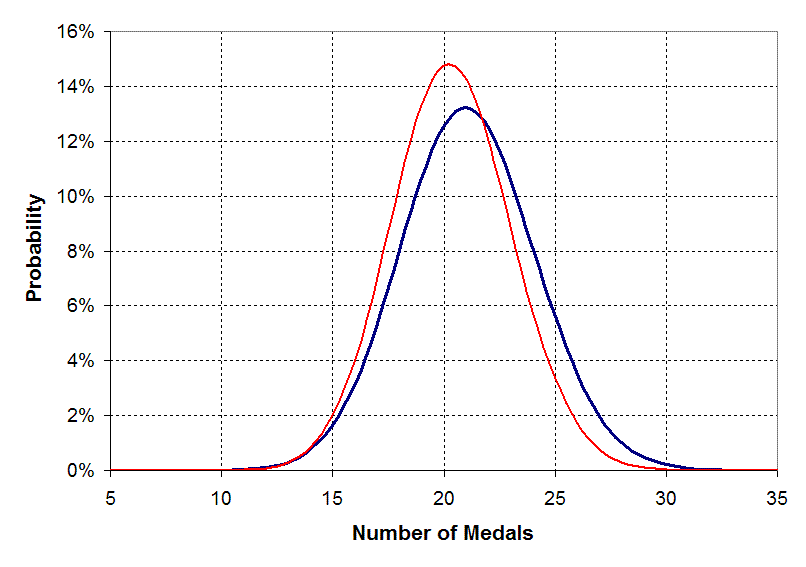
I am only really writing this blog post so that I can display my latest prediction for Canada's medal total (inset right). Note that I am not changing my original prediction; I'm just updating the probabilities for events where the medals have already been decided. That changes the probability distribution every day.

In case you are wondering, no, I am not obsessed with the medal table, or with Canadian performances. After all, the Olympic Games are competitions between athletes in individual or team events and not between countries. (If it's in the rules, it must be true.) No, I am actually obsessed with my own predictions, which is a different personality problem entirely.

As long as I'm using up valuable time when I could be sleeping, I should have pointed out yesterday that US speed skater Chad Hedrick will definitely not win five gold medals in Turin, since the Americans were eliminated in the quarterfinals of the men's team pursuit. To be charitable I will point out that they were beaten by the eventual gold medallists.

The US did not have their best skaters available, which is a matter of some controversy. That's not what I want to talk about here. I am more interested in the ease with which everybody seems to have swallowed the five-medal hype in the first place. Is it really possible for a speed skater to win five gold medals at the Olympics any more? And if it is, doesn't that show that the depth of the field is pretty poor?

Hedrick is still predicting that he will win the 1,000, 1,500, 5,000, and 10,000 m events at the Olympics. He has already won the 5,000, actually, so only three more to go. But that sweep looks humanly impossible to me. The 1,000 m race will be won with a time of about 70 seconds. The 10,000 m race will take Hedrick in the ballpark of 13 minutes. To compare that to running, it equates roughly to the 800 m (or a 600 m, if that was an event) and the 5,000 m. In swimming, it would be about the same as pairing the 200 m (or 150 m) and 1,500 m.

But in swimming and running, those doubles simply cannot be done. Evenly the freakishly gifted Ian Thorpe has never done it at the world championships or Olympics. Sure, he's won at 200, 400, and 800; but extending or contracting that distance requires completely different (and mutually competing) physiological systems. In running, forget about it; nobody even enters the 800 and the 5,000. I feel pretty safe in saying that in this modern age of highly specialized athletes, It Cannot Be Done. Nobody is ever going to be world or Olympic swimming champion in the 200 m and 1,500 m simultaneously. Nobody is ever going to be world or Olympic athletics champion in the 800 m and 5,000 m simultaneously. And nobody is going to be world or Olympic speed skating champion in the 1,000 m and 10,000 m simultaneously, either. The fact that Hedrick is even competitive in both distances makes him almost superhuman.

And yes, I know that Eric Heiden did it. In fact, Heiden's five-gold feat was even more astounding than the one Hedrick was shooting for, since he won the 500 m instead of the team pursuit. But that was twenty-six years ago! Speed skaters still raced outside! Human physiology hasn't changed, but the level of competition has. I think. The fact that people seriously entertain the idea that Hedrick can do this gives me pause. Maybe he really can do it. But if he does, it will just show me that the world's speed skating talent pool is actually pretty shallow.

February 15, 2006

Why Women's Hockey Should Stay

I have a high opinion of SI's Michael Farber, so I took note when I read this story asking:

If the IOC can boot women's softball from the Games after 2008, a sport in which four countries -- the U.S., Australia, China and Japan -- play at a high level, why does it tolerate a sport that is truly mastered by only two?

The next day, Damien Cox of the Toronto Star joined in. Cox has two daughters in minor hockey, and claims that he doesn't want to see women's hockey go, but but his editorial was framed with words of surrender:

Before, the absence of any depth in the women's hockey field appeared to be a temporary problem that would be fixed over time as countries new to the game got their programs fired up. Now, it appears permanent, and at a time when the IOC is eliminating viable sports that are more competitive than women's hockey.

And this morning Chris Cochrane's column, the best feature of my morning paper, threw another log on the fire:

Why is women's hockey included in the Winter Olympics? Sure, there are always debates over what sports should and shouldn’t be part of the Olympic offering. Regional biases and politics, under the Olympic umbrella, make for questionable entries and fuel such debates. Yet there shouldn’t be any debate about the inability of women’s hockey to field a slate of competitive teams.

Is there a theme developing here?

I have to admit something. If women's hockey was a sport seeking admission to the summer Olympics, I would be opposed. All three columns make the point that Canada and the USA have dominated the sport's history; I would go even further than that and point out that a single country has won eight of nine world championships, plus one of two Olympic gold medals. The writers are obviously correct to say that this is not an acceptable level of competitive balance.

But women's hockey is not seeking admission to the games — they're already in. And there is little, if any, pressure to "contract" the winter Olympics. The columnists raising this question seem to be making some kind of ethical argument — that it's not fair to have women's hockey in the Olympics, when a more deserving sport like softball is on the outside looking in. It's all so very Canadian. It's almost as if we can't stand the thought that there's an Olympic sport where Canada can be dominant. Everybody's looking around sheepishly saying, "Oh, gosh, sorry about that! We thought everybody would be better by now! We'll just pack up and go home, then, if we're bothering you."

Canada, get over it. You don't hear the Germans proposing to drop luge from the program, even though they've won 65 of 108 Olympic medals since 1964 — and been even more dominant than that in the women's discipline. Yes, I know that women's hockey, so far, is an extreme case; let's admit that they probably got into the Olympics before they were really ready. But things will not always be like this.

First of all, let's not forget that Canadian hockey has gone through an astounding rebirth in the past decade — and I'm talking about men's hockey. The inferiority complex of the 70's and 80's seems like a distant memory, and Canada enters most international tournaments as the favourite. No, it isn't like the old days (and thank god for that) but Canada's hockey program, top to bottom, has never been in better shape. Against that background, is it surprising that our women's hockey team has also pulled away from the field?

And then, there's been the rivalry with the United States. Without each other, either country might have become complacent, allowing the world to catch up to them. But this rivalry won't let that happen. In fact, it seems clear to me (and I am not the only one) that the Canadian and US women's teams have improved markedly since 1998. The competitive balance hasn't improved, but that's not because the world is getting worse.

I think, though, that the women are almost as good as they are going to get, on an absolute scale. Right now, the US women's team plays competitively against top-level high school boys teams, and the Canadian women's team plays at about .500 against AAA-Midget teams in Alberta. This is pretty comparable to the men-women matchup in other, more established sports like basketball or soccer. I don't think that there is another big jump that the Canadian and American teams can make; they're never going to be playing at the major junior or NCAA Div I level. I think that their improvement is bound to slow to a crawl.

Again, let's just admit that women's hockey was rushed into the winter Olympics. But as part of that discussion, we have to admit that we're talking about a very young sport. Eight years ago, there were eight teams in the World Championships, and there was a six-team Olympic tournament. Today, the world championships have a three-tiered qualifying system, going down to such traditional strongholds as Australia, South Africa, and Hungary. That sounds like growth and development. So who decided that eight years (sixteen since the first World Championships) is the maximum allowable incubation time? Does Michael Farber think it's that easy to develop a brand new national sport? Has Canada "truly mastered" soccer yet? I think we may need a few more decades.

So let's give the world a chance, too. The gold medal game in women's hockey already has a memorable history, and has become one of the highlights of the Olympic games. If we're patient, we can have a whole tournament like that.

Olympics.2006.05

Updated Predictions

Canadian medal prediction, 2006 -- Updated 13 February

Figure 1 — Probability distribution for Canada's 2006 winter Olympic medal total (updated).

I've got good news, and I've got bad news.

The good news is that the luge competition is over.

The bad news is that the skeleton competition is about to begin.

Before we leave the luge sliders, though, I'd just like to point out that of the 21 entries in the doubles luge, five of the pairs have the same last name. The winners, Andreas and Wolfgang Linger from Austria, are brothers, as are the Canadians Chris and Mike Moffat, who finished tenth. The fourth-place finishers were cousins Tobias and Markus Scheigl, also from Austria. I don't know anything about Andris and Juris Sics from Latvia (seventh), or Lukas and Antonin Broz from the Czech Republic (sixteenth), but it seems fairly safe to assume that they're family in one way or another.

So close, it's got to be family?

I know I'm not supposed to say this out loud, and I am sure that Olympic-calibre sliders never think about it, but the double-luge position is an extremely intimate one: two skin-suited bodies stacked one on top of the other, front-to-back. So does the high incidence of these pairs mean that men are generally more comfortable in that situation with a family member?

February 14, 2006

Olympics.2006.04

Updated Predictions

Canadian medal prediction, 2006 -- Updated 13 February

Figure 1 — Probability distribution for Canada's 2006 winter Olympic medal total.

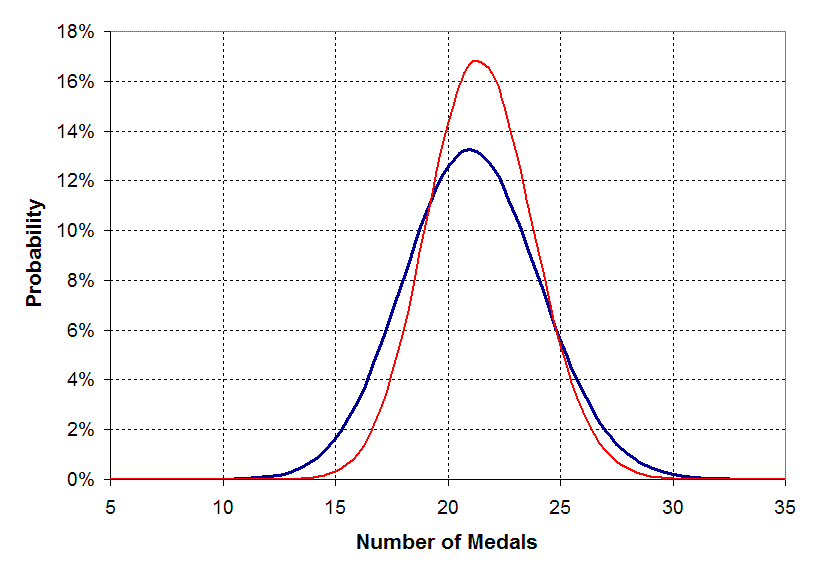
Either you've been ignoring me for the last week, or you know the drill. The blue curve shows my original (a priori) prediction, and the red curve shows the current prediction, accounting for events that have already happened.

The team sprint medal today brings my expected number of Canadian medals back up to 20.4.

Joey Cheek Acts

American speed skating gold medallist Joey Cheek has pledged to donate his $25,000 reward from the USOC to Right to Play. The money will be earmarked for children in the Darfur region of Sudan, where hundreds of thousands of people have been killed, and millions displaced, by war and genocide.

I have discussed athlete activism here before and in my opinion this fits the bill. It is not a protest, I admit, since Cheeks is risking very little (only a few xenophobic patriots will question his actions). However, an act meant to help others and right a wrong is still an act, even if it is uncontroversial.

I ♥ Cross Country

Canada's result of the day was also the race of the day, in my opinion (although the men's alpine combined also had plenty of drama). Cross country skiers Sara Renner and Beckie Scott raced very aggressively in the women's team sprint, pushing the pace at every opportunity. Renner broke a pole on an uphill during her second leg in the alternating relay format; she took a spare from a sportsmanlike Norwegian coach, and then got the right replacement at the bottom of the hill. Renner becomes only the second North American woman to win an Olympic medal in cross country skiing. The Norwegians finished fourth in the race.

I just have to add that the cross country skiing has been the most enjoyable sport at the Olympics to watch. I'm fond of speed skating, and alpine skiing, but I am loving the head-to-head racing in cross country; it's a great combination of physical prowess and strategy.

Blogs of Note

Today I stumbled upon a very well-done blog about the Olympics at Eurosport.com called citius altius fortius. The blog began just before the 2006 Olympics, but the author plans to keep it going afterward. In general I have not been terribly impressed by many of the blogs dedicated to the Torino Olympics, but this is a good one. The golden (retriever) predictions are worth the effort, just by themselves.

I also found out today about the resurrection of DFL, a blog that got quite a lot of publicity during the Athens Olympics; I did not expect it to reappear, but I am glad that it did. DFL's motto is "Celebrating last-place finishes at the Olympics. Because they're there, and you're not." Celebrating last-place finishes is a dangerous game; it would be easy to fall into mockery or unjustified glorification. Author Jonathan Crowe keeps things in the right perspective.