Showing posts with label Sport Funding. Show all posts

October 24, 2006

Gold Medal Plates

Last Tuesday night my wife and I attended a fundraiser called Gold Medal Plates. The series kicked off in Halifax and will be held in six other cities across Canada in November. The Halifax event was very well-attended and raised a good chunk of money for the Canadian Olympic Foundation, which will direct the proceeds toward Own the Podium 2010 and Road to Excellence.

The event is a clever mixture of sport and haute cuisine. Eight of the city's best chefs were paired with high-profile local athletes (an Olympian or Paralympian or Olympic hopeful) and charged with preparing their "ultimate chef's creation." For $225 per ticket, attendees could taste those creations, sample Canadian wines, and schmooze with Olympians and other sports VIPs. While enjoying dessert and coffee guests were treated to speeches by two of Canada's top athletes, and given the opportunity to spend more of their money on silent or live auction items. The finale of the evening was the awarding of bronze, silver, and gold medals to the winning chefs. In the 2004 edition of this event, the paying guests voted for their favourite dish. This time, the winners were chosen by a panel of expert judges.

Not having been assigned to a chef, I was free to wander around, tasting everything and doing some schmoozing myself. I know it's kind of shallow (possibly pathetic) to say so, but I still find it fun to wear a name tag that says "Olympic Athlete."

The athletic guests of honour, meanwhile, were excellent. Sledge hockey gold medallist Paul Rosen and two-time Olympic champion Catriona Lemay Doan gave powerful speeches about their own experiences at the Paralympic and Olympic Games.

(As an irrelevant aside, I remembered during dinner that one of the first photographs I ever saw on the Internet was a picture of Catriona Lemay at the 1994 Olympics. It's pretty amusing to go back and see what the first Olympic Games web site looked like just twelve years ago.)

The culinary star of the evening was Chef Ray Bear, who was teamed up with canoeist Mike Scarola. I was not surprised that the chefs appeared to be quite engrossed in the culinary competition. I was a little bit surprised that the chefs got behind the fundraising effort as strongly as they did. After winning the gold medal, Chef Bear offered a nine-course meal, cooked in your home, for auction. He and Scarola ended up selling two such meals for the cause.

September 30, 2006

Oh Sure, But Is It a Sport?

Back in the May budget the Canadian federal government proposed a Children's Fitness Tax Credit, intended "to promote physical fitness among children." The proposal went on to say that "the credit will be provided on up to $500 in eligible fees for programs of physical activity for each child under age 16."

[An eligible program of physical activity is] an ongoing program suitable for children in which substantially all of the activities undertaken include a significant amount of physical activity that contributes to one or more of cardio-respiratory endurance, muscular strength, muscular endurance, flexibility and balance.

Of course, that still leaves a little room for interpretation. So for the last two months, an expert panel, appointed by the Minister of Finance, has been touring the country. They've been hearing from Canadians about what they consider meaningful physical activity, aiming to use that feedback to set the criteria for what should (and should not) be eligible for the tax credit.

As you might expect, Canadians think that everything their own children are involved in should be eligible. The panel has heard appeals for everything from ballet, to music and art, to "free-form play." The recommendation of the expert panel is due to the Minister on October 6.

I've written before that I don't want to get drawn into a debate about whether such-and-such activity is or is not a sport. In this case, however, we're debating whether specific programs should qualify as "physical activities."

The case for ballet seems like a no-brainer to me, although Linyee Goh takes a backhanded swipe at organized sports in the Vancouver Sun article, saying that ballet is "the best physical exercise for children, because it's both physical and mental." Unlike, say, soccer, where you just turn your brain off, is that it?

As my contribution to the debate, here are Amateur's suggested guidelines for eligibility for the Children's Fitness Tax Credit:

  • In eligible programs, increased physical activity should be seen as an accomplishment in itself. I'll concede that you can achieve a good workout by playing the violin, but you can't achieve playing the violin by just increasing your level of physical activity.
  • The incurred expense should include some element of instruction; that is, it should be something more than just the opportunity for exercise. Buying a bike or a Y membership isn't enough. And when I say instruction, I don't mean supervision — if you're paying money so that your children can engage in "free-form play," I say that's just "child care" under another name. And we know that you've already got plenty of money for that.
  • .

August 20, 2006

World or Olympic Champion?

King Kaufman, one of my favourite sportswriters, writes about his lack of interest in the ongoing Basketball World Championships:

Because of the alchemy of what we care about, the Olympics are thrilling in a way the exact same competition is not if it's not the Olympics. The difference is the rings. … In the big picture, sports are important. Anything that can draw crowds of 20,000 or 50,000 or even 100,000 on a regular basis and that gets its own section in every newspaper and several TV networks to itself is pretty important. But individual games are only important to the extent that we collectively buy into the fiction that they're important. The fact that so many of us care which of two metal rings a ball goes through more times on a given night is significant. It says something about us as a society. But the actual ball going through the actual hoop is just nonsense. All of the meaning comes from us. We, and by we I mean me, but I don't think I'm off on an island here, don't put much meaning in these international tournaments, except the Olympics.

King is speaking as a sports fan here and trying to explain why certain events draw much more interest than others, even though the sporting competition may be exactly the same. I think he's hit the nail on the head; the truth is, there isn't really any "reason" behind it at all. Certain sporting events are more important because the world pays attention, and the world pays attention because the events are more important. There's not much point in arguing that people "should" pay attention to the world championships the same way that they do the Olympics.

But I don't think King's right when he says that all the meaning comes from us, the fans. For the athletes participating, there is intrinsic meaning in the competition that has nothing to do with the number of fans in the seats or the number of reporters in the press box.

Don't get me wrong. I'm not here to argue that athletes believe that a world championship is just as important as an Olympic championship. For most sports that are in the Olympics, the Olympic championship is the pinnacle of achievement, and of course that has everything to do with the fact that the whole world is paying attention.

But almost nobody pays attention to the World Championships in many of those same sports. So if all the meaning came from the fans, then the world championship would be very nearly meaningless. And to an athlete, of course, it isn't. After all, the Olympic champion is still only the best in the world. Can there be a more meaningful title? One of my experienced teammates used to describe the Olympics as a World Championship held in the middle of a World's Fair; in other words, the most meaningful possible competition, surrounded by a festival of meaningless hyperbole.

Successful amateur athletes derive meaning from sports through their performances, and not through the attention of others. In fact, athletes care a great deal about their performances even when nobody is watching at all. I lived with three of my teammates for four years and every training session had meaning in that household. Some of the most memorable moments of my entire career came during those training sessions! Even a pickup basketball game would be remembered and performances dissected into moments of glory and shame.

That's not to say that athletes don't want recognition for what they do. In Canada this is a very common lament: the Canadian public only pay attention to amateur sports every four years, and the athletes toil in anonymity the rest of the time. The media get their fair share of the blame for this attitude, too. I am all in favour of constructive efforts to increase public awareness of amateur sport — efforts like CanSport.com — but I don't like it when the lack of interest is treated as some kind of moral failure of the Canadian people.

And if the Olympic Games didn't draw the dominant part of the public's attention, what do you think would happen to sports funding in this country? Sport Canada's excellence funding strategy is based entirely on the Olympic Games. In 2004-05 Sport Canada provided more than $51M to national sport organizations (NSOs) for Olympic and Paralympic sports, and is starting to give an increasing fraction of that money to sports that have a good chance of Olympic success. In contrast, non-Olympic NSO's received less than $2.6M (about 1/20th). You can win fistfuls of medals in the Pan American Games, Commonwealth Games, and Jeux de la Francophonie, but if your sport isn't in the Olympics, even the federal government isn't that interested. (It's interesting to think about what this means about the reasons that governments support amateur sport, but that's a topic for another day.) If public interest was more evenly spread out, instead of being so concentrated on the Olympic Games, I suspect that sport funding would also show more balance. And of course that would be to the detriment of the Olympic sport NSOs.

POSTSCRIPT Speaking of constructive efforts to increase awareness, the 2006 ICF World Flatwater Championships just wrapped up in Szeged, Hungary. Lots of Canadian crews did very well (including our K-4 heros), so you will be able to see some highlights next weekend on CBC Sports Saturday.

June 28, 2006

Following the Money, 2006

More than a year ago I wrote a series of posts titled "Following the Money" that examined the breakdown of Sport Canada's overall contributions to all recipients, and the percentages allocated to Olympic sports. I went looking for the 2003-2004 and 2004-2005 numbers on the Sport Canada website so that I could update the charts I did then.

Regular readers and people who work in the Canadian sport system will know that Canada's sport funding partners have recently made a change in their funding strategy. The old strategy, sometimes described as "a mile wide and an inch deep," was to distribute funds to a large number of sports in more or less equal measure. The "inch deep" part of that metaphor comes from the recognition that the total number of dollars available is fairly small, so a wide distribution means less for everybody — and perhaps not enough for anybody.

The new strategy adopted by Sport Canada and the Canadian Olympic Committee is intended to target funds where they will give the most benefit and are being best used. For high-performance funding, that means giving more money to sports with a high probability of future Olympic success. A few weeks ago I wrote about the Canadian Sport Review Panel's allocations for summer sport high-performance funding and assessed how the highest-ranked sports have done. Here I want to take a look at funding in the broader picture and take a look at the new strategy in the context of the past decade.

Figure 1

Figure 1 — Sport Canada funding contributions, 1995-2005 (click to enlarge).

Figure 1 (inset) shows the updated chart of Sport Canada contributions, divided into more or less the same categories as last time. I made a few minor adjustments; for example, I made Olympic and Paralympic sports into a single category. For the most part, that's because it's actually not easy to separate them. National Sport Federations (NSFs) like Athletics Canada get funding for Olympic and Paralympic programs, but the Sport Canada summaries just provide totals.

The first conclusion we can draw is that the Sport Canada budget has seen a strong increase — about 160% — over the past decade. Aside from the International Events category, which tends to wax and wane depending on which events Canada is hosting in any given year, every category has seen a steady increase. The Olympic/Paralympic Sports category represents the total funding given to NSFs for Olympic and Paralympic sports, plus a few multi-sport organiations (MSOs) dedicated to high-performance sport, such as the Canadian Olympic Committee and Canadian Paralympic Committee. That amount has increased from $21M to $51M since 1995-96. The contribution to the Athlete Assistance Program, which goes directly into the hands of national team athletes, has similarly increased from $10M to $20M.

That's all very good news for Canada's elite athletes, and for sport in general.

Figure 2

Figure 1: Distribution of Olympic sport funding, 1995-2005

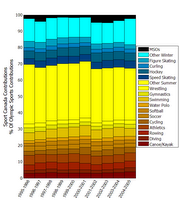
Figure 2 — Sport Canada funding distribution for Olympic and Paralympic sports, 1995-2005 (click to enlarge).

Figure 2 (inset) shows more detail about the Olympic/Paralympic Sports category, and the results were somewhat surprising to me.

Here the plot shows the distribution of funds to Olympic and Paralympic sport organizations. Each bar shows the Sport Canada contribution as a percentage of the total in the Olympic/Paralympic Sport category each year. (Recall that the total has increased from $21M in 1995-96 to $51M in 2004-05.) What this should show us, then, is whether any recipient or group of recipients has been recieving a bigger or smaller piece of the (growing) pie.

I've identified specifically a small number of NSFs for summer and winter sports in the chart. For summer sports, I singled out the NSFs responsible for the twelve top-ranked CSRP sports on my previous report card. Remember that these eleven NSFs fielded teams that won eleven of Canada's 12 medals in Athens, and the CSRP is predicting that they will be responsible for 17 of 20 medals in Beijing. For winter sports, I have broken out the four NSFs responsible for the Own the Podium program's top-priority sports.

The surprising results show that these "have" sports have not significantly changed their share of the total contribution. The eleven summer sports in question took in 33.1% of the total Olympic/Paralympic funding in 1995-96, and 35.6% in 2004-2005. The high point of 36.8%, curiously, was 2000-01, which also saw a big increase in the total funding. The top four winter sport NSFs saw 14.2% of the total in 1995-96, and 14.5% in 2004-05. The highest percentage (16.0%) was allocated in 1997-98.

There has been a slight shift towards winter sports overall of about 2%, with the decrease coming out of summer sports.

So what does this all mean? Is targeted funding just a myth?

Well, maybe. There are a couple of confounding factors here. The first is that several of these "high-priority" NSFs have somewhat split personalities. For example, Canoe Kayak Canada gets funding for sprint canoe-kayak, which is a CSRP 1A sport, and for slalom canoe-kayak, which is in category 4. The Sport Canada contribution represents the total for everything, so an increase in sprint funding might be masked by a decrease in slalom funding.

A more fundamental difficulty with these numbers is that they represent contributions for domestic programs, including grass roots development, and not just for high performance sport. In many cases the high-performance budget dwarfs other contributions, but in other cases it does not.

However, the results still surprised me. I expected to see the top-priority sports taking a bigger share of the pie over the last two funding cycles. I think what we're seeing here is the fact that Sport Canada has mostly avoided having to make the tough decisions because of the overall increase in its budget. When there's more money to go around, they can increase budgets for the high-priority sports without having to make a lot of painful cuts elsewhere. It will be interesting to see how the targeting strategy plays out when budgets start shrinking again.

May 14, 2006

Summer Sport Report Cards 2005

In the past few years, the agencies that fund high-performance sport in Canada have made a change to their basic philosophy. Instead of stretching the available funding until it's thin enough to cover every sport, there has been a trend toward concentrating financial resources on sports with the greatest probability of international success. I've previously touched quite a bit on the winter sport Own the Podium program. Today I want to talk about summer sports.

The 2005 Report of the Canadian Sport Review Panel was finally completed and released last month. The CSRP is an arm's length group of technical experts that reports to Canada's high performance sport funding partners: Sport Canada, the Canadian Olympic Committee (COC), and the Canadian Paralympic Committee (CPC). The CSRP was created with a mandate to assess the high performance programs of Canada's summer sports, and the potential for repeatedly winning medals at the summer Olympic, and the summer and winter Paralympic Games. The report contains summaries of those assessments, and funding recommendations for each sport from the CSRP.

Before I get into the data, it is important to note that the CSRP evaluation is based on the high performance programs of the various sports, and doesn't address the broader goals of Canada's sports organizations, such as participation or outreach.

(I should also disclose the fact that my brother is one of the members of the CSRP. He has never discussed any confidential information with me, and all of the information I am going to discuss here is in the official report linked to above.)

The CSRP defines several categories of Olympic summer sports, from 1A through 6B. Category 1A/1B is for Olympic individual/team sports with high probability of podium success, category 2A/2B is for sports with moderate probability of podium success, and so on. Sports are ranked on the basis of their athlete development systems, technical leadership and authority, organizational commitment and the capacity to implement, and sport science development.

There are three 1A sports, two 2A sports, three 2B sports, and four 3A sports. Altogether, these sports garnered 55% of the CSRP funding, and account for 17 of the 20 medals that the CSRP predicts Canada will win at the 2008 Olympic Games. I will focus on these twelve sports.

As part of the CSRP evaluation process, each Canadian NSO was asked to provide detailed information to the panel. This information included a budget submission, and an assessment of potential Olympic medal performances in 2008 and 2012. The CSRP then performed its own evaluation of the submissions, and used them to provide recommendations to the funding partners. The table below attempts to capture some information about the NSO inputs, the CSRP evaluation, and the sport performance in 2005, for each of the sports in categories 1A through 3A.

Table 1 — Summary of CSRP inputs, outputs, and 2005 performance.
Olympic Sport
(Discipline)
CSRP Support 2005-06 2004 Olympic Medals 2008 Medal Prediction 2005 Worlds (Olympic Events)
CategoryReqst. ($K)Recmd. ($K) SportCSRP Top 3Top 8Top 12
Canoe-Kayak (Sprint) 1A 1420 987 3 5 3 4 6 9
Aquatics (Diving) 1A 515 377 2 4 2 2 5 8
Rowing 1A 994 898 1 3 3 1 3 3
Athletics 2A 766 823 0 6 2 1 5 12
Cycling (all) 2A 803 562 2 7 1 0 5 6
Soccer (women) 2B 140 140 0 1 0 N/A N/A N/A
Softball (women) 2B 480 229 0 0 1 N/A N/A N/A
Waterpolo (women) 2B 666 468 0 1 1 1 0 0
Gymnastics (Artistic, men) 3A 501 299 1 1 1 1 1 1
Aquatics (Swimming) 3A 1462 688 0 4 1 4 9 13
Gymnastics (Trampoline) 3A 493 150 1 1 1 0 1 1
Wrestling (women) 3A 240 259 1 1 1 1 3 4

The list of sports follows CSRP terminology; in many cases they identified one discipline governed by an NSO as a distinct "sport" separate from other disciplines. It is significant that "men" and "women" are listed as different disciplines in some sports. The CSRP has obviously decided that in many cases one gender should be supported more than the other. The support money in the table is only the portion for Olympic funding, which is separate from Paralympic allocations. The "Requested" column shows the budget presented by the NSO, and the "Recommended" column indicates the CSRP recommendation to the funding partners. The next column lists 2004 Olympic medals — the twelve sports in the table accounted for all but one of Canada's 12 medals in Athens. The 2008 Medal Prediction column indicates the number of medals predicted by the NSO, and the number of medals predicted by the CSRP after an evaluation of the NSO submission. The last three columns show Canada's performance in each discipline at the 2005 World Championships.

It is amusing to note that the sports, when asked to predict their own success at the 2008 Olympics, came back with a "bottom-up" estimate of 68 medals — more than three times the total in 1996, which was the best non-boycott result ever. The CSRP has refined that estimate to 20, with a "top end" of 30. The top 12 sports included in Table 1 — presumably the best-managed of the bunch — thought that they could contribute 34 medals in 2008. The CSRP reduced this by "only" a factor of two.

The lion's share of that reduction came from Athletics, Cycling, and Swimming, which together predicted 17 medals in 2008. That story didn't wash with the CSRP, who reduced the number to 4. That mistrust of the medal predictions didn't necessarily translate into a loss of sport funding; Athletics, in fact, was recommended for a larger allocation than they asked for.

All three of these "over-confident" sports had relatively good years in 2005, putting a large number of athletes into top-8 and top-12 positions at the 2005 World Championships. The top 12 sports are otherwise living up to CSRP expectations, with sprint canoe/kayak and diving leading the way. It will be interesting to follow progress leading up to the next summer Olympics.

May 08, 2006

2006 Budget Recap

I know things have been a bit slow around here lately. I've been travelling a lot, and busy at work, but I think things should clear up a bit soon.

I did want to recap last week's federal budget, as it deals with amateur sport in Canada. As my patrons at CanSport have already pointed out, the Harper government didn't fulfil its campaign promise to increase funding for sport to one percent of the health care budget.

In fact, things went just about as I predicted the night before the budget. Although I haven't figured out what the total allocation is, the conservatives didn't dramatically increase the budget for sport. They did introduce a number of tax breaks, including one for parents who register their children in organized sports, and one for people who donate securities to non-profit organizations. On the question of infrastructure, the conservatives didn't make any committments, and wouldn't even grant Vancouver's request for more funding for the 2010 Olympics. That's not an encouraging sign for infrastructure.

Locally, the new premier of Nova Scotia — a former gym teacher — delivered his first Throne Speech last week and promised to make physical education mandatory in high school. I took PE in grade 10 and I remember it as a year filled with Dodgeball and Kickball (which we called soccer baseball in my neighbourhood). I don't think it did much for my physical fitness.

May 02, 2006

The Budget as Sport

Tomorrow is budget day for our new federal government — our new minority federal government, and that adds quite a lot of drama to the proceedings. Like most Canadians, I'll be looking closely at the issues that affect me personally and how the Conservatives plan to address them.

Before the election, I wrote a bit about the Sport Matters Group and their analysis of which political party would come closest to meeting its "wish list" of pro-sport initiatives. Last month the SMG released the submission they made to the Minister of Finance in advance of the budget. In a separate e-mail I received, SMG stated that the Minister received about 400 submissions on sport and physical activity out of 5600 total.

The conclusion of the report identifies three broad recommendations for "introducing a comprehensive package of investments in sport and physical activity." Here's my summary of those recommendations and my take on the Conservative view. (I should say up front that I my knowledge of politics is quite shallow, so you can take that part for what it's worth.)

Sport Funding

Sport Matters Group is calling for funding for sport and physical activity that is equal to 1% of total federal health care spending. This paper goes through the calculation and assesses the 1% mark as $465M per year. The report admits that some might take a less generous definition, which would come out at $318M. Either way, it would be a very significant increase from current levels.

According to SMG, the Conservative party platform for 2006 made a promise to meet this goal. I predict that they'll break this one. As a minority government, they'll be under pressure to spend; as Conservatives, they'll be pressured to cut. Funding for sport isn't an area where there is significant pressure to increase spending. As usual, it will be quickly passed over by the press and the public. I do believe that they will propose a small increase, but not a tripling or even a doubling.

New Fiscal Policy

Sport Matters Group is proposing a number of tax breaks and fiscal policy changes, including:

  • Tax credits for fees to register children in organized sport, and for fees paid by coaches and officials
  • Elimination of the capital gains tax on donations of securities to charities (including sport not-for-profits)
  • An increase in the allowable tax deduction for sponsorship of community sport by private corporations
  • Tax credits for parents supporting high-performance athletes
  • The renewal of the national sport lottery

Some of the above were Conservative campaign promises. And Conservatives and tax cuts, that's like peas and carrots. I think there will be a number of proposals in tomorrow's budget along these lines, and they will sail through parliament without debate. Many middle-class parents will be pleased when they read about this on page three.

Investments in Infrastructure

Sport Matters Group is hyping sport infrastructure as an investment in community health, and as an economic investment as well:

The lack of facilities that meet international standards causes many Canadian communities to miss out on the opportunity to reap the economic benefits from hosting competitive games. Similarly many communities are unable to fully exploit their potential to attract sport tourism because of inadequate or insufficient facilities.

SMG is asking for a "designated envelope" for sport facilities and infrastructure, with "adequate, long-term funding for this envelope." To be honest, I don't know what all this talk about "envelopes" means. I don't expect to see any of it in tomorrow's Conservative budget, though. My prediction is that they won't be sold on the alleged social or economic benefits.

Sport Matters Group has made a very coherent presentation, and a well-reasoned argument for their cause. And of course they don't really expect to check off everything on their wish list tomorrow. I don't think they'll be disappointed, and they'll have some concrete successes to point to at the end of the day.

February 04, 2006

Olympic Wrestling With Jane Roos

The Canadian Olympic Committee and its international counterparts regularly get bad press over their aggressive defense of their Olympic trademarks. Every few weeks it seems that there's a story about the USOC sending a cease-and-desist order to some bizarre "Olympics" or another. I don't usually comment on those stories, because I don't understand all the legal issues, and because frankly they are all pretty much the same.

The most recent mini-controversy , however, is a little bit different. This time, the offended group includes a significant number of Canadian Olympic athletes.

In 1997, a former athlete named Jane Roos started the "See You in Sydney Fund," a not-for-profit organization that collected donations from ordinary Canadians, and from Canadian corporations, and distributed them to Canadian Olympic hopefuls. That successful project turned into the "See You in Salt Lake Fund," the "See You in Athens Fund," and eventually the "See You in Torino Fund." In total, Roos has already distributed about three million dollars directly to about 500 Canadian athletes. The amount of each distribution depends on the total amount raised, but we're talking about thousands of dollars per athlete. That's a significant amount for a Canadian amateur athlete.

Roos and the people who work for her have also been quite successful at building their brand. If you read the sports pages in Canadian newspapers, you may remember a series of print ads that raised a few eyebrows by comparing elite athletes to the homeless. Those were followed by a pair of dramatic television spots, entitled "Tears" and "Thoughts."

Those two commercials make a very thinly-veiled allusion to the Olympic games; combined with the "See You In Athens" name, it's difficult to argue that Roos isn't using the Olympics as a selling point for her fundraising. And in Canada, the Olympic Games and associated trademarks are the property of the COC.

I won't pretend to understand all of the legal issues here, but the COC has stepped in and claimed the "See You In" name as its own. Clearly, they did that for the sole purpose of stopping Roos from using the name. Their action has been called "punitive and petty" in the Toronto Sun, and last Friday night on CBC television they got a few more heaping helpings of abuse:

It's crazy. Why would you want to see something that's helping so many people and doing nothing negative go on? If she didn't exist, we would have five, six less medals at the last Olympics. If you want to get rid of Jane, what are you going to replace her with? It's not going to happen. If you're going to get rid of the fund, where's that gap going to be filled? It's a necessary part of the Canadian sports system. — Adam van Koeverden, Olympic gold medallist
Right now for the existence of this fund, we have to get behind it. The COC can't attack its own athletes. It can't attack the Olympians. — Jake Wetzel, Olympic medallist
She embarrassed them. They said, oh, look at what this lovely woman is doing by herself. Maybe we better copy it, but first we better cut her head off. Oh, come on. There was a big misconception in Canada. The misconception is that the Canadian Olympic Committee looks after athletes, amateur athletes in Canada. They do not. — Paul Henderson, former member of the COC

Well, all of this is a bit hyperbolic, which I'll get to in a minute; but did the COC do wrong by Canadian athletes here, or not? My first thought was that the COC ought to have played nice on this. They've been watching Roos flirt with the Olympics for quite a while now. Why not just approach her about licensing the "See You In …" name? Surely everybody is working toward the same goal here, and the COC shouldn't object to some extra fundraising for athletes. License the name to Roos for a token fee, and everybody's happy — maybe the COC could even be listed as a fund sponsor. What would be the harm?

Well, the harm comes when Roos' corporate sponsors are in direct competition with the COC's:

Credit card giant Visa paid $100-million (U.S.) to be an official IOC sponsor. Rival MasterCard put $500,000 (Canadian) into Roos's fund and could say it was supporting Canada's team, though it had to stop short of referring to the Olympics.

Now let's think about how Canada's athletes would react to that situation if the Mastercard donation wasn't going directly into their pockets. If Mastercard was using scenes from the Olympics, or the Olympic rings, or even the word Olympic in their advertising, and they weren't an official Olympic sponsor, the athletes would be lining up to support the COC. They know, or they should, that the COC is a very important source of support for amateur sport in Canada, and they know that the COC derives its income from its ability to license the Olympic brand. Mastercard's cheap entry into the market weakens the COC's position and reduces the value of the official Olympic sponsorship. Money lost to the COC is money lost to amateur sport; in this particular case, the athletes are reaping a small gain, but risking a large loss. What would happen if all of the COC's official Olympic sponsors decided to go the "unofficial" route? That would be a big net loss for sport, because the COC puts a lot more money into the system than the "See You In …" fund.

It's true, as Paul Henderson says, that the COC does not put a lot of money directly into the hands of Canadian athletes. They distribute funding indirectly though the NSOs. (It's also true that there is some public misconception about this fact, which Roos has worked hard to correct.) And it might be true that more amateur sport money should go right to the athletes, and not to the NSOs. But the fact remains that if you raise money based on a link to the Olympics, you're doing it at the COC's expense. And that, in the big picture, is not good for Canada's athletes.

Now, as for the end-of-the-world scenarios of Wetzel and van Koeverden, that's really just another example of Roos' marketing genius. Because of course taking away the name is not the same as taking away the fund. Roos and her team, while they pursue their legal challenge against the COC, have already created the CAN (Canadian Athletes Now) Fund; and frankly, I think it's a great change. I found the old strategy, centred around the claim that "70% of Canadian athletes live below the poverty line," to be excessively negative, not to mention intellectually dishonest. The new print campaign is a refreshing about-face, concentrating instead on the positive impact of the funding. And with her PR skills, Roos has also been able to rally her anti-establishment image, which won't hurt one bit.

I just hope that these guys like the name.

January 21, 2006

How To Vote

Now, I would never suggest that anybody should cast their vote in the Canadian federal election on the basis of a party's policies on amateur sport. Not when our entire society is on the verge of being wiped out by the question of whether a man can or cannot legally get married to another man.

But in case those more important issues haven't helped you make up your mind, let's talk about the various federal parties and the promises they've made about amateur sport. Before I start I want to give credit once again to local sports columnist Chris Cochrane who covered this in his column earlier in the week. Cochrane does a great job covering local sports at all levels, and often has something insightful to say. No doubt he will be scooped up by a real newspaper soon, but in the meantime I will enjoy his column while I can.

But I digress. An organization called the Sport Matters Group sent out a summary press release on Thursday that summarizes the federal parties' plans for amateur sport.

The Sport Matters Group have called on the federal government to make a larger financial investment in sport, including:

  • Annual funding of $300M a year for sport and physical activity, which represents the equivalent of 1% of the federal health care budget;
  • Long-term investment in sport and recreation facilities and infrastructure; and
  • Innovative tax measures to encourage participation and private sector investment

The press release summarizes the response of the Conservatives, the Liberals, the Green Party, the New Democrats, and the Bloc Québécois. In that order, too, and although there is no explicit endorsement of any of the parties, it is clear that this is meant to indicate which party has come closest to matching the Sport Matters Group's wish list.

Since this is a press release, I'll assume that I'm allowed to quote from it as extensively as I please:

The Conservatives have committed to spending a minimum of 1% of total federal health funding on physical activity and sport (about $300 million/year). They have also promised to maintain both the Sport Canada budget for amateur sport of $140 million/year and commitments to the 2010 Olympics and Paralympics, including the Own the Podium strategy. As well, they have announced a tax credit on spending of up to $500/year on registration fees and memberships for programs promoting fitness in children under sixteen, estimated to cost $130 million/year. Lastly, the Tories have pledged $50 million/year for community-based programs targeting youth at risk, which includes sport.

The Liberals emphasize the need for additional facilities and infrastructure for sport and recreation, directing $350 million over 5 years to a new Community, Sport and Recreation Infrastructure Fund, with the intention of obtaining matching dollars from the provinces/territories and municipalities. In addition, the Liberal platform reaffirms existing funding of $140 million/year for amateur sport as well as commitments to the 2010 Olympic and Paralympic Games including the Own the Podium strategy. Lastly, the Liberals have pledged to maintain the Healthy Living Strategy investments of $300 million over 5 years, which includes physical activity. In the Strategy’s first year, $3 million was dedicated to physical activity.

The Green Party takes a broad approach, promising a national standard for daily physical education in schools and implementation of the national goal of a 10% increase in physical activity by 2010, as adopted by all levels of government in 2002. The Party has committed to spend $100 million/year for 5 years to reduce inactivity and obesity, through federal initiatives, school-based physical education, and community programs and facilities. The Party also pledges support for high performance athletes, but has not put a dollar value to this component of their sport policy. To advance sustainable sport and recreation management practices, the Greens will promote the Olympic Movement’s "Agenda 21" initiative.

The New Democratic Party platform does not include any sport-specific initiatives. In a letter to the Sport Matters Group, Party leader Jack Layton specifies that sport and recreation facilities would be included in the NDP pledge to establish a new national public infrastructure agency with substantial federal funding. Likewise, the NDP commitment to increase funding for youth at risk programs by $100 million/year for 4 years includes sport and physical activity.

The platform of the Bloc Québécois reflects the cultural importance of sport in the province of Quebec. The Bloc is calling for separate national teams and the enhanced provision of services for athletes in French. The Bloc pledges increased support for elite athletes, as well as support for the World Anti-Doping Agency. The Bloc proposes to use athletes to promote the benefits of sport and physical activity and to include anti-doping programs in schools and recreation centres. The Bloc platform also emphasizes the need to invest in physical activity, through awareness campaigns and accessible sport facilities. It is important to note that none of these commitments has been costed out.

So now you're informed. And depending on your perspective on this issue, I think that there's really something for everyone here. Well, unless you think that the government shouldn't spend a red cent of your hard-earned money on sport.

If you'd like a more personal spin on it, Sport Nova Scotia also took a survey of some Nova Scotia candidates, and you can see their answers here (PDF).

December 08, 2005

Dumbed-Down Olympic Selection

The Canadian Olympic Committee held a board meeting a couple of weekends ago. Among other items on the agenda, they approved new Olympic selection criteria:

At the meeting, the COC Board … voted strongly in favour of using International Federation qualification criteria as the minimum standard for nomination to the 2008 Canadian Olympic Team. Similar to existing criteria for the 2006 and 2010 Olympic Winter Games, each summer National Sport Federation has the right to require selection standards for its athletes that are higher than International Federation criteria.

What this means is that the COC will not place any explicit restrictions on qualification for the summer Olympics in 2008; if your IF says that you're good enough, then you will be part of the team. I am surprised that I have not seen much about this in the press, since the very tough "Top 12" selection standard got a lot of negative coverage in 2004. A Google News search turned up a single piece by Alison Korn at RunnersWeb.com, a publication that was particularly critical of the Top 12 criteria.

Some of you will have heard my diatribes on this issue before. A year ago I laid out my arguments in favour of tough selection criteria. One of the most common arguments against tough standards is that they stifle development of up-and-coming athletes; I've done some analysis attempting to debunk that theory.

I still believe, as I stated last November, that using IF selection criteria creates a situation that is inherently unfair to Canadian athletes:

would it be fair to allow a top 40 trap shooter to go to Athens, when the IF for rowing has set their field size much smaller? Sometimes different IFs set very different criteria. The top 12 standard allows the COC to ensure that athletes from different sports have to meet similar standards. That's only fair.

My other principle objection to weakening the standard was that it causes the COC (and Sport Canada, too) to waste money preparing Olympic teams and athletes that have little chance of performing well when they get there. The policy approved by the COC board, however, attempts to make it clear that all Olympians are not created equal. Korn puts it well in her article:

Previously, the COC funded all Olympic teams fairly equally; hence its interest in taking a small team. After Athens, the organization decided to focus its resources primarily on those ranked in the top eight, with far less support given to lower-ranked teams. So the overall size of the team became less of a financial concern.

So although the Olympic team will get bigger, and will potentially include more sports, the COC is so far holding the line on the idea that funding will be targeted at the highest-performing sports. That's a good policy. Of course, we'll see how it holds up when the stories start to surface about the "unfairness" of unequal NSF funding leading up to the 2008 games.

December 07, 2005

Sport For Good

Let me change the subject for a minute, just to get away from "professional" amateur sports. Last week there was an article in my local paper — buried inside the Living section, not in the Sports section — about a non-government organization called KidSport. KidSport raises money through personal and corporate donations, and distributes it to needy families to defray the costs of putting their kids in organized sports.

KidSport are always happy to take donations; they are also looking for volunteers. I hear a voice in my head telling me that I do not have time for this activity. I have no time for this activity in part because I recently agreed to increase my volunteer committment to the high performance program of my favourite Canadian NSO. Are my committments completely misguided?

November 24, 2005

More On …

I won't be doing much blogging this weekend. I'll be doing some of that sports volunteering I talk about sometimes. So here's a little dump from my "draft post" pile that should provide some interesting reading, and tie up some loose ends that I've left dangling. I'll warn you up front that most of these stories have to do with doping, but I think that there are a few fresh perspectives on that well-worn topic.

The Canadian Centre for Ethics in Sport conducted 1081 drug tests in July, August, and September. About half were exclusively Canadian athletes. Of the 1081 tests, two resulted in doping violations: one for EPO and one for refusing to provide a sample. That's a catch rate of 0.19%, if you're scoring at home (follow up to On Doping Rates and Sample Size.)

The International Herald Tribune reports on what Bode Miller really thinks about doping in sport (follow-up to Getting the Drugs Out of My System):

In an Olympic season that should introduce Miller, the best all-around Alpine skier in the world, to a much broader audience, he has decided to start it all off by becoming the only prominent winter Olympian to be bold or benighted enough to argue for a more laissez-faire approach to doping.

The USOC now has its own official supplier of nutritional supplements (follow-up to Doping and the "Culture of Pills and Powders"). I originally spotted this in the New York Times, but the article seems to have gone away. Here's a quote I grabbed from the NYT piece:

The U.S.O.C. recently reached the agreement with Ajinomoto, a Japanese food company [Amateur: the world's leading manufacturer of Aspartame], to market an amino-acid replacement product called Amino Vital. It is a cautious step into the minefield of the supplement business, one largely unregulated by the Food and Drug Administration and the cause of untold numbers of failed drug tests.

Some former East German athletes are now suing the German Olympic Committee for damages related to the GDR's state-run doping program; here's the story from CBS News and The Scotsman (follow-up to Damages). On a related note, here's an in-depth article about the quest to erase East German accomplishments from the German record books (follow-up to Getting the Drugs Out of My System).

The Boston Globe has a story on the recent breakthrough in steroid detection (follow-up to Getting the Drugs Out of My System):

Authorities have long based their efforts to find evidence of doping through chemistry, with labs searching an athlete's blood or urine for chemical compounds known to enhance performance. But designer steroids such as THG -- the substance at the center of the Bay Area Laboratory Cooperative doping scandal -- are crafted to be invisible because authorities don't know to look for its particular chemical markers.

Speaking of beating the tests, Dick Pound is still insisting that there is no problem with the urinary EPO Test (follow-up to More on Urinary EPO Test). Then again, what else can he say?

"Of course WADA can't back down," said one European sport official, who requested anonymity. "How can they back down on a test they've used to ban people for years? If they come out and say, 'Our test has got flaws,' how many millions are people going to sue for?"

Leaving the topic of doping now, Italy is offering huge cash rewards to athletes who win medals at the upcoming 2006 Olympics — $180,000 for a gold medal. You already know that I think that this is money poorly spent (follow-up to Amateur Athlete Funding Q&A).

And finally, some Scots' dreams of an independent Olympic team died in parliament some time ago (follow-up to Not-So-United Kingdom). Since then, the Scottish governing body for soccer has decided that their organization will not have anything to do with fielding a GBR soccer team in 2012, and Scottish players will not be eligible. I'll be curious to see if any legal action results.

November 16, 2005

Abandon Hope

As I mentioned once before, host nations at the Olympics get a special athletic perk: their teams don't have to qualify. That means that GBR can send a full Olympic squad in 2012 — that's about 700 athletes — if they choose to.

Will they choose to? Earlier this week UK Sport, the agency that distributes national lottery money to high-performance sport, proposed that they should. The government now has to approve that proposal, since it's going to cost about a quarter of a billion pounds.

Now, you may be wondering how it could possibly cost £250m to send 700 British athletes to London; that's more than half a million pounds per additional competitor, when you consider that there were 271 British athletes in Athens in 2004.

Well, it turns out that we're not just talking about a train ticket and a uniform. The British Olympic Association aren't interested in sending the best British athletes in every sport to the Olympics — even if it is a "home Games" — unless the best British athletes get a lot better. The £250m in new funding will be invested in bringing the UK's weakest sports up to a competitive international level.

The important thing is to discount the Eddie the Eagle scenario. We are absolutely not looking to send a team of 700 just because we have the right to send a team of 700. — Lord Moynihan, chairman of the BOA

That's not quite good enough for some people, though. The story ran in the Telegraph under the headline, "£250m bid to fund Olympic no-hopers promised a place in 2012 team." The article has a pretty narrow definition of a "no-hoper," being an athlete or team with little chance of winning an Olympic medal:

… Britain would compete in all 26 Olympic sports. … However, UK Sport has conceded that in certain sports - such as handball, volleyball and basketball - Britain lags so far behind the rest of the world that it would be a miracle if the country were in a position to challenge for a medal in seven years.

(As an aside, that assessment may be a bit of a blow to 14-year-old Amber Charles, but never mind.)

By that definition, then, the "no-hoper" label would encompass the majority of Olympic athletes (including myself, I suppose). Conservative MP Andrew Rossindell chimes in, too, saying, "It does not sound wise to break with precedent and enter people in parts of the Olympics we don't usually participate in when there's no chance of success."

Now, I've spoken out in favour of tough qualifying standards before, but setting the bar at top 3 seems a bit excessive even to me. On the other hand, I'm not sure that trying to float all boats, as it were, is the wisest plan, either. Very few countries have the resources to support high performance in all Olympic sports, and by attempting to raise everybody up to an "acceptable" level, the BOA and UK Sport might just end up with mediocrity across the board.

Without the new funding, of course, the BOA might decide to send a full team anyway — that is to say, Moynihan and the BOA might just be bluffing here, using the home Games as a wedge to get increased funding for high-performance sport. If they don't get it, it will be interesting to see if they stick to their high standards, or if they'll send several hundred athletes to London just to participate.

November 11, 2005

Responsibility and Control

Here's the lead paragraph from a recent article in the Toronto Sun:

A federal government pilot program that funnelled cash to targeted elite winter Olympians with medal potential at the 2002 Salt Lake City games created stress and led to underperformance, according to an evaluation of the program obtained by Sun Media shows [sic].

Now there's a statement guaranteed to cause some pain in the Canadian amateur sport community. We've been very publicly asking, no, begging the federal government for more money — just give us more money, we know what to do with it, we'll bring home more medals. And here's a government report that concludes that extra money cost medals in 2002?

Well, not exactly. Let's back up a bit.

Prior to the 2002 Winter Olympics, the Canadian government and the COC created the Podium 2002 pilot program. Under the program, extra funding — beyond the basic allotment for National Sport Organizations (NSOs) — was provided for athletes that were ranked in the top 5 in the world in an Olympic event. According to the Sun article, that amounted to 93 athletes, but that seems high to me. I can't find an independent verification of that number.

The Sun quotes directly from the "secret" (I am not sure what that means) report to note that athletes were "very appreciative" of the funding and that "medals were won because of this program." That sounds like a good thing, assuming that winning more medals was one of the goals … which is probably a safe assumption since the program was called Podium 2002.

Here's where the stress/underperformance thing comes in, again quoting from the report:

But to the evaluator's surprise, several athletes indicated that they would have done better without funding, due to stress endured as a result of the podium problem and their lack of control over the money.

So it's a bit of a stretch — drawing a sensational conclusion from comments by "several athletes" — to say that the extra funding led to lost medals. Sport Canada, for their part, must have decided that the program was a success, because they've expanded it into the $55M Own the Podium initiative. On the other hand, the report does make an interesting criticism of the way that the pilot program was administered.

The "podium problem" mentioned above is the name for the alleged division that the initiative created between funded and non-funded athletes; a sort of "team chemistry" excuse, I guess. Since we're talking about individual sports here, I have to take that with a large grain of salt. The rest of the quote is interesting, though — athletes endured stress due to their lack of control over the money.

That shouldn't come as a big surprise. It's a well-known maxim of stress management that high responsibility with low control leads to stress. In this case, some of the targeted athletes obviously felt responsible for the extra funding, but they didn't have control over how it was spent.

The reason they didn't have control over the money is because it was delivered into the hands of the winter sport NSOs. One can see how this might cause problems, especially in situations where athletes and NSOs were already in conflict. You could, instead, give the extra funding directly to the athletes, to spend as they saw fit. That would increase the responsibility of the athletes, but it would also dramatically increase their control. The COC's Athlete Fund (part of the Excellence Fund) follows this model.

The Own The Podium program, however, still gives money to NSFs, not to athletes. However, as I understand it, the allocation is not directly attributed to specific athletes or teams; rather, the money is preferentially given to those NSFs with the best chances to win lots of medals. Of course, this assessment is based on the recent performances of specific athletes, but the funding is not a simple dollars-per-top-five-athlete allocation. In other words, Sport Canada has attempted to reduce the athletes' feeling of responsibility, rather than giving them more control.

The combination of these two programs might be just about right, though. World-class athletes earn extra support from the Excellence Fund, and it goes into their pockets directly; that's a lot of responsibility, but a corresponding high level of control. The NSFs that develop the largest number of high-performing athletes get extra money from Own the Podium: again, they bear all the responsibility, but they've got an appropriate level of control.

November 02, 2005

Amateur Athlete Funding Q&A

Canadian Olympic champion Lori-Ann Muenzer has decided to take a year off from cycling competition.

Muenzer was the 2004 gold medalist in the match sprint, an accomplishment made more astonishing by the fact that she was 38 years old. All of the articles covering Muenzer's recent announcement attributed the decision to "funding issues," indicating that she just doesn't have enough money to cover the required competition schedule this year. She plans to continue training at home in Edmonton, and to make a decision on her future in twelve months.

Are you shocked? Did you think that an Olympic gold medal was a ticket to fame and fortune? Well then here, for your enlightenment, your athlete funding questions will be answered.

Q. Don't the federal government and the Canadian Olympic Committee give gold medalists a lot of financial support?

As an Olympic athlete you make $16,000 gross per year. I have no RSPs. I have no portfolio. I'm 39 years old and it is really time I started thinking about it. — Lori-Ann Muenzer

Every national team athlete in Canada receives a monthly living and training allowance from Sport Canada's Athlete Assistance Program. The current stipend is $1500 a month (more than three times what I ever got — not that I'm bitter), which amounts to $18,000 a year. Unless something has changed in the last eight years, that money is not subject to federal or provincial income tax. For an athlete of Muenzer's calibre, the COC's Excellence Fund probably kicks in a couple thousand more each year; less in the year after the Olympics, more in the year of the Olympics, but in that ballpark. I would guess that Muenzer is picking up about $20K annually, after taxes, from the government and the COC.

Q. Sure, but Muenzer is an Olympic champion. She gets more than everybody else, doesn't she?

No. Olympic champion Lori-Ann Muenzer doesn't get any more AAP money than any other national team athlete in Canada, and that includes a significant number of athletes who will never reach the Olympics. The AAP used to be graduated (A,B,C) based on international rankings, but Sport Canada did away with that system a few years ago.

Q. Is $20,000 enough money, or not?

In the quote above, Muenzer is trying to explain how difficult it is to live the life of an adult in Canada on $20K, never mind supporting your career as an elite athlete. Muenzer has a job (a "real" job, as we used to say), which helps her keep her head above water. Since her Olympic win she's also initiated a couple of projects, trying to turn her Olympic gold medal into a source of income. Note that she's not standing around shouting that she "deserves" more money; she's working hard to take care of her own future. Unfortunately, all that effort takes away from her ability to be a full-time athlete.

If Canada wants to produce and keep top-flight international athletes, then the government needs to provide a decent living allowance. That a Canadian cyclist won an Olympic gold medal while working another job is … well, it's something that just doesn't happen in the twenty-first century. If Canada wants to win Olympic medals like Australia does, then being an elite athlete should be a career, not a part-time job. I'm not talking about money as motivation — more on that topic later — I'm talking about money that allows an athlete to concentrate fully on their athletic performance.

Here's a useful point of reference: to bring in a yearly income of $18,000, you would have to have a full-time job that paid about $8.70 an hour. As I noted, the AAP is not subject to income tax or other deductions, so let's call it equivalent to $12 an hour. In 2003, about thirty percent of Canadian employees made less than $12 per hour of work. The median wage was $16 an hour. So sure, our elite athletes have enough to buy groceries, but no, they aren't getting a lot of money.

On the other hand, here's another point of reference: in 1996, an A-carded athlete (ranked top 4 in the world) made $7800 a year. So Sport Canada has already taken strong action on this issue.

Q. But Olympic athletes win big cash prizes for medals, don't they?

In Australia and several other countries now, they pay the podium. The going rate is $50,000 for an Olympic gold medal. I asked Muenzer what percentage of something like that she may have received. She held up her hand and made a circle - the universal sign for zero. — Terry Jones

There are no financial prizes awarded at the Olympics by the IOC. As far as I know, none of the International sport Federations give out prizes for medals won or records broken at the Olympics, either.

Neither the Canadian federal government nor the COC pays prize money to Canadian Olympic medalists, although this is standard practice in many other countries. As far as I am aware, none of Canada's NSOs or provincial sport organizations pay medal bonuses, either.

Q. So should Canada award prizes for Olympic medals?

Many people argue in favour of cash rewards. The quote above comes from Terry Jones of the Edmonton Sun, who wrote an article about the Muenzer situation that ran under the headline She's a Hero With Zero. Jones is essentially making the case that we (as a nation) owe these athletes a big prize, as a reward for all the hardship they went through on our behalf:

… once again a Canadian is having to settle for the journey and the moment as the payoff. After all those years of eating Kraft dinners, they don't give you steak. They give you all sorts of honours. But you can't eat fame and glory.

Putting the hyperbolic starvation metaphor aside, maybe we do owe Lori-Ann Muenzer something; I don't know. That sounds like a philosophical argument to me, and I'm not going to touch it. A more interesting question to me is: does it pay? Assuming that the goal is to win more Olympic medals, would offering financial prizes improve Canada's performance?

Q. OK, then. Would offering financial prizes for medals improve Canada's performance at the Olympics?

I don't see it. I guess there are two parts to the theory behind this practice. First, Canada's elite athletes are lacking motivation; and second, the chance to win a pile of money would provide that missing motivation. I don't even buy the first part. In my experience, Canadian athletes do not lack drive, or the desire to win; they're doing it for "the journey and the moment," and they're doing it as well as they can. If you don't believe me, try asking one of them if they could possibly be working harder towards their goals.

Again, this is not to say that Canadian athletes couldn't use more money; in many cases their training and preparation are hindered by a lack of funding. But providing prize money doesn't solve those problems until it's too late. Athletes need more support when they're preparing for the Olympics. That's a much more effective way to improve performance, in my opinion.

Q. What about government money that's given to NSOs?

[Steve Lacell, Chief Operating Officer of the Canadian Cycling Association] was disappointed by Muenzer's decision. The association has been lobbying Sport Canada and the [sic] corporate Canada for extra funding for elite athletes. He said there is some hope there will be increased funding in the spring federal budget … Lacelle said he hopes Muenzer will reconsider. "It is a blow. She is a gold medallist," he said from Ottawa. "We are working at getting additional funding so we can prevent these situations from happening."

In addition to government money that goes directly into her pocket, Muenzer benefits from public funds through her national sport organization (NSO). I don't have any inside knowledge about the workings of the Canadian Cycling Association; some of what I'm about to say will assume that the CCA is well-run, and is doing its best to produce world-class Canadian cyclists. I may be wrong on both counts, but I have not seen Muenzer being critical of the CCA, so far.

Funding for NSOs is allocated in different categories. The part that we are interested in here is the high-performance budget. Based on my experience as a volunteer at another Canadian NSO, I suspect that the CCA spends most of its high performance budget on coaching, equipment, and travel. These are exactly the expenses that Muenzer is claiming she can't meet herself, so why can't the CCA help her out?

Let's look at the numbers. The CCA is one of the "have" NSOs in Canada. Cycling was allocated $435,000 for its high-performance program in 2005, seventh most among all NSOs. The CCA is responsible for all three Olympic cycling disciplines (road, track, and mountain bike). Altogether there are 38 carded athletes (national team supported through AAP) in cycling, which gives you a rough idea that the CCA can spend about $11,000 per carded athlete per year. (The CCA undoubtedly has some private-sector income as well, but this is a good first approximation.) If you divide the high-performance money equally between all 150 athletes in the "national team pool" instead, then you've only got about $3000 per athlete.

In a sport like cycling, where all of the serious competition is in Europe or Australia, and where equipment has a huge impact on performance, that kind of money doesn't go very far.

Q. But couldn't they have gone out of their way to provide more in Muenzer's case? She is an Olympic champion, after all.

Muenzer probably does get more than an equal share of the CCA's support, since she's one of their best athletes. And yes, the CCA probably could do more if they chose to. But would that be the wisest decision? The CCA's high-performance funding is determined, in large part, by the performance of their national team each year. So if you've got a limited amount of money, and if your future funding depends on the future performance of your national team, do you spend extra to make your 39-year-old Olympic champion happy? After all Muenzer, who was eliminated in the quarter finals at the 2005 world championships, is unlikely to ever reproduce her 2004 performance. For all their nice words, it's not really in the CCA's best interests to make sacrifices for their gold medalist.

Basically what it comes down to is that Canadian NSOs are underfunded. If the defending Olympic champion and her coach decide that they need to spend four months in Europe racing, then their NSO should be able to afford it, and not at the expense of the rest of the high performance program. That's not the reality in Canada today, though.

Q. Wait a minute. If NSO funding depends on athlete performance, then doesn't a big chunk of the 2005 money belong to Muenzer?

It's definitely true that the CCA's high performance allocation was partly due to Muenzer's Olympic gold medal; and now it sounds like Steve Lacell might use her financial difficulties to lobby for even more government support! I suppose you could argue that Muenzer deserves to reap the lion's share of the rewards, but I think that this argument ignores what's come before. It is likely that the CCA provided a lot of financial support to Muenzer before she became Olympic champion, using money that was "earned" by athletes like Curt Harnett, Alison Sydor, and Steve Bauer.

Q. What about private sponsorship? Can't Olympic champions get rich from endorsements?

You think that when you win a gold medal that your world is going to change, that you are going to have to open a couple of bank accounts. — Lori-Ann Muenzer

Canada had only three gold medal winners in 2004: Muenzer, gymnast Kyle Shewfelt, and flatwater kayaker Adam van Koeverden. Although none of these athletes is a household name — and none of them are getting rich — van Koeverden and (especially) Shewfelt compete in more popular sports than Muenzer. In addition, van Koeverden and Shewfelt are both 23 years old, and have the potential to be at the top of their respective sports for some time to come. Perhaps that is part of the reason that Shewfelt and van Koeverden have both signed with IMG, while Muenzer is left to promote herself, and has no sponsors.

But is there really so little interest in Olympic champions in Canada that Muenzer can't find anything? Adam Nelson, a shotputter from the US — not an Olympic champion — found somebody who was willing to pay him $12,000 for a one-month contract, and there's no shortage of Olympic medalists in the USA. Joanna Stone, a javelin thrower from Australia — also not an Olympic champion, and also in a country where they are relatively plentiful — earned $12,000 in sponsorships in 1999. I know that this isn't a conclusive sample, but there is some evidence that athlete sponsorships are much more widespread in other countries than they are in Canada.

Q. Why is it so difficult in Canada, then?

The standard explanation goes like this: corporations don't put money into amateur sport sponsorships because they don't pay. It isn't an effective marketing strategy because Canadians (their customers) don't care enough about sports, so corporations are better off spending their money on other types of advertising. If Canadians paid more attention to amateur sports, then corporate money would follow quickly after.

I think that there is some truth in this argument, in the sense that the amount of money directed into athletic sponsorships depends strongly on the level of public interest in amateur sports. However, I have a hard time believing that athletic sponsorships don't pay, because the price is so low. I don't know what kind of money van Koeverden or Shewfelt are making from endorsements, but how much do you think it would take to get Lori-Ann Muenzer's interest? The amount is probably measured in thousands of dollars, not tens of thousands. In the world of corporate advertising, that's peanuts.

The final point I would make about this argument is that it falsely absolves the corporations of any responsibility. It's true that Canadians don't care as much about amateur sport as Australians, but we shouldn't forget that some of those uncaring Canadians run Canadian corporations. I would bet that athletic sponsorships are not the most efficient way to advertise in Australia either; the fact that they are more common there is due to the fact that consumers and corporate executives believe that supporting amateur sport is a worthy cause, in a way that Canadians don't.

February 22, 2005

More Funding for Canadian Amateur Sports

The Canadian Press has leaked this news about tomorrow's federal budget (a Canadian tradition). According to the CP's sources, the Sport Canada budget will be increased to $140M CAD for the upcoming fiscal year.

If I have my facts straight, last year's Sport Canada budget was $90M, which was then boosted by a "one-time only" $30M infusion in May of 2004. So the new total could be interpreted as an extension of this $30M, plus $20M in new money. It falls significantly short of what the COC was pitching to Parliament earlier this month, but is still a significant increase.

As discussed previously here, the "excellence" portion of the Sport Canada budget, targeted at the programs that produce high-performance athletes, will not be distributed evenly to all sports. The high-performance programs of all summer and winter sports are currently under an in-depth review, to identify those sports where Canada's medal chances are best.

Bring Back the A Card!

As part of the budget increase, the CP is reporting that the monthly living allowance given to Canadian national team athletes under the Athlete Assistance Program will rise from $1100 to $1500. This will be a nice increase for our athletes, who have now seen the maximum monthly stipend go from $650 to $1500 in the last eight years. At the beginning of that period, Sport Canada did away with the "graded" carding levels (A, B, and C) that rewarded the top performers on the national team with a bigger allowance. Personally, I would like to see that come back, so that athletes who have proven podium potential get a bigger piece of the pie.