Showing posts with label Athletes. Show all posts

November 29, 2008

Olympic Team Google Map, 2008 Edition

Just before the Olympic Games started in Beijing, I put together an interactive Google map of the 2008 Canadian Olympic team. It was too late to get it incorporated into the COC's own excellent 2008 Beijing web site, but here it is for your entertainment. The map is interactive in the usual Google Maps way, and clicking on the icons will bring up a capsule on the athlete in question. Within the capsule, the link will take you to the full athlete profile on the COC site.

This was a repeat of my 2006 effort, although it required significant modification to make it work with the new Google Maps API, and I also went to the effort of making it look like the COC pages.

November 15, 2008

How Fast Could Usain Bolt Have Run?

File this one in the category of Left-Brain specials from somebody else’s brain (thanks to SportsFilter for picking up on this, many weeks ago).

In September, four physicists from the University of Oslo submitted a scientific paper cleverly titled Velocity Dispersions in a Cluster of Stars: How Fast Could Usain Bolt Have Run? As the abstract describes, the paper investigates the question of what Bolt’s 100 metre time might have been in the Olympic final, had he not spent the last 20 metres of the race celebrating his victory:

We revisit this question by measuring Bolt’s position as a function of time using footage of the run, and then extrapolate into the last two seconds based on two different assumptions. First, we conservatively assume that Bolt could have maintained Richard Thompson’s, the runner-up, acceleration during the end of the race. Second, based on the race development prior to the celebration, we assume that he could also have kept an acceleration of 0.5 m/s2 higher than Thompson. In these two cases, we find that the new world record would have been 9.61 ± 0.04 and 9.55 ± 0.04 seconds, respectively, where the uncertainties denote 95% statistical errors.

I will have more to say about Bolt's astounding performance at a later date, assuming that I find time to keep this up.

October 23, 2006

Stone Cast: Olympian Struck

Three-time Olympian and world championship silver medallist Tamas Buday Jr. needed three stitches to repair a cut below his left eye on Saturday. Buday was hit by a rock thrown from a railway bridge across the Credit River while he and his brother Attila were paddling in Mississauga.

Tamas Buday (Toronto Star)

Tamas (a very young teammate of mine in 1996) is extremely lucky that the damage was not more serious. He is lucky that he was paddling in C-2, and therefore didn't go into the water. He is lucky that he was accompanied by his coach (also his father), which isn't true for every workout. And he is lucky that the rock struck him a relatively glancing blow and did not do more permanent damage.

The young morons who perpetrated this crime were chased off by Tamas Sr. The Buday brothers made some solicitous comments in the Star article, suggesting that the youths are "just kids" who "don't understand the consequences" of their actions. According to an e-mail I received this morning, their delinquency goes a bit further than the usual restlessness of youth:

… probably we scared enough the guys that they felt to respond: Today morning the two north door of the canoe club was full with graffiti including a bunch of swastika, mafia, fuck the canoe club, Hitler my god, and rock band names … Larry and I removed those.

(Thanks to Sean for the Star link.)

October 17, 2006

Floyd Landis: the Editorial

By now you will have heard that Floyd Landis has gone public with the documentary evidence against him in his anti-doping case. Landis, you will recall, tested positive for testosterone after Stage 17 of the 2006 Tour de France. He is contesting that positive finding on the basis that the laboratory and anti-doping agencies departed from applicable international standards. I have written before about Floyd's chances in this case but I thought I would revisit the issue now that I have more facts in front of me.

The full laboratory documentation has been released by Landis' team and you can find the download instructions at FloydLandis.com. The download includes a PowerPoint presentation created by one Dr. Arnie Baker, and the letter that Landis' lawyer submitted to the ADRB asking that the case against him be dismissed.

Alternatively you can also access the documents at archive.com, where the blogger at Trust But Verify has made all three hundred and seventy individual pages available as separate PDFs. TBV has become an excellent clearinghouse for information on the case.

Before I get to my analysis of the evidence, I have a little bit of editorializing to do.

Providing all of this information to the public is certainly a novel approach. To many internet-savvy cycling fans this move (and his request for an open hearing) has cemented the perception of Landis as an honest man in a crooked system. There has not yet been any technical response from the LNDD, the UCI, or WADA, and I would not expect one until the hearing. However, it would be foolish to assume that Dr. Baker's PowerPoint slides are the last word on the subject. Unfortunately there are few people who have shown a willingness to be skeptical towards both sides of this story. I'm going to try.

There are two separate but related issues that we could debate here, and I'd like to distinguish between them. The first question is: did Floyd Landis use prohibited Performance Enhancing Drugs (PEDs)? The second is: will he be sanctioned for using prohibeted PEDs?

The answer to the second question is not completely dependent on the answer to the first. Landis may be innocent, but if he has had a valid positive test then he will be punished anyway. By a "valid" positive, I mean one that is positive under the anti-doping rules and procedures that were in place at the time the test was performed.

Of course, the opposite scenario is also possible; Landis might be guilty of using PEDs but still get off on a technicality. Again, the answer to this question rides on the validity of the positive test. If Landis' positive is ruled to be invalid, then he will not be sanctioned.

Part of Floyd's very public campaign of self-defence is aimed at convincing the public and his sponsors that he is not a cheater. It would make me very happy if that was true; however, I think that the answer to this question is essentially unknowable and I am not going to spend any time debating it. If some day Floyd admits that he cheated, or an LNDD technician admits that (s)he cooked the test results, then we can resolve the issue one way or another. I don't think anything I can say in the meantime will change anybody's mind.

The technical portions of Landis' defence, on the other hand, wisely concentrate on challenging the validity of his positive test. In other words, leaving the question of guilt or innocence out of it, Landis will attempt to escape sanction by demonstrating that he did not have a valid positive test. It is this question — the validity of the test results and Floyd's chances of being found "not guilty" — that I will try to address here.

One last point: if you are one of those Floyd Landis fans who thinks that this whole thing is some grand conspiracy orchestrated by the Tour de France, UCI, French media, LNDD, and/or Dick Pound, then nothing in the laboratory documentation package is going to change your mind one way or another. A perfect documentation package, after all, would only be evidence of a perfect conspiracy! In fact if you are one of those conspiracy theorists I would recommend that you don't even look at the evidence — it's just going to be a lot of hard work for nothing.

Now: onward to the analysis!

Floyd Landis: the Evidence

(See the preamble to this post.)

The case assembled by Floyd Landis' support team aims to prove that the athlete's alleged positive test result should be invalidated. In particular, Dr. Baker's PowerPoint presentation and Howard Jacobs' argument for dismissal present a number of points of evidence supporting that claim. I have combed through the laboratory documents to see whether that evidence might lead to Landis' exoneration in this case.

I should say up front that I used the aforementioned two documents (and especially Dr. Baker's slide set) as my guide; I did not go through page by page assembling evidence from scratch. As a result, this is not necessarily a complete argument, as Landis' team claims that there are "dozens of problems" with the tests.

I should also say that I am a physicist, not a biochemist, so I do not have a very deep understanding of the technical data presented in the laboratory documentation. I understand the basic idea of mass spectrometry, but I can't really interpret the raw data. I am not really sure if this is a great hindrance, though; most of the people who review this case (either at the AAA or ultimately at the CAS) will not be medical or scientific experts, either.

In what follows the references of the form "USADA 0000" are to individual pages in the laboratory documentation package. These pages have been provided on archive.com by the blogger at Trust But Verify.

As I noted before, Landis' defence here is based on Article 3.2.1 of the WADA Code. I will repeat that article here to remind you who bears the burden of proof in this matter:

WADA-accredited laboratories are presumed to have conducted sample analysis and custodial procedures in accordance with the International Standard for laboratory analysis. The athlete may rebut this presumption by establishing that a departure from the International Standard occurred.

If the athlete rebuts the preceding assumption by showing that a departure from the International Standard occurred, then the anti-doping organization shall have the burden to establish that such departure did not cause the adverse analytical finding.

The arguments in Dr. Baker's PowerPoint presentation and Howard Jacobs' letter are divided into four rough categories. I will deal with each of these in turn.

1. Bad laboratory documentation: Dr. Baker's presentation shows a number of specific examples of sloppy record keeping by the lab, and I have found at least one more which I will discuss later. The laboratory identification number was incorrect on Landis' T/E results page. The athlete identification number was incorrect — that is, not Landis' — on the same document. The athlete identification number was also incorrect on the specimen transport record, which records the chain of custody of the sample between the collection point and the lab, and on the lab's summary record of the test results.

Another page shows that the sample identification number has been overwritten in a manner inconsistent with the Laboratory Internal Chain of Custody (reference above) — although technically the modification was not made on the Chain of Custody documentation, so the cited reference is not really applicable.

Nevertheless, these mistakes are very embarassing for the lab, and somebody's wrist should definitely be slapped. However, it's probably not going to get Landis off the hook. The lab and sample identification numbers appear dozens (if not hundreds) of times throughout the document; a few errors here and there do not create a significant doubt that the tested samples came from Landis.

To put this in terms of Article 3.2.1, Landis has shown that a departure from the international standard has occurred, but the UCI will not have to work very hard to demonstrate that these errors did not cause his positive tests. If an arbitration panel dismisses Landis' positive over this issue it will be the most technical of technicalities. It's not impossible, but I consider it unlikely.

2. Unexplained variability in the T/E ratio:

In all there were nine vials of Landis' urine subjected to GC/MS (Gas Chromatograph / Mass Spectrometer) analysis at LNDD.

Table 1 — Floyd Landis urine samples subjected to measurement of T, E, and T/E.
Vial Testosterone Concentration
(ng/mL)
Epitestosterone Concentration
(ng/mL)
T/E
(Raw)
T/E
(using Concentration)
References Comment
A Sample Screening Procedure (GC/MS), Aliquot ES04, 2006-Jul-21
11 60.60 13.70 4.9 4.9 USADA 0054, 0055, 0056 T/E exceeds screening threshold (> 4)
A Sample First Confirmation Analysis (GC/MS), Aliquot EC24D, 2006-Jul-22
10 172.23 17.59 10.7 9.8 USADA 0212, 0213 Sample with hydrolysis
11 1.06 0.10 11.2 10.2 USADA 0214, 0215 Sample without hydrolysis
A Sample Second Confirmation Analysis (GC/MS), Aliquot EC24D, 2006-Jul-24
4 61.37 5.20 11.4 11.8 USADA 0092, 0093 Sample with hydrolysis
A Sample Re-Screening Procedure (GC/MS), Aliquot Unknown, 2006-Jul-25
2 49.70 11.10 5.1 5.1 USADA 0057, 0058, 0059 Test not described in aliquot chain of custody table
B Sample Confirmation Analysis (GC/MS), Aliquot EC24D, 2006-Aug-3
4 63.15 5.94 10.9 10.6 USADA 0278, 0277 Sample with hydrolysis
5 61.64 5.75 11.0 10.7 USADA 0279, 0280 Sample with hydrolysis
6 60.18 5.55 11.1 10.8 USADA 0281, 0282 Sample with hydrolysis
7 1.22 0.44 3.6 2.8 USADA 0283, 0284 Sample without hydrolysis

In the table above the "Raw" T/E ratio is calculated using the response amplitudes from the instrument, and the "Concentration" values are calculated after first converting the instrument response to a concentration using a calibration curve. The values don't differ significantly in any case.

The first sample noted was subjected to the Screening Procedure for Natural Hormones. Screening procedures for threshold substances like testosterone are meant to flag a sample for further study; in this case, when the T/E ratio exceeds 4. A sample could also be flagged as suspicious if it showed a high concentration of either testosterone or epitestosterone (> 200 ng/mL). There are no numerical accuracy requirements for Screening procedures.

The sample I have called the "A Sample Re-Screening Procedure" is odd for a couple of reasons. First, it was performed after all of the confirmation tests, including the IRMS confirmation. At that point in time, the screening procedure would appear to be more or less irrelevant, so I am not sure why this was done. The handwritten note on the summary results page (USADA 0057) appears to read "vial de conf reinjecte pr screening." Another odd fact is that this test does not appear on the Aliquot chain of custody table (USADA 0011, 0012, repeated USADA 0255, 0256). This is a very clear violation of the Laboratory Internal Chain of Custody (reference above) and therefore another error in the documentation. Add it to the pile in item 1 above.

The Confirmation Analyses are used to definitively assess the T/E ratio in a sample once it has been identified as suspicious by the screening procedure. The samples I noted as "with hydrolysis" are the ones we should focus on, for now. These samples are subjected to hydrolysis to cleave testosterone and epitestosterone from the various compounds that they form in the urine sample (that's this physicist's understanding). The GC/MS then detects the total concentration of T and E in the urine.

The Confirmation Analysis (with hydrolysis) was run on five different vials of Landis' urine sample; two from the A sample and three from the B sample. Of those, four were very self-consistent: the A sample aliquot tested on 24 July, and the B sample aliquots tested on 3 August all showed T concentrations between 60.18 and 63.15 ng/mL, E concentrations between 5.20 and 5.94 ng/mL, and T/E ratios between 10.6 and 11.8. The LNDD claims (e.g. USADA 0101) that the uncertainty for these results is 30% for E, 20% for T, and 30% for T/E. All four of these measurements fall well within those expectations.

The fifth sample, which was actually the first one tested, is way, way off, with T = 172.23 and E = 17.59. It is true that the ratio of T/E is consistent with the rest of the samples, but the variation in steroid concentration remains unexplained.

It is possible that the LNDD will respond with a valid explanation for this variability. At any rate, by itself I do not think it is sufficient to doom the case. It might suggest that the confirmation procedure was run incorrectly in one instance, but it does not directly imply that all of the other results are invalid.

This brings me, however, to Dr. Baker's third claim.

3. Contamination of the sample: Dr. Baker makes a case that Floyd's B Sample was not suitable for testing. The Reporting and Evaluation Guidance for Testosterone (reference above) has this to say about microbial contamination of urine samples (emphasis mine):

The urine Sample is not collected under sterile conditions, and where the circumstances are favourable, the microbes present in the Sample can cause changes to the profile of the urinary steroids. Initially there is cleavage of the glucuronides and sulfates followed by modifications of the steroids’ structure by oxido-reductive reactions. To report an Adverse Analytical Finding of an elevated T/E value, testosterone or epitestosterone concentration or any other endogenous steroid parameters, the concentration of free testosterone and/or epitestosterone in the specimen is not to exceed 5% of the respective glucuroconjugates. Elevated amounts of 5ALPHA- and 5ß-androstan-3,17-dione in the free form also indicate microbial degradation.

The "free" testosterone in a urine sample is provided by running the Confirmation procedure on a sample without subjecting it to hydrolysis. Only T and E that exists "free" in the urine shows up in the GC/MS traces.

So let's go back to Table 1. There were two aliquots subjected to the confirmation procedure without hydrolysis. One of these was the first A sample confirmation on July 22, which showed acceptable levels of free T and free E (about 0.6% in both cases). The second was from the B sample on August 3 — but that sample showed 2% free testosterone and 7.7% free epitestosterone, calculated as a percentage of the mean of the results from the samples with hydrolysis.

Unless I am misreading the documentation or misinterpreting the science (both possibilities) it seems fairly clear to me that Floyd's B Sample should have been ruled too contaminated for testing. The paragraph I quoted above is quite clear on this: with a concentration of free epitestosterone this high, the B sample could not be used to report an adverse analytical finding.

And if the B Sample cannot confirm the A Sample results, the International Standard for Laboratories (reference above) states clearly that the test is negative:

5.2.4.3.2.3 The B Sample result must confirm the A Sample identification for the Adverse Analytical Finding to be valid. The mean value for the B Sample finding for Threshold Substances is required to exceed that threshold including consideration of uncertainty. (International Standard for Laboratories)

If the “B” Sample confirmation does not provide analytical findings that confirm the “A” Sample result, the Sample shall be considered negative and the Testing Authority notified of the new analytical finding.

It is also interesting to consider the hypothesis of contamination with respect to the sample-to-sample variability I discussed in point 3 above. No measurement of free T and E was made in the A sample second confirmation analysis, so there is no evidence of contamination in that sample. However, the concentration results are consistent with the B sample results, which do show evidence of contamination. It might be that the only uncontaminated sample was the first confirmation of the A sample. Note that the aliquot used in the second confirmation of the A sample was prepared for confirmation on the afternoon of July 23 and not tested until almost 24 hours later (ref. USADA 0256).

This speculative explanation does not cover the B sample contamination; however, any microbes present in the sample had an additional 10 days to act on the refrigerated B sample while it was stored at LNDD. Perhaps this was sufficient time to degrade the sample.

4. CIR results did not support a "positive" finding: I've already stated that I think that Landis is ultimately going to win his appeal due to the evidence that his B sample was contaminated when it was tested.

That outcome, however, might still leave the public with the feeling that Landis was a cheater who "got lucky" on the test. After all, his clearly uncontaminated A Sample showed a T/E ratio of approximately 11/1, and the IRMS results on that same sample showed evidence of exogenous testosterone. The IRMS results have been treated by most (including me) as the "smoking gun" in the case.

Landis has an answer for that, too: the IRMS test results do not show evidence of exogenous testosterone, by WADA's own standards.

The argument hinges on the fact that the IRMS test was performed on four different hormone ratios, and more than half of them came up negative when the laboratory standard is applied.

Table 2 — Floyd Landis urine samples subjected to IRMS testing
Metabolite-Reference Blank Urine Δ‰ Sample Δ‰
A Sample IRMS, Aliquot EC31, 2006-July-23 (reference USADA 0186)
Etio - 11 Kétoétio -0.87 -2.58
Andro - 11 Kétoétio -0.48 -3.99
5ß Adiol - 5ß Pdiol -0.55 -2.15
5α Adiol - 5ß Pdiol -1.59 -6.14
B Sample IRMS, Aliquot EC31, 2006-Aug-3 (reference USADA 0352)
Etio - 11 Kétoétio -1.08 -2.02
Andro - 11 Kétoétio -0.08 -3.51
5ß Adiol - 5ß Pdiol -0.67 -2.65
5α Adiol - 5ß Pdiol -1.60 -6.39

The threshold for a positive IRMS finding for exogenous testosterone is Δ‰ = -3.0. The IRMS uncertainty, according to LNDD, is 0.8. That means, according to the International Standard for Laboratories (reference above), that a positive must show Δ‰ of -3.8 or less.

By this standard, the A sample shows two metabolites as positive, and the B sample shows only one.

Landis' team asserts that this is not enough; they argue that all four ratios must exceed the -3.8 threshold to make a positive test. The Reporting and Evaluation Guidance (reference above) is ambiguous on this point; it neither specifies which metabolites should be measured, which reference steroids should be used, nor does it specify how many or which pairs must exceed the threshold.

Depending upon the nature of the endogenous steroid suspected to have been administered, the metabolites analysed could be testosterone, epitestosterone, androsterone, etiocholanolone, the androstanediols, DHEA, or other relevant metabolites while the urinary reference steroid usually analysed by the Laboratories is one of, pregnanediol, pregnanetriol, cholesterol, 11-hydroxyandrosterone or 11-ketoetiocholanolone. …

The results will be reported as consistent with the administration of a steroid when the 13C/12C value measured for the metabolite(s) differs significantly i.e. by 3 delta units or more from that of the urinary reference steroid chosen.

It seems pretty clear, under the Reporting and Evaluation Guidance, that the LNDD could legitimately have tested for a single ratio; and if they had chosen to use the 5α Adiol - 5ß Pdiol ratio as their single measure, it would have returned an unambiguously positive result.

But they didn't do that, and I can't really predict how things are going to go here. It will come down to a question of precedent, I think; whether there is an undocumented standard for the choice of metabolites and the application of the threshold, and whether the LNDD can prove it. This will become an important question if my prediction is incorrect and the B sample results are ruled to be valid.

September 06, 2006

Mark Graham, 1973-2006

Mark Graham, a member of the 1992 Canadian Olympic team, was killed by a US warplane in Afghanistan on Monday. He was 33 years old.

Name: Mark Anthony Graham
Rank: 13th, 4×400m relay
Rank: Private, 1st Battalion, Royal Canadian Regiment
Serial Number: 35941 Serial Number: 32
The goal of Olympism is to place sport at the service of the harmonious development of man, with a view to promoting a peaceful society concerned with the preservation of human dignity. … The Olympic Games are competitions between athletes in individual or team events and not between countries.
the Security Council … may take such action by air, sea, or land forces as may be necessary to maintain or restore international peace and security. … The Members of the United Nations shall join in affording mutual assistance in carrying out the measures decided upon by the Security Council.

August 11, 2006

The Best Rider With Two X Chromosomes

Michelle Dumaresq and the 100% Pure Woman Canadian Champion

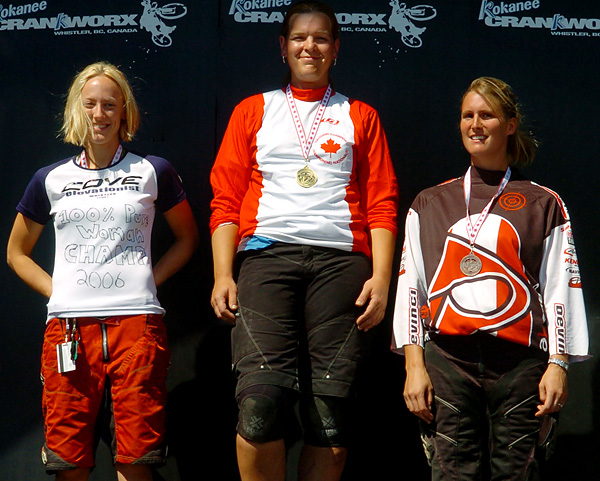
Canadian mountain biker Danika Schroeter has been suspended for three months for inappropriate behaviour at the Canadian downhill championships. The women's title was won by Michelle Dumaresq, her third. Schroeter finished in second place, losing to Dumaresq by one second. For the medal presentation (pictured at right), Schroeter wore a sponsor's white t-shirt with the words "100% Pure Woman Champ 2006" scrawled on the front.

Schroeter's claim of 100% purity might be a bit puzzling if you don't know the back story here, and you might assume that she's making an allegation about doping. But Schroeter isn't claiming to be more virtuous than Dumaresq; she's claiming to be more female. You see, Michelle Dumaresq does not have two X chromosomes. She was born a male, and underwent sex-reassignment surgery (SRS) in 1996.

This is not a secret. The IOC now allows individuals who have had SRS to compete under the reassigned sex under certain circumstances (more on that later). The international governing body for cycling, the UCI, has adopted those same rules for international competitions (including downhill, even though it is not an Olympic discipline). And the Canadian Cycling Association naturally uses the same eligibility criteria as the UCI. Michelle Dumaresq has been open about her sex reassignment since she started competing in 2001, and her participation in women's mountain biking is perfectly legal. In fact, it would almost certainly be illegal to try to stop her.

Dumaresq's story is pretty fascinating, actually, and worth a read. Here's a long piece in Outside Online, describing how she was "discovered" Free-riding in BC in 1999, and her subsequent struggle to gain acceptance from her Canadian rivals. She has also been covered several times in Sports Illustrated, and you can read her story in her own words here. She is also the subject of a recent Canadian documentary film titled (did you guess?) One Hundred Percent Woman.

Of course Dumaresq's openness about her sex reassignment creates an incredibly complex and difficult issue for her competitors. Namely, is it fair that a sex-reassigned female is allowed to compete against athletes who were born women? I talked about it with my wife, who was a varsity rower in university, and her opinion was that Dumaresq's advantages were unfair. I suspect that the majority of female athletes would instinctively agree, and from Schroeter's verbal comments I do not get the sense that she feels more resentment about it than most. Many of Dumaresq's Canadian teammates have been less than warm to her, to say the least. According to those who know Schroeter (including her father), Schroeter and Dumaresq are at least respectful acquaintances, if not friends. By all accounts, Schroeter has struggled with this issue without getting personal, until now.

And, wouldn't you know it, it turns out that there's a 100% Pure Man behind this circus. Schroeter's boyfriend, John Starcevic (also a downhill racer), has confessed to setting Schroeter up in Whistler. After Starcevic posted an apology to "anyone who was offended" on a Canadian Cyclist forum, an editor posted this e-mail he had received from Starcevic. I added the emphasis, and deleted a few irrelevant bits, but the rest of this is 100% Pure manly man:

befor you guys and gals start beaking off about something you know nothing about you should learn the facts. Danika nor her sponsers knew anything of the shirt. If you were there you would have seen that i, a male name:John Starcevic ran on stage and put the shirt on her. I caught her off Gaurd and told her to take off her jersey, when she Questioned me i told her to just do it. I basically betrayed the six years of trust that we had built up. She was extreamly embarrest and angry. I chose to use her to make my stand. it is pathetic how fast people will jump on someone with out knowing the facts. … [more about how Schroeter is being unfairly blamed] … as far as knowlage on Transgenders you read a quote and its the truth to you. What have you done on your own to find info on transgenders. I have gone to see Michelle do her speach on why she chos her path, I have talked to other transgenders with well over half believing what Michelle is doing is wrong. I have also Scedualed appointment and talked to other specialists on the subject most who said they nor anyone else could prove if a transgender had an advantage or a disadvantage. … [tangent about how poorly the Canadian Cycling Association treats the downhill discipline] … I hope you are happy that after all the embarresment i put Danika threw you jumped all over her befor knowing the facts.
Joe Louis and the 100% Pure white heavyweight champion of the world

It seems that Mr. Starcevic has spent a considerable amount of time and effort researching the issue, and he should be commended for that — but I can't help asking myself why he cares so much. It's not like he has to compete against Dumaresq. Except for attention. And as far as making a stand goes, that usually requires putting your own reputation and status at risk. Not your girlfriend's. At any rate, I don't think that this particular act is a valid political statement, although some would like to frame it that way. You play the game in the categories that are provided; you don't get to make up your own categories just so that you can call yourself a champion.

But I'd like to leave this incident behind, and get back to the bigger issue of fairness. The root of the problem here is that the categories we use in sports are binary. Either you're a woman, or you're a man. Real life, unfortunately, doesn't really follow that model.

When I went to the Olympics in 1996, all female competitors had to submit to a gender verification test. A buccal swab was taken from each athlete and subjected to a DNA-based test for detection of Y-chromosomal material. I was struck by the statistics I found in this excellent article about the history of gender verification in sport. In 1996, samples were taken from 3387 female athletes. Eight of those — more than 1 in 500 — "failed" their gender test. All eight of the women were certified as females and permitted to compete at the Olympics. In other words, their gender verification test results were ruled to be false positives.

Seven of these eight women had androgen insensitivity syndrome. I'm not a medical doctor, but from what I understand, a person with Complete Androgen Insensitivity Syndrome (CAIS) is born with normal female external genitalia even though she has XY sex chromosomes. She develops as a female because a mutation in the androgen receptor gene makes her insensitive to the effects of testosterone. There are other medical conditions that can lead a "born female" athlete to test positive for Y chromosomal material, but AIS appears to be the most common.

Jesse Owens and the 100% Pure Aryan Olympic champion

This doesn't have anything to do with Danika Schroeter, really, except to underline the often-ignored fact that it is not trivial to define a test that categorizes everybody as either a woman or a man. A woman with CAIS may have inguinal testes, but her body has no ability to use the testosterone that they produce. Other people have partial AIS, meaning that they have "overmasculinized" external female genitalia, and some people with partial AIS have "undermasculinized" external male genitalia. Michelle Dumaresq went through puberty with testes, but hasn't had them for ten years, and in fact receives the female hormones artificially that Danika Schroeter's body produces naturally.

So what percent pure woman do we assign to all these cases?

Obviously, by 1996 rules, Michelle Dumaresq would test positive for male genetic material in the IOC's gender verification test. But it turns out that 1996 was the last summer Olympic games where gender verification testing was performed. At the end of 2003, an ad-hoc committee convened by the IOC Medical Commission issued a consensus on the issue of sex reassignment and sporting competition. The statement (PDF) and accompanying Expanatory Note (PDF) included the following recommendations:

  • Any individuals undergoing SRS before puberty should be regarded as members of the reassigned sex.
  • Any individuals undergoing SRS after puberty should be eligible for competition as members of the reassigned sex if: surgical changes have been completed, including gonadectomy at least two years ago; legal recognition of the reassigned sex has been granted by the authorities; and hormonal therapy appropriate for the assigned sex has been administered in a verifiable manner and for a sufficient length of time to minimise gender-related advantages.
Mark Tewksbury and the 100% Pure heterosexual Olympic champion

You might read the committee's report and interpret it as an argument that gender-related advantages completely disappear over time — perhaps as short as two years' time. It doesn't really say that, though; it talks about "minimizing" the advantages. Going through puberty as a hormonal male means that boys, on average, grow up bigger and stronger. It also means that they get treated like boys throughout their childhood, which might lead to a big difference in athletic ability as an adult. It seems unlikely to me that either of these advantages is completely erased by SRS.

But even if we admit that Michelle Dumaresq has an advantage over her competitors, so what? The fact is that some humans have physical and psychological advantages over others. Is the unfairness of Dumaresq's advantage so overwhelming that she should be barred from competing against other women? What would be fair to Michelle Dumaresq? As you think about that, consider this: Michelle Dumaresq gets beaten in races all the time. By 100% Pure women. Who were never men. In fact, outside of Canada, she has never been on an international podium. Her best-ever finish in a World Cup downhill was a ninth-place finish in 2005. I would argue that whatever "unfair" advantage she retains from having been a man ten years ago is small compared to the "natural" advantages that all elite athletes have over the general population. I would bet that Danika Schroeter is taller, stronger, and more aggressive than the average woman, too — and that's part of the reason why she's a good downhill racer.

Let's look at this another way. Let's consider SRS as a performance-enhancing method. Would it be banned under the WADA Code? As we know, WADA uses a two-out-of-three criterion for determining whether a substance or method is prohibited. If it is performance-enhancing, then it is prohibited if it is either (a) bad for your health, or (b) contrary to the spirit of sport. SRS, unless it was done specifically for the purpose of joining and winning sporting competitions, doesn't fall into either of these categories.

And even if it was determined that SRS was contrary to the spirit of sport, what would be a just punishment? Just suppose that Michelle Dumaresq had been born a woman, but was given testosterone injections all through puberty and into her twenties. And suppose that she admitted that to the CCA, so that they suspended her for a doping violation. What would happen to her? Well, in two years — an interesting coincidence, no? — she would be eligible for competition again. And she wouldn't be told that she had to race with the men.

August 03, 2006

Fluffy White Stuff

One of Canada's most famous athletes is suing CTV, and it has nothing to do with the broadcast rights for the 2010 Olympics.

Ross Rebagliati, who won an infamous gold medal at the 1998 Winter Olympics, has taken issue with the characters and plotlines in Whistler. One of the characters on the show, which is set in Whistler, BC, is Beck MacKaye, who won the first-ever snowboarding gold medal in Olympic history.

At a press conference announcing the suit, Rebagliati stated that "The similarities between my personality and the central 'Whistler' program character Beck MacKaye are overwhelming and a clear misappropriation."

The executive producer of the show responded that "You know, lots of people ski, lots of people snowboard, a lot of them look the same. That's where it ends."

Mmmm hmmm. I won't pretend to know enough to predict how all this might come out in court (or settlement), and I'm not sure I can see any harm being done to Mr. Rebagliati here, but I will say this: every time I see a promotional spot for Whistler, I think of Ross Rebagliati. Maybe it's just me.

July 27, 2006

Floyd Landis Story Incomplete

By now most sports fans will have heard the news that Floyd Landis tested positive for testosterone after Stage 17 of the Tour de France.

I have a tendency to be long-winded, and I am going to be long-winded again on this subject. But there are two points that should be made up front here:

  • Landis has had a drug test with an abnormal T/E ratio. That is not the same thing as a doping sanction. Regardless of the outcome of the B sample test, Landis may not have violated anti-doping rules.
  • Landis apparently did not test positive with an elevated level of testosterone.

Now, if you want to read some real journalism on this story, skip ESPN and try the Boulder Report

This is not proof of exogenous testosterone

Testosterone is classified as an Endogenous Anabolic Androgenic Steroid (AAS). "Endogenous" substances are those produced naturally in the body. Using exogenous — that is, from outside one's own body — sources is against the rules. Here's the relevant section of the WADA Prohibited List:

Where an [AAS] is capable of being produced endogenously, a Sample will be deemed to contain such a Prohibited Substance where the concentration of such Prohibited Substance or its metabolites or markers and/or any other relevant ratio(s) in the Athlete's Sample so deviates from the range of values normally found in humans that it is unlikely to be consistent with normal endogenous production. A Sample shall not be deemed to contain a Prohibited Substance in any such case where the Athlete proves that the concentration of the Prohibited Substance … is attributable to a physiological or pathological condition.

… When a laboratory has reported a T/E [Testosterone to Epitestosterone] ratio greater than four (4) to one (1) and any reliable analytical method (e.g. IRMS [Isotope Ratio Mass Spectrometer]) applied has not determined the exogenous origin of the substance, further investigation may be conducted by a review of previous tests or by conducting subsequent test(s), in order to determine whether the result is due to a physiological or pathological condition, or has occurred as a consequence of the exogenous origin of a Prohibited Substance. … When an additional reliable analytical method (e.g. IRMS) has not been applied and a minimum of three previous test results are not available, the relevant Anti-Doping Organization shall test the Athlete with no advance notice at least three times within a three-month period. …

Landis' team, sponsored by Phonak, has issued a statement that it received notice Wednesday from the UCI that Landis "showed a disproportionately high ratio of testosterone to epitestosterone." Some sources are reporting the result as a T/E ratio of 11/1. So as noted above, that's step one in the process. Landis will now have his B sample tested. That's quite likely to show exactly the same problem as the A sample. But that is not the end of the story for Landis — it's only step one. The mere presence of an elevated T/E ratio is not enough to confirm a doping offense.

Was Landis' testosterone actually elevated?

It's being widely (although not loudly) reported, including at the Boulder Report article I cited above, that Landis' abnormally high T/E ratio was due to an extremely low level of epitestosterone (small E) and not a high level of testosterone (big T). That might seem like a subtlety, but it's an important fact if it's confirmed. If Landis had a lower-than-normal concentration of testosterone, then he clearly wasn't using that particular prohibited substance, was he? In fact it sounds like Landis has a good chance of proving that his elevated T/E ratio was endogenous in origin. In that case, he'll be exonerated. Of course, his moment of glory already lies in tatters. Which brings me to my third point …

And what happened to due process (again)?

Floyd Landis — and any athlete — deserves better than this. As I noted back here, in 2003 fewer than 15% of A Sample Adverse Analytical findings in cycling led to doping sanctions. We're actually a long way from a doping sanction against Floyd Landis in this case.

So why, given these facts, and the process outlined in WADA's own rules, did the UCI feel that it was a good idea to announce yesterday that an "unidentified rider" had "tested positive?" And why does Dick Pound again feel the need to open his mouth?

The guys who came second, third, fourth, fifth and sixth at last year's event have been busted in the [Spanish investigation], and now the winner of this year's event is busted in the race itself.

Right. Except that Floyd Landis has not yet been "busted" (and neither have the other five riders Pound mentions, but that's another story). It's one thing for the media to jump the gun on this story, and to miss the subtleties of the process still to come — they've got advertising to sell. But shouldn't Dick Pound, the head of the world's anti-doping law enforcement agency, have enough restraint to let due process run its course?

July 07, 2006

Gert Fredriksson, 1919-2006

I once had a Hungarian coach (who I have written about before) who used to teach us about kayaking in his own unique language. As part of that language there was a particular phrase that he used almost as a litany when discussing the historical stars of our sport. Whenever he mentioned the name of one of the greats — Helm, Parfenovich, Barton, Gyulai, Holmann — it was always followed by the responsorial psalm, "You know, he was many times World Champion."

A contemporary of Coach K—'s, Gert Fredriksson of Sweden, died Wednesday at the age of 86.

Gert Fredriksson from www.olympic.org

Fredriksson won six gold, a silver, and a bronze medal in flatwater kayaking over four Olympic games (1948-1960), which makes him the most decorated man in the history of Olympic canoeing. He also won seven World Championships outside of the Olympics. No other man has ever won more than his thirteen combined Olympic and World titles. He holds the unofficial records for the largest margin of victory in any Olympic canoe or kayak race, and for the largest margin of victory in any race that is still contested at the Olympics. When he won his final Olympic championship, he was nearly 41 years old.

Gert Fredriksson, 21 November 1919 - 5 July 2006.

You know, he was many times World Champion.

May 25, 2006

More Blogs by Athletes: A Pair of Skate(r)s

My Google Blog Search RSS feed recently led me to a blog called The Protocol written by US Speed Skater Eva Rodansky. The post I stumbled into was an interesting look at the differences between the very successful US and Canadian Speed Skating programs. Rodansky referred to another speed skating blog, Zen and the Art of Speedskating, written by Andrew Love.

These two blogs, together, offer a fascinating look at speed skating in the US. Neither Rodansky nor Love is a big star in the sport, but both are high-performance skaters. Although the two are friends, their blogs are very different.

Rodansky can barely bring herself to say anything positive about US Speedskating; she wields The Protocol like a weapon against her enemies. Some of it is quite difficult to read — not because it's poorly written (it isn't) but because of her ferocity.

Love's blog is personal in a different way; he is more positive, and more poetic. Here is Love discussing Rodansky's blog.

May 05, 2006

Timed Finals

While I had a few free minutes, I just wanted to point out a new link over on the right under "Other Amateurs." Timed Finals is a blog all about swimming run by two-time Olympic medallist Scott Goldblatt. It's well written, and has interesting material from a unique perspective. (I found it via Light the Torch, which I found through a Google Blog Search RSS feed I subscribe to.)

Scott also has a more personal blog that you can check out. Be warned, though — if you haven't got small kids, you probably won't find much there for you.

April 25, 2006

Organized Sports

Canadian sporting hero Silken Laumann has written a book. I should know better than to judge a book by its press release, but as the father of two kids under five, the headline in the Ottawa Citizen certainly caught my eye: Take your kids out of sports, top rower Silken Laumann says.

Of course, after reading the rest of the article, it seems that Ms. Laumann's position is considerably more nuanced (surprise, surprise). Here's an excerpt from Child's Play:

I am certainly not suggesting that we stop all organized sports and activities, but I am advocating that we pull back in order to create the time for families to be active together. Let's not make physical activity too complicated. Let's rejoice in the fact that our kids want to move and encourage them to jump a little more, wrestle a little more, run outside roaring.

Allow me to superimpose that thought — and the objectives of Laumann's organization, Silken's Active Kids — with some quotes from the Long Term Athlete Development Plan for Rowing, available from Rowing Canada Aviron (draft version here). Here's what Laumann's own "organized sport," and many others across Canada, have to say about young kids and sport:

Stage 1: Active Start
Age: 0 to 6 years
Objective: Learn fundamental movements and link them together into play.
Key Outcomes: Fun and movement skills.
Physical activity should be fun and a natural part of a child’s daily life, not something required.Active play is the way young children are physically active.
Rowing does not have a direct role to play during the Active Start stage other than to support organizations that promote physical activity.

Stage 2: FUNdamentals
Age: females 6 to 8, males 6 to 9
Objective: Learn fundamental movement skills and build overall motor skills.
Key Outcomes: At the end of this stage, children will

  • be competent in the fundamental movement skills.
  • know how to swim.
Skill development in the FUNdamentals stage should be well structured and FUN, with the emphasis on participation. Children should be encouraged to participate in a variety of sports and physical activity in order to develop fundamental movement skills:
  • Agility, Balance, Coordination, and Speed (ABCs)
  • Kinesthetics, Gliding (“run”), Buoyancy, Striking with a body part (KGBs)
  • Running, Jumping,Throwing (RJTs)
  • Catching, Kicking, Striking with an implement (CKs)
In addition, children should learn water safety and how to swim.
Rowing does not have a direct role to play during the FUNdamentals stage other than to support organizations that promote physical activity and the development of fundamental movement skills.

April 14, 2006

Leg Up

I'm not disabled. I just don't have any legs. — Oscar Pistorius, 2005

It's been more than a year since I wrote about South African sprinter Oscar Pistorius. He's in the news again this week, as he prepares to defend his 100 m and 200 m titles at the Visa Paralympic World Cup in May.

Pistorius, you will recall, is missing both of his legs below the knee. His personal best over 400 m, which is also a world record, is 47.34 seconds. That time ranked him fifth in South Africa in 2005 — not fifth among disabled runners, but fifth among all runners.

His goal is to compete in the 2008 Olympics. He figures he needs two seconds of improvement, or maybe a little more, to qualify for the South African team. Now, two seconds is a long way in 400 m; but there are two things working in his favour here. The first is that he is only 19 years old, and the second is that he has only been running since January 2004. It will be interesting to watch his progress over the next few years. It will also be interesting to watch how the IAAF handles his case.

I love photo finishes — there is something that appeals to me about the weird dimensionality of the photos. Because I find them fascinating, and to demonstrate Pistorius' current level, I constructed a composite photo depicting all of the finishers in the men's 400 m at the 2005 World Championships in Helsinki.

Men's 400m, 2005 World Championships (click to enlarge)

The composite includes all seven heats, three semifinals, and the final, although a few of the slowest finishers were not included in the photos. The guy in the red box is Pistorius — based on his personal best 47.34.

(Incidentally, the guy way over there on the right is Jeremy Wariner. He just turned 22.)

February 23, 2006

Olympics.2006.13

Figure 1

Canadian medal prediction, 2006

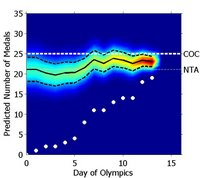
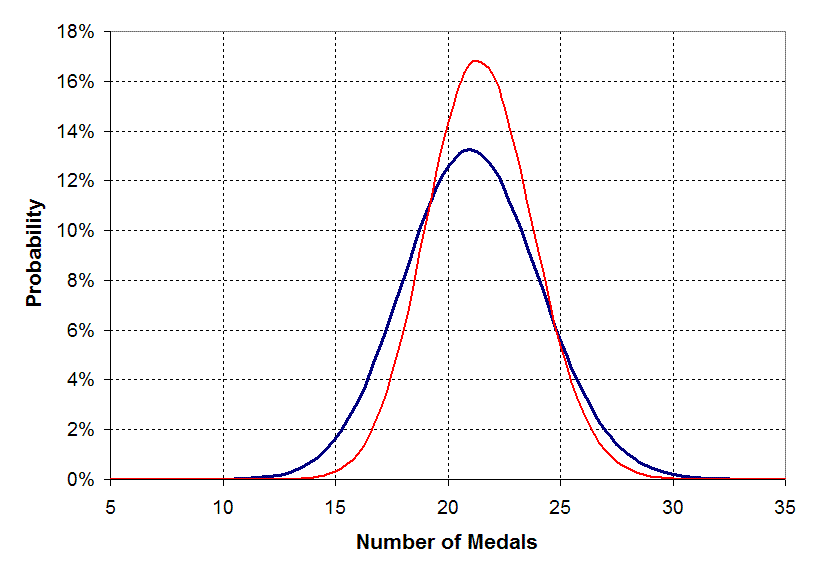
Figure 1 — Updated probability distribution for Canada's 2006 winter Olympic medal total (click to enlarge). Prediction is based on the probability assessment here, updated as events are decided. The probability has already been updated to account for the outcome of the men's curling and men's hockey, as well.

The prediction at the end of Day 13 stands at 23.0±1.3.

Let me make a confession: I do not find all winter Olympic sports equally enthralling. But talking about which winter sports you don't like is pretty dull, so I'll leave that to other people. Instead, let's go back to Day 12. It was a lot more fun.

Short Track

I wanted to make a comment about the women's short track speed skating relay on Day 12. The final was contested by Korea, Canada, China, and Italy. The race was action-packed, with plenty of contact and some aggressive skating by Canada. The Koreans finished first, Canada second, and China third. The Italians hung tough through most of the race, but over the last few laps they dropped away and finished well back in fourth place.

Or did they? Shortly after the conclusion of the race, the Chinese were disqualified for making illegal contact with the Canadians. And at that point, the Italian fans and athletes exploded in celebration.

Seamus from citius altius fortius said that the Italians actually made an appeal for the disqualification; I didn't see that part. But I sure noticed the celebration:

The Azzurri-clad Italian team leapt for joy when the final standings were posted. The crowd serenaded the four skaters with chants of "Italia! Italia!"

Indeed, it was quite a scene, flags waving, skaters jumping, and crowd chanting. Now, I don't have any problem with celebrating a bronze medal performance. In fact, I don't have any problem with celebrating a fourth-place performance. I wish I saw more of that! I don't even object to asking for a disqualification based on a foul that did not affect your performance in any way. Hey, the rules are the rules, and they should apply to everybody.

The Italian team should feel proud of what they accomplished. But there's something unseemly about that vigorous celebration, in my mind. It was clearly only about the medal. They didn't find anything to celebrate in their performance when they thought they had finished fourth, after all. A post-race decision by the officials just should not change your mood that dramatically.

Cross Country

Chandra Crawford is the first Canadian athlete to completely surprise me at the 2006 winter Olympics. Although I predicted that Canada had a good chance at a medal in the women's sprint, I did not expect Crawford to be involved. And in fact, her gold-medal performance looked … well, easy.

Canada's new status as a contender in cross country skiing is pretty remarkable, as well. Crawford becomes the third Canadian woman at these Games, and the third North American woman ever to win a medal in cross country skiing.

Speed Skating

Seamus has called Cindy Klassen's win in the women's 1500 m his "performance of the games." I don't have too much to add, except to point out the splits. In contrast with Enrico Fabris in the men's race, Klassen was second at 300 m, first after 700 m, first after 1100 m, and first at the finish. That strategy has not been a successful one at the Turin oval so far, which makes Klassen's race even more remarkable.

Hockey Post-Mortem

There will be tens of thousands of words written about the failure of the Canadian men's hockey team at these Olympics. I could add a few thousand of my own, but I am not sure that I have anything original or very informed to say. In this, I am only a fan. There are very few things in sports that can still make me feel joy or despair; the Canadian Olympic hockey team is one of them.

Very Canadian of You

Speaking of sports and national identity, see if you can name that country:

________ newspapers turned against their Olympic team on Thursday after another string of disappointments pushed the Nordic country toward their worst Winter Games in 18 years.

February 21, 2006

Olympics.2006.11

Figure 1

Canadian medal prediction, 2006

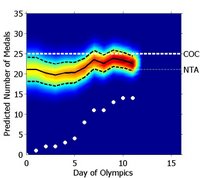
Figure 1 — Updated probability distribution for Canada's 2006 winter Olympic medal total (click to enlarge). Prediction is based on the probability assessment here, updated as events are decided.

Things You Shouldn't Say …

… when contemplating the possibility of winning your next hockey game in the qualifying round:

And of course, it is the question: Shall we win [and face Canada in the quarter-finals] or shall we play a good game to get a 0-0 result [and face Switzerland]? There are many questions going through our heads right now. — Bengt-Ake Gustafsson

… after being beaten once:

You know I always say that you can beat Chad Hedrick once but you can't beat him twice — Chad Hedrick

… after being beaten for the third time:

I would say, if you re-ran the race it would be a 90-95 per cent chance that Shani or I was gonna win the race … — Chad Hedrick

… at a post-race press conference with your teammate and rival:

I'm just throwing it out there. It would have been nice if after I won the 1,000-meter race, he could have been a good teammate and shook my hand, just like I shook his hand — and hugged him — after he won the 5,000 meters. — Shani Davis

And Speaking of that Race …

I will admit it, I am kind of enjoying the rivalry between Davis and Hedrick. Hedrick is a very, very bad loser, and Davis is a very, very bad winner, but at least there is nothing at all phony about them. And they are both very gifted athletes, so I can forgive them, as long as I don't have to live with either one of them.

However, it would be remiss not to make a point about the performance of gold medallist Enrico Fabris from Italy. Check out these splits. Fabris was 25th at the 300 m mark, 23rd at 700 m, 11th at 1100 m, and first at the finish. His last three laps went 26.68, 27.14, and 27.73 seconds. He covered each of the last two laps faster than any other competitor. On the last lap he was almost nine-tenths of a second faster than the nearest skater.

On the opposite side of the coin was the third American skater, who finished ninth. Joey Cheek was "livin' the dream," as an old coach used to say — he led at 300 m, 700 m, and 1100 m, before somebody threw a piano on his back and he finished up with a 30.67-second lap. That last lap was the sixth-slowest put up by any of the 39 competitors — and he gave up almost three full seconds to Enrico Fabris.

February 20, 2006

Olympics.2006.10

Figure 1

Canadian medal prediction, 2006

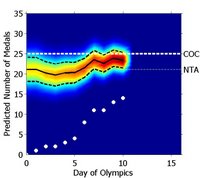
Figure 1 — Updated probability distribution for Canada's 2006 winter Olympic medal total (click to enlarge). Prediction is based on the probability assessment here, updated as events are decided.

A "Horrible" Day in Alpine Skiing

When the 2006 Olympics started, I was thinking that I would include a snarky "Brian Williams" feature in each day's post, highlighting the inaccurate or infuriating claims that the CBC's Williams made each day.

I really am not a fan.

Fortunately for everybody, Williams has actually been pretty well-behaved, and I haven't had much material to work with. There was a pretty funny incident involving Mr. Williams' tongue — I wish I had a picture, but I don't — but he actually handled that one pretty well.

Then Williams apparently made a reference to "Bad, Bad, Leroy Brown" after Shani Davis won his gold medal. I didn't actually see that, so I couldn't really say much. L-Girl took care of it, though.

Tonight, though, Williams got me all revved up in his discussion of the results in alpine skiing. "There's no way to sugarcoat this — a horrible day for Canada," was how he put it. And in typical Williams style, he said it more than once, just to get his point across.

Let's see. In the men's Giant Slalom, 21-year-old Francois Bourque finished fourth, behind Benjamin Raich (eight-time GS World Cup winner), Joel Chenal, and Hermann Maier (14-time GS World Cup winner and reigning GS world champion). Thomas Grandi finished tenth.

In the women's Super-G, 23-year-old Kelly VanderBeek finished fourth, behind Michaela Dorfmeister (most gold medals in Olympic alpine skiing history), Janica Kostelic (most medals for a woman in Olympic alpine skiing history), and Alexandra Meissnitzer. Emily Brydon finished ninth.

How embarrassing for Alpine Canada! How can they live with themselves? Chokers.

Justice for Sami Jo!

Now on a positive note, I did learn something interesting from the CBC broadcast tonight. Williams had Geraldine Heaney on to talk about the Olympic champion Canadian women's hockey team. Heaney went out of her way to point out the positive role played by my acquaintance close personal friend Sami Jo Small. Heaney noted that Sami Jo, as the alternate (third) goalkeeper, will not get a gold medal — which I knew — but she then added that in men's hockey, the alternate goalkeepers do get medals.

I don't know if there is anything that anybody can actually do about that, at this stage; Heaney encouraged Williams to bring it up with Don Cherry when he is on tomorrow night, but I don't know if Don has that much pull with the IIHF. And I have considerably less, to put it mildly. However, I will put the full power of this blog behind any effort to get Sami Jo a gold medal, even if it means an alliance with Don Cherry.

More Serious News

Of course there is a major doping story going on in Turin, and I am going to comment on that at some point. It seems that we have come to a frightening crossroads in the "war" against doping, and I am not sure that everybody has carefully thought that through. To be honest, I haven't had time to do it justice, and the news is still breaking so fast that I have struggled to write something that contains the essence of the story. But it does need to be discussed, and I'm not ignoring it.

February 16, 2006

Olympics.2006.06

Updated Predictions

Canadian medal prediction, 2006 -- Updated 16 February

Figure 1 — Probability distribution for Canada's 2006 winter Olympic medal total (updated).

I am only really writing this blog post so that I can display my latest prediction for Canada's medal total (inset right). Note that I am not changing my original prediction; I'm just updating the probabilities for events where the medals have already been decided. That changes the probability distribution every day.

In case you are wondering, no, I am not obsessed with the medal table, or with Canadian performances. After all, the Olympic Games are competitions between athletes in individual or team events and not between countries. (If it's in the rules, it must be true.) No, I am actually obsessed with my own predictions, which is a different personality problem entirely.

As long as I'm using up valuable time when I could be sleeping, I should have pointed out yesterday that US speed skater Chad Hedrick will definitely not win five gold medals in Turin, since the Americans were eliminated in the quarterfinals of the men's team pursuit. To be charitable I will point out that they were beaten by the eventual gold medallists.

The US did not have their best skaters available, which is a matter of some controversy. That's not what I want to talk about here. I am more interested in the ease with which everybody seems to have swallowed the five-medal hype in the first place. Is it really possible for a speed skater to win five gold medals at the Olympics any more? And if it is, doesn't that show that the depth of the field is pretty poor?

Hedrick is still predicting that he will win the 1,000, 1,500, 5,000, and 10,000 m events at the Olympics. He has already won the 5,000, actually, so only three more to go. But that sweep looks humanly impossible to me. The 1,000 m race will be won with a time of about 70 seconds. The 10,000 m race will take Hedrick in the ballpark of 13 minutes. To compare that to running, it equates roughly to the 800 m (or a 600 m, if that was an event) and the 5,000 m. In swimming, it would be about the same as pairing the 200 m (or 150 m) and 1,500 m.

But in swimming and running, those doubles simply cannot be done. Evenly the freakishly gifted Ian Thorpe has never done it at the world championships or Olympics. Sure, he's won at 200, 400, and 800; but extending or contracting that distance requires completely different (and mutually competing) physiological systems. In running, forget about it; nobody even enters the 800 and the 5,000. I feel pretty safe in saying that in this modern age of highly specialized athletes, It Cannot Be Done. Nobody is ever going to be world or Olympic swimming champion in the 200 m and 1,500 m simultaneously. Nobody is ever going to be world or Olympic athletics champion in the 800 m and 5,000 m simultaneously. And nobody is going to be world or Olympic speed skating champion in the 1,000 m and 10,000 m simultaneously, either. The fact that Hedrick is even competitive in both distances makes him almost superhuman.

And yes, I know that Eric Heiden did it. In fact, Heiden's five-gold feat was even more astounding than the one Hedrick was shooting for, since he won the 500 m instead of the team pursuit. But that was twenty-six years ago! Speed skaters still raced outside! Human physiology hasn't changed, but the level of competition has. I think. The fact that people seriously entertain the idea that Hedrick can do this gives me pause. Maybe he really can do it. But if he does, it will just show me that the world's speed skating talent pool is actually pretty shallow.

February 14, 2006

Olympics.2006.04

Updated Predictions

Canadian medal prediction, 2006 -- Updated 13 February

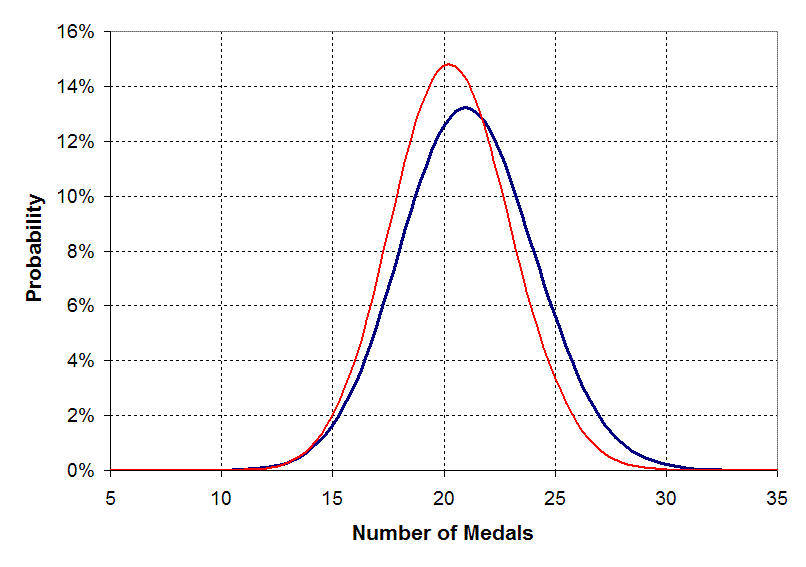
Figure 1 — Probability distribution for Canada's 2006 winter Olympic medal total.

Either you've been ignoring me for the last week, or you know the drill. The blue curve shows my original (a priori) prediction, and the red curve shows the current prediction, accounting for events that have already happened.

The team sprint medal today brings my expected number of Canadian medals back up to 20.4.

Joey Cheek Acts

American speed skating gold medallist Joey Cheek has pledged to donate his $25,000 reward from the USOC to Right to Play. The money will be earmarked for children in the Darfur region of Sudan, where hundreds of thousands of people have been killed, and millions displaced, by war and genocide.

I have discussed athlete activism here before and in my opinion this fits the bill. It is not a protest, I admit, since Cheeks is risking very little (only a few xenophobic patriots will question his actions). However, an act meant to help others and right a wrong is still an act, even if it is uncontroversial.

I ♥ Cross Country

Canada's result of the day was also the race of the day, in my opinion (although the men's alpine combined also had plenty of drama). Cross country skiers Sara Renner and Beckie Scott raced very aggressively in the women's team sprint, pushing the pace at every opportunity. Renner broke a pole on an uphill during her second leg in the alternating relay format; she took a spare from a sportsmanlike Norwegian coach, and then got the right replacement at the bottom of the hill. Renner becomes only the second North American woman to win an Olympic medal in cross country skiing. The Norwegians finished fourth in the race.

I just have to add that the cross country skiing has been the most enjoyable sport at the Olympics to watch. I'm fond of speed skating, and alpine skiing, but I am loving the head-to-head racing in cross country; it's a great combination of physical prowess and strategy.

Blogs of Note

Today I stumbled upon a very well-done blog about the Olympics at Eurosport.com called citius altius fortius. The blog began just before the 2006 Olympics, but the author plans to keep it going afterward. In general I have not been terribly impressed by many of the blogs dedicated to the Torino Olympics, but this is a good one. The golden (retriever) predictions are worth the effort, just by themselves.

I also found out today about the resurrection of DFL, a blog that got quite a lot of publicity during the Athens Olympics; I did not expect it to reappear, but I am glad that it did. DFL's motto is "Celebrating last-place finishes at the Olympics. Because they're there, and you're not." Celebrating last-place finishes is a dangerous game; it would be easy to fall into mockery or unjustified glorification. Author Jonathan Crowe keeps things in the right perspective.

January 12, 2006

Battling Bode Miller

Outspoken American alpine star Bode Miller has been in the news again, after an interview on 60 Minutes where he confessed to skiing while drunk.

Talk about a hard challenge right there … If you ever tried to ski when you're wasted, it's not easy. Try and ski a slalom when … you hit a gate less than every one second, so it's risky. You're putting your life at risk. … It's like driving drunk, only there are no rules about it in ski racing.

Miller's comments have created quite an uproar — even more than when he argued that everybody should just chill out about doping. Bill Marolt, president of the US alpine ski federation (USSSA), has called the remarks "unacceptable," the FIS is ordering the American federation to keep him quiet, and the USOC is distancing itself from Miller as quickly as they can.

So what did Miller do that's so wrong? It can't be that he showed up for training under the influence. Chad Hedrick has a reputation for training while drunk, and nobody seems very upset about that. And frankly, I don't think it's that uncommon for athletes to do it on occasion. During my athlete days, I showed up hungover at morning practice a time or two. Is there an unwritten "don't ask, don't tell" policy on alcohol? Is it OK to drink and train, but not OK to admit it?

Or maybe this is just about rules. If Miller is admitting to racing while drunk — and I can't figure out whether he's admitting it or not — then he's been breaking some very serious rules, despite his claims that those rules don't exist. The 2005 Prohibited List published by WADA specifically states that alcohol is banned in-competition in skiing. That is, on the basis of a blood alcohol level exceeding 0.10 g/L, as measured by breath or blood analysis, an athlete could be disqualified from an FIS event.

(And if he has admitted to racing while drunk, will WADA come after him? After all, Tim Montgomery and Chryste Gains were suspended on the basis of an admission attested to by a single eyewitness; surely Miller's confession on network television would stand up at least as well. The ground-breaking aspect of the case would be that alcohol is only prohibited above a certain level, unlike steroids, which are prohibited at any level. A non-analytical positive will be more difficult to prove.)

But I don't think the reaction to Miller's comments is about the possibility that he may have broken FIS rules. And I don't think that it's even about drinking per se. I think what has upset people is the self-destructiveness of it. "You're putting your life at risk. It's like driving drunk, only there are no rules about it." Miller is showing us something dark about himself here, and it's not a comfortable view. Maybe Bode Miller is the kind of thrill-seeker for whom the rush of a ski race isn't quite enough. Maybe Bode Miller has a little too much in common with Bill Johnson.

Miller has since apologized for — but not retracted — his comments after a discussion with Marolt. Here's hoping that their discussion was at least a little bit about Bode Miller and his demons, and not just about the USSSA's donors and sponsors.

POSTSCRIPT I was laid up with the flu last weekend, and I missed the Ultimate Olympian's column on this issue over at SportsFilter. It's worth a read.

POSTSCRIPT I missed this — Miller wrote a special to the Denver Post where he describes the events in detail. Short version: he raced hungover, which is "a form of impairment," but not drunk. Thanks to lil brown bat at SportsFilter for pointing it out.