Showing posts with label Media. Show all posts

February 14, 2010

Svein Tuft of the Day - Day 1

I've decided, inspired by my friends who are with the Canadian team in Vancouver and Whistler, to take a daily detour from obsessing about math and medal counts. Welcome to the first installment of the Team Canada Svein Tuft of the Day.

I know that some of you are thinking, "What the hell is a Svein Tuft?" Well, if you're a Canadian sports fan, you should already know that, but you probably don't. I can only change that situation for the few of you who read this blog, but I'm going to do my best.

Let me go back in time to day 5 of the 2008 Olympic Games in Beijing. For 2008, the Canadian team had set a goal of finishing in the Top 16 countries as measured by total number of medals won. By Day 5, no Canadian had won a medal, and the Canadian media had started to mention that fact prominently in almost every team story.

Svein Tuft was a member of Canada's Olympic road cycling team, competing on Day 5 in the Men's Road Time Trial. The Canadian men's cycling team is a relatively unheralded group, especially in the road discipline, which includes many of Europe's highest-profile athletes. Tuft had an early start number in Beijing. He posted the fastest time and was the leader of the race for most of the event, as he watched the best in the world fail to beat him. He eventually finished seventh, just ahead of three-time world champion Michael Rogers. (Tuft later won a silver medal in the same event at the 2008 World Championships.)

Tuft's achievement, in a time where Canadians were searching for positive Olympic stories, deserved a celebration. Unfortunately, he didn't get it. A couple of hours after the road time trial finished, Sherraine Schalm was eliminated in the first round of an event where she was expected to contend for a medal. Even better for the media, the elimination came with more than a little spectacle. Tuft, who was on his way to a CBC television interview when the Schalm story broke, never had a chance.

Canada went two more days without a medal, and our team spirit survived the negative press; eventually Canada won 18 medals, our best Summer Games total since 1996, and good enough (so far) for thirteenth place. In case you think I'm exaggerating about the media coverage from Beijing, note the following quote from that CanWest News story about Schalm's result:

The latest Canadian to fail to live up to expectations in Beijing, Schalm indicated she'd be able to tune out the criticism about to coming the way of her and other athletes who've come up short here.

I think we're in danger of entering a similar time period in the 2010 Olympic games. Last night, Jennifer Heil won Canada's first medal, but we all know that Jennifer Heil was hoping for gold. And Canada has very high expectations this year, at home, so every setback is going to be examined with even more angst than usual. When we're all concentrating on the podium, it's easy for each day's small successes to get lost. For what it's worth, I'm going to do my small part to make sure that doesn't happen.

I want to finish this introduction by making a couple of things clear. First of all, I'm a big supporter of the Own the Podium program. I think it's important to say, out loud, what you want to achieve. I don't believe it is somehow un-Canadian to want to win.

Second, the Svein Tuft of the Day is not going to be about celebrating mediocrity. I don't believe that the Olympic spirit is best exemplified by the overmatched or the underprepared. Svein Tuft was a great Canadian athlete who had a great day on the world's biggest stage. That day didn't include a medal, but it should have been noticed. Maybe Randy Starkman put it best, when he challenged us all:

Are you really behind this unique group of athletes about to lay it on the line? Or are you only behind them gold, silver or bronze?

This year, I'm getting behind the team from the comfort of my couch, and I'll be cheering loudly for all the medallists; but I'm also going to do my best to notice the unnoticed victories each day.

February 13: Chloe Dufour-Laplante

The women's moguls competition at Cypress last night — held in atrociously bad weather conditions — was full of successes for Canada. Jennifer Heil skied well and was narrowly beaten by a great performance. Kristi Richards reached for the medal that was within her grasp, and just crossed over the edge.

If you're Canadian and you've been reading about the 2010 Olympics this morning, you've heard all about Heil. But my Svein Tuft for Saturday is Canada's third qualifier for the women's moguls final, Chloe Dufour-Laplante. Dufour-Laplante entered the Olympics ranked eleventh in the 2010 World Cup and third on her own team. She placed ninth in qualification.

In the final, she was dazzling. She finished fifth.

I just can't realize it right now, I'm so full of emotion. I did amazing and I'm so happy. It was really a good long way to come here.

Dufour-Lapointe, who lists Jennifer Heil as one of her heros, has earned one World Cup medal in her career, and none this season. She will turn 19 in December.

August 03, 2006

Fluffy White Stuff

One of Canada's most famous athletes is suing CTV, and it has nothing to do with the broadcast rights for the 2010 Olympics.

Ross Rebagliati, who won an infamous gold medal at the 1998 Winter Olympics, has taken issue with the characters and plotlines in Whistler. One of the characters on the show, which is set in Whistler, BC, is Beck MacKaye, who won the first-ever snowboarding gold medal in Olympic history.

At a press conference announcing the suit, Rebagliati stated that "The similarities between my personality and the central 'Whistler' program character Beck MacKaye are overwhelming and a clear misappropriation."

The executive producer of the show responded that "You know, lots of people ski, lots of people snowboard, a lot of them look the same. That's where it ends."

Mmmm hmmm. I won't pretend to know enough to predict how all this might come out in court (or settlement), and I'm not sure I can see any harm being done to Mr. Rebagliati here, but I will say this: every time I see a promotional spot for Whistler, I think of Ross Rebagliati. Maybe it's just me.

July 05, 2006

Brian Williams Leaves CBC Sports

This story is a few weeks old, and L-girl already brought it up in the comments back here, but I thought I'd better mention it. Brian Willams* has left CBC Sports. Williams is now working for Rogers/CTV, who have the rights to the Canadian Olympic broadcasts for 2010 and 2012.

(*Note to American readers: I don't mean this guy.)

So, short-term good news: we won't have Brian Williams to kick around in 2008 (which is still a CBC property). OK, that's not really fair. I know that lots of people really like Brian Williams, and his absence will be seen as a loss for CBC Sports. He's just not my cup of tea.

Just like when Chris Cuthbert left, there's gossip going around that CBC Sports boss Nancy Lee didn't handle the situation with the utmost of delicacy. In this case I'm not sure many bosses would have done differently — Williams had, after all, already accepted a job with CTV when he was fired.

As long as we're talking about CBC Sports, I'll mention the Final Report on the Canadian News Media, authored by the Standing Senate Committee on Transport and Communication. The Standing Committee has recommended, among other things, that CBC should get out of the business of broadcasting professional sports and the Olympics:

This Committee believes that the CBC should greatly reduce its broadcasting of professional sports (e.g., hockey games) and the Olympics since these are activities that will be covered by other broadcasters in both official languages. In addition, broadcasts of professional sports are readily available everywhere in Canada via cable and satellite.

Sport is, of course, part of Canadian culture. Professional sports are increasingly carried by specialty channels and this trend will continue. This tendency, evident in the United States, is also occurring in Canada. It has already had an impact on the CBC French language service, which has lost its rights to NHL hockey to a specialty channel (RDS). Similarly, the CBC lost its bid for the 2010 and 2012 Olympics. In the near future, the CBC may well lose the English-language rights for the NHL to a private sector service. This reality needs to be recognized and dealt with in a way that does not interfere with the mandate of Canada’s national public broadcaster.

I should point out that the committee has also recommended that the government provide "realistic and stable funding" on a "long-term basis," with the goal of removing advertising from CBC Television. I suppose that in the fantasy land where this funding recommendation comes true, getting out of the revenue-generating sports business might be good for Canadian sport as a whole. It would probably mean more exposure for lower-profile sports, and support for projects that only a public broadcaster can do. That exposure — subsidized by the Canadian taxpayer — would indirectly lead to more private-sector revenue for amateur sport.

I found the link to the report via The Tea Makers, a good blog written by an anonymous CBC employee. Ouimet supports the concept of cutting sports, but argues that the private broadcasters should be the ones paying to keep the CBC out of the competition.

As a big fan of the Olympics, I'd be sorry to see the CBC stop bidding. In my experience, they do a better job of covering the Games than any private broadcaster I have seen. But that doesn't mean, necessarily, that CTV or some other private entity couldn't do a good job. They just haven't shown it so far, and I'm not sure why that is. Maybe part of the answer is that CBC Sports just has more expertise, developed through years of experience. If CBC Sports really got out of the business, then a lot of talented people — on-screen and off — would migrate to the private broadcasters eventually.

It's kind of amusing, though, to read suggestions that CBC should get out of the hockey business. Even if they didn't have the NHL or the winter Olympics, hockey is just too much part of Canadian culture for the CBC to ignore. We still might end up with a program lineup entirely and completely dedicated to shows about hockey.

June 18, 2006

The Times of Finals

There's an international uproar brewing over the schedule of events in Beijing in 2008. You may have read about it at Timed Finals, where Scott Goldblatt has been doing an excellent job following the story and laying out the issues.

The outline of the story is this: NBC has suggested that the finals in swimming (and perhaps a number of other high-profile events) should be rescheduled from late afternoon to early morning. That would mean that they could be broadcast live in United States primetime, meaning a bigger audience and more advertising revenue for NBC.

As Scott also reported, a few Australian sources are today stating that this is a done deal — the IOC is "set to announce" that the swimming schedule in Beijing will be modified in accordance with NBC's request.

My prediction is that this announcement will not materialize, at least not for a week or so. That's because the IOC Executive Board meeting doesn't start until Wednesday, and concludes on Friday. It's possible that the Board has made a decision already, or that sources inside the IOC already know how it's going to turn out, but the stories I have read are not all that convincing. My guess is that the decision has not yet been made, and statements to the contrary are just speculation fueled by outrage at the possibility.

But let's back up a few steps. First of all, who really has jurisdiction over the scheduling of competitions? The Olympic Charter, Rule 49, deals with the Technical responsibilities of the IFs [International Federations] at the Olympic Games:

1. Each IF is responsible for the technical control and direction of its sport at the Olympic Games; all elements of the competitions, including the schedule, field of play, training sites and all equipment must comply with its rules. For all these technical arrangements, the OCOG [local organizing committee] must consult the relevant IFs. The holding of all events in each sport is placed under the direct responsibility of the IF concerned.

2. The OCOG must ensure that the various Olympic sports are treated and integrated equitably.

3. As to the schedule and daily timetable of events, the final decision lies with the IOC Executive Board.

Rule 49 starts out giving all responsibility for the technical arrangements to the IF (meaning FINA, in this case). Of course, it makes a lot of sense to let FINA set the competition schedule, since their resident technical committees have much more sport-specific expertise than BOCOG or the IOC. On top of that, though, somebody has to be responsible for rationalizing the schedules for all the sports — allocating days to sports, avoiding venue conflicts, and even making minor schedule adjustments to ensure that concurrent finals are avoided as much as possible. My reading of the intent of Rule 49 is that this is the responsibility given to the IOC Executive; not overhauling the daily schedule, but making sure that the swimming schedule as defined by FINA fits within the overall Games programme.

However, the letter of Rule 49 clearly gives the Executive the power to modify the FINA-sanctioned competition schedule as dramatically as they want to, and for any reason they choose, even if that modification has a significant impact on the athletic competition.

I don't really have an opinion on whether swimming a final in the morning is better or worse than swimming a final in the afternoon, or whether it gives anybody a particular advantage. I'll defer to Scott and the other experts on that question. However, there is no doubt that this change will have an impact on the competition.

In many Olympic swimming events, athletes have to compete in event finals on the same day as heats or semi-finals. Rescheduling finals to the morning, therefore, means reshuffling an already-crowded schedule, and will lead to new and unanticipated conflicts. Some swimmers who compete in multiple events will now be faced with the prospect of racing a flat-out personal best in the morning — and then turning around to race in qualifying heats later that same day. This is not a big issue for the superstars, who cruise through the advancement anyway, but will have an effect on athletes who need their best performances just to reach the finals.

At any rate, I am not qualified to decide whether racing finals in the morning instead of the afternoon is a good thing or not — but the IOC Executive members are not qualified, either, and certainly NBC Sports executives are not. I agree with Scott and most of the people who are covering this story that modifying the competition schedule to suit NBC is a bad idea.

Of course NBC has a lot of influence with the IOC, and there is no getting around that. The US television broadcasters pay enormous sums to the IOC for the rights to broadcast the Olympic games. NBC paid more than $3.5 billion for the rights to the 2000, 2002, 2004, 2006, and 2008 games; they added another $2 billion for 2010 and 2012. That's somewhere between half and two-thirds of the money that the IOC takes in for TV and multimedia rights. It's not surprising that NBC's opinions and requests carry a great deal of weight with the IOC.

NBC might also have a legitimate feeling that they overpaid for the 2008 contract. An oddity of the bid process, as I pointed out before, is that the IOC tenders the Olympic broadcast rights before the bidders know the identity of the host city. NBC signed the contract for the 2008 games sometime in 1998. Beijing was not selected as host city until 2001. The heads of NBC Sports know that the Beijing Olympics will not be as lucrative as, say, a Toronto Olympics, because the time differences will mean a lot of tape-delayed broadcasts. I don't think it's surprising or unethical that they are trying to use their financial power to make the best (for them) of a bad situation.

It's interesting, though, to ask yourself this: why does the IOC sell television rights before selecting a host city? This article proposes one answer:

Neal Pilson, a former CBS Sports president who advised the IOC on this year's rights deals, says that … "The decision [on the host city] is made on the merits, not based on U.S. television interests. … The reason why bidding took place before the selections was to take that factor (US television money) out of the games selection process."

In other words, the IOC doesn't want the IOC delegates selecting the host city to be swayed by the potential impact on broadcast revenue. They get NBC to sign on the dotted line first, and then ask the delegates to select the host city "on the merits."

That's all very noble and everything, and if I believed that the host city election was an important IOC function with some kind of integrity that needed protecting, then I guess it would be a good idea to keep NBC out of it.

It turns out that I don't believe any such thing. But putting my own views aside for now, let's think about the logic of this situation. In order to limit NBC's influence on the host city election, the IOC forces them to bid on the 2008 Olympics without knowing where they will be held. Then the IOC chooses Beijing, which has the completely predictable outcome of making NBC unhappy. So to make NBC slightly less unhappy, they're willing to allow some influence on the schedule of the competition.

So in other words, although it would be wrong to let NBC influence the selection of the host city, it's OK to let NBC influence the sporting competition itself.

Does that seem backwards to anybody else?

April 07, 2006

More Money In

More from the IOC Executive Board meeting: the IOC expects to bring in more and more money for the rights to broadcast the Olympics:

The IOC's Asian negotiations come after the conclusion of negotiations with U.S. and European broadcasters, who Carrion says paid rates more than 30 percent higher for the 2010 and 2012 games than they did in previous contracts. … The amounts the IOC pulls in keep climbing. Even without the Asian markets, TV rights sales so far for the 2010 and 2012 Games have exceeded $2.9 billion, eclipsing the $2.5 billion for the Turin Games and Beijing Games.

On the surface, the most surprising revelation here is that NBC agreed to pay $2 Billion for the US broadcast rights, a 35 percent increase over what they paid for 2006/2008. It was widely reported that NBC did very poorly on their ratings for the 2006 coverage. So what would make them up their bid this much?

First, of course, NBC will be hoping to make most of its money back on the summer Olympics, not the winter Olympics, so the bad ratings for the winter Olympics aren't necessarily critical. Second, the negotiated rights aren't just for television; they include internet multimedia, too, and NBC saw record traffic on their web site in February.

A little research, though, reveals the real reason for the disconnect: NBC made their bid for 2010/2012 long before the 2006 Games — in fact, even before they knew the identity of the 2010 or 2012 host cities!

So the offer from NBC reflected their best guess at potential advertising revenue more than two years ago. If the 2006 ratings indicate a real decrease in viewer interest, it will be a couple of years before we see the impact on the bid price.

As for the rising IOC revenues, the increase from US rights accounts for half a billion dollars of the bump. Even discounting that, it looks like the price for worldwide broadcast rights will show a significant increase over the four-year cycle.

March 18, 2006

In Spectacular Fashion (take our word for it)

It isn't too often these days that Canada enters an ice hockey game as a decided underdog. But that happened today in the sledge hockey gold medal game at the Paralympics. Canada took on top-ranked and defending Paralympic champions Norway, and defeated them 3-0. It is Canada's first ever Paralympic gold in hockey.

I can't really make any personal observations on this one, since I had no opportunity to watch; the CBC coverage in the Maritimes has been extremely sparse. I see from the broadcast schedule that there will be Paralympic coverage on three Saturdays in April, so maybe I'll see a condensed version of the game then.

March 17, 2006

Let's Pretend It's All About Sport

RICK HANSEN: "My dream back [at the 1984 summer Olympics] was that one day our athletes with a disability would have equal recognition. Today, as Canada's best competes at the ninth Paralympic Winter Games that dream remains unfulfilled. My challenge to Canadians is to see our team and indeed all the participants recognized as athletes first."

MARY ORMSBY: "You can't force people to care. You can't guilt them into cheering for athletes in sports for which they have no passion. Otherwise, we'd spend all our leisure time watching cricket and precision skating and ringette."

AMATEUR: Mr. Hansen, did you get that? We Canadians have no passion for skiing, curling, or hockey. Please stop trying to force us to care. (Also, apparently somebody is trying to make me feel guilty about not watching cricket. If it's you, please stop that also.)

MR. HANSEN: "In many ways, our acceptance of our athletes with a disability have broader socio-cultural implications, reflecting our acceptance of people with a disability in the offices, factories and boardrooms of our nation. Certainly more must be done before true equality is achieved. However, great strides have been made."

MS. ORMSBY: "There's no conspiracy. There's no deliberate attempt to ignore the country's disabled in Italy while more compelling news, such as the Maple Leafs' playoff battle, dominates sports coverage."

AMATEUR: I know, I'm totally pumped about the fact that the Leafs are going to miss the playoffs. But, uh, Mr. Hansen didn't actually say anything about a conspiracy. I like your straw man, though.

MS. ORMSBY: "These Games do not have the same worldwide involvement as the Olympics in numbers of countries and participants and therefore its heft as an event of true international scope and gravitas is diminished. There are 486 Paralympians from 39 countries in Turin, while more than 2,500 athletes from 84 nations attended the Olympics."

AMATEUR: Oh yeah, I can see your point. I knew there must be a logical reason that the Paralympics don't get more attention: not enough international scope and gravitas. And it also explains why the world junior hockey championship tournament is such a washout with Canadian audiences: there were only ten countries, and fewer than 250 athletes! No wonder those poor kids never get any credit for their success.

MS. ORMSBY: "In addition, events are divided into separate categories, a layered approach making it difficult to figure who's the true champion — is it the blind skier or the standing class skier? Or the sitting class skier?"

AMATEUR: I hate that, when you've got a layered approach that makes it difficult to figure out who's the true champion. Like the BCS system in US college football. That's a total audience killer, isn't it?

MS. ORMSBY: "Disabled sport in general also suffers from a dearth of competition. The best example of this is the remarkable success of Canadian wheelchair athlete Chantal Petitclerc. At 36 years old — an age when many athletes' best days are behind them — Petitclerc currently holds every world record from the 100 metres to the 1,500, strongly suggesting her competitive fields are shallow."

AMATEUR: FactualPS and analytical — I'm starting to like you more. Unfortunately, these facts are irrelevant to the argument! Ice hockey also suffers a dearth of competition compared to, say, soccer. A couple of years ago Canada simultaneously held the titles of men's Olympic champion, women's Olympic champion, men's world champion, women's world champion, men's junior world champion — and probably two or three more that I'm not even aware of. Think that could happen in soccer? Think again. And yet, Canadians as a group would rather watch hockey! Funny, isn't it?

MR. HANSEN: "When I participated in Los Angeles I wanted to prove to myself and to the world that being in a wheelchair would not limit my ability to achieve my goals. Today, our Paralympic athletes will once again prove that anything is possible when you believe in a dream. I would urge all Canadians that as our Paralympic athletes capture medals in Turin, their achievements are celebrated with the same kind of enthusiasm afforded to Cindy Klassen and others."

MS. ORMSBY: "Rick Hansen believes that Canadians are wrong not to embrace every Paralympic medallist with the same fervour accorded speed skater Cindy Klassen because that prevents athletes with disabilities achieving 'equal recognition.' But that philosophical stand confuses crusading for the cause with logic. You cannot create the illusion that the Paralympics are on par with the Olympics and suggest that not believing this constitutes prejudice."

AMATEUR: I don't think Mr. Hansen is the one who is confused. We're talking about sports fandom here; how does logic enter into the discussion? It's easy to prove that the Paralympics are not "on par with" the Olympics; I can similarly prove that the Winter Olympics are not "on par with" the Summer Olympics, and that the NCAA basketball tournament is not "on par with" soccer's world cup. But so what? I enjoy all of those events, and they are all capable of inspiring joy, anguish, and admiration. The connection to a sporting event is based, fundamentally, on emotion, and not on logic.

Mr. Hansen is "urging" us, as Canadian sports fans, to give our Paralympians the same recognition that we give to our Olympians. Ms. Ormsby makes it sound like just another appeal for an obscure sport; like if I wrote here that everybody should pay more attention to flatwater kayaking. Then we could have a little debate about the merits of the sport, compared to others that are more popular; we could throw some numbers around, and make comparisons, and talk about what we like and don't like in a sport.

Ms. Ormsby wants to pretend that our national lack of interest in the Paralympics is just like that, I guess. That we all really, truly, don't even think about the fact that the athletes are disabled. We just don't care as much about the Paralympics because the competition is not as broad, or as deep; or the events are too complicated to follow; or skiing's just not our cup of tea and we'd rather watch cricket. And maybe that's true. So then, what's our excuse for the way disabled people get treated in other walks of life?

I'll give the last word to the two columnists:

MS. ORMSBY: "in this country of many choices, where Canadians choose to send Olympians and Paralympians around the globe to compete, we don't need to be told whom to cheer."

MR. HANSEN: "Then, let's begin building a truly Canadian model of inclusiveness for 2010 which ensures that the Games and the benefits of hosting them are applied equally to all our athletes."

PS L-girl did the homework that I did not do, and has discovered that this claim of five world records is actually not factual. My mistake.

March 01, 2006

I Am Aster … So Play Safe

Aster, Prone, With Rifle

Anticipating the start of the 2006 Paralympic Winter Games, I wandered over to the official web site and was greeted by this image. That's Aster, the lovable cartoon mascot of the Torino Paralympics, prone on the snow with a rifle.

I know that this is supposed to depict biathlon, but does this give anybody else the creeps? It's not as creepy as the 400 brides at the Olympic closing ceremonies, but it's disturbing, don't you think?

I also wonder about the design of the mascot itself. Is it just an accident that the Paralympic mascot is named Aster and looks just like an asterisk? As in a parenthetical annotation that provides further explanation? e.g. Paralympic gold medallist, 2006, long distance biathlon*.

And of course, the term "asterisk" in sports almost always has a negative connotation: see Olympic gold medallist, 2004**. I know, I know, Aster is a snowflake, or an ice crystal, or something. But am I the only one who notices these things?


*LW10 class

**Due to judging error

February 20, 2006

Olympics.2006.10

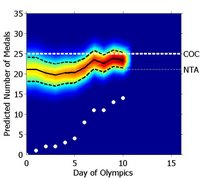
Figure 1

Canadian medal prediction, 2006

Figure 1 — Updated probability distribution for Canada's 2006 winter Olympic medal total (click to enlarge). Prediction is based on the probability assessment here, updated as events are decided.

A "Horrible" Day in Alpine Skiing

When the 2006 Olympics started, I was thinking that I would include a snarky "Brian Williams" feature in each day's post, highlighting the inaccurate or infuriating claims that the CBC's Williams made each day.

I really am not a fan.

Fortunately for everybody, Williams has actually been pretty well-behaved, and I haven't had much material to work with. There was a pretty funny incident involving Mr. Williams' tongue — I wish I had a picture, but I don't — but he actually handled that one pretty well.

Then Williams apparently made a reference to "Bad, Bad, Leroy Brown" after Shani Davis won his gold medal. I didn't actually see that, so I couldn't really say much. L-Girl took care of it, though.

Tonight, though, Williams got me all revved up in his discussion of the results in alpine skiing. "There's no way to sugarcoat this — a horrible day for Canada," was how he put it. And in typical Williams style, he said it more than once, just to get his point across.

Let's see. In the men's Giant Slalom, 21-year-old Francois Bourque finished fourth, behind Benjamin Raich (eight-time GS World Cup winner), Joel Chenal, and Hermann Maier (14-time GS World Cup winner and reigning GS world champion). Thomas Grandi finished tenth.

In the women's Super-G, 23-year-old Kelly VanderBeek finished fourth, behind Michaela Dorfmeister (most gold medals in Olympic alpine skiing history), Janica Kostelic (most medals for a woman in Olympic alpine skiing history), and Alexandra Meissnitzer. Emily Brydon finished ninth.

How embarrassing for Alpine Canada! How can they live with themselves? Chokers.

Justice for Sami Jo!

Now on a positive note, I did learn something interesting from the CBC broadcast tonight. Williams had Geraldine Heaney on to talk about the Olympic champion Canadian women's hockey team. Heaney went out of her way to point out the positive role played by my acquaintance close personal friend Sami Jo Small. Heaney noted that Sami Jo, as the alternate (third) goalkeeper, will not get a gold medal — which I knew — but she then added that in men's hockey, the alternate goalkeepers do get medals.

I don't know if there is anything that anybody can actually do about that, at this stage; Heaney encouraged Williams to bring it up with Don Cherry when he is on tomorrow night, but I don't know if Don has that much pull with the IIHF. And I have considerably less, to put it mildly. However, I will put the full power of this blog behind any effort to get Sami Jo a gold medal, even if it means an alliance with Don Cherry.

More Serious News

Of course there is a major doping story going on in Turin, and I am going to comment on that at some point. It seems that we have come to a frightening crossroads in the "war" against doping, and I am not sure that everybody has carefully thought that through. To be honest, I haven't had time to do it justice, and the news is still breaking so fast that I have struggled to write something that contains the essence of the story. But it does need to be discussed, and I'm not ignoring it.

February 14, 2006

Olympics.2006.03

The Winter Olympics are slippery and very fast. Today the danger of that combination was front and centre in Turin and the surrounding area.

At the downhill in San Sicario, four women crashed during a training run, and three of them had to be carried off of the hill. Canada's Alison Forsythe tore her ACL and will return to Canada for surgery; American Lindsey Kildow drew gasps from the crowd for her fall, but appears to have only a bruised hip.

At the luge track in Cesana, six of thirty competitors crashed or fell off their sleds on the first or second run, and several others had close calls. American Samantha Retrosi had a sickening crash and appeared to be unconscious when she finally came to a stop. Fortunately, she appears to have escaped serious injury.

Updated Predictions

Canadian medal prediction, 2006 -- Updated 13 February

Figure 1 — Probability distribution for Canada's 2006 winter Olympic medal total.

Back here I made a probabilistic estimate of the number of medals Canada would win in Torino. I'm updating that estimate as events are decided. The blue curve shows my original (a priori) prediction, and the red curve shows the current prediction, accounting for events that have already happened.

Canada lost half a medal today in the men's 500 m speed skating. The expected number of medals stands at 19.7.

I didn't see this one, but an injured Japanese athlete was also taken away on a stretcher from the snowboard halfpipe; and there was some high-speed sliding at the long track speed skating oval, too.

In most sports, of course, falls — especially the kind that need medical attention — put you out of contention. Not so in figure skating. The top Chinese pair, Zhang and Zhang, badly bungled a throw in their long program this evening; Zhang Dan limped to the edge of the ice surface with her partner and spoke with the on-site paramedical team for a couple of minutes. The pair then returned to complete their program … and were rewarded with the silver medal!

Getting back to sports where the outcome of the competition is decided on an objective basis: it was interesting to watch for the effect of the crashes on subsequent competitors at the downhill and the luge track. I'm only speculating here, but it seemed to me that the sliders at the luge track got more and more rattled with each crash, whereas the downhillers mostly kept their fear under control. Of course, the skiers were only doing training runs, so they weren't facing the same kind of pressure. It's also possible that the skiers who became worried about falling just slowed down; I am not a luge expert, but there does not appear to be much you can do to reduce your speed to any great degree. And finally, it might be that frightening crashes are simply more common in alpine skiing; the skiers who make it to the Olympics have certainly learned that damaged and (hopefully) repaired bodies are part of their sport.

Over at sportsFilter, some are speculating that NBC has been timid about showing the most spectacular crashes. I didn't notice CBC shying away from the slow-motion replays; they showed Kildow's crash several times, including a close-up of Renata Goetschl's reaction from the bottom of the hill. And NBC has posted a slideshow of Retrosi's accident on their web site.

I've got two things to finish up. First, Sean at sportsBabel has a new post called The New Temporality of Olympic Triumph, which addresses the tension between the increasing speed of Olympic sport, and the increasing slowness of the anti-doping process:

The Games have been officially opened! For the armchair athlete, the next few weeks will provide a feast for the eyes, as winners are determined and medals handed out at a number of Olympic and Paralympic sporting events in Torino, Italy. We must note, however, that these will only be the interim winners of the XX Olympic Winter Games. We won't know the true victors for another eight years.

I wish I had thought of that.

Finally, yesterday I addressed the freshly manufactured controversy about the Canadian women's hockey team's "unsportsmanlike" behaviour. Today, CBC.ca ran this anonymous column on the subject, opening with the question on nobody's mind:

What would Don Cherry do if he was coach of the women's hockey team in Turin and his players mounted a 7-0 lead in the first period? Would he tell them to coast or would he encourage them to score more goals?

So here's an unnamed CBC writer wondering aloud what a high-profile CBC employee would have to say about the Canadian national team. There is not a single current quote from Cherry himself, although the article does remind the reader that Cherry has a regular feature on Hockey Night in Canada.

I've forgotten: which network is HNIC on, again?

February 10, 2006

On The Eve of the Olympics

As ken said in the comments, Happy Opening Ceremony Day! I only have a couple of things to say about the Opening Ceremonies, so I'll keep this brief.

First, I will remind the spectators of Rule 6, paragraph 1 of the Olympic Charter, which states (emphasis mine):

The Olympic Games are competitions between athletes in individual or team events and not between countries. They bring together the athletes selected by their respective NOCs, whose entries have been accepted by the IOC. They compete under the technical direction of the IFs concerned.

Try not to forget.

Second, I wanted to bring your attention to a quote that NBC's Olympics boss, Dick Ebersol, made earlier this week:

The Olympic opening ceremony is the most important event for the vast majority of the athletes here. Most won't come close to a medal. And for them, this is the pinnacle of their athletic careers.

Now, as thrilling as it is to march in the parade of nations national Olympic committees, the Opening Ceremonies are not even part of anybody's athletic career. Is it possible that the Chairman of NBC Universal Sports and Olympics has so little understanding of sports? Does he really think that the "vast majority" of Olympic athletes would describe the opening ceremony as the most important event of the Olympics? Or is he just trying to sell a television show, and insulting the athletes to do it?

December 08, 2005

Dumbed-Down Olympic Selection

The Canadian Olympic Committee held a board meeting a couple of weekends ago. Among other items on the agenda, they approved new Olympic selection criteria:

At the meeting, the COC Board … voted strongly in favour of using International Federation qualification criteria as the minimum standard for nomination to the 2008 Canadian Olympic Team. Similar to existing criteria for the 2006 and 2010 Olympic Winter Games, each summer National Sport Federation has the right to require selection standards for its athletes that are higher than International Federation criteria.

What this means is that the COC will not place any explicit restrictions on qualification for the summer Olympics in 2008; if your IF says that you're good enough, then you will be part of the team. I am surprised that I have not seen much about this in the press, since the very tough "Top 12" selection standard got a lot of negative coverage in 2004. A Google News search turned up a single piece by Alison Korn at RunnersWeb.com, a publication that was particularly critical of the Top 12 criteria.

Some of you will have heard my diatribes on this issue before. A year ago I laid out my arguments in favour of tough selection criteria. One of the most common arguments against tough standards is that they stifle development of up-and-coming athletes; I've done some analysis attempting to debunk that theory.

I still believe, as I stated last November, that using IF selection criteria creates a situation that is inherently unfair to Canadian athletes:

would it be fair to allow a top 40 trap shooter to go to Athens, when the IF for rowing has set their field size much smaller? Sometimes different IFs set very different criteria. The top 12 standard allows the COC to ensure that athletes from different sports have to meet similar standards. That's only fair.

My other principle objection to weakening the standard was that it causes the COC (and Sport Canada, too) to waste money preparing Olympic teams and athletes that have little chance of performing well when they get there. The policy approved by the COC board, however, attempts to make it clear that all Olympians are not created equal. Korn puts it well in her article:

Previously, the COC funded all Olympic teams fairly equally; hence its interest in taking a small team. After Athens, the organization decided to focus its resources primarily on those ranked in the top eight, with far less support given to lower-ranked teams. So the overall size of the team became less of a financial concern.

So although the Olympic team will get bigger, and will potentially include more sports, the COC is so far holding the line on the idea that funding will be targeted at the highest-performing sports. That's a good policy. Of course, we'll see how it holds up when the stories start to surface about the "unfairness" of unequal NSF funding leading up to the 2008 games.

February 17, 2005

Rogers/CTV Win Olympic Rights

Last week, Canadian broadcast rights for the 2010 and 2012 Olympic games were awarded to Rogers/CTV. The bid group includes english broadcasters CTV, TSN, OLN, and the regional Rogers SportsNets, which makes the possibilities pretty intriguing:
The plan is for CTV to carry the opening and closing ceremonies, plus the major sports events on its free, over-the-air channels. Sportsnet's four regional cable channels plus TSN will have the ability to show entire events, from start to finish. "The tastes are changing in sports," said CTV president Rick Brace. "People want to be able to watch the events they want to see and they want to be able to watch them in their entirety and they want to be able to watch them live."

All true. Not mentioned, however, is the fact that people also want to watch the events with decent commentary and analysis! According to past experience, this is much more likely to occur on CBC than it is on CTV (all my previous complaints about Brian Williams aside ...).

It's possible that I am being unfair to the on-air staff at CTV/TSN/OLN/Rogers. Maybe they are not nearly as bad as I remember from the last time CTV hosted the games. At the very least, I will look forward to the increased coverage of the events — even if I have to watch with the sound turned down!

January 17, 2005

Athens COG President Tackles Obscenity Complaints

Just another quick one (I've got my hands full with other matters these days). Earlier I wrote an entry about the indecency complaints received by the FCC about NBC's coverage of the 2004 summer Olympics.

Gianna Angelopoulos-Daskalaki, who was the president of the Athens organizing committee, has written this editorial on this issue for the L.A. Times. Happy reading!

December 22, 2004

NBC's Audience Conflict

The Associated Press ran this story a couple of weeks ago, breaking the news that the U.S. Federal Communications Commission (FCC) is investigating a decency complaint against NBC for its coverage of the 2004 Olympic Games.

At the time, the AP didn't know any specifics about the alleged indecency, or even how many complaints there had been. Well, it turns out that you can read the complaints here. All nine of them.

Of the nine, four refer specifically to the broadcast of the Opening Ceremony, and each one appears to be about something different. Two complaints refer to indecent commercials aired during the Olympics (specifically for Viagra and Cialis). Four refer to obscenities heard on the air, and two of those specifically mention women's volleyball. There was also a complaint about yet another racy profile of U.S. swimmer Amanda Beard.

Now, I probably spent about 30 minutes, total, watching NBC's coverage of the Olympics, and I didn't watch the Opening at all, so I didn't see or hear any of the "offending" material. Since I'm an adult, and I have cable, and I watch sports pretty regularly, I doubt that I would have taken much offense, anyway.

I know that we're only talking about a few nuts, out of tens of millions of viewers — NBC claims that the opening alone was viewed by 56 million people — but it sounds like the FCC is considering taking some action. What kind of standard is being applied here? I wonder how many complaints the FCC receives every Sunday about the NFL broadcast? If these people are really offended by an advertisement for Viagra, Michael Powell must get a lot of e-mail. And I hate to imagine how worked up they must get about beer commercials!

The Olympic television broadcast, of course, attracts a very broad spectrum of viewers. NBC and the other broadcasters, at least in North America, have worked very hard to expand that audience over the past twenty years. The strategy has worked so well that a significant fraction of today's Olympic audience is made up of people who don't particularly like sports, and don't watch other sporting events on TV. This is especially true of the Opening Ceremony, of course, since that doesn't have any sport content at all, but it carries over to the sporting events, too. The offending commercials, the Beard profile, and the uncensored expletives are surely nothing unusual for your average sports fan, but might be shocking to viewers more accustomed to the Family channel. To a certain extent, the networks have gotten themselves into a bit of a mess; maybe they can't continue to treat the Olympics like other big sporting events.

And here's another tip for viewers who are worried that they might accidentally witness something sexy at the Olympics: stay away from beach volleyball. I don't want to denigrate the athletic skills of the participants, which are formidable; and I don't particularly care if they're a bit foul-mouthed. But the official uniform guidelines and the bikini-clad cheerleaders should be a giveaway, folks — you and your family are not the target audience for this show.