Showing posts with label Speed Skating. Show all posts

February 18, 2010

2010 Olympics Day 5

Unnoticed Noteworthy Performance for Day 5

For Day 5 I had a tough time finding an unexpected, non-medal, overachieving performance for Canada. It was one of those days. Due congratulations to Marianne St. Gelais for her silver in the short track 500 m yesterday, but the medal disqualifies her from consideration.

I'm going to name two co-recipients for yesterday. Both of them probably had dreams of getting on the podium, and missed; nevertheless I think that the performances were noteworthy and overshadowed.

Whistler native Britt Janyk finished sixth in the women's downhill yesterday, the best Canadian result in the premier alpine event since 1994. American Lindsey Vonn absolutely dominated the field, with her teammate Julia Mancuso the only competitor to come within a second of her time.

The second co-recipient for Day 5 is short track speedskater Jessica Gregg. Gregg did not have a great race in the 500 m final last night, but she got into the final by being great in the preliminary rounds. She finished fourth after a restart. Gregg will turn 22 in March, and is in her first Olympic Games.

Medal Prediction

Alright, I know I'm falling behind! It's nice to know that somebody's reading … even if it is to nag.

Canada "lost" another 0.7 medals yesterday, compared to my prediction. The short track women's 500 m was a good chance for two medals, so to win one was not enough to boost us back over my predicted pace.

I suspect that there are a number of Canadians starting to think that reaching the top of the medal table is going to be very tough. I agree. In fact, I agreed from the outset. To add to that feeling, the US team has exceeded my expectations a bit. However, there is still lots of reason to think that the highly-publicized Own the Podium goal can be achieved.

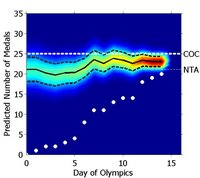
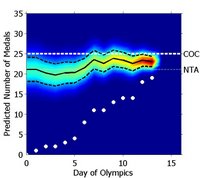
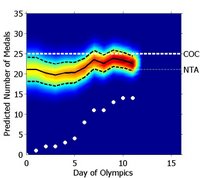
First of all, let's look at my own prediction. It's true that so far the team is tracking a little bit under my initial prediction, as shown in the figure at the end of this post. But don't forget that I have tended (in the past) to be pessimistic about Canada's chances. And even according to my prediction, after the results of day 5 our chances of reaching 30 medals or more has decreased from about 25% to about 9%. A couple of days of winning two medals per day would recover essentially all of what's been "lost."

Second, let's look at some of the other predictions that were made before the Games. As previously noted, the Associated Press predicted that Canada would win 30 medals, and that they would have won 7 by the end of day 5. So we're only "down" by one on that front. Sports Illustrated also predicted 30 medals, but only six by the end of day 5, so we're even on that one. And the Canadian Press predicted a ridiculous 37 medals for Canada — remember that nobody won more than 29 in Torino — so the fact that we're "only" at six compared to the 10 predicted by Day 5 is not that disturbing.

In short, there are still lots of ways that Team Canada can get to 30 medals. I don't know for sure if that will be enough. As I said above, the US team is lapping the field at the moment. In Torino they "only" won 25 medals and they are going to have more than 15 medals after Day 6 this time. But I can say that Canadian experts fully expected to get their biggest medal surge in the last few days of the games.

Sport Event Athlete Category Result Impact
Initial Prediction         27.05
Day 1         -0.75
Day 2         +0.45
Day 3         -0.50
Day 4         +0.00
Alpine Ski Downhill - W Brydon, Emily Possibility 16th -0.35
Alpine Ski Downhill - W Janyk, Britt Outside 6th -0.10
Speed Skating - ST 500 m - W Roberge, Kalyna Strong 6th -0.65
Speed Skating - ST 500 m - W Gregg, Jessica Outside 4th -0.10
Speed Skating - ST 500 m - W St. Gelais, Marianne Outside SILVER +0.90
Speed Skating - LT 1,000 m - M Morrison, Dennis Outside 13th -0.10
Cross Country Ski Sprint - W Renner, Sara Outside 34th -0.10
Cross Country Ski Sprint - W Crawford, Chandra Outside 26th -0.10
Snowboard Halfpipe - M Lamoureux, Justin Outside 7th -0.10
Day 5         -0.70
Current         25.55

May 25, 2006

More Blogs by Athletes: A Pair of Skate(r)s

My Google Blog Search RSS feed recently led me to a blog called The Protocol written by US Speed Skater Eva Rodansky. The post I stumbled into was an interesting look at the differences between the very successful US and Canadian Speed Skating programs. Rodansky referred to another speed skating blog, Zen and the Art of Speedskating, written by Andrew Love.

These two blogs, together, offer a fascinating look at speed skating in the US. Neither Rodansky nor Love is a big star in the sport, but both are high-performance skaters. Although the two are friends, their blogs are very different.

Rodansky can barely bring herself to say anything positive about US Speedskating; she wields The Protocol like a weapon against her enemies. Some of it is quite difficult to read — not because it's poorly written (it isn't) but because of her ferocity.

Love's blog is personal in a different way; he is more positive, and more poetic. Here is Love discussing Rodansky's blog.

February 24, 2006

Olympics.2006.14

Last week I made the claim that the Winter Olympics were slippery and very, very fast. Of course there is an important exception to that rule. The last two days have featured the medal games in curling, the slowest sport in the Winter Olympics.

I honestly do not mean that as an insult; curling is one of my favourite winter sports. Personally, I get more thrills from watching curling than from freestyle skiing and snowboarding put together.

The four medal games offered plenty of drama. The women's gold-medal game went to eleven ends; the men's bronze-medal game was decided on a last-shot draw in the tenth. The men's gold-medal game was a close affair until Canada blew it open with six in the sixth, following an incredible run-back take-out by third Mark Nichols.

There have been plenty of reports about how curling has captured the imagination of the television audience at these games. Why should this be so surprising? After all, curling is enormously popular in Canada, a nation otherwise obsessed with ice hockey; there is no reason why it cannot find its audience in other countries as well.

Figure 1

Canadian medal prediction, 2006

Figure 1 — Updated probability distribution for Canada's 2006 winter Olympic medal total (click to enlarge). Prediction is based on the probability assessment here, updated as events are decided.

Predictions

My medal prediction for Canada (see inset) currently sits at 23 medals, which means that they have somewhat exceeded my expectations to this point. The final outcome will be decided on Day 15, because there are only two events being contested on Day 16; the men's hockey final, and the men's 50 km mass start in cross country. Canadians have no chance of winning a medal in either event.

Saturday (Day 15) will see six events that can impact the medal total for Canada:

  • Speed Skating, Women's 5000 m. Kristina Groves, Clara Hughes, and Cindy Klassen will race for Canada. All three have already won medals at these Olympics. Klassen and Hughes will start in the last two pairs.
  • Short Track Speed Skating, Men's 500 m. Canadians Eric Bédard and Francois-Louis Tremblay advanced out of the qualifying round with fourteen other athletes.
  • Short Track Speed Skating, Women's 1000 m. Canadians Tania Vicent and Amanda Overland advanced out of the qualifying round with fourteen other athletes.
  • Short Track Speed Skating, Men's 5000 m relay. The Canadian team has advanced to a five-team final.
  • Alpine Skiing, Men's Slalom. Four Canadians will race. Thomas Grandi has an outside chance at a medal.
  • Bobsleigh, Men's third and fourth heats. Canada-1, captained by Pierre Leuders, is fourth after the first two heats, and is a tenth of a second out of a medal.

I should point out that no matter what happens tomorrow, the Canadian Olympic team has already won more medals than ever before. Incidentally Sports Illustrated, who made picks for every medal winner in every event, had Canada down for 21, and the Associated Press came up with 24 using the same strategy. Tomorrow will tell.

February 23, 2006

Olympics.2006.13

Figure 1

Canadian medal prediction, 2006

Figure 1 — Updated probability distribution for Canada's 2006 winter Olympic medal total (click to enlarge). Prediction is based on the probability assessment here, updated as events are decided. The probability has already been updated to account for the outcome of the men's curling and men's hockey, as well.

The prediction at the end of Day 13 stands at 23.0±1.3.

Let me make a confession: I do not find all winter Olympic sports equally enthralling. But talking about which winter sports you don't like is pretty dull, so I'll leave that to other people. Instead, let's go back to Day 12. It was a lot more fun.

Short Track

I wanted to make a comment about the women's short track speed skating relay on Day 12. The final was contested by Korea, Canada, China, and Italy. The race was action-packed, with plenty of contact and some aggressive skating by Canada. The Koreans finished first, Canada second, and China third. The Italians hung tough through most of the race, but over the last few laps they dropped away and finished well back in fourth place.

Or did they? Shortly after the conclusion of the race, the Chinese were disqualified for making illegal contact with the Canadians. And at that point, the Italian fans and athletes exploded in celebration.

Seamus from citius altius fortius said that the Italians actually made an appeal for the disqualification; I didn't see that part. But I sure noticed the celebration:

The Azzurri-clad Italian team leapt for joy when the final standings were posted. The crowd serenaded the four skaters with chants of "Italia! Italia!"

Indeed, it was quite a scene, flags waving, skaters jumping, and crowd chanting. Now, I don't have any problem with celebrating a bronze medal performance. In fact, I don't have any problem with celebrating a fourth-place performance. I wish I saw more of that! I don't even object to asking for a disqualification based on a foul that did not affect your performance in any way. Hey, the rules are the rules, and they should apply to everybody.

The Italian team should feel proud of what they accomplished. But there's something unseemly about that vigorous celebration, in my mind. It was clearly only about the medal. They didn't find anything to celebrate in their performance when they thought they had finished fourth, after all. A post-race decision by the officials just should not change your mood that dramatically.

Cross Country

Chandra Crawford is the first Canadian athlete to completely surprise me at the 2006 winter Olympics. Although I predicted that Canada had a good chance at a medal in the women's sprint, I did not expect Crawford to be involved. And in fact, her gold-medal performance looked … well, easy.

Canada's new status as a contender in cross country skiing is pretty remarkable, as well. Crawford becomes the third Canadian woman at these Games, and the third North American woman ever to win a medal in cross country skiing.

Speed Skating

Seamus has called Cindy Klassen's win in the women's 1500 m his "performance of the games." I don't have too much to add, except to point out the splits. In contrast with Enrico Fabris in the men's race, Klassen was second at 300 m, first after 700 m, first after 1100 m, and first at the finish. That strategy has not been a successful one at the Turin oval so far, which makes Klassen's race even more remarkable.

Hockey Post-Mortem

There will be tens of thousands of words written about the failure of the Canadian men's hockey team at these Olympics. I could add a few thousand of my own, but I am not sure that I have anything original or very informed to say. In this, I am only a fan. There are very few things in sports that can still make me feel joy or despair; the Canadian Olympic hockey team is one of them.

Very Canadian of You

Speaking of sports and national identity, see if you can name that country:

________ newspapers turned against their Olympic team on Thursday after another string of disappointments pushed the Nordic country toward their worst Winter Games in 18 years.

February 21, 2006

Olympics.2006.11

Figure 1

Canadian medal prediction, 2006

Figure 1 — Updated probability distribution for Canada's 2006 winter Olympic medal total (click to enlarge). Prediction is based on the probability assessment here, updated as events are decided.

Things You Shouldn't Say …

… when contemplating the possibility of winning your next hockey game in the qualifying round:

And of course, it is the question: Shall we win [and face Canada in the quarter-finals] or shall we play a good game to get a 0-0 result [and face Switzerland]? There are many questions going through our heads right now. — Bengt-Ake Gustafsson

… after being beaten once:

You know I always say that you can beat Chad Hedrick once but you can't beat him twice — Chad Hedrick

… after being beaten for the third time:

I would say, if you re-ran the race it would be a 90-95 per cent chance that Shani or I was gonna win the race … — Chad Hedrick

… at a post-race press conference with your teammate and rival:

I'm just throwing it out there. It would have been nice if after I won the 1,000-meter race, he could have been a good teammate and shook my hand, just like I shook his hand — and hugged him — after he won the 5,000 meters. — Shani Davis

And Speaking of that Race …

I will admit it, I am kind of enjoying the rivalry between Davis and Hedrick. Hedrick is a very, very bad loser, and Davis is a very, very bad winner, but at least there is nothing at all phony about them. And they are both very gifted athletes, so I can forgive them, as long as I don't have to live with either one of them.

However, it would be remiss not to make a point about the performance of gold medallist Enrico Fabris from Italy. Check out these splits. Fabris was 25th at the 300 m mark, 23rd at 700 m, 11th at 1100 m, and first at the finish. His last three laps went 26.68, 27.14, and 27.73 seconds. He covered each of the last two laps faster than any other competitor. On the last lap he was almost nine-tenths of a second faster than the nearest skater.

On the opposite side of the coin was the third American skater, who finished ninth. Joey Cheek was "livin' the dream," as an old coach used to say — he led at 300 m, 700 m, and 1100 m, before somebody threw a piano on his back and he finished up with a 30.67-second lap. That last lap was the sixth-slowest put up by any of the 39 competitors — and he gave up almost three full seconds to Enrico Fabris.

February 16, 2006

Olympics.2006.06

Updated Predictions

Canadian medal prediction, 2006 -- Updated 16 February

Figure 1 — Probability distribution for Canada's 2006 winter Olympic medal total (updated).

I am only really writing this blog post so that I can display my latest prediction for Canada's medal total (inset right). Note that I am not changing my original prediction; I'm just updating the probabilities for events where the medals have already been decided. That changes the probability distribution every day.

In case you are wondering, no, I am not obsessed with the medal table, or with Canadian performances. After all, the Olympic Games are competitions between athletes in individual or team events and not between countries. (If it's in the rules, it must be true.) No, I am actually obsessed with my own predictions, which is a different personality problem entirely.

As long as I'm using up valuable time when I could be sleeping, I should have pointed out yesterday that US speed skater Chad Hedrick will definitely not win five gold medals in Turin, since the Americans were eliminated in the quarterfinals of the men's team pursuit. To be charitable I will point out that they were beaten by the eventual gold medallists.

The US did not have their best skaters available, which is a matter of some controversy. That's not what I want to talk about here. I am more interested in the ease with which everybody seems to have swallowed the five-medal hype in the first place. Is it really possible for a speed skater to win five gold medals at the Olympics any more? And if it is, doesn't that show that the depth of the field is pretty poor?

Hedrick is still predicting that he will win the 1,000, 1,500, 5,000, and 10,000 m events at the Olympics. He has already won the 5,000, actually, so only three more to go. But that sweep looks humanly impossible to me. The 1,000 m race will be won with a time of about 70 seconds. The 10,000 m race will take Hedrick in the ballpark of 13 minutes. To compare that to running, it equates roughly to the 800 m (or a 600 m, if that was an event) and the 5,000 m. In swimming, it would be about the same as pairing the 200 m (or 150 m) and 1,500 m.

But in swimming and running, those doubles simply cannot be done. Evenly the freakishly gifted Ian Thorpe has never done it at the world championships or Olympics. Sure, he's won at 200, 400, and 800; but extending or contracting that distance requires completely different (and mutually competing) physiological systems. In running, forget about it; nobody even enters the 800 and the 5,000. I feel pretty safe in saying that in this modern age of highly specialized athletes, It Cannot Be Done. Nobody is ever going to be world or Olympic swimming champion in the 200 m and 1,500 m simultaneously. Nobody is ever going to be world or Olympic athletics champion in the 800 m and 5,000 m simultaneously. And nobody is going to be world or Olympic speed skating champion in the 1,000 m and 10,000 m simultaneously, either. The fact that Hedrick is even competitive in both distances makes him almost superhuman.

And yes, I know that Eric Heiden did it. In fact, Heiden's five-gold feat was even more astounding than the one Hedrick was shooting for, since he won the 500 m instead of the team pursuit. But that was twenty-six years ago! Speed skaters still raced outside! Human physiology hasn't changed, but the level of competition has. I think. The fact that people seriously entertain the idea that Hedrick can do this gives me pause. Maybe he really can do it. But if he does, it will just show me that the world's speed skating talent pool is actually pretty shallow.

February 12, 2006

Olympics.2006.01

First of all, I just wanted to pass along this link. It's something the kids are calling a "Google Maps Mashup," and it's a pretty cool little application for scanning the Olympic results of the day.

Updated Predictions

Canadian medal prediction, 2006 -- Updated 11 February

Figure 1 — Probability distribution for Canada's 2006 winter Olympic medal total.

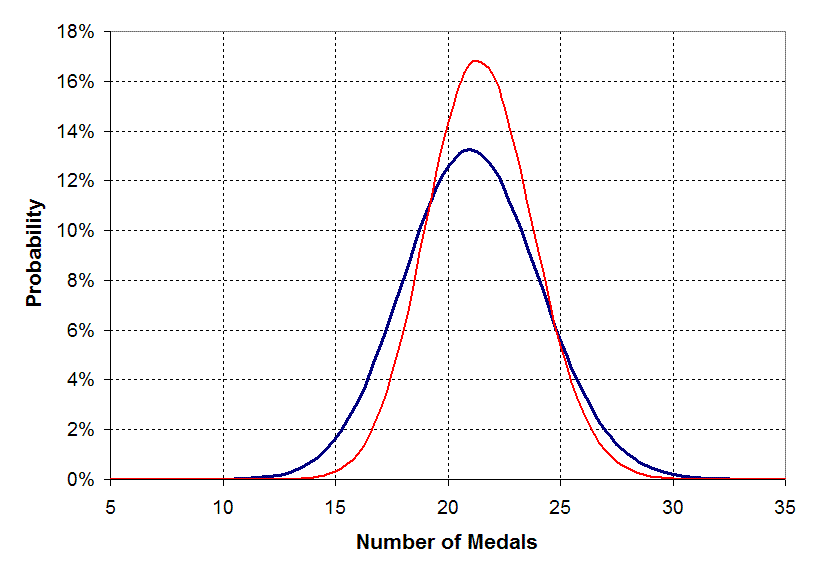
Back here I made a probabilistic estimate of the number of medals Canada would win in Torino, based on my estimates of the probabilities for individual athletes and teams. I'm going to update that estimate as events are decided, one way or another. The blue curve shows my original (a priori) prediction, and the red curve shows the current prediction, accounting for events that have already happened.

Nothing very surprising happened today. Canada won one medal, in an event where I predicted a high probability of success; and they didn't win in a bunch of events where I said there was zero chance of winning. So the distribution has become slightly narrower, but is otherwise unchanged.

Now for two Olympic stories of the day. First, let me express my disgust with the thought that Michelle Kwan might withdraw from competition due to poor health and an inability to complete her program. It is a little late to discover that her body might not be able to back up her enormous ego in the claim that she is, by default, and without competing or training, better than every other figure skater in America. And the USFSA will look like complete idiots unless she skates, and skates well.

Speaking of enormous egos, the sports story of the day, for me, happened at the speed skating oval. US skater Chad Hedrick won the men's 5000 m in dominant form. He came within two one-hundredths of a second of breaking the Olympic record, set in 2002 on much faster ice, and beat his nearest competitor by almost two seconds. That competitor, world record holder Sven Kramer of the Netherlands, had the misfortune of skating just before Hedrick, but I don't think he can reasonably say that it made the difference. Kramer skated well enough to put the outcome in doubt, and that's something. The bronze medallist was also a great story, as Italy's Enrico Fabris just edged out the second entry from the Netherlands, Carl Verheijen. Fabris was in sixth place with three laps to go, and in fourth place with one lap to do.

Canada's Arne Dankers also had a great race, finishing fifth. That was better than he has ever done in the 5,000 m on the World Cup, which is exactly what you want to do at the Olympics.

Now I should take a few minutes to commend CBC on their coverage. They showed about 7 or 8 pairs of skaters live and in real time, even though each heat took more than 6 minutes. They talked a lot about Dankers, but not excessively so, and gave Hedrick, Kramer, and Fabris their due for their performances. The broadcast team did a good job of explaining what to watch for and keeping the viewer up to date. And maybe I missed it, but I didn't hear a peep about how it was the thirteenth anniversary of Hedrick's grandmother's death. All in all, a nice job of covering sports.