Showing posts with label Olympic Programme. Show all posts

August 19, 2006

More Than One Way Into the Olympics

Mark Keast wrote a piece in the Toronto Sun last week about the IDBF World Dragon Boat Club Crew Championships held in Toronto last weekend. The article was titled "Olympic hopes a long shot" and described some of the hurdles that the sport of dragon boat faces in gaining inclusion in the Olympics.

I wanted to point out that there are some interesting facts missing from the discussion about dragon boat racing in the Olympics. Here's what Keast wrote:

Haslam [executive president of IDBF] thinks it will take at least 20 years to get into the Olympics. The sport needs recognition as an Olympic federation first. Before that, it needs 75 national federations around the world under its umbrella. Dragon boating currently has around 60, Haslam said.

Indeed, the IDBF has a lot of hurdles to clear before it can get dragon boat into the Olympics. Even if it can gain recognition as an IF, the IDBF will still have to get the sport elected onto the list of Olympic sports; as we've seen before, the Olympic Charter says that this requires two-thirds support of the IOC membership, and that's a very tough standard to meet.

What the article doesn't mention, however, is that there's another possibility for dragon boat.

The sport of drachenbootrennen was in fact already included in the 2005 World Games. If you've never heard of the World Games, its a competition that the IOC supports as a sort of audition for the Olympics. Triathlon and taekwondo are both sports that entered the summer Olympic programme after a try-out at the World Games.

But you might ask yourself how a sport gets a place in the World Games when the IOC doesn't recognize its IF. That's the part that Mr. Haslam of the IDBF didn't mention: the IOC already recognizes the International Canoe Federation as the IF responsible for dragon boat.

And the ICF is not just a recognized IF — it also has two disciplines already on the summer Olympic programme. If the ICF decided that they wanted to add dragon boat as a new discipline of the sport of canoe-kayak, it would only require approval of the IOC Executive. The IOC members wouldn't get to vote on the idea, at least not directly. So if dragon boat really wants into the Olympics, then going in through the ICF would significantly reduce some of the political hurdles.

Of course, it would increase some others. Mainly, the dragon boat lobby would have to deal with the internal politics of the ICF. Those two Olympic disciplines I mentioned (flatwater and slalom) would not be too keen to give up any of their events to dragon boats, and the ICF is probably not strong enough to wrestle extra medals from the IOC's quota. Trying to strike out as an independent IF allows the sport of dragon boat to be, well, independent, with an IF that is looking out for its interests alone.

So although the ICF has an "official" responsibility for dragon boat's Olympic destiny, that's currently not worth very much. The IDBF-sanctioned competitions are much better attended, and more prestigious, and the ICF World Championships are a poor cousin to the IDBF event. Without a credible World Championship, the ICF couldn't get dragon boat into the Olympics even if it did want to, and without recognition by the IOC, the IDBF can't either. It isn't entirely clear whether the IDBF will ever be recognized. The Sun article makes it sound like it's a simple matter of having 75 member national federations, but the existence of the ICF within the IOC will complicate matters. At any rate, the acrimony between the two federations doesn't help either side, and trickles down to the competing national federations as well.

I'm not arguing that the sport of dragon boat would be "better off" under the ICF umbrella. But I do think that this is an interesting example of the politics of Olympic sport. I will be watching to see how this power struggle plays itself out as competitive dragon boat racing continues to grow.

June 04, 2006

More Wishful Thinking and Free Publicity

Last week there was another one of those stories that pop up from time to time, the ones that claim "sport X wants to be in the Olympic Games!" Of course sport X is a pastime that may or may not even be a sport, which means that the story gets quickly propagated as an "odd news" bit and gets a bunch of free publicity as a result. The last one I saw was poker.

Last week's version has it that gaming (video gaming) is "pushing" for "Olympic recognition." I know I am only fueling this ridiculous story by publishing the link, but I can't help myself.

[Ted] Owen, who runs the Global Gaming League (GGL), a media company focused on the lifestyle and culture of gaming, is currently talking with the Chinese government in hopes of bringing competitive video gaming to the 2008 Games as a demonstration sport. … Owen, though, said he believes gaming's worldwide appeal - especially to a younger audience - could be the biggest boost to the Games since snowboarding. "People aren't watching [the Olympics] as much anymore," he argued. "You need to bring younger viewers back if you want to keep making money. To do that, you need to embrace non-traditional sports. They did it with snowboarding — and look how the popularity of that has surged in the Games. Video games deserve to be seen as a non-traditional sport. … They would bring something to the Games that [that age group] engages in and everyone understands."

There are so many things wrong with this whole thesis that I don't know where to start. I think I'll just stick to the administrative impossibilities:

  • The official sports for 2008 are cast in stone at this point. The programme for 2012 was selected last summer. You may remember that. There was quite a lot of publicity about it.
  • Ted Owen thinks that "The only reason they [the IOC] haven't done an exhibition sport in the past several years is no one has brought a good one to them." He is incorrect. The IOC placed a moratorium on demonstration sports at the winter or summer Olympics starting in 1996. There will not be any demonstration sports in 2008.
  • The GGL is not recognized as an international federation (IF) by the IOC and therefore has no standing (unlike other Olympic outsiders like DanceSport, Mountaineering and Climbing, and Wushu). Getting recognized is not trivial — among other things, the GGL would be required to "apply the Olympic Movement Anti-Doping Code and conduct effective out-of-competition tests." I'm not trying to cast any aspersions on gamers here, I just don't really think that the GGL has thought carefully about all of the burdens that go along with being on the inside of the Olympic movement.

I try not to get into discussions of whether "sport X" is or is not a sport, or "deserves" to be in the Olympics. Most people who do so end up making idiots of themselves rather quickly. Here's Exhibit A. Jason includes a list of sports that have "as little or less merit as being regarded as official sports." I assume he means that they deserve to be in the Olympics even less than gaming. I personally don't buy that argument for even one of the sports (actually disciplines or events, in some cases) on his list. But regardless, if you want to get your sport into the Olympics, surely you've got to have a more compelling argument than that.

April 06, 2006

Misreading Rogge (Again)

The IOC executive board is meeting in Seoul this week. In between sessions, president Jacques Rogge had this to say about baseball's possible inclusion on the Olympic programme for 2016:

We still have issues about doping. Progress has been made but not to the level where the Olympic family would accept it.

The Associated Press report makes it sound like Rogge has set a condition for baseball's reinstatement, and the Globe and Mail headline echos the opening paragraph: "Rogge: Baseball needs to address doping prior to reinstatement."

Of course, Rogge very carefully did not say that baseball would be back in if it cleans up its doping problem; and we all know that he cannot say that. Barring a change to the Olympic Charter, the decision on the sports programme will be made by a vote of the IOC members, not by Jacques Rogge. He's free to speculate about what might swing the vote in baseball's favour, but he really can't make any promises — or any threats, for that matter.

I've said it before, and I'll say it again: Rogge has a gift for this kind of thing.

February 09, 2006

Softball, Baseball Fail in Attempt at Reinstatement

This just in: baseball and softball have failed in their attempt to be reconsidered for the 2012 programme.

The Canadian Press report is a little bit confusing, but if the earlier description of the process is correct, it sounds like both sports obtained the one-third support required to raise a motion that the vote should be redone. Then the motion failed to gain majority approval. That surprises me, given that softball lost by the slimmest of margins last time.

One thing I notice is that there were about 15 fewer voting delegates this time around, which may have been part of the problem. Because of the 2012 host city election, the summer congress was very well-attended. In particular, some of the Latin American and Asian delegates who supported the two sports might have stayed away from this session, given their lack of interest in the Winter Olympics.

November 18, 2005

Athletes Nervous About More Cuts

Since this summer's Olympic programme debacle, Jacques Rogge has been trying to make it easier to add sports to the summer Olympics. On October 26, the IOC Executive Board met with the IOC Athletes' Commission:

… the Athletes' Commission, chaired by Sergey Bubka, made some recommendations on the way to move forward with the systematic review of the Olympic programme. Proposals were made to allow new sports to be included in the programme upon a simple majority of the IOC Session votes cast - instead of the two-thirds majority currently required, and to increase the minimum number of sports from 15 to 25.

Clearly, the athletes are worried about "shrinkage" of the Olympic games, and it's easy to see why they've made these proposals; under the process followed this summer, removal of a sport required a simple majority, whereas addition of a sport required two-thirds approval. That definitely looks like a recipe for contraction.

To a certain extent, though, the IOC's hands are tied on this issue, and the solution won't be simple. There aren't many details in the news release above, so I can't tell exactly what the Athletes' Commission proposed; I'll assume that the members are familiar with the Olympic Charter, which states that:

  • The IOC establishes the programme of the Olympic Games, which only includes Olympic Sports (Rule 47)
  • The sports governed by the following IFs are considered as Olympic sports [followed by list of 28 summer sport IFs and 7 winter sport IFs] (Rule 46)
  • The admission or exclusion of a sport falls within the competence of the IOC Session. (Rule 47, paragraph 7)
  • Decisions of the Session are taken by a majority of the votes cast; however, a majority of two-thirds of the IOC members attending the Session is required for any modification of the Fundamental Principles of Olympism or the Rules of the Olympic Charter. (Rule 18, paragraph 3)

So according to the rules, there are 28 sports that can be put on the summer Olympic programme without modifying the Olympic Charter — and therefore with a simple majority vote of the IOC members. Of those 28, 26 are already on the 2012 programme. The other two, of course, are softball and baseball. I don't think Rogge is really interested in putting softball and baseball back onto the programme. Nevertheless, anybody else that wants in will need a two-thirds majority, either to modify Rule 47 (which is very unlikely) or to modify Rule 46.

As it stands, things are a little bit unfair, in my opinion. Although I would personally favour baseball and softball over any of the proposed alternatives, the rules of the Charter give them an immense advantage over every other sport that isn't in the Olympics. That advantage is based purely on the fact that they have been in the Olympics before; but on that basis, rugby and golf (and tug-of-war and polo, for that matter) should also be on the list of "Olympic Sports."

One way around this problem would be to remove softball and baseball from Rule 46, giving them the same status as the other non-Olympic sports. Of course, that change to Rule 46 would itself require a two-thirds vote, and since both sports received support from at least 50 delegates at the last IOC Session, I suspect that's not going to happen. It's also not something that Rogge is likely to propose, since he wants to make it easier to add sports to the Olympics, not harder.

The only other solution is to have a number of sports added to the list in Rule 46; say, for starters, Golf, Rugby, Squash, Roller Sports, and Karate. Unfortunately, this is pretty similar to the proposal that the IOC delegates soundly rejected in July, and there's Rogge's dilemma. His best bet is to approach this as a two-step process. First, propose to have all five sports (or some other subset of the recognized group) added to the list of "Olympic sports" in Rule 46. To have any chance of success, Rogge will have to make it clear that the new sports aren't being added to the Olympic programme, and emphasize that they are really only being given the same status as baseball and softball.

Once that's accomplished, Rule 46 will include a list of 33 summer Olympic sports, from which the IOC members can choose up to 28 for each Olympics — by simple majority vote. But as long as I'm handing out free advice to the IOC, I've got a few ideas about how that choice should be made, too.

The process that was followed at this summer's session was deeply flawed, as I wrote when I first heard the details. Putting every sport to an up-or-down vote by the general membership makes the entire decision political — and puts sports at the mercy of some very ill-informed voters. The objective should be to maintain the strength and attractiveness of the sports programme above all else. Think about it this way: when it comes time to choose the host city, do you think that the IOC delegates usually pick the city that will provide the best sporting event, or the city that plays the politics best? Truly, I don't care that much about the host city election; the free vote is more unpredictable and therefore more exciting, and the host city is really just a side show, anyway. The sports programme, however, is the main event, and it should be treated with more care and attention.

The IOC has a detailed set of criteria for evaluating sports on an objective basis; I might quibble with the details, but at least somebody has given it some careful thought. The IOC also has an Olympic Programme Commission, "responsible for reviewing and analysing the programme of sports, disciplines and events … for the Games of the Olympiad and the Olympic Winter Games." Since Jacques Rogge has this ready-made panel of experts at his disposal, why doesn't he ask them to make a recommendation? The Commission's major report this spring was explicitly restricted from doing any such thing. Does that make any sense?

If you ask me (and surprisingly, nobody has, although I've been waiting since April), the IOC Olympic Programme Commission should make a specific recommendation on the composition of the programme, to be presented and either accepted or rejected (by simple majority) at an IOC Session. They should present their reasons for the recommendation — another thing that's missing in the current system — which must be based on the evaluation criteria. That doesn't prevent other suggestions from being brought forward from the floor, although they would have to follow the standard process; but it would allow a small group of experts to make a reasoned argument for their choice, which is a step up from what happened this summer.

When it comes right down to it, though, I don't like Rogge's chances of getting any new sports added to the programme in the near future. The last time the members considered it, they emphatically rejected the idea that karate and squash were worthy Olympic sports. Neither sport garnered anything close to a simple majority, and I don't see that much has changed since then.

October 18, 2005

Wishful Wushu

I don't know what it is about Jacques Rogge, but it seems that he can't open his mouth without being misinterpreted in the press.

In April, Rogge discussed the impending vote on the makeup of the 2012 Olympic programme:

  • Rogge said: "There should be no anxiety. The process will be a totally fair process. Reading the [IOC programme commission] report, I have only one conclusion. We have very strong federations, and strong federations should have nothing to fear."
  • The press reported: Olympics chief reassures federations that sports won't go

In September, Rogge commented on the recent elimination of softball from the 2012 Olympic programme:

  • Rogge said: "Our charter is very clear that the [executive board] cannot take an initiative to say 'we want a new vote' because that would open up the door to all kinds of re-votes." But he said there were precedents for the full IOC to reconsider a decision.
  • The press reported: A second chance? IOC may take another look at softball for 2012 Games

And last week, Rogge paid a visit to China's National Games:

  • Rogge said: "There will be a wushu competition during the Olympic Games. It's not going to be one of the official 28 sports but we will organize with BOCOG a wushu competition."
  • The press reported: Wushu to Be Part of Beijing Olympics

The Chinese have been trying to get Wushu — better-known as kung fu in North America — on the Olympic programme ever since they won the right to host the 2008 Olympics. As I understand it, the proposed Olympic version is not a combat sport but a judged demonstration of skill, somewhat like gymnastics — just what the summer Olympics needs, right? Anyway, despite the recent excitement I can assure everybody that wushu is not going to be part of the 2008 summer Olympics. It is not one of the 28 sports on the programme, and it cannot be a demonstration sport, since the IOC decided in 1989 to place a moratorium on demonstration sports at the summer and winter Olympics (they were discontinued starting in 1996).

In an effort to make things perfectly clear, Rogge made a statement clarifying what he said, for those who missed it the first time:

"We are not introducing wushu into the Olympic program. It will not be an exhibition. Not at all" … He said wushu will be neither an exhibition event nor an Olympic sport. Asked if there is any possibility of wushu’s becoming a medal event in future Olympic Games beyond 2012, Rogge said: “No one can predict the future.”

Tomorrow's headline: Rogge Promises Wushu in Future Olympic Games.

October 11, 2005

Baseball's Reinstatement Plan

After months of silence, the International Baseball Federation has outlined its plan for getting back on the Olympic programme. It sounds an awful lot like softball's plan, actually, with a few key differences:

  • Softball was eliminated by one vote. Baseball was cut 54-50, which means that they have to convince three delegates to flip.
  • Nobody's claiming that delegates voted against baseball because they were confused.
  • The USOC, which is putting all of its weight behind softball's reinstatement, will definitely not be making the case for baseball.

October 06, 2005

My Two Favourite Sports

Well to be honest, I'm not that fond of boxing or softball, but they seem to come up quite often. I guess I write about boxing a lot because it's so screwed up, and of course softball is not on the Olympic program for 2012.

And here they are in the news, again. Don Porter, the head of the International Softball Federation, led a delegation to Switzerland this week to meet with IOC president Jacques Rogge. Apparently the purpose of the meeting was to get Rogge's support for softball's reinstatement, although Rogge has already made it clear that the decision rests with the IOC members. Rogge reiterated that point this week:

Under IOC rules, at least one-third of the 115 members would need to submit a motion [at the February meeting in Turin] to consider a new vote. If the motion passed, softball would require a majority in favor to win reinstatement.

That looks fair to me; and given that softball was eliminated in a very close vote, I don't see why it would be difficult to at least get the motion brought forward from the floor.

Boxing, meanwhile, is still thinking about adding a women's discipline. I guess that's good news if you believe in equal punching opportunities for women.

Keep Trying, Guys

How backwards is the AIBA? First, the home page still lists the notice of the cancellation of the women's world championships on September 5, right alongside the results … of the women's world championships on September 26-29. Guys, either get the cancellation notice off of there, or explain how the event was rescued.

And here's a telling quote from their home page promoting this great event: "In women's boxing, we can see some nations winning bouts that would, in men boxing, never win!" How fabulous!

There were a couple of articles on this issue in the past week. The People's Daily Online are reporting that the IOC executive will make a decision on the inclusion of women's boxing in the 2008 Olympics at their meeting on October 26-28.

The article claims that the IOC have received a proposal from the AIBA, with no description of what was proposed. Now Rogge has already made it pretty clear that he's not interested in adding women's events unless some men's weight classes are consolidated, and the AIBA has not been supportive of that idea. So I'm sticking to my story that this is mostly just for show, probably so that the AIBA can shift the blame to the IOC. I suspect that the boxing officials have submitted a proposal that they already know is going to be quickly rejected. In truth, the IOC really can't just let boxing increase their medal or athlete quotas, since they forced other sports (like wrestling and weightlifting) to remove some men's events when they added women's events.

Then, there was this odd little story in the Globe and Mail. The story starts off typically enough, describing how Canada's top female boxers really want to have a chance to compete at the Olympics. But then Robert Crête, executive director of Boxing Canada, drops a new idea:

… Canada would be willing to look at the possibility of women's boxing being part of the Winter Olympics. We're asking the international federation to look at all avenues of getting women's boxing into the Games.

It's an interesting idea, but probably destined to fail because of the giant can of worms it would open. The AIBA will probably embrace the idea, since it would allow them to make a token gesture for women without diminishing the men's program. The IOC, I suspect, is unlikely to entertain this; if they say yes to boxing, they'll have the wrestlers and weightlifters on their backs asking for the same arrangement.

September 07, 2005

On Doping Rates and Sample Size

Are you ready for more fun with the IOC Programme Commission Report? In case you've forgotten, that's the document that the IOC produced this spring evaluating each of the 28 summer Olympic sports, plus five other recognized sports (Roller Sports, Golf, Rugby, Squash, and Karate), prior to the big programme review and sport elimination vote.

Of course the actual vote had almost nothing to do with the evaluation report, but it has a lot of interesting information in it, anyway. As I previously noted, one of the evaluation criteria is an assessment of each sport's anti-doping effort. At the back of the report is a table that documents the number of tests performed, and the number of confirmed positive tests, for each of the 33 IFs.

Here's a little trivia question for you: out of the 28 summer Olympic sports, plus the five recognized sports, which one had the highest rate of positive tests?

The answer would have to be athletics, right? Athletics reported that 0.64% of tests in 2003 showed doping violations, which is pretty high, but that wasn't the highest reported rate. It wasn't weightlifting (0.50%), cycling (0.49%), or aquatics (0.20%), either.

The winner was Golf, with an astonishing 1.67%. And as far as I can tell, the IF in question (the IGF) has no jurisdiction over the professional golf tours, so these would have been largely amateurs. Actually, three of the proposed sports (Golf, Karate, and Roller Sports) finished in the top 5, and Rugby was 8th. Athletics was 6th, and the third-highest among current Olympic sports. The highest among Olympic sports (and second overall) was Baseball, at 1.24%, followed by Archery, at 0.88%. These are all fairly surprising results, in my opinion. I was even somewhat caught off guard by the high rate in baseball; remember, these are tests administered by the IBAF, which has no jurisdiction over major league baseball and its steroid problems.

So what's behind these surprising results? Is drug use really rampant in amateur golf, at two and half times the rate of athletics?

Well, maybe. But I suspect that there's a more mundane reason for the odd results: small sample size. Whenever you sample a population (athletes) to calculate a rate of incidence (rate of doping), you're in fact making an estimate of the actual rate of incidence. That estimate comes from an underlying probability distribution, which implies a confidence interval associated with the estimate. If we want to convert the measured number of positive tests into a doping rate, we should also note the uncertainty in our estimate. The IOC table gives the percentage of positive tests, which is a legitimate estimate of the rate of doping in a sport; however, it does not address the issue of uncertainty.

In this case, we can estimate the uncertainty in the estimates of the doping rate by making some simplifying assumptions. Let's assume that the actual rate of doping in a given sport is p, and let's further assume that the tests are absolutely perfect — they catch every cheater, and never give any false alarms. (I'll discuss this second assumption a bit more later.)

If we test M athletes from the population, we would expect to find k = λpM positive tests. In fact, of course, even with a perfect test we would not find exactly λ positives every time, due to the random nature of the sample; there is a non-zero probability that we would find k = λ ± 1, λ ± 2, etc. The probability distribution for k is described by the binomial distribution, which is nicely described in this Wikipedia article. We could use the binomial distribution directly to estimate the uncertainty in our estimate, but I'm going to make a few more simplifications until we get to the point where I can do the calculation on the back of the proverbial envelope.

It turns out that if positive tests are "rare," which they are, then the binomial distribution will approach the Poisson distribution (Wikipedia again). The Poisson distribution has the nice property that the mean and the variance are both equal to λ. The variance gives us a measure of the width of the distribution, or in other words, the uncertainty in our sampled estimate.

Now we can make one further simplification. If the the number of samples M is "large," then the Poisson distribution for k is well-approximated by a normal distribution, retaining the mean value (λ) and the variance (also λ). It turns out that in some of our cases the number of samples is not really large enough to completely justify this assumption, but let's go with it — this is rough work anyway. Now we really can work on the back of the envelope — we can say that the "one-sigma" uncertainty on the doping rate is equal to the square root of the number of positive tests, divided by the number of tests.

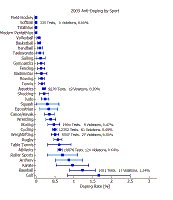
Figure 1

Figure 1 - 2003 positive doping test rates by sport

Figure 1 — 2003 positive doping test rates by sport (click to enlarge).

So for Golf (4 positive tests out of 240), the estimated doping rate is (1.67 ± 0.83)%, whereas for Athletics (120 positive tests out of 18,876), the estimated doping rate would be (0.64 ± 0.06)%;. Here the ± covers the one-sigma uncertainty, which is a roughly 68% confidence interval; to get a 95% confidence interval we could just double the uncertainty.

Figure 1 (inset) shows the estimated doping rates for 2003, including uncertainty, for 32 of the 33 sports (FIFA, which governs Olympic soccer, reported the largest number of tests (20,104) but did not reveal the number of violations). As you can see, the non-Olympic sports generally did not perform a large number of tests, and so their doping rate estimates are very uncertain. Other sports with high but uncertain positive test rates are Baseball, Archery, and Table Tennis. In fact, all of the truly susprising results have relatively large error bars, which tends to support the idea that the results are more due to random chance than any underlying truth.

Speaking of truth, of course we can't translate the positive test rate into a real doping rate unless we believe in the tests themselves. If the tests have a high probability of detection (near 100%), and a low probability of false alarm (near zero), then these numbers are realistic estimates of the incidence of doping among high-performance athletes. Otherwise, false positives and missed detections muddy the picture considerably. Some people will see this graph as evidence that overall doping rates are extremely low; others will conclude that the tests don't work. I've made a few arguments on this topic before, but I know I won't convince everybody, and I don't think we're ever going to know the objective truth.

August 26, 2005

One Sport, One Vote

The vault has been opened! The envelope has been unsealed, and the IOC has released the sport vote totals from the programme review at their 117th session. Well, for one sport, anyway.

As I hoped, softball agreed to have their vote total released to all IOC members, so the IOC Executive agreed to let them have it. The result is astonishing. The sport was knocked out of the 2012 Olympics by a single vote. Actually, you might say by just half a vote; the result was 52-52, with one abstention.

The USOC and the International Softball Federation plan to work to have the decision revisited. Peter Ueberroth, Chairman of the USOC, claims that at least four IOC members were confused at the time of the vote, believing that they were voting against baseball. Now that's a well-informed voter!

I have been wanting to compare my detailed predictions with the actual vote totals. One result isn't much to go on, but maybe more will follow now that the cat is out of the bag. In the meantime, I have to admit that 52 votes is a lot more than I dreamed softball would get, although I did acknowledge that the method would underestimate team sport totals.

Things to Do in London

It looks like Denis Oswald is going to be spending a lot of time in London.

Oswald, an IOC member from Switzerland and president of the ASOIF, has been appointed chairman of the coordination commission for the 2012 summer Olympics and will oversee preparations for the IOC. He held the same position for the 2004 games in Athens.

Oswald was quoted as saying, "I am confident that London has all the ingredients for success — from a technically sound plan to widespread popular support." I am sure that the British will be gratified to hear that. Of course, the last time Oswald was in the news, he was quoted as saying this:

When it comes to rugby I'm not a specialist but people within the sport tell me that rugby sevens is something of a joke.

Fortunately, he won't have to worry about that conflict, since Rugby didn't get added to the Olympic programme after all.

July 29, 2005

IOC Sport Vote Still Super-Duper Secret

The leaders of the International Softball Federation would like to know exactly how many votes they got when they were removed from the Olympic programme.

But they don't want to know so badly that they're willing to reveal the results to everybody else:

The International Olympic Committee agreed to release the sealed voting figures to the U.S.-based federation, but the softball body declined because the totals would have been given to all IOC members. (AP via The State)

So for now, still super-duper-secret; but I now have some hope that these voting results might some day be released. Stay tuned.

July 21, 2005

Olympic Host Voting Analysis

So everybody knows by now that London is going to be the host of the 2012 summer Olympics. I don't know if you happened to catch the broadcast of the voting, with Jacques Rogge opening the final envelope with trembling hands … such drama! The IOC sure knows how to put on a show.

London edged out Paris on the fourth ballot, which was a mild upset according to the experts. I don't know how the experts came up with their predictions, since there isn't much to base them on, but that was the general consensus. Eight months ago I made my own prediction, which was rather vague about the actual winner, but got the rest exactly right:

Moscow has got to be considered the longest shot here … New York seems to have two fairly significant political problems … That leaves one of the big three EU capitals. The winner will be the group that can win votes from outside of Europe.

The result was met with joy, despair, and excuse-making, which just proves that human beings really, really want to win any prize that they have to compete for, regardless of its value.

(For the second time in a week, I'll put in a plug for King Kaufman at Salon.com, who treated the whole thing with the appropriate amount of gravity — which is to say, very little.)

It's slightly amusing to look at what actually happened to the delegate votes through the different rounds. In case you aren't aware, the host city voting is conducted in multiple rounds until one candidate receives a majority of the votes. If no candidate receives a majority, then the lowest-scoring candidate is eliminated and the vote is repeated. Also, delegates from countries with candidate cities can't vote until their cities are eliminated.

Figure 1

Figure 1 - 2012 Host city voting

Figure 1 — 2012 summer Olympic host city voting by round (click to enlarge).

Figure 1 (inset right) shows what happened in this very close vote.

In the first round, the votes were split quite evenly, with Moscow (as expected) coming up a little bit short.

The New York delegation was probably hoping that some regional politics would come into play here. The logic would go something like this: the delegates who wanted an Olympics in Moscow would recognize that a 2012 win for a European city would shut that continent out until at least 2020. Therefore, they would throw their support behind New York, leaving Moscow as an option for 2016. Supporters of each European capital, as their city was eliminated, would use the same logic, and voilà — victory for New York.

But it's a far-fetched theory. Who, other than the Russians, feels that strongly about an Olympics in Moscow?

At any rate, the plan failed spectacularly. In the second round, there were 15 delegates who voted for Moscow, plus the three Russian delegates, who were "free agents." There's no evidence that any of them voted for New York; in fact, at least three of the delegates who voted for New York in the first round abandoned them in the second! Perhaps they had voted for New York the first time just as a nice gesture. If we assume that there were three switchers, that makes 18 votes to be redistributed; 12 of them went to Madrid, with the rest split 5-4 London-Paris. At the end of two rounds, Madrid was the surprising leader.

In the third round, the 16 New York voters plus the 3 USA delegates came into play. At least one voter also abandoned Madrid, for no apparent reason. This was where London got its big break. Of the 20 free voters, London took 12, and Paris took the other 8. My suspicion is that the second-round New York and Madrid votes went 9-8 London-Paris in the third round, and the USA delegates all went to London.

That decisive edge was all London needed; when Madrid was eliminated, its 31 supporters and the Spanish delegate were evenly split between Paris and London; a slight (17-15) edge to Paris, actually, but not enough to take the lead.

If my theory is correct (and I can't prove it) then the three USA delegates held the balance of power here; had they switched from London to Paris, the outcome would have been reversed. At any rate it is clear that there was only one block of delegates that significantly favoured London over Paris, and that's the group of voters that supported New York.

Hmmm, do you think that world politics came into play at all?

July 19, 2005

Diamond Cutters

Well, I'm back from vacation. Two weeks in Beautiful British Columbia are good for the soul. Unfortunately I was away from my computer during a very busy week, when the IOC held its 117th session.

The first order of business was to select the host city for the 2012 Summer Olympics, and London was chosen in an "upset" against Paris. There was the usual orgy of excess. I'll write more on that later.

The more interesting news from Singapore concerned the vote on the sports programme for 2012. I've written a lot on that subject in the past few months. On May 28, in particular, I made the following prediction:

If I was going to place bets on the outcome of the vote, I would guess that softball is going down, and baseball will probably be dragged out with it by the most backwards kind of "gender-equity" reasoning. I predict that all of the non-team sports will survive, but it will be a close call for modern pentathlon and badminton.

So, let's just get this out of the way: Ahem. I was right. If any of you placed actual wagers on this outcome, you can send my share of the winnings to P.O. Box …

My post also included some quantitative analysis by sport, where I made a crude prediction of the number of votes that each sport would receive. I would love to be able to show you a comparison of the predicted and actual vote totals, but I can't. That's because the IOC has decided that the actual number of votes received by any sport is super-top-secret:

Not even the IOC members or sports federations will learn the totals. Rogge said the figures will be seen only by an independent official, who will send the results by sealed envelope to an IOC notary in Lausanne, Switzerland. [IOC President Jacques] Rogge will only open the envelope in the case of a voting dispute. (SI.com)

So we won't ever know how close it was for badminton, or modern pentathlon, or anybody else; all we know is that baseball and softball failed to gain a majority of the votes. The SI.com article goes on to say that Canadian IOC member Dick Pound shares my opinion of this secrecy (it sucks). Rogge points out that the procedure was requested by the IFs themselves, to avoid embarrassment for sports that fared poorly.

As for what I think of the vote itself, I stated long ago that I thought the whole process was idiotic. But even though I'm a big baseball fan, I really can't get too worked up about the results. If you believe that the summer Olympics are too big, then cutting baseball and softball makes sense. You eliminate a relatively large number of athletes, and a whole venue, which means a significant cost reduction. And not that many people are going to be upset about this. Many American sports columnists, predictably, are outraged, but they don't really care that much about baseball in the Olympics — they just don't like anybody criticizing baseball, especially the IOC. But sticking it to the USA is pretty much everybody's favourite pastime these days, so nobody's going to care. Canada, Cuba, Japan, and Australia are also a bit miffed, but don't have any clout within the IOC.

(Speaking of American sports columnists, allow me to put in a little plug here for the work of King Kaufman, one of my favourite sportswriters. And Ray Ratto is not usually my cup of tea, but he has a few pithy comments on this topic as well.)

Baseball has four major problems. First of all, not enough countries play baseball at a high level. Second in importance, the world's best baseball players don't participate in the Olympics. Third, only men compete at the Olympics. And finally, there's a persistent association with steroids, and a lack of serious enforcement of anti-doping policies. This last reason is getting a lot of press but I don't honestly believe that it has much to do with the outcome of the vote. The first two reasons are the critical factors, in my opinion.

Softball suffers from the first and third problems, too (although I am sure that they would be happy to add men's softball to the Olympic programme, as a replacement for baseball). Although I am not a fan of softball, its exclusion from the Olympics is much more significant than the exclusion of baseball. Baseball will survive anyway, since professional leagues already exist in the Americas, Europe, and Asia, but this will be a huge blow to softball. The NCAA will probably save high-level softball from extinction in North America, but it's going to be a dead end in the rest of the world unless they can get back into the Olympics.

After the IOC decided to drop baseball and softball, something really bizarre happened. Here's what the official procedure says should have happened. With two spots available on the programme, the IOC Executive Board would meet to select two substitute sports, to be proposed to the IOC membership for admission into the 2012 programme. Admission would require a change to the Olympic Charter, and therefore a 2/3 vote of the general membership.

There's nothing in the procedure to explain how the two candidates would be selected, other than to say that there were five candidates under consideration (rugby, roller sports, golf, karate, and squash). It turns out that karate and squash were selected, but apparently not by the Executive. Several news stories (SI.com, AFP) have reported that the two candidates were selected by a secret ballot of all of the delegates. Perhaps Rogge and the Executive bowed to pressure from the membership.

Conventional wisdom has it that Rogge's personal favourites were rugby and golf, so you could see the surprising selection of karate and squash as a deliberate snub, but that might be reading too much into it. At any rate, even though the members chose those two sports as the best candidates to replace baseball and softball, neither of them came close to receiving 2/3 delegate support in the final vote to modify the Olympic charter. What's really interesting is that both sports got slaughtered — 63-38 against for karate, and 63-39 against for squash. So at least half of the delegates thought that karate and squash were the best of the five possible additions, but fewer than half — far fewer — thought that they were worthy Olympic sports. In other words, the delegates thought that karate and squash were the best of a bad lot. That's an interesting statement, indeed.

Rogge is already wondering aloud if maybe it's too difficult to get new sports into the Olympics. I wouldn't be that surprised to see the "final" decision revisited once more before the 2012 games. The IOC has an interest in making the games as big as they think they can get away with; I am sure that Rogge's goal was not to shrink the number of sports by two. I will not be shocked if he finds a way to get what he wants.

June 14, 2005

Programme Commission Report Released

I've been super busy lately, but if you are looking for some reading material, the IOC Programme Commission report (PDF) has been released to the general public. The report assesses each of the 28 summer Olympic sports against the IOC's 33 criteria.

There is a lot of information here, including comments from the IFs themselves, but the report doesn't make any recommendations. I'll slowly have a go at this and see if I can glean any insight into what's going to happen in Singapore. If you're interested in comparing different sports, it's a worthwhile reference to have.

Denis Oswald's Political Problem

The International Rugby Board and its members are not too pleased about Denis Oswald's comment that rugby sevens is "something of a joke."

The IRB is shrewd enough to see this small gaffe as an opportunity:

The IRB is therefore asking that rugby, and the other four short-listed sports, be allowed to present to the IOC Members in Singapore in July so that our cases can be properly heard and understood before any vote is taken on the existing 28 sports.

If they do get the chance to make a presentation, it will be a nice bonus for them, a last opportunity to sway some IOC members to vote somebody out.

As an IOC member, Oswald has clearly put his foot in it. (To be fair, Oswald framed his criticism as a second-hand barb, but that doesn't really excuse it.) As president of the ASOIF, on the other hand, he's showing appropriate loyalty to his constituents, by trying to convince the IOC that a change to the programme would not be in the best interest of the Olympic movement.

But it's a delicate balancing act he's doing. His constituency within the ASOIF is fluid, and not really under his control. Who knows? In a month, it might include the IRB. And then he's going to have to change his tune.

June 08, 2005

Who's Getting Nervous?

No, I'm not talking about the 2012 host city election.

Baseball joins the growing list of sports that are absolutely sure that they are not going to be voted off the Olympic Programme next month. In this case, they want us to believe that their recent anti-doping crusade and the upcoming World Baseball Classic will convince voters that they belong in the Olympic Games.

(International readers should note that the World Baseball Classic is not to be confused with the World Series, which has nothing whatsoever to do with the World.)

Meanwhile, IOC president Jacques Rogge continues to give his empty reassurances:

In 2002, we proposed to delete baseball. This time, we're not proposing to delete any specific sport and the fact that it's not a negative proposal is a good sign for all sports.

And the summer Olympic sports are still speaking (or is that begging?) with one voice, at least in public. But the brotherhood doesn't extend to sports that want to be on the Olympic programme. Here's ASOIF president and IOC member Denis Oswald:

When it comes to rugby I'm not a specialist but people within the sport tell me that rugby sevens is something of a joke.

And this coming from a rower!

May 31, 2005

SI.com Weighs In On the Olympic Programme

This is an excellent story by E. M. Swift about the upcoming IOC vote on the sports on the Olympic programme.

Of course, not to blow my own horn or anything, but I've covered almost all of this before. See my previous posts here, here, here, here, here, and here.

May 20, 2005

Badminton Wants More Countries

Well, they don't sound very alarmed. I guess they haven't read my prediction. But the International Badminton Federation is planning some changes, designed to increase the number of participating nations in the Olympics.

New IBF president Datuk Punch Gunalan has noticed that the international participation in badminton is dismal:

Last year's Athens Olympic had a 32-country representation. We hope to have about 50 countries involved in the next Games in Beijing

As step one, they should hope that they are included in the programme!

Badminton also won't be helped by the recent resignation of one of the Korean IOC members, vice president Kim Un-yong.

May 11, 2005

28 Sports: In or Out?

During the last week several analysts have come out with new rankings comparing the 2012 bid cities. If you're interested, everybody agrees that Paris is winning, with London close behind, and New York trailing. Ho hum, pretty much what everybody has been saying for months.

Here at Now THAT's Amateur, we know what's really important. If you follow this blog you will already be aware of the impending vote on the composition of the summer Olympic programme. Many of the international federations (IFs) for the current Olympic sports are concerned about the voting process, but so far there has been no sign that their displeasure is going to cause the IOC to change their plan. Today I want to present my analysis of which sports have the most to fear in the upcoming vote.

The IOC went to a lot of trouble to set out specific criteria to be used in evaluating Olympic sports, and the Programme Commission then spent a lot of time collecting data and evaluating each of the IFs against these criteria. I am not even going to attempt to repeat this evaluation, because (a) the IOC has already done it, and (b) in my opinion it won't influence the vote anyway. When the time comes to vote by secret ballot, I think that the outcome will be determined by politics, not technical merit. Therefore, this is not an analysis of which sports should be voted out of the Olympics, but an attempt to guess which sports will be voted out.

As usual, I'll spell out my (very heroic) assumptions before we start. I am not going to do anything very sophisticated here, since you could probably spend several months studying the complex interactions between the delegates and the IFs. My goal is to get a quick idea of which sports are safe and which sports might be in trouble, and see if there are any surprises in the results. I have three primary assumptions:

  • Each IOC voter is independent of all others. This is certainly not true, but the vote will be by secret ballot, which should serve to make the voters more independent than they otherwise would be.
  • Each IOC voter will vote according to his or her national interest. I will use a couple of different (simple) ways to measure national interest.
  • All IOC voters have an interest in adding at least one new sport to the summer Olympic programme. I am not sure if this is true, but if true it means that each IOC member will vote for as few sports as possible, in the hopes that at least one of their non-preferred sports fails to gain a majority.

I am also assuming that the delegates will be voting on each of the 28 sports, and not disciplines within those sports. This agrees with all published reports that I have seen. The distinction is not necessarily obvious to everybody, but it is critical to the outcome. It means, for example, that the delegates will be voting on the sport of Aquatics, and not on the component disciplines of Swimming, Diving, Synchro, and Water Polo. Obviously, this is good news for Synchro! There are several similar cases where a potentially vulnerable discipline (e.g. Trampoline) will benefit from an untouchable protector (e.g. Artistic Gymnastics).

Before we go any further, it is worth pointing out that the 117 IOC members, who represent 79 different countries, are not evenly distributed according to region. Table 1 shows the number of active IOC members for each of the continental Olympic Associations.

Table 1 — IOC votes by continent
Continent Active IOC Members
Europe 53
Asia 22
Africa 19
Americas 18
Oceania 5
Total 117

Remember: a sport will need a simple majority of 59 out of 117 votes to remain on the programme. This means that a European-dominated sport like modern pentathlon starts out with a huge advantage over an Asian-dominated sport like badminton, even though badminton might be an order of magnitude more popular worldwide.

I've attempted to come up with some simple measures of a nation's interest in a sport. When I say "simple" I mean that the data are easy to obtain on the web, and also that they are not very sophisticated. Nevertheless I think that they might provide some interesting insight into the voting tendencies of the committee.

Let's assume that a delegate will vote in favour of a sport if his or her country has won at least one Olympic medal in that sport. This criterion gives the same weight to a bronze medal in 1904 as it does to six medals in 2004, but using a long time baseline does allow some of the ups and downs of national performance to be smoothed out. The historical medal data by sport and nation are available from the NOC database of the Athens 2004 web site. I call this the "historical medals" criterion.

Let's also assume that a delegate will vote in favour of a sport if at least one athlete from his or her country participated in that sport in the 2004 summer games. This one is problematic for sports with tough qualifying standards, especially team sports. On the other hand, it should be a more current and more generous measure of a nation's interest in a sport than my "historical medals" definition. The participant numbers by nation and sport discipline are available from the participant database of the Athens 2004 web site. I call this the "2004 participation" criterion.

Table 2 summarizes the results of the hypothetical vote, using these two methods of estimating national interest. I present the projected votes using only the "historical medals" definition, using only the "2004 participation" definition, and then the combined score under "either or both." The 28 sports have been divided into non-team sports and team sports, and then ranked according to the total votes in the "either or both" column.

Table 2 — projected IOC votes by sport
Sport Projected Votes
Historical Medals 2004 Participants Either or Both
  Non-team Sports
Athletics 90 117 117
Aquatics 67 113 113
Shooting 74 99 99
Weightlifting 73 71 93
Judo 57 90 90
Boxing 76 73 88
Wrestling 63 78 84
Tennis 53 83 83
Sailing 63 81 82
Rowing 55 82 82
Cycling 55 80 80
Fencing 48 71 75
Equestrian 52 69 73
Gymnastics 59 69 72
Taekwondo 32 69 71
Canoe/Kayak 50 69 69
Table Tennis 15 66 66
Archery 40 61 62
Triathlon 12 60 60
Modern Pentathlon 26 54 56
Badminton 9 55 55
  Team Sports
Football 48 35 63
Volleyball 36 40 44
Basketball 30 32 42
Handball 31 27 39
Hockey 28 28 33
Baseball 10 18 24
Softball 10 18 18

Given the heroic assumptions, it would be unwise to make any wagers based on the results, especially since most of the non-team sports end up above or very close to the required 59 votes. This is an interesting result in itself, however, and suggests to me that we are not going to see a massive programme amputation at the July session. In fact, overall my analysis probably underestimates the number of votes for each sport, so it seems possible that all of the non-team sports will be brought back for 2012.

As for the ranking order, common wisdom has it that modern pentathlon is the non-team sport most at risk, and sure enough my analysis shows it to be near the bottom of the pile. I have heard some speculation about shooting and weightlifting, but I don't see any worries there. Equestrian, fencing, taekwondo, and canoe/kayak have been having a few sleepless nights too, but they appear to have enough delegate support to survive. Archery is another sport worried about its status, and I do show them on the bubble.

On the other hand, I haven't heard anybody worrying about badminton, which comes in last in my ranking. The shockingly small number of "medal" votes (9) is partly due to the fact that badminton only became a medal sport in 1992, but it still indicates a lack of competitive balance that might hurt it. There have been 61 medals awarded in badminton in Olympic history, and 50 of them have been won by China, Indonesia, and Korea (Malaysia, Denmark, Great Britain, and the Netherlands have won the rest). The number of "participation" votes is also the smallest of the non-team sports. This is one sport that could be hurt by Asia's underrepresentation on the IOC. Remember, if badminton is voted out, you heard it here first!

Although it is outside the scope of my assumptions, there's an interesting political possibility here as well. It turns out that the delegate overlap for badminton and modern pentathlon is quite low. Of the 55 votes I am predicting for Badminton, only 35 of them also have an interest in Modern Pentathlon. That means that there are about 20 votes out there with an interest in Badminton and no interest in Modern Pentathlon, and vice versa. This in turn opens up the possibility of vote bargaining between delegates.

For the team sports, it isn't really fair to use the projections as an estimate of the total votes, because of the hard limit on the participation numbers. This means that the projected vote totals for the team sports are certainly underestimates. However, it is still interesting to compare the team sport numbers to each other. Baseball and softball are way down the list, which is again in agreement with the conventional wisdom. The "medal" comparison is slightly unfair because both have only been on the programme for a few Olympics. Both sports are also hurt by the fact that they are single-discipline, single-event sports. Each of the other team sports has a men's and a women's event, which boosts both the "medal" votes and the "participation" votes. In reality, I think that this oddity will hurt baseball and softball. The more events a sport has, the more difficult it will be to vote it off of the programme.

To try to put baseball and softball on the same scale as the non-team sports, I expanded the "participation" votes to include all of the countries that competed in the Olympic qualifying events. In this case, baseball ends up with 59 votes, which puts it just barely over the acceptance threshold. For softball, even the expanded picture still looks pretty bleak: including all of the countries that participated in the 2002 World Championships and the three 2003 regional qualifying tournaments increases the total to only 45. To survive, softball is going to have to get significant delegate support from countries that don't compete at a high international level. Add to this the fact that softball is on president Rogge's hit list, and things don't look good.

If I was going to place bets on the outcome of the vote, I would guess that softball is going down, and baseball will probably be dragged out with it by the most backwards kind of "gender-equity" reasoning. I predict that all of the non-team sports will survive, but it will be a close call for modern pentathlon and badminton.