Showing posts with label WADA. Show all posts

October 17, 2006

Floyd Landis: the Evidence

(See the preamble to this post.)

The case assembled by Floyd Landis' support team aims to prove that the athlete's alleged positive test result should be invalidated. In particular, Dr. Baker's PowerPoint presentation and Howard Jacobs' argument for dismissal present a number of points of evidence supporting that claim. I have combed through the laboratory documents to see whether that evidence might lead to Landis' exoneration in this case.

I should say up front that I used the aforementioned two documents (and especially Dr. Baker's slide set) as my guide; I did not go through page by page assembling evidence from scratch. As a result, this is not necessarily a complete argument, as Landis' team claims that there are "dozens of problems" with the tests.

I should also say that I am a physicist, not a biochemist, so I do not have a very deep understanding of the technical data presented in the laboratory documentation. I understand the basic idea of mass spectrometry, but I can't really interpret the raw data. I am not really sure if this is a great hindrance, though; most of the people who review this case (either at the AAA or ultimately at the CAS) will not be medical or scientific experts, either.

In what follows the references of the form "USADA 0000" are to individual pages in the laboratory documentation package. These pages have been provided on archive.com by the blogger at Trust But Verify.

As I noted before, Landis' defence here is based on Article 3.2.1 of the WADA Code. I will repeat that article here to remind you who bears the burden of proof in this matter:

WADA-accredited laboratories are presumed to have conducted sample analysis and custodial procedures in accordance with the International Standard for laboratory analysis. The athlete may rebut this presumption by establishing that a departure from the International Standard occurred.

If the athlete rebuts the preceding assumption by showing that a departure from the International Standard occurred, then the anti-doping organization shall have the burden to establish that such departure did not cause the adverse analytical finding.

The arguments in Dr. Baker's PowerPoint presentation and Howard Jacobs' letter are divided into four rough categories. I will deal with each of these in turn.

1. Bad laboratory documentation: Dr. Baker's presentation shows a number of specific examples of sloppy record keeping by the lab, and I have found at least one more which I will discuss later. The laboratory identification number was incorrect on Landis' T/E results page. The athlete identification number was incorrect — that is, not Landis' — on the same document. The athlete identification number was also incorrect on the specimen transport record, which records the chain of custody of the sample between the collection point and the lab, and on the lab's summary record of the test results.

Another page shows that the sample identification number has been overwritten in a manner inconsistent with the Laboratory Internal Chain of Custody (reference above) — although technically the modification was not made on the Chain of Custody documentation, so the cited reference is not really applicable.

Nevertheless, these mistakes are very embarassing for the lab, and somebody's wrist should definitely be slapped. However, it's probably not going to get Landis off the hook. The lab and sample identification numbers appear dozens (if not hundreds) of times throughout the document; a few errors here and there do not create a significant doubt that the tested samples came from Landis.

To put this in terms of Article 3.2.1, Landis has shown that a departure from the international standard has occurred, but the UCI will not have to work very hard to demonstrate that these errors did not cause his positive tests. If an arbitration panel dismisses Landis' positive over this issue it will be the most technical of technicalities. It's not impossible, but I consider it unlikely.

2. Unexplained variability in the T/E ratio:

In all there were nine vials of Landis' urine subjected to GC/MS (Gas Chromatograph / Mass Spectrometer) analysis at LNDD.

Table 1 — Floyd Landis urine samples subjected to measurement of T, E, and T/E.
Vial Testosterone Concentration
(ng/mL)
Epitestosterone Concentration
(ng/mL)
T/E
(Raw)
T/E
(using Concentration)
References Comment
A Sample Screening Procedure (GC/MS), Aliquot ES04, 2006-Jul-21
11 60.60 13.70 4.9 4.9 USADA 0054, 0055, 0056 T/E exceeds screening threshold (> 4)
A Sample First Confirmation Analysis (GC/MS), Aliquot EC24D, 2006-Jul-22
10 172.23 17.59 10.7 9.8 USADA 0212, 0213 Sample with hydrolysis
11 1.06 0.10 11.2 10.2 USADA 0214, 0215 Sample without hydrolysis
A Sample Second Confirmation Analysis (GC/MS), Aliquot EC24D, 2006-Jul-24
4 61.37 5.20 11.4 11.8 USADA 0092, 0093 Sample with hydrolysis
A Sample Re-Screening Procedure (GC/MS), Aliquot Unknown, 2006-Jul-25
2 49.70 11.10 5.1 5.1 USADA 0057, 0058, 0059 Test not described in aliquot chain of custody table
B Sample Confirmation Analysis (GC/MS), Aliquot EC24D, 2006-Aug-3
4 63.15 5.94 10.9 10.6 USADA 0278, 0277 Sample with hydrolysis
5 61.64 5.75 11.0 10.7 USADA 0279, 0280 Sample with hydrolysis
6 60.18 5.55 11.1 10.8 USADA 0281, 0282 Sample with hydrolysis
7 1.22 0.44 3.6 2.8 USADA 0283, 0284 Sample without hydrolysis

In the table above the "Raw" T/E ratio is calculated using the response amplitudes from the instrument, and the "Concentration" values are calculated after first converting the instrument response to a concentration using a calibration curve. The values don't differ significantly in any case.

The first sample noted was subjected to the Screening Procedure for Natural Hormones. Screening procedures for threshold substances like testosterone are meant to flag a sample for further study; in this case, when the T/E ratio exceeds 4. A sample could also be flagged as suspicious if it showed a high concentration of either testosterone or epitestosterone (> 200 ng/mL). There are no numerical accuracy requirements for Screening procedures.

The sample I have called the "A Sample Re-Screening Procedure" is odd for a couple of reasons. First, it was performed after all of the confirmation tests, including the IRMS confirmation. At that point in time, the screening procedure would appear to be more or less irrelevant, so I am not sure why this was done. The handwritten note on the summary results page (USADA 0057) appears to read "vial de conf reinjecte pr screening." Another odd fact is that this test does not appear on the Aliquot chain of custody table (USADA 0011, 0012, repeated USADA 0255, 0256). This is a very clear violation of the Laboratory Internal Chain of Custody (reference above) and therefore another error in the documentation. Add it to the pile in item 1 above.

The Confirmation Analyses are used to definitively assess the T/E ratio in a sample once it has been identified as suspicious by the screening procedure. The samples I noted as "with hydrolysis" are the ones we should focus on, for now. These samples are subjected to hydrolysis to cleave testosterone and epitestosterone from the various compounds that they form in the urine sample (that's this physicist's understanding). The GC/MS then detects the total concentration of T and E in the urine.

The Confirmation Analysis (with hydrolysis) was run on five different vials of Landis' urine sample; two from the A sample and three from the B sample. Of those, four were very self-consistent: the A sample aliquot tested on 24 July, and the B sample aliquots tested on 3 August all showed T concentrations between 60.18 and 63.15 ng/mL, E concentrations between 5.20 and 5.94 ng/mL, and T/E ratios between 10.6 and 11.8. The LNDD claims (e.g. USADA 0101) that the uncertainty for these results is 30% for E, 20% for T, and 30% for T/E. All four of these measurements fall well within those expectations.

The fifth sample, which was actually the first one tested, is way, way off, with T = 172.23 and E = 17.59. It is true that the ratio of T/E is consistent with the rest of the samples, but the variation in steroid concentration remains unexplained.

It is possible that the LNDD will respond with a valid explanation for this variability. At any rate, by itself I do not think it is sufficient to doom the case. It might suggest that the confirmation procedure was run incorrectly in one instance, but it does not directly imply that all of the other results are invalid.

This brings me, however, to Dr. Baker's third claim.

3. Contamination of the sample: Dr. Baker makes a case that Floyd's B Sample was not suitable for testing. The Reporting and Evaluation Guidance for Testosterone (reference above) has this to say about microbial contamination of urine samples (emphasis mine):

The urine Sample is not collected under sterile conditions, and where the circumstances are favourable, the microbes present in the Sample can cause changes to the profile of the urinary steroids. Initially there is cleavage of the glucuronides and sulfates followed by modifications of the steroids’ structure by oxido-reductive reactions. To report an Adverse Analytical Finding of an elevated T/E value, testosterone or epitestosterone concentration or any other endogenous steroid parameters, the concentration of free testosterone and/or epitestosterone in the specimen is not to exceed 5% of the respective glucuroconjugates. Elevated amounts of 5ALPHA- and 5ß-androstan-3,17-dione in the free form also indicate microbial degradation.

The "free" testosterone in a urine sample is provided by running the Confirmation procedure on a sample without subjecting it to hydrolysis. Only T and E that exists "free" in the urine shows up in the GC/MS traces.

So let's go back to Table 1. There were two aliquots subjected to the confirmation procedure without hydrolysis. One of these was the first A sample confirmation on July 22, which showed acceptable levels of free T and free E (about 0.6% in both cases). The second was from the B sample on August 3 — but that sample showed 2% free testosterone and 7.7% free epitestosterone, calculated as a percentage of the mean of the results from the samples with hydrolysis.

Unless I am misreading the documentation or misinterpreting the science (both possibilities) it seems fairly clear to me that Floyd's B Sample should have been ruled too contaminated for testing. The paragraph I quoted above is quite clear on this: with a concentration of free epitestosterone this high, the B sample could not be used to report an adverse analytical finding.

And if the B Sample cannot confirm the A Sample results, the International Standard for Laboratories (reference above) states clearly that the test is negative:

5.2.4.3.2.3 The B Sample result must confirm the A Sample identification for the Adverse Analytical Finding to be valid. The mean value for the B Sample finding for Threshold Substances is required to exceed that threshold including consideration of uncertainty. (International Standard for Laboratories)

If the “B” Sample confirmation does not provide analytical findings that confirm the “A” Sample result, the Sample shall be considered negative and the Testing Authority notified of the new analytical finding.

It is also interesting to consider the hypothesis of contamination with respect to the sample-to-sample variability I discussed in point 3 above. No measurement of free T and E was made in the A sample second confirmation analysis, so there is no evidence of contamination in that sample. However, the concentration results are consistent with the B sample results, which do show evidence of contamination. It might be that the only uncontaminated sample was the first confirmation of the A sample. Note that the aliquot used in the second confirmation of the A sample was prepared for confirmation on the afternoon of July 23 and not tested until almost 24 hours later (ref. USADA 0256).

This speculative explanation does not cover the B sample contamination; however, any microbes present in the sample had an additional 10 days to act on the refrigerated B sample while it was stored at LNDD. Perhaps this was sufficient time to degrade the sample.

4. CIR results did not support a "positive" finding: I've already stated that I think that Landis is ultimately going to win his appeal due to the evidence that his B sample was contaminated when it was tested.

That outcome, however, might still leave the public with the feeling that Landis was a cheater who "got lucky" on the test. After all, his clearly uncontaminated A Sample showed a T/E ratio of approximately 11/1, and the IRMS results on that same sample showed evidence of exogenous testosterone. The IRMS results have been treated by most (including me) as the "smoking gun" in the case.

Landis has an answer for that, too: the IRMS test results do not show evidence of exogenous testosterone, by WADA's own standards.

The argument hinges on the fact that the IRMS test was performed on four different hormone ratios, and more than half of them came up negative when the laboratory standard is applied.

Table 2 — Floyd Landis urine samples subjected to IRMS testing
Metabolite-Reference Blank Urine Δ‰ Sample Δ‰
A Sample IRMS, Aliquot EC31, 2006-July-23 (reference USADA 0186)
Etio - 11 Kétoétio -0.87 -2.58
Andro - 11 Kétoétio -0.48 -3.99
5ß Adiol - 5ß Pdiol -0.55 -2.15
5α Adiol - 5ß Pdiol -1.59 -6.14
B Sample IRMS, Aliquot EC31, 2006-Aug-3 (reference USADA 0352)
Etio - 11 Kétoétio -1.08 -2.02
Andro - 11 Kétoétio -0.08 -3.51
5ß Adiol - 5ß Pdiol -0.67 -2.65
5α Adiol - 5ß Pdiol -1.60 -6.39

The threshold for a positive IRMS finding for exogenous testosterone is Δ‰ = -3.0. The IRMS uncertainty, according to LNDD, is 0.8. That means, according to the International Standard for Laboratories (reference above), that a positive must show Δ‰ of -3.8 or less.

By this standard, the A sample shows two metabolites as positive, and the B sample shows only one.

Landis' team asserts that this is not enough; they argue that all four ratios must exceed the -3.8 threshold to make a positive test. The Reporting and Evaluation Guidance (reference above) is ambiguous on this point; it neither specifies which metabolites should be measured, which reference steroids should be used, nor does it specify how many or which pairs must exceed the threshold.

Depending upon the nature of the endogenous steroid suspected to have been administered, the metabolites analysed could be testosterone, epitestosterone, androsterone, etiocholanolone, the androstanediols, DHEA, or other relevant metabolites while the urinary reference steroid usually analysed by the Laboratories is one of, pregnanediol, pregnanetriol, cholesterol, 11-hydroxyandrosterone or 11-ketoetiocholanolone. …

The results will be reported as consistent with the administration of a steroid when the 13C/12C value measured for the metabolite(s) differs significantly i.e. by 3 delta units or more from that of the urinary reference steroid chosen.

It seems pretty clear, under the Reporting and Evaluation Guidance, that the LNDD could legitimately have tested for a single ratio; and if they had chosen to use the 5α Adiol - 5ß Pdiol ratio as their single measure, it would have returned an unambiguously positive result.

But they didn't do that, and I can't really predict how things are going to go here. It will come down to a question of precedent, I think; whether there is an undocumented standard for the choice of metabolites and the application of the threshold, and whether the LNDD can prove it. This will become an important question if my prediction is incorrect and the B sample results are ruled to be valid.

September 22, 2006

Marion Jones and WADA Code Article 6.4

This week I am taking a look at three recent high-profile doping cases in the United States. In each instance I'll frame the athlete's case in terms of the WADA Code (PDF) and associated anti-doping rules. Each of the cases provides a slightly different perspective on anti-doping rules in sport.

This is part 3 of the three-part series, concerning the case of sprinter Marion Jones. In Part 1 I discussed the case of sprinter Justin Gatlin, and in Part 2 I discussed the case of cyclist Floyd Landis.

Marion Jones is a five-time Olympic medallist and three-time World Champion in athletics. She has been dogged by doping allegations for years, but had never tested positive for performance-enhancing drugs until June of this year.

At the 2006 USA Track and Field Championships, Jones provided a urine sample that tested positive for EPO. A test of her B sample this month produced a negative result.

By now everybody knows that Marion Jones has been "cleared" of any doping violation as a result of her non-negative B sample. But what exactly is a B Sample, and what does the non-negative result really mean?

I have written briefly about B Samples once before, in the context of the Bernard Lagat lawsuit, but I wanted to expand a bit on the topic. Some of the consequences of a non-negative B sample are addressed peripherally in Article 7 of the WADA Code (Results Management), but the meat of the subject is covered in those International Standards we learned about in part 2. Article 6.4 of the WADA Code, "Standards for Sample Analysis and Reporting," states that:

Laboratories shall analyze Doping Control Samples and report results in conformity with the International Standard for laboratory analysis.

Let's talk about analysis of samples and reporting of results, then.

The B Sample Defined: The International Standard for Testing

The WADA Code International Standard for Testing (PDF) describes in detail how anti-doping tests are managed and performed, including the creation of the so-called A and B samples.

When an athlete produces a urine sample under the direction of a doping control officer, it is divided into two parts; one labelled as the A sample, and one marked as the B sample. The bottles are sealed separately, and then pass into the custody of the anti-doping organization.

I should emphasize that the B Sample is not really a separate sample of an athlete's urine; the A and B samples together make up a single bodily specimen, collected from an athlete at a single instant of time.

The Meaning of the B Sample: The International Standard for Laboratories

Most drug screening tests are performed on multiple aliquots, or portions, of the A sample. The International Standard for Laboratories (PDF), paragraph 5.2.4.3.1.1, states:

Presumptive identification from a Screening Procedure of a Prohibited Substance … must be confirmed using a second Aliquot(s) taken from the original “A” Sample.

So if the routine calls for testing the A Sample more than once, and the B Sample is just more of the same urine, what's the point? Why split the urine sample at all?

There are a couple of reasons for this. First, the B Sample is collected and stored in a separate, sealed container. This offers at least some degree of protection against inadvertent or intentional contamination of the athlete's urine sample.

The second reason relates to an interesting rule that I didn't know about before, namely paragraph 5.2.4.3.2.2 of the International Standard for Laboratories:

The “B” Sample confirmation must be performed in the same Laboratory as the “A” Sample confirmation. A different analyst must perform the “B” analytical procedure. The same individual(s) that performed the “A” analysis may perform instrumental set up and performance checks and verify results.

So the B Sample is the same urine as the A Sample, collected at the same time, and stored and tested at the same lab; but it is stored in a different container, and tested by a different analyst, at a different time.

Still, this doesn't amount to a great deal of sample independence, and as you might expect it is pretty rare that a B Sample result fails to confirm the A Sample result (more on that later).

However, on those rare occasions, the Standards are quite clear about the result:

The B Sample result must confirm the A Sample identification for the Adverse Analytical Finding to be valid. … If the “B” Sample confirmation does not provide analytical findings that confirm the “A” Sample result, the Sample shall be considered negative and the Testing Authority notified of the new analytical finding.

Without a positive B sample, there is no positive test. This includes, by precedent, the case where the B sample cannot be tested — most famously during Tyler Hamilton's positive at the 2004 Olympics. If I can backtrack for a moment, this has important implications for Floyd Landis. As I noted in Part 2, there seems to be a possibility that the confirming B sample in his case cannot be conclusively identified as the one that he provided at the Tour de France. If that is the case, the B sample positive will probably be annulled, and Landis will be exonerated.

Getting back to Jones, the negative B sample has raised a few questions. Dick Pound says that WADA wants to look into what happened, but it's well-known that the urinary EPO test is, shall we say, imperfect. WADA has a defense of the test on its web site, but Pound's initial reaction to Jones' negative B sample says it all, I think:

It's a question of interpretation and the benefit of any doubt goes to the athlete.

Public Disclosure: WADA Code Article 14.2

Several news stories have reported that there has been only one previous instance of an EPO positive being overturned on B sample analysis, that being the Bernard Lagat case I referred to above. That might be true, but I doubt it. The fact is that many A sample positives are not publicly disclosed. In Jones' case, the initial reports were leaked to the press by unnamed USADA officials. That may have been a violation of the WADA Code, although I can't tell for sure. Article 14.2 of the Code, "Public Disclosure," states that anti-doping organizations may make public disclosure of adverse analytical findings "no earlier than completion of an administrative review of [the A sample positive]." The anti-doping organization is not required to make public disclosure of positives until 20 days after an anti-doping rule violation has been determined, which in turn requires either a B sample positive or a waiver of B sample testing.

I don't like the first part of this rule much. I agree that there is a lot of value in public disclosure as a deterrent; indeed, I think that the threat of public shame is a more powerful deterrent than the threat of suspension from competition. But public disclosure before an anti-doping rule violation has been confirmed by due process is not fair, in my opinion. People have been so suspicious of Marion Jones for so long that they're not going to feel a lot of sympathy for whatever she's got left of her reputation. But the rules state quite clearly that there are no positive tests without B sample confirmation. So why are some positive tests disclosed before B sample confirmation?

September 17, 2006

Floyd Landis and WADA Code Article 3.2

This week I am taking a look at three recent high-profile doping cases in the United States. In each instance I'll frame the athlete's case in terms of the WADA Code (PDF) and associated anti-doping rules. Each of the cases provides a slightly different perspective on anti-doping rules in sport.

This is part 2 of the three-part series, concerning the case of road cyclist Floyd Landis. In Part 1 I discussed the case of sprinter Justin Gatlin.

Floyd Landis is an American cyclist, 2006 winner of the Tour de France. A urine sample collected during that event came back positive for an elevated T/E ratio. His specimen also showed evidence of exogenous testosterone via the carbon isotope ratio test.

Last week Landis' lawyers filed a request with USADA to have the doping charges against their client dismissed. This request is based on a claim that the tests performed on Landis' urine sample were invalid.

This is an interesting contrast to the Gatlin case I discussed in part 1. Gatlin has conceded that his positive test constitutes an anti-doping violation under Article 2.1 of the WADA Code. His defense will apparently attempt to establish "exceptional circumstances" with respect to that violation.

Landis, on the other hand — and I should repeat again that I have no inside knowledge of the athlete's case, and am basing my comments on the public statements of the various parties — appears to be concentrating on Article 3 of the WADA Code, "Proof of Doping," denying that he had a banned substance in his specimen at all.

WADA Code Article 3.2

Article 3 of the Code clearly states that anti-doping organizations (the UCI in this case) bear the burden of proving that an anti-doping rule violation has occurred. The standard of proof is described as "greater than a mere balance of probability but less than proof beyond a reasonable doubt." In general, a positive urine test by a WADA-accredited lab is assumed to meet that standard. But this assumption can be challenged by the athlete:

WADA-accredited laboratories are presumed to have conducted sample analysis and custodial procedures in accordance with the International Standard for laboratory analysis. The athlete may rebut this presumption by establishing that a departure from the International Standard occurred.

If the athlete rebuts the preceding assumption by showing that a departure from the International Standard occurred, then the anti-doping organization shall have the burden to establish that such departure did not cause the adverse analytical finding.

     —WADA Code Article 3.2.1

It appears that this clause will be the crux of Landis' defense. He and his lawyers will attempt to establish that the WADA-accredited laboratory in Châtenay-Malabry did not follow the International Standard during the analysis of his urine sample from the Tour de France. I should point out Landis, as the athlete, faces a lower standard of proof than the UCI. He only has to establish a departure from the International Standard "by a balance of probability." If he is successful, the UCI will then be called upon to demonstrate that the lab's failures did not cause Landis' positive test. If they are successful in turn, then the positive test will be treated as proof of doping in spite of the departure from the International Standard. However, putting the burden of proof back on the UCI would be a significant victory for Landis. Let's see if he's likely to succeed.

WADA Code International Standards

The WADA Code International Standard for Laboratories (PDF) contains 45 pages of requirements and rules concerning the conduct of laboratory tests. Annex C makes reference to WADA Technical Document TD2004EAAS, Reporting and Evaluation Guidance for Testosterone, Epitestosterone, T/E Ratio and Other Endogenous Steroids (PDF), which is particularly relevant to the Landis case. There are a number of areas where an athlete might choose to challenge the way that their test was conducted, and Landis' lawyers have given us some hints about where their defense is heading.

Any challenge to the science of urine tests will necessarily be quite technical, but I think we can break the argument (as laid out in the Yahoo! News article) into two main thrusts:

1. The test results do not constitute sufficient evidence of exogenous testosterone under the International Standard. In particular, Landis' appeal makes some specific technical claims about the results of the carbon isotope ratio (also called an IRMS) test performed on his A sample. The Reporting and Evaluation Guidance explains that a number of different urinary metabolites and reference steroids can be measured via IRMS. Landis' team is claiming that although one of those metabolites had a 13C/12C differential that exceeded the threshold for a positive finding, the combined test results for all metabolites were not sufficient for a positive finding.

The Reporting and Evaluation Guidance is rather vague on the interpretation of results, stating only that "the results of IRMS analysis and/or of the steroid profile measured by GC/MS [the test used to measure the T/E ratio] shall be used to draw conclusions as to whether a doping violation may have been committed." I'm not a medical expert, so it's difficult to predict whether this defense will be successful, especially since I've only seen a brief summary of one side of the argument. But I think that those who want to believe that Landis is innocent (and I am one of them) can find some reason for hope here.

2. The urine tested was not Landis' specimen. When urine samples are collected, the vials containing the A and B samples are labeled with unique identifying numbers. Both vials are sealed, and then sealed together within another labeled container. The number on each sample ensures that the test results are properly assigned to the appropriate athlete, and are also supposed to ensure anonymity of the sample within the lab. The lab documentation would report the positive test by sample number only.

Landis' attorney, Howard Jacobs, claims that the laboratory documentation shows that the B sample that tested positive had a sample number that was not assigned to Landis.

Under the International Standard it is the clear responsibility of the anti-doping organization and the laboratory to ensure proper identification, documentation, and chain of custody of samples. This is critical to the integrity of the anti-doping effort. It will be extremely embarassing for the lab if it this error is confirmed.

More importantly for Landis, this would probably invalidate the results of the tests on the B sample. And if that happens, Landis is going to walk away from this doping charge.

But I'll have more to say on that subject in Part 3.

Bonus Topic: WADA Code Article 4.4

Although I don't expect it to be part of Landis' defense, I should also address the issue of therapeutic use. Earlier this week it was revealed that Landis' infamous positive was only one of thirteen at the 2006 Tour de France. The other twelve adverse findings were not reported as doping violations because the riders in question held Therapeutic Use Exemptions (TUEs) for the substances in question. A doctor for the French Council to Prevent and Combat Doping expressed concern about the fact that of the 105 riders tested at the 2006 Tour, 60 held TUEs for at least one banned substance:

This statistical indication leads us to think that there are a lot of still uncontrolled excesses in the peloton. It is quite troubling. Sixty percent of medical justifications on the Tour raises serious doubts and leads one to think that they could be hiding doping

Article 4.4 of the WADA Code states that "Every IF shall ensure … that a process is in place whereby athletes with documented medical conditions requiring the use of a prohibited substance or a prohibited method may request a therapeutic use exemption. … Such requests shall be evaluated in accordance with the International Standard on therapeutic use."

The International Standard for Therapeutic Use (PDF) states that a TUE will be granted "only in strict accordance with the following criteria:"

  • An athlete must face a "significant impairment to health" if the drug or treatment is withheld;
  • The therapeutic use of the drug or treatment may enhance performance only to the degree that a return to normal health would enhance performance; and
  • There must be no reasonable therapeutic alternative.

This is only a partial list of the criteria, actually, but the three points above outline the medical case that needs to be made before a TUE will be granted. Section 7 of the International Standard describes the detailed application process. The requesting athlete must provide a medical history, results of examinations or imaging studies, and statements from medical professionals. The anti-doping organization has 30 days to review the application after it is received.

For two very specific classes of banned subtances a TUE can be granted through an Abbreviated TUE Application Process. This process, described in section 8 of the International Standard, is just what it sounds like: a very simplified application for a TUE. In this case, the TUE is granted more or less automatically upon receipt of a medical notification from the athlete, stating the "name of the drug, dosage, route of administration and duration of the treatment." The process is only applicable for two categories of substances, in acknowledgement that "some substances included on the list of Prohibited Substances are used to treat medical conditions frequently encountered in the athlete population." The two substance classes are beta-2 antagonists (commonly used to treat asthma) and glucocorticosteroids (commonly used as an anti-inflammatory). Landis himself held a TUE for cortisone during the Tour de France, which he used for treatment of his hip.

At the end of the Sports Illustrated article I referred to above, the French doctor reveals that the thirteen positive tests at the 2006 Tour de France were for three classes of banned substance. One of them, of course, was anabolic steroids — we knew about one case already. Care to guess what the other two classes were?

I don't think we should to be outraged that Floyd Landis and some of his competitors hold very limited and specific exemptions required for their medical treatment. Is it surprising that more than half the riders in the peleton hold TUEs? I was surprised, yes. Is it possible that some athletes are abusing the TUE process to cheat the system? Well, it wouldn't be that hard to fake the application, really. All you would need is a cooperative doctor or two. But it would not be easy to get a TUE for the really serious stuff — AAS, HGH, EPO — under the criteria in the International Standard. If there's a doping epidemic in cycling, I think that bogus TUEs play a very small role.

September 11, 2006

Justin Gatlin and WADA Code Article 10.5

This week I am taking a look at three recent high-profile doping cases in the United States, where they stand now, and what's likely to happen next. In each case I'll frame the athlete's case in terms of the WADA Code (PDF) and associated anti-doping rules. Each of the cases is being handled somewhat differently and each offers an interesting case study to a particular aspect of anti-doping rules in sport.

This is part 1 of the three-part series, concerning the case of sprinter Justin Gatlin.

Justin Gatlin is an American sprinter in athletics, Olympic and world champion and co-holder of the world record (pending IAAF review) in the men's 100 m. At an in-competition test this past spring, Gatlin tested positive for testosterone or its metabolites. He has maintained his innocence in the case and had previously proclaimed himself "clean" on numerous occasions.

Gatlin is coached by Trevor Graham, who has a long (although circumstantial) record of association with doping. Graham had never been sanctioned for an anti-doping rule violation before this case. Gatlin had previously been punished for an anti-doping rule violation in 2002, after he tested positive for a banned prescription medication (an amphetamine) at an in-competition test.

Late last month, the USADA announced that it had reached an agreement (PDF) with Justin Gatlin, in which Gatlin "agreed to the accuracy of the laboratory results from his sample collected by USADA on April 22, 2006. Gatlin has further agreed that his positive test constitutes a doping violation and has promised to cooperate in the effort to eradicate the use of drugs from sport." For its part, "in exchange for Gatlin's promise to cooperate, and in recognition of the exceptional circumstances of his prior violation," USADA agreed that the maximum period of suspension for this violation would be eight years.

Gatlin reserved the right to appeal the eight-year ban to the American Arbitration Association (AAA). He quickly announced that he intends to do so and expects to have his ban further reduced:

I have put my faith in a system that I believe will clear my name and that I believe will allow me to compete again … I expect when that process is concluded that this entire matter will be resolved favourably … I have never knowingly used any banned substance, nor have I allowed anyone to administer one to me … Cheating, in any form, is completely contrary to who I am as an athlete and a person.

The IAAF then reminded everybody that it reserves the right to review any decision handed down by the AAA, and to appeal the decision to the CAS if necessary.

In other words, we're quite a long way from the final word in Mr. Gatlin's case, and there are a number of different ways it could go. I should say right now that I'm not privy to the evidence that Gatlin will present at his arbitration hearing, and I can only go by the public statements of the various players up to this point. I still think it's instructive to consider whether the actions of USADA are consistent with the WADA Code (the IAAF follows a consistent set of rules), and whether Gatlin has a reasonable chance of having his ban reduced.

As part of the announced agreement, Gatlin has effectively confessed to a violation of Article 2.1 of the Code, "The presence of a Prohibited Substance or its Metabolites or Markers in an Athlete's bodily Specimen." In this case, the Prohibited Substance is exogenous testosterone, and according to the USADA, Gatlin has waived his right to contest the fact that it was in his bodily specimen.

Since we know Gatlin's violation, we can move directly to the question of sanctions. Sanctions for doping offenses are discussed in Article 10 of the code. Specifically, the length of Gatlin's suspension from competition is covered by Article 10.2, "Imposition of Ineligibility for Prohibited Substances and Prohibited Methods." Article 10.2 states that the period of ineligibility imposed for a first violation of Article 2.1 shall be two years, and the period of ineligibility imposed for a second violation of Article 2.1 shall be a lifetime. It then goes on to say that the athlete shall have the opportunity in each case "to establish the basis for eliminating or reducing this sanction as provided in Article 10.5."

Gatlin served only a one-year suspension for his first violation of Article 2.1, and has now been handed an eight-year suspension for his second violation. Therefore, we can conclude that Article 10.5, "Elimination or Reduction of Period of Ineligibility Based on Exceptional Circumstances," was invoked in both cases. From Gatlin's public statements, it seems clear that he will attempt to have the period of ineligibility for his second offense reduced even further by arguing exceptional circumstances. Article 10.5, therefore, is now at the heart of the Gatlin case.

Article 10.5 outlines three different means whereby a period of ineligibility may be reduced or eliminated:

  • Article 10.5.1 states that the period of ineligibility will be eliminated if an athlete can establish that he bears no fault or negligence for the violation.
  • Article 10.5.2 states that the period of ineligibility may be reduced if the athlete can establish that he bears no significant fault or negligence for the violation.
  • Article 10.5.3 states that an anti-doping organization may reduce the period of ineligibility if the athlete has provided substantial assistance which "results in the discovery or establishment of an anti-doping rule violation by another person." That rule violation may involve possession, trafficking, or administration to an athlete of a prohibited substance or method.

There are three other important points that are contained in Article 10.5, each of which bears on the agreement between USADA and Justin Gatlin, and on what might happen in the months to come.

1. Gatlin's eight-year suspension is the minimum allowed, unless he is completely exonerated. The USADA announcement describes Gatlin's punishment as a "maximum period of suspension" of eight years, implying that the actual period of ineligibility might be less than eight years. Article 10.5 of the Code clearly states that where a sanction is reduced under Articles 10.5.2 or 10.5.3, the reduced period of ineligibility may not be less than one-half of the minimum period of ineligibility otherwise applicable. When that minimum period is a lifetime, then the reduced sanction may not be less than eight years. The only way to reduce the sanction further is by invoking Article 10.5.1. If Gatlin can prove no fault or negligence for his doping violation, he will serve no suspension at all. Eight years to life, or nothing; these are the only options allowed under the Code.

2. The exceptional circumstances of Gatlin's prior violation can have no role in determining the period of ineligibility for his second violation. In its public statements, USADA has claimed that Gatlin's ban was reduced from a lifetime to eight years because he agreed to cooperate with their anti-doping efforts, and because of the exceptional circumstances of his first violation. The former justification may be allowed by Article 10.5.3, but the second is clearly not allowed under the WADA Code.

When a period of ineligibility is eliminated under Article 10.5.1, the doping offense is not counted as a first violation when determining the period of ineligibility for any future violations. In other words, the athlete's slate is wiped clean, at least when it comes to determining the lengths of suspensions, so your next violation would result in a two-year ban. It is important to note that this same consideration is not applied when a sanction is reduced under Articles 10.5.2 or 10.5.3.

It's clear that Gatlin successfully argued that he bore no significant fault or negligence for his first offense (you can read the AAA decision (PDF) in that case here). Described in terms of the current WADA Code, the IAAF applied Article 10.5.2 in determining Gatlin's sanction, and gave him the minimum sentence allowed. They did not, however, agree that Gatlin bore no fault or negligence — they did not apply Article 10.5.1. As I noted above — and as the IAAF stated at the time (PDF, p.2) — under the WADA code this finding has no impact on determining the period of ineligibility imposed for the second violation.

3. Gatlin faces an extremely heavy burden of proof going forward. At the present time, there is no reason for Gatlin to pursue a defense of no significant fault or negligence, since the USADA has already agreed to reduce his sentence to the eight-year minimum allowed under that article. Gatlin's only viable strategy is to argue that he had no fault or negligence for the violation as described in Article 10.5.1. If he is successful in that defense, then his sanction will be eliminated completely.

The chances of that happening are very slim. First of all, the WADA Code states that in order to successfully have a sanction reduced under Articles 10.5.1 (no fault or negligence) or 10.5.2 (no significant fault or negligence) the athlete must establish how the Prohibited Substance entered his or her system. That's difficult enough, but it's conceivable that Gatlin has a story ready. Perhaps he has some evidence to support Trevor Graham's theory that a disgruntled massage therapist sabotaged him on the day in question, or perhaps he has some evidence to present against Graham himself. Since he has promised to cooperate with USADA, it's reasonable to assume that he has something to bargain with.

However, I don't believe that either of these two hypothetical examples would get him off the hook. Here is some text excerpted from the notes to Article 10.5 of the WADA Code (emphasis mine):

To illustrate the operation of Article 10.5, an example where No Fault or Negligence would result in the total elimination of a sanction is where an athlete could prove that, despite all due care, he or she was sabotaged by a competitor. Conversely, a sanction could not be completely eliminated on the basis of No Fault or Negligence in the following circumstances: (a) a positive test resulting from a mislabeled or contaminated vitamin supplement …; (b) the administration of a prohibited substance by the Athlete's personal physician or trainer without disclosure for the Athlete …; and (c) sabotage of the Athlete's food or drink by a spouse, coach, or other person within the athlete's circle of associates. … However, depending on the unique facts of a particular case, any of the referenced illustrations could result in a reduced sanction based on No Significant Fault or Negligence.

It seems clear that Gatlin cannot satisfy Article 10.5.1 by proving that his positive test was his coach's fault, even if Gatlin did not know what Graham was doing at the time. It also seems doubtful that he could use the massage therapist as an excuse. It is a basic principle of the WADA Code that the athlete is partially responsible for the actions of those he chooses to surround himself with; if a doping violation results from their actions, the athlete's fault is reduced but not eliminated.

In Gatlin's case, a reduction of fault doesn't get him any further ahead than he is right now, which is serving an eight-year ban from competition.

It's possible that this might go in completely the opposite direction, although I doubt it. The IAAF and WADA might question whether Gatlin's agreement to cooperate is anything more than a convenient escape mechanism for USADA. The wording in Article 10.5.3 is quite specific: Gatlin must now provide assistance that results in the discovery or establishment of an anti-doping rule violation by another person. Gatlin's sanction cannot be reduced based on a promise to cooperate; it can be reduced based on the result of that cooperation. It remains to be seen whether he can deliver on his side of the agreement. I think it's unlikely that the IAAF would appeal an eight-year ban on the grounds that Gatlin hasn't actually cooperated; the practical difference between eight years and a lifetime is almost zero, and an appeal would make USADA look pretty bad. And if Gatlin is successful in arguing no fault or negligence, then his previous agreement to cooperate becomes irrelevant, anyway.

The USADA's agreement with Gatlin does smell a bit bad, in my opinion. Had they simply banned him for life, what would have happened next? Well, pretty much what's happening now. If Gatlin really has any evidence against anybody, then he'll have to present it to the appeals panel. If he wants his ban reduced, he has to argue that somebody else was responsible for his positive test; furthermore, he has to prove who it was, and how they did it. By presenting evidence against this hypothetical other person (or persons), Gatlin might succeed in having his ban reduced to as little as eight years. He might, of course, succeed in having his sanction eliminated altogether — but his chances, and his strategy, would be essentially the same as they are right now. Either way, USADA gets their evidence, and Gatlin serves whatever sentence the appeals panel feels is appropriate.

In fact, the only thing USADA appears to get out of this deal — other than the opportunity to make Gatlin somebody else's problem — is the concession from Gatlin that his positive test constitutes a doping violation. On the surface there wouldn't seem to be much doubt about that, but the point is not conceded by the athlete in every case.

But that's a subject best left for part 2.

August 06, 2006

Landis' Goose Is Cooked

It looks like Floyd Landis will soon be Tour de France champion no more.

Landis' B sample confirmed a very high ratio (11/1) of testosterone to epitestosterone. Furthermore, both his A and B samples were subjected to carbon isotope ratio testing, and came back positive for the presence of exogenous (synthetic) testosterone in the urine.

The carbon isotope ratio test is quite definitive. The New York Times ran a nice description of the test last week, when rumours leaked out that Landis' A sample had been positive. The test measures the ratios of two different naturally occurring isotopes of carbon in urinary testosterone. 13C and 12C are chemically identical, but can be distinguished by their mass, for example, in a mass spectrometer. Since bodies get their carbon supply from food, the actual ratio of 13C to 12C in the body is slightly influenced by diet. However, it should be the same for any chemical that the body produces. The test procedure controls for this effect by using some other hormone in the urine as a reference:

The test determines whether the testosterone in the athlete's urine has less carbon-13 than another naturally occurring hormone in the urine, like cholesterol. The test is considered positive when the carbon isotope ratio — the amount of carbon-13 compared to carbon-12 — is three or more units higher in the athlete's testosterone than it is in the comparison hormone. It is evidence that the testosterone in the urine was not made by the athlete's body.

Landis' slim hopes will now rest on the defense that either his body was tampered with (somebody slipped him a dose of testosterone without his knowledge, a.k.a. the Trevor Graham defense), or his sample was tampered with. From my own experience, I can tell you that there are a number of safeguards in place to prevent tampering between the collection point and the laboratory. After that, I can't say very much.

Of course, it is always possible that somebody at the lab intentionally or inadvertently contaminated Landis' sample. Conspiracy theories will continue to thrive, I am sure. It is also possible that the isotope ratio test result is simply a statistical false positive — it would be foolish to claim that any detection tool has a false positive rate equal to zero. The long and the short of it, though, is that Landis has failed the tests under the rules that the UCI plays by, and he will be unable to prove contamination unless he finds somebody who wants to confess. This isn't like an American-style court of law, where Landis only has to raise a reasonable doubt. The burden of proof in this defense is very high, indeed almost impossible to meet.

The doping case against Floyd Landis has been an opportunity to learn more, and write more, about the anti-doping procedures that WADA and its labs use for detecting testosterone. A few weeks ago, before the Landis and Gatlin positives, I looked at the testing statistics for 2005 and decided that the current testosterone test has a significant false positive problem. I have learned a bit more about the issue by following Landis' case. I still believe that most of the "positives" for testosterone in those statistics are false alarms; however, I now understand that most of those cases do not result in doping sanctions, which mitigates somewhat my concern about the test threshold. I'm going to look at the WADA numbers again, as well as some references that other bloggers turned up because of the Landis case, and see if I can refine my conclusions.

I still think that the media, in general, did a poor job reporting the facts of this story. Unfortunately, most of the off-the-cuff conclusions that the press jumped to have turned out to be correct! There are unlikely to be any lessons learned on that front.

Furthermore, I still am not comfortable with the way Landis' case has been handled by the UCI or by Landis' team (Phonak). As I wrote back here, Landis was being tried in the press before due process had been completed; before the results of the isotope ratio test had been provided to him (and perhaps before it had even been performed), and before the B sample results had been confirmed. As Landis himself has pointed out, Justin Gatlin's case was handled using a very different set of rules. And even though the process eventually confirmed Landis' guilt, that doesn't excuse what happened.

July 30, 2006

Testosterone, Too

Free Floyd Landis: I wish I had thought of that title, but it's a new blog that promises to address the issues surrounding the testosterone test as the Landis story unfolds over the coming weeks and months. The author, "Free Floyd," has already done a nice job discussing the testosterone testing protocol and the T/E ratio threshold.

This weekend American track star and world record co-holder Justin Gatlin was informed that he had tested positive for testosterone or its precursors at an in-competition test on April 22. Naturally, this is being linked to the Landis case in the media (and now I'm doing it, too). But there are a couple of important differences. First, judging by the statements of Dick Pound, it sounds like this has already been judged to be a doping violation — in other words, unlike the Landis case, the complete laboratory investigation has been completed before the public announcement of the test result.

The B sample is positive, they've gone through that whole exercise. What remains now is for the appropriate penalty to be handed out by the US Anti-Doping Agency and that will be reviewed by the IAAF, and by WADA if we're not satisfied that the right result has been achieved.

I can't really speak to exactly what was done with Gatlin's sample in the laboratory. In light of the announcement, I hope that a "reliable analytical method (e.g. IRMS)," as WADA puts it, was performed on either his A or his B sample, and came back positive for exogenous testosterone.

The other difference between the two cases is that while Landis' supporters are searching for a physiological excuse for the positive test, Gatlin's coach has immediately determined, with full certainty, that his was an inside job:

We are 100 percent sure who it is. The individual that did it, it's an individual that we fired and we went back and hired … he came to the [April 22] Kansas relay and was [upset] with Justin.

Gatlin is coached by Trevor Graham, who is the former coach of (dum, da-dum-dum) Tim Montgomery and Marion Jones. Graham has confessed to being the man who kick-started the investigation that led to the BALCO scandal, by anonymously sending the USADA a syringe filled with THG. Nine of his current or former athletes have tested positive and/or been charged with doping offenses.

Gatlin has already been suspended once for using a banned stimulant. In that case he was eventually found to have "no significant fault or negligence" as he had a legitimate medical need for the medication. His two-year ban was reduced to just over a year, but he was specifically warned by the IAAF that any repeat offense would result in a lifetime ban. A case of sabotage, if it could be proven, might be the only thing that can save him from that fate.

And since Graham is 100 percent sure who the culprit is, then the proof should be forthcoming any day now.

July 17, 2006

WADA Statistics 2005, Part 3

In Part 2 of this post, I discussed the statistics of anti-doping tests conducted by WADA from 2003 to 2005. Specifically, I showed the positive test rates for 2003, 2004, and 2005 for all summer and winter Olympic sports, plus a few selected other sports. As I noted in that post, there was a significant increase in the positive test rate in 2005 compared to the previous two-year period. In the first part of this discussion, which was several months ago, I discussed WADA's publicly-stated hypothesis that the year-over-year increase was due to an increase in the effectiveness of their testing, and not due to an increase in the rate of cheating.

In this post, I want to explore the statistics of the increase in more detail. My goal here is to provide a crude test of the hypothesis that the effectiveness of anti-doping programs increased between 2004 and 2005.

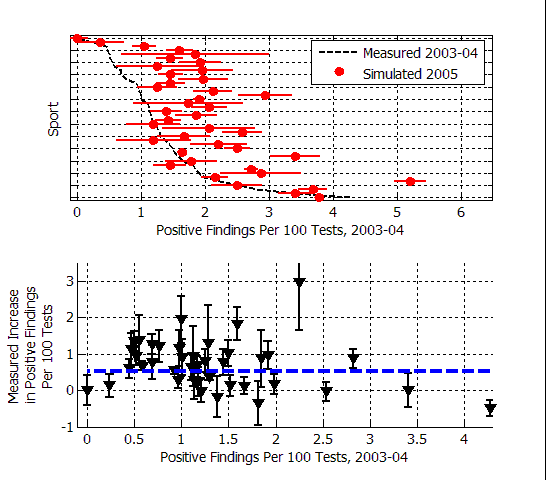
Measured positive test rate changes

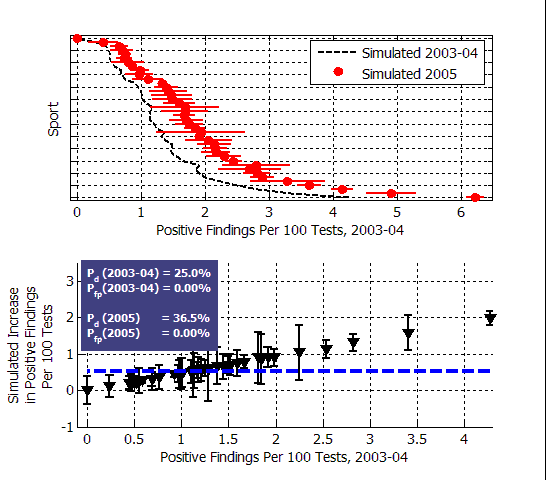
The figure above shows some of the key data summarizing that increase. The upper plot shows the positive test rates for the period 2003-2004, and for 2005, for all of the sports. The sports are arrayed on the vertical axis, although the names are not shown in this plot — see Figure 1 from Part 2 for more detail. The positive test rate, defined here as the number of A-sample adverse analytical findings divided by the total number of tests, is displayed on the horizontal axis. The error bars on the positive test rate are calculated on the basis of the total number of tests performed. Large error bars mean there were few tests performed, and small error bars mean that there were many tests (see this post for details).

The lower plot shows the change in the positive test rate (2005 rate minus the 2003-04 rate) plotted as a function of the 2003-04 positive test rate. As I noted last time, the curve is consistent with the hypothesis that the increase is the same for all sports, having a mean value of 0.53%.

Now it is interesting to note that almost all of this 0.53% increase can be attributed to a single banned substance: testosterone. The number of adverse analytical findings for testosterone in 2004, in all sports, was 392. The number of adverse analytical findings for testosterone in 2005, in all sports, was 1132. An increase of 740 positive tests, out of 146,539 total tests, would result in an increase in the positive test rate of 0.50%. That's an interesting coincidence.

It also turns out that the test for testosterone was changed between 2004 and 2005. Specifically, the threshold for the testosterone test was lowered:

The 2005 figures include several elevated T/E ratios [a urine parameter used in anti-drug tests] over 4, which were not reported in previous years when the threshold was 6, partially accounting for the increased number of AAFs in 2005. (source, PDF)

Now, lowering your failure threshhold is guaranteed to accomplish two things: it will increase your probability of detecting cheaters, and it will increase your probability of "catching" innocent athletes by mistake. The degree of each change will depend on how many cheaters are below the current threshhold, and how many non-cheaters are above the new one. To be honest, I don't know the details of those distributions, but the observations we do have (provided by WADA) might be of some help in assessing the change. I don't have the testing breakdown by sport by substance, so I'll have to look at the global data for all banned substances.

To quantify this a little bit further, I'll assume that within each sport, a fraction DS of the population of tested athletes are using banned substances, where DS is different for each sport. I'll assume that when one of those cheating athletes is tested, there is a probability Pd (the probability of detection) that the test will give an adverse analytical finding, and that Pd is the same for all forty sports. (In other words, drug testing, overall, is equally effective in all sports. I don't think that's really true, but I'll do my best to gloss over that fact when I'm finished.) Finally, I'll assume that when any athlete (clean or dirty) in any sport is tested, there is a probability Pfp that the test will generate a false positive.

Under these assumptions, when N athletes are tested, the expected number of positive tests will be given by:

      A = N (Pfp + Pd DS) ,

and the positive test rate will be simply A/N. Since we're talking about positive tests for all banned substances combined, the probabilities and rates in the equation above have to be averaged over all banned substances as well.

I've run some simulations using this equation to try to estimate the effect of changing the probabilities Pd and Pfp. I set N equal to the number of tests actually performed, using the 2005 numbers as a basis, and then ran multiple Monte Carlo simulations to estimate the statistics of the distribution of the number A of observed positives. The underlying doping rates DS are unknown, but once the values of Pd and Pfp are specified, then the doping rates have to be set to match the observed positive test rates for 2003-04; from there I can simulate the effect of changing either Pd, or Pfp, or both, while holding the DS fixed.

If drug testing was more effective in 2005 than it was in 2004, I can model that as an increase in Pd for all sports. To make things simple, I'll assume for the moment that the probability of false positives is zero. I don't really have any idea what to use as the value for Pd in 2003-04, but for starters I'll assume that the probability of catching a doping athlete with a drug test was 25%.

If that probability increased to 36.5% in 2005, then the simulated positive test rates would be as shown in the figure below:

Simulated positive test rate changes

The upper plot shows the simulated positive test rates for the two proposed values of Pd, where the doping rates DS are set to match the 2003-04 observations, and then held constant for the 2005 simulation. The error bars on the positive test rates indicate the standard deviations of the Monte Carlo runs, and the red circles indicate the means.

The increase in Pd was chosen to match the mean observed increase of 0.53% in all sports, indicated by the dashed blue line on the lower plot. The same result is obtained from any similar proportional change in the probability of detection. In other words, an increase from 25% to 36.5% looks exactly the same as an increase from 65% to 95%, or from 10% to 14.5%.

As you can see, if the probability of detection is increased for all sports, then the greatest increase in the positive test rate should be in sports with the highest positive test rates, and the sports with very low positive test rates show the smallest increase. The expected increase is proportional to the initial positive test rate. That doesn't actually match the observed changes very well. In general the sports with the highest positive test rates showed little or no change in 2005 compared to 2003-04.

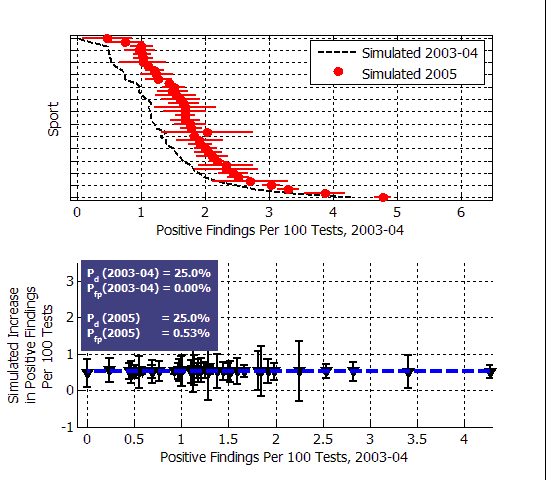
But what if, instead of increasing Pd, we simulated an increase in Pfp, the false positive rate? Then the picture looks quite different:

Simulated positive test rate changes

The figure above shows the effect of increasing the false positive rate in all sports from zero to 0.53%. In this case, the positive test rate is increased uniformly for all sports, regardless of the underlying doping rate. (I used a probability of detection of 25% for the simulation, but that parameter turns out to be irrelevant to the increase.)

Modelling the 2005 increase as an increase in the false positive rate looks like it matches the observations quite a bit better than an increase in the detection rate. Given the sample uncertainty, as I stated at the outset of this post, the observed increase is consistent with a uniform change in all sports.

One small problem with this theory is that the postulated false positive rate is pretty high. If Pfp = 0.0053 for all sports in 2005, then that should set a lower threshold on the observed positive test rates. Both luge (0%) and softball (0.37%) came in under the limit in 2005, but the number of tests involved was very small. With 178 tests in luge, we would have expected 0.94 positive tests, whereas none were observed. In softball, 542 tests should lead to 2.87 positives, whereas two were observed. So we're talking about less than one "missing" positive test in each case — I don't think we can rule out a false positive rate of 0.53% quite yet, and I think we have to at least consider the possibility that the false positive rate increased significantly in 2005.

Of course the assumptions I've used in my analysis are pretty simplistic; certainly all sports don't have the same kind of doping problem, and therefore their anti-doping programs are not all the same either. But my conclusions are based on a comparison of broad trends, and don't really depend critically on that assumption, I don't think. For a future analysis, it would be really nice if I could study the positive test rate changes for testosterone by itself, since I think that the increase in positive test rates was largely due to the changes in the testosterone test. Unfortunately, WADA doesn't provide that breakdown.

Some people might also reject my very first assumption, which was that athlete behaviour (specifically doping rates) didn't change between 2004 and 2005. What if they did change? Well, assuming that the tests were consistent from year to year, the observed changes in positive test rates suggest that the rate of doping increased more or less uniformly across the board. I can't really tell the difference between that event and a change in the false positive rate.

I have to live with the limitations of the analysis, which means that there's no "smoking gun" here. But everything I've looked at in the 2003-2005 statistics suggests that the increase in the positive test rate in 2005 came largely at the expense of athletes that weren't cheating in the first place.

July 11, 2006

WADA Statistics 2005, Part 2

Last September I wrote about the statistics of anti-doping tests. More recently WADA released the statistics for out-of-competition tests they conducted in 2005. As I noted at that time, there was a statistically significant rise in the percentage of positive tests in 2005 compared to 2004.

Last month, WADA released their annual report covering all tests conducted by WADA-accredited labs. That includes all in-competition and out-of-competition tests conducted by the various IFs, as well as those conducted by WADA directly. That's a huge number of tests, and the archives include detailed results for 2003 and 2004 as well. I'm going to spend a couple of posts looking at these numbers in more detail.

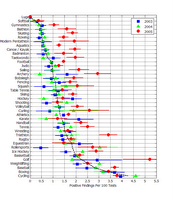
In Figure 1 (inset), I have plotted the positive test rate (number of positive tests divided by the total number of tests). The results are shown for each of the three years for all Olympic sports, and the five summer sports that are on the "short list" for inclusion in the Olympics. The total number of tests was more than 145,000 in 2005.

Figures

Figure 1 - Positive test rates 2003-2005

Figure 1 — positive test rates at WADA-accredited labs in 2003, 2004, and 2005 (click to enlarge).

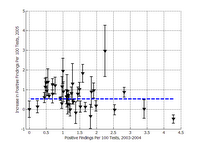
Figure 2 - Positive test rate changes in 2005

Figure 2 — changes in the positive test rate in 2005 compared to the average for 2003-04 (click to enlarge).

Back in September I discussed how the sample size (number of tests) can be used to estimate the uncertainty in the measurement. Similar error bars are shown in Figure 1.

At the time I explained that calculation, I sort of glossed over the meaning of those error bars. I'm going to talk about changes in positive test rates, and in the next part of this post I'm going to speculate about reasons why those test rates changed in 2005, so I should be a bit more careful about that point here. What the error bars represent is the statistical distribution of positive test rates that you would measure if you repeated the ensemble of tests many times using different (but equivalent) random samples of athletes. If the tests don't change, and the behaviour of the athletes doesn't change, then the error bars should also represent the year-to-year variation in positive test rates.

As was the case with the much smaller sample I discussed in April, there was a statitsically significant increase in the positive test rate in 2005 compared to 2004 and 2003. The overall rate, averaged for the 40 sports, was (1.51 ± 0.36)% in 2003, (1.67 ± 0.35)% in 2004, and (2.10 ± 0.38)% in 2005.

It's also interesting to look at the increase on a sport-by-sport basis. Figure 1 demonstrates that the increase is roughly constant for all sports, although there are of course some exceptions. Figure 2 explores this in a little bit more detail, showing the difference between the 2005 positive test rate and the average of the 2003-04 positive test rates. Where the change is positive — as most of them are — it indicates more positive tests in 2005. The blue dashed line is the average change, which is 0.53%. When we take the error bars into account, the changes are consistent with the assumption that the positive test rate has increased uniformly for all sports.

If you squint, you might even convince yourself that the increase has been greatest for sports with low positive test rates, and less for sports with the highest catch rates. In the next part of this post, I'll talk a little bit more about what kinds of changes might lead to that kind of distribution.

Speaking of sports with high positive test rates, something struck me when I was comparing the 2003 results from my September post to the 2003 curve from this post. Namely, the 2003 rates reported by WADA are significantly higher than those reported by the IFs for the IOC report that was the basis of my earlier post. This is true across the board, but I particularly noticed cycling and triathlon.

Cycling was, by WADA's measure, the dirtiest of all 40 sports in 2003, with 486 positive tests out of 12,352 total (3.93%). In the IOC report, the UCI noted a total of 61 positives out of 12,352 tests (0.49%). The ITU similarly reported no positives out of 1664, whereas WADA's accredited labs counted 23 positives.

So what gives? It turns out there's a subtle difference in what's being reported. The IOC report counts "Number of tests reported that resulted in anti-doping rule violations," whereas WADA counts "A sample adverse analytical findings." The WADA reports footnote that fact, stating:

These figures may not to be [sic] identical to sanctioned cases, as the figures given in this report may contain findings that underwent the Therapeutic Use Exemption (TUE) approval process. In addition, some adverse analytical findings also correspond to multiple measurements performed on the same athlete, in the case of longitudinal studies on testosterone.

This of course leads to a natural consideration of false positives, which I will also touch on in the next part of this post. But there's an interesting piece of data in the WADA results that sheds some light on the issue. The sport of Luge has not had a single positive test in three years (458 tests). This lets us put an upper bound on the false positive rate — the probability that an innocent athlete will have an adverse analytical finding by random chance. Based on the results from luge over the past few years, it can't be much more than 1 in 500 or 0.2%. Of course, if it's really that high I would be pretty dismayed — that would mean that about 290 tests (0.002 × 145000) were false positives in 2005 alone.

May 19, 2006

WADA: Best Two Out of Three

Should listening to music before your race be a violation of the World Anti-Doping Agency Code?

Section 4.3 of the WADA Code (PDF) identifies the Criteria for Including Substances and Methods on the Prohibited List (PDF). Rather than quoting the criteria, I will reproduce here the note attached to this section. The language is less technical, but captures the essence of the criteria, and includes a few interesting examples to help explain the rationale:

A substance shall be considered for inclusion on the Prohibited List if the substance is a masking agent or meets two of the following three criteria: (1) it has the potential to enhance or enhances sport performance; (2) it represents a potential or actual health risk; or (3) it is contrary to the spirit of sport. None of the three criteria alone is a sufficient basis for adding a substance to the Prohibited List. Using the potential to enhance performance as the sole criteria would include, for example, physical and mental training, red meat, carbohydrate loading and training at altitude. Risk of harm would include smoking. Requiring all three criteria would also be unsatisfactory. For example the use of genetic transfer technology to dramatically enhance sport performance should be prohibited as contrary to the spirit of sport even if it is not harmful. Similarly, the potentially unhealthy abuse of certain substances without therapeutic justification based on the mistaken belief they enhance performance is clearly contradictory to the spirit of sport regardless of whether the expectation of performance enhancement is realistic.

This two-out-of-three business is a complicated matter. Is it really necessary to prohibit methods or substances (other than masking agents) that aren't performance-enhancing? I guess the last sentence of the note attempts to explain the rationale; if an athlete believes that a substance is performance-enhancing then he or she is trying to cheat, and therefore violating the spirit of sport. But isn't that a bit crazy? If Chinese swimmers believe that their success is due to caterpillar fungus soup, does that mean that eating caterpillar fungus soup is contrary to the spirit of sport? Even if they're wrong?

This nebulous "spirit of sport" is defined more fully in the Introduction to the Code:

Anti-doping programs seek to preserve what is intrinsically valuable about sport. This intrinsic value is often referred to as "the spirit of sport"; it is the essence of Olympism; it is how we play true. The spirit of sport is the celebration of the human spirit, body and mind, and is characterized by the following values: ethics, fair play, and honesty; health; excellence in performance; character and education; fun and joy; teamwork; dedication and commitment; respect for rules and laws; respect for self and other participants; courage; and community and solidarity. Doping is fundamentally contrary to the spirit of sport.

Once you have separated out the issues of performance enhancement and health, does the "spirit of sport" clause add anything useful to the argument? It seems to me that there are some serious problems with this definition in conjunction with the two-out-of-three criteria. If part of the spirit of sport is "health," does that mean that everything that's bad for your health is contrary to the spirit of sport? If so, then any substance or method that's bad for you — for example, smoking — automatically meets the two-out-of-three criteria for inclusion on the prohibited list.

And as for performance-enhancing methods and substances, the Code requires WADA to rule on which are "unethical" or "unfair." In practice, it seems to me, this means that the Prohibited List could be extended to include almost any performance-enhancement technique.

Recently the WADA Ethical Issues Review Panel ruled that hypoxic tents are contrary to the spirit of sport. Hypoxic tents allow athletes to simulate the effect of sleeping at high altitude. The tent contains an oxygen-poor environment; sleeping in the tent stimulates an athlete's body to produce extra red blood cells, which may increase performance in endurance sports. Hypoxic tents are used by a significant number of athletes, particularly in cross country skiing, cycling, and triathlon.

Few people dispute the theory that hypoxic tents are performance-enhancing. If we take the decision of the ethics panel at face value, that means that they would qualify as a Prohibited Method under WADA's criteria. The WADA Executive is clearly reluctant to make that ruling, but they find themselves in a bit of a tight spot. WADA recently announced that they would "seek broad stakeholder comment" on the question of whether hypoxic tents are an unethical performance-enhancing method or not.

So in what sense are hypoxic tents unethical or unfair? How should we decide? I would submit that they are unfair only to the extent that they are performance-enhancing; that is, if the tents were not performance-enhancing then they could not be unethical. There is clearly more to this, of course; at least in the minds of the ethics panel, there is a line between the use of hypoxic tents on one hand, and living at high altitude on the other. At least for now, one of these is "artificial" enough (I'm speculating) that it is not an ethical training practice. But is it really a good idea for WADA to be making such subjective evaluations? Is it necessary?

Let me bring you back to the hook that started this post: could music be added to the list of Prohibited Methods? A few months ago I came across an opinion posted at The Doping Journal. Alexei R. Koudinov of the Russian Academy of Medical Sciences noted that some swimmers at the Olympics in Athens were using headphones when they arrived on the pool deck. Koudinov goes on to point out:

Michael Phelps enhancing oxygen transfer before a race
Previously published research … showed that in humans, music makes saturation of oxyhemoglobin (SPO(2)) significantly higher … The statistically significant higher SPO(2) level indicates the "enhancement of oxygen transfer" and implies that "music by the pool" is prohibited by WADA in competition blood-doping method of "the use of products that enhance the uptake, transport or delivery of oxygen"*, apparently conflicting with the essence of olympism, and WADA calls for "ethics, fair play and honestly [sic]."

*Here Dr. Koudinov is quoting from an older version of the Prohibited List. The new version refers to "artificially enhancing the uptake, transport or delivery of oxygen."

I assumed, when I first read this, that Dr. Koudinov intended it to be a satirical barb pointed at WADA's policies. (The "previously published research" he cites concerns music therapy applied to premature infants.) After further investigation, it appears that Dr. Koudinov is quite serious. Although his campaign is unlikely to lead to any action by WADA, is this really so much different than the debate over hypoxic tents? Dr. Koudinov is arguing that listening to your pre-race psych-up tape is performance-enhancing. Most athletes who listen to music before their competition would not dispute that statement, although they may not swallow Dr. Koudinov's explanation of the mechanism for the improvement. That mechanism, he argues, puts pre-race music in the same category as EPO — and hypoxic tents. Note that Dr. Koudinov explicitly refers to the WADA spirit of sport definition.

Could WADA really go there? Are headphones going to be banned on the pool deck? Well, that's very unlikely, I would think. On the other hand, I do think that the current criteria, with their slippery two-out-of-three conditions, leave WADA open to just this kind of nonsense.

April 17, 2006

WADA Statistics 2005

A couple of weeks ago WADA released a summary of their anti-doping test results for 2005. The rate of positive tests saw a sharp increase, from 1.03% (19/1848) in 2004, to 1.96% (61/3114) in 2005.

I have written before about the fact that these numbers, as reported, never include error bars — estimates on the uncertainty in the real rate of doping.

As I noted in that post, if we assume that the rate of positive tests is an accurate measurement of the doping rate in the athlete population, it's actually fairly simple to calculate the uncertainty that goes with that measurement. Using that algorithm, the 2004 rate becomes (1.03 ± 0.24)%, and the 2005 rate is (1.96 ± 0.25)%. The increase is almost four standard deviations, so it's clearly significant.

WADA had their own explanation for the increase:

The 2005 figures include several elevated T/E ratios [a urine parameter used in testosterone testing] over 4, which were not reported in previous years when the threshold was 6, partially accounting for the increased number of AAFs [Adverse Analytical Findings] in 2005. However, there is a significant increase in other AAFs, such as those for steroids. One reason for this may be WADA’s increasingly targeted approach to testing.

WADA is suggesting, then, that the increase in the rate of positive tests is not due to an increase in the rate of doping; it's because of an increase in the effectiveness of the testing program. In short, WADA has succeeded in testing more cheaters. We can take that suggestion under consideration; it's difficult to prove the case either way.

I should (again) point out that the measured doping rate is still extremely low. I think it is far below the rate that most people would guess, if you asked them what percentage of elite athletes use performance-enhancing drugs. Although I would have to assume that the measured rate is an underestimate of the actual rate, I think the common wisdom exaggerates the prevalence of doping.

I've come to realize, however, that this is almost like arguing over religion; some people will never be convinced. A lack of positive tests simply proves, for those sports fans, that the testing program is ineffective. It's the old axiom that "absence of evidence is not evidence of absence." And if the positive test rate ever reached zero, it would only prove that testing is 100% ineffective. So to those people, I have to ask: what kind of proof would change your opinion? Perhaps you'd be convinced by around-the-clock surveillance?

Even if an athlete is tested every day, somebody will suggest that we don't know what he's doing in his bathroom after showering and maybe that's when he injects undetectable steroids. … OK, fine, says the athlete. Put a Web cam on me for six months before the Olympics and feed it straight to a small panel of testers at USADA. Then they will know what I'm doing in my bathroom. Better yet, attach a USADA rep to my hip for six months before the Olympics. Let him check the trash every day. Let him frisk my visitors.