Showing posts with label Canoe-Kayak. Show all posts

October 23, 2006

Stone Cast: Olympian Struck

Three-time Olympian and world championship silver medallist Tamas Buday Jr. needed three stitches to repair a cut below his left eye on Saturday. Buday was hit by a rock thrown from a railway bridge across the Credit River while he and his brother Attila were paddling in Mississauga.

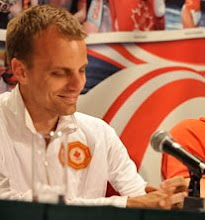
Tamas Buday (Toronto Star)

Tamas (a very young teammate of mine in 1996) is extremely lucky that the damage was not more serious. He is lucky that he was paddling in C-2, and therefore didn't go into the water. He is lucky that he was accompanied by his coach (also his father), which isn't true for every workout. And he is lucky that the rock struck him a relatively glancing blow and did not do more permanent damage.

The young morons who perpetrated this crime were chased off by Tamas Sr. The Buday brothers made some solicitous comments in the Star article, suggesting that the youths are "just kids" who "don't understand the consequences" of their actions. According to an e-mail I received this morning, their delinquency goes a bit further than the usual restlessness of youth:

… probably we scared enough the guys that they felt to respond: Today morning the two north door of the canoe club was full with graffiti including a bunch of swastika, mafia, fuck the canoe club, Hitler my god, and rock band names … Larry and I removed those.

(Thanks to Sean for the Star link.)

September 26, 2006

Rules of the Game

Scott at Timed Finals had an interesting post a few days ago about the various different sets of rules in effect at swimming competitions in the United States.

Scott examines the use of the butterfly kick in breaststroke events and points out that some young swimmers are bound by one set of rules at USA Swimming events and a different set of rules at National Federation of High Schools events. (The former organization runs the US national team and development programs, and the latter governs high school swimming competitions.)

This high school season, the National Federation Swim and Dive Rules Committee changed its rules to allow butterfly kicks, but to the dismay of many coaches and athletes, the rule is different from the USA Swimming rule. The butterfly kick - in which the leg bends and the legs move together in unison - allowed in high school swimming this year permits a swimmer to take a dolphin kick only after the arm stroke, not at any point in it.

What’s the problem then? The high school swimmers who swim for USA Swimming clubs are taught to take the dolphin kick at whatever point in the arm stroke they feel comfortable.

Scott goes on to express the opinion that the competition rules should be uniform and charges the various governing bodies "to come together to discuss these rules in order to keep everyone on a level and similar playing field."

I myself have a role in one of those governing bodies — not for swimming in the United States, but for flatwater canoe-kayak in Canada. I am currently the chairman of the committee that has responsibility for setting the racing rules for national team trials.

Members of the Canadian national canoe-kayak team have to race under at least three different sets of rules during a season:

  • Domestic racing rules established by CanoeKayak Canada and in force at regional and national championships, where athletes race for their clubs;
  • National team trials racing rules established by the High Performance Commitee of CKC and in force at national team selection trials, where athletes race for selection to international competition; and
  • International racing rules established by the International Canoe Federation and in force at international competitions, where athletes race for Canada.

The domestic competition rules are quite different from the international rules. That's partly because those rules are determined by majority vote of the member clubs of CKC, and there is no higher governing body "handing down" rules that must be followed. And partly it's because the scope and objectives of domestic competition are very different from the scope and objectives of international competition.

As I noted, I have some responsibility for setting the second set of rules. The primary purpose of the national team trials is to select athletes for international competition. To do that, we need to let the athletes perform on a fair and level playing field, and we need to collect objective data (rankings and times) that are used to make the selections. A secondary purpose of the trials is to prepare athletes for international competition. In this respect we want to simulate ICF-sanctioned regattas as closely as possible.

In general, then, we stick closely to the ICF rules (PDF) because it clearly supports the secondary objective. But sometimes strict adherence to ICF rules undermines the primary objective.

For this reason there are a very few ICF rules that we do not enforce at our trials; for example, rule 14.1:

At least three kayaks or canoes must be entered before the race can be held. …

We sometimes hold races with two crews, or even only one crew, for example in cases where a crew has yet to meet some minimum performance standard. We also sometimes hold events (usually women's canoe races) that are not yet recognized by the ICF.

This is a relatively minor variance, to which nobody objects. Other cases are not so clear-cut. Here's an example of a very unpopular ICF rule (16.3) that we do enforce at our Trials:

If the competitor does not start, and has no valid reason approved by the Competition Committee, he shall be disqualified for the whole regatta. A competitor, who arrives too late at the start, shall be considered to have voluntarily withdrawn and shall be disqualified under this rule.

ICF rule 16.3 was most famously invoked at the 1988 Olympic Games. French paddlers (and heavy favourites) Philippe Boccara and Pascal Boucherit missed the semi-final for their K-2 1000m semi-final, which was held a short time after Boccara had qualified for the K-1 1000m final. Under rule 16.3 Boccara was disqualified not only from progressing further in K-2, but also from racing the final in K-1 (more here under "Distraits," if you read French).

The rationale behind rule 16.3 is somewhat convoluted. Basically the rule tries to prevent athletes and teams from corrupting the seeded draw by entering events they have no intention of racing. In our case, most of the athletes who run afoul of this rule are young paddlers at their first trials who miss the start of their first heat and then are not allowed to race the entire weekend in any event — singles, doubles, or fours at any distance. By enforcing the rule, we are eliminating the opportunity to evaluate those athletes (and for them to evaluate themselves) against their peers. In other words, we're undermining the primary purpose of the competition. If the enforcement of the rule is not making a significant improvement in the fairness of the competition, then its only purpose is to "teach athletes a lesson" about ICF rules, and that has to be balanced off against the detrimental effects.

Other variances can arise if we start to think that an ICF rule is itself unfair or open to manipulation. Lately I've been starting to wonder about ICF rule 9.3, which concerns boat weighing and measurement following each race:

… Three or more boats according to the decision of the Competition Committee and on a random system shall be re-controlled [weighed, measured, and inspected] immediately after the race.

Usually at the trials we call four boats to boat control; if we call them "on a random system," you have a 5/9 chance of not being checked after your race, even if you win. Part of the primary purpose of the trials is to ensure a fair and objective evaluation of our athletes, and I am not sure that rule 9.3 safeguards that fairness well enough. I would feel more comfortable with a system where the top finishers are always checked — or possibly where all boats are checked.

In such an event, the committee must deal with a temptation to modify the ICF rule and make it "better." Probably something like this is sentiment is the cause of the minor rule difference that Scott pointed out from US swimming. There will always be some tension between the desire to make the rules uniform and the desire to make the rules suit your specific purpose.

August 29, 2006

In the Wind

This weekend CBC Sports broadcast the ICF World Flatwater Championships from Szeged, Hungary. The broadcast was not live — competition was held the weekend before — but that's about the only complaint I can come up with about the coverage. Commentators Scott Russell and Scott Logan did a very good job putting things in context. They made a few factual slip-ups, but you would have to be a real know-it-all to point those out. Best of all, we got to see every final Canada was in — two and a half hours in all.

The local organizing committee should also be commended for giving the championship some good exposure. There were two things that I wanted to mention in particular. The first was the use of some unusual camera angles during the races. There was one mobile overhead camera in particular that gave a few fabulous shots from right on top of the boats. It provided some very dynamic views of the athletes as they passed by during the races.

The second item that was very cool was the event web site. If you go to the Results page and click on "Download Full Results," you can download a CD Image file of all of the race results — heats, semis, and finals, including all of the finish photos. The .iso file can be burned onto a CD and you will then have a web-browser-ready database of all of the race results.

Speaking of race results, there were lots of interesting things that happened at the World Championships this year. I won't talk too much about the Canadian team results, except to say congratulations to the team and all you sports fans should be ashamed of yourselves for the attention you don't give our amateur athletes.

Kidding, I'm kidding. But since I have all those results on CD now, let me try to dig something interesting out of the data. Specifically, I wanted to take a look at the influence that the wind conditions had on some of the races, since that point was raised a few times by Russell and Logan during the broadcast.

Flatwater canoe-kayak races are seeded from the middle out, just like swimming races and athletic sprints. The course has nine lanes, and the (nominally) fastest crews are put in the middle lanes, with the (nominally) slower boats in the outside lanes. When everything works properly, you get a photo finish that looks like this:
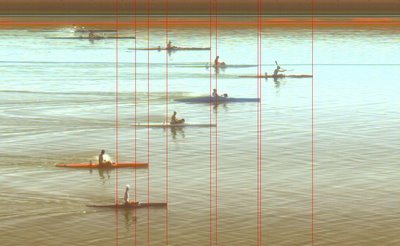
Finish photo from 2006 world flatwater canoe-kayak championships, showing typical pattern of lanes

In Szeged, lane 1 is furthest from the judges' tower, at the top of the photo, and lane 9 is closest, at the bottom. If we look at the ensemble of all races at the World Championships, including preliminary rounds, we can see that the seeding is generally pretty good:
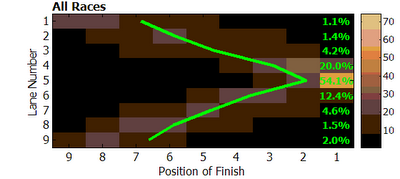
Position of finish versus lane: all races at 2006 world flatwater canoe-kayak world championships

This picture is arranged to mimic the photo finish above; position of finish goes from first place on the right, to ninth place at left, and the lanes go from 1 at the top to 9 at the bottom. The brightness of the image at each point represents the percentage of competitors racing in each lane who finished in each position. The green numbers on the right-hand edge show the percentage of competitors in each lane who finished first in their race. The green curve shows the average position of finish for each lane (1-9) for all 220 races.

You might wonder exactly how this seeding works. For the first round of races, known as heats, competitors are seeded based on prior season results (World Cups etc.). As you can imagine, this is not really an exact science, but the people who do the ranking are pretty effective. Seeding for the semifinals is based on performance in the heats, so the athletes self-seed themselves for the second round. That works even better:
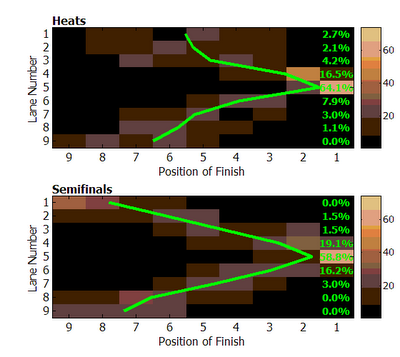
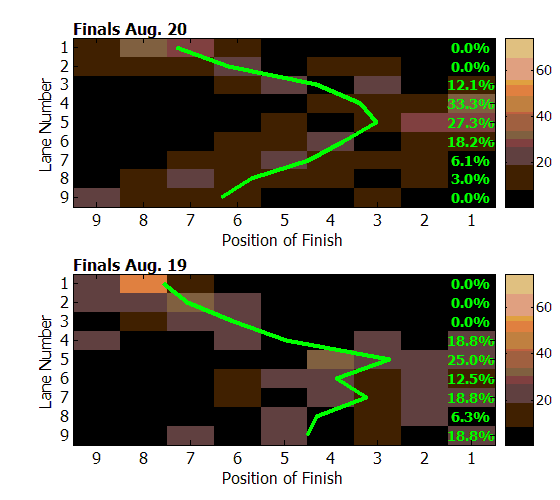
Position of finish versus lane: heats and semis at 2006 world flatwater canoe-kayak world championships

In this picture, the top image includes the 103 heats, and the bottom image shows the 68 semifinals. You can see that the seeding in the heats and semifinals is a very good predictor of performance. In these preliminary rounds, more than 60% of winners come from lane 5, and only a few from lanes 1, 8, or 9.

In fact, over two and a half days and 171 races, there wasn't a single winner from lane 9. And then came the afternoon of Saturday, August 19.

The finals don't go quite as strongly according to seed as the preliminary rounds, even when everything goes right. That's because the separation between the fastest and slowest paddlers shrinks when you get to the final. It's also because the seeding has a random component to it. For example, in men's K-1 there are four semifinals, and the winners go into the four middle lanes; only one of them can have lane 5, and that selection is made in a pseudo-random manner so that athletes can't easily choose their lane for the final.

But on average, you would still expect my probability diagrams to be fairly symmetric around lane 5, even if they're not as strongly peaked as they are for the semis. The upper image in the plot below shows the statistics for the 33 finals held on Sunday, August 20 (all 500 m and 200 m finals). I wasn't there in person, but from the broadcast it looked like pretty ideal conditions on Sunday — flat calm or slight headwind. There is not a strong asymmetry in the expected position of finish, which supports the idea that the wind conditions were fair.
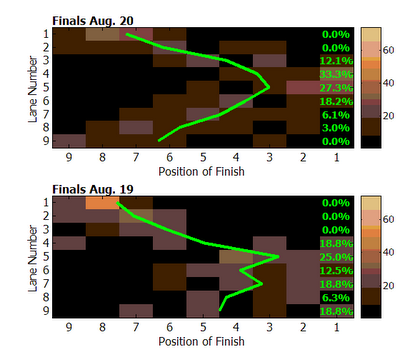
Position of finish versus lane: finals at 2006 world flatwater canoe-kayak world championships

On Saturday afternoon, though, it was pretty clear that some lanes were better than others. The lower plot shows the statistics for the 16 finals (A and B finals) held on Saturday afternoon. As you can see, the distribution of finishes was significantly altered. Competitors in the near lanes had enhanced performances relative to competitors in the far lanes. There were even three winners out of lane 9, one in a 'B' final and two in championship finals.

From the broadcast it appeared that there was a significant cross-headwind during the 1000 m finals. Again, it's difficult to assess the conditions from the pictures on TV, but the statistics seem to show a pretty clear advantage for the high-numbered lanes, where the Szeged course is more sheltered by the shore and the grandstand. My point here is not to make excuses for anybody, nor to discount the two world championships earned by paddlers in lane 9. Canoe-kayak is not like swimming, where most environmental factors can be rigorously controlled. That's just the nature of our sport; sometimes the conditions work in your favour, sometimes they work against you, and hopefully most of the time it's neutral.

August 19, 2006

More Than One Way Into the Olympics

Mark Keast wrote a piece in the Toronto Sun last week about the IDBF World Dragon Boat Club Crew Championships held in Toronto last weekend. The article was titled "Olympic hopes a long shot" and described some of the hurdles that the sport of dragon boat faces in gaining inclusion in the Olympics.

I wanted to point out that there are some interesting facts missing from the discussion about dragon boat racing in the Olympics. Here's what Keast wrote:

Haslam [executive president of IDBF] thinks it will take at least 20 years to get into the Olympics. The sport needs recognition as an Olympic federation first. Before that, it needs 75 national federations around the world under its umbrella. Dragon boating currently has around 60, Haslam said.

Indeed, the IDBF has a lot of hurdles to clear before it can get dragon boat into the Olympics. Even if it can gain recognition as an IF, the IDBF will still have to get the sport elected onto the list of Olympic sports; as we've seen before, the Olympic Charter says that this requires two-thirds support of the IOC membership, and that's a very tough standard to meet.

What the article doesn't mention, however, is that there's another possibility for dragon boat.

The sport of drachenbootrennen was in fact already included in the 2005 World Games. If you've never heard of the World Games, its a competition that the IOC supports as a sort of audition for the Olympics. Triathlon and taekwondo are both sports that entered the summer Olympic programme after a try-out at the World Games.

But you might ask yourself how a sport gets a place in the World Games when the IOC doesn't recognize its IF. That's the part that Mr. Haslam of the IDBF didn't mention: the IOC already recognizes the International Canoe Federation as the IF responsible for dragon boat.

And the ICF is not just a recognized IF — it also has two disciplines already on the summer Olympic programme. If the ICF decided that they wanted to add dragon boat as a new discipline of the sport of canoe-kayak, it would only require approval of the IOC Executive. The IOC members wouldn't get to vote on the idea, at least not directly. So if dragon boat really wants into the Olympics, then going in through the ICF would significantly reduce some of the political hurdles.

Of course, it would increase some others. Mainly, the dragon boat lobby would have to deal with the internal politics of the ICF. Those two Olympic disciplines I mentioned (flatwater and slalom) would not be too keen to give up any of their events to dragon boats, and the ICF is probably not strong enough to wrestle extra medals from the IOC's quota. Trying to strike out as an independent IF allows the sport of dragon boat to be, well, independent, with an IF that is looking out for its interests alone.

So although the ICF has an "official" responsibility for dragon boat's Olympic destiny, that's currently not worth very much. The IDBF-sanctioned competitions are much better attended, and more prestigious, and the ICF World Championships are a poor cousin to the IDBF event. Without a credible World Championship, the ICF couldn't get dragon boat into the Olympics even if it did want to, and without recognition by the IOC, the IDBF can't either. It isn't entirely clear whether the IDBF will ever be recognized. The Sun article makes it sound like it's a simple matter of having 75 member national federations, but the existence of the ICF within the IOC will complicate matters. At any rate, the acrimony between the two federations doesn't help either side, and trickles down to the competing national federations as well.

I'm not arguing that the sport of dragon boat would be "better off" under the ICF umbrella. But I do think that this is an interesting example of the politics of Olympic sport. I will be watching to see how this power struggle plays itself out as competitive dragon boat racing continues to grow.

August 08, 2006

Por Falta de Água

The Pan American championships for canoe-kayak slalom are being moved to Madawaska, Ontario, por falta de água — for lack of water.

The competition had been scheduled to be held in September, on Brazil's Itaipu Whitewater Canal. The Itaipu canal was opened in May of this year on a part of the outflow from the massive Itaipu Hydroelectric Dam.

The Amazon River basin is entering its second consecutive year of severe drought, and reservoirs are at 25% of capacity. Last week the Brazilian government declared a state of emergency across the region.

Rivers and lakes have become sand and mud. Millions of fish rot in the sun. Boats are stranded. A massive fire rages out of control along Brazil's eastern coastline. Hundreds of towns receive emergency deliveries by the Brazilian Air Force, including water-purifying chemicals to counter the threat of disease. The Amazon rain forest is drying out as the worst drought on record lingers into its second year. … Scientists do not consider the Amazonian drought to be temporary or local. Scientist Carlos Nobre, of Brazil's National Institute of Space Research (INPE), said, "This drought has no parallel in the last 103 years" since the water levels began to be measured.

The Pan American event will be held on August 19 and 20 in conjunction with the Canadian national championships.

"It's ironic that I heard about the Amazon drought because an email about a sports event" said 18 year old Sara Potvin-Bernal of Chelsea, Quebec, one of the kayak athletes looking forward to the National Championships, and now to the PanAms. "With all the war news dominating headlines right now, it seems hardly anyone has noticed that the Amazon ecosystem is in the middle of a collapse."

July 07, 2006

Gert Fredriksson, 1919-2006

I once had a Hungarian coach (who I have written about before) who used to teach us about kayaking in his own unique language. As part of that language there was a particular phrase that he used almost as a litany when discussing the historical stars of our sport. Whenever he mentioned the name of one of the greats — Helm, Parfenovich, Barton, Gyulai, Holmann — it was always followed by the responsorial psalm, "You know, he was many times World Champion."

A contemporary of Coach K—'s, Gert Fredriksson of Sweden, died Wednesday at the age of 86.

Gert Fredriksson from www.olympic.org

Fredriksson won six gold, a silver, and a bronze medal in flatwater kayaking over four Olympic games (1948-1960), which makes him the most decorated man in the history of Olympic canoeing. He also won seven World Championships outside of the Olympics. No other man has ever won more than his thirteen combined Olympic and World titles. He holds the unofficial records for the largest margin of victory in any Olympic canoe or kayak race, and for the largest margin of victory in any race that is still contested at the Olympics. When he won his final Olympic championship, he was nearly 41 years old.

Gert Fredriksson, 21 November 1919 - 5 July 2006.

You know, he was many times World Champion.

June 14, 2006

UltraAmateur Sport

A few months ago I agreed to become a member of the organizing committee for the Medavie Blue Cross Canoe Challenge. The Canoe Challenge is a charity event that has raised over a million dollars (Canadian) for the IWK Health Centre Foundation and Ronald McDonald House Atlantic.

The Canoe Challenge is an interesting example of a very popular kind of event, the sport-based charity fund raiser. The basic structure of the sport-based charity fund raiser is as follows. Individuals or teams sign up for a sporting event in support of a good cause. They go out to their communities looking for sponsorship. They bring their sponsorship money to the sporting event. They "compete" against other individuals or teams. There are token prizes for winning the competition, and more substantial incentives for raising the most money.

If you're trying to raise money this way, it's good to round up as many participants as you can possibly squeeze in. As a rule, charity events are based on sports that are either very popular among adults, or relatively simple to master. No, scratch that. The sport doesn't need to be mastered; in fact, being an expert is really contrary to the basic spirit of the event. The sport does have to be simple to pick up, though. Ideally, most people can do it without any serious preparation. Slow-pitch softball, volleyball, dragon boat racing … these are all good candidates for a charity sporting event.

War Canoe racing at the Canadian national (club) championships

And that's what makes the Canoe Challenge an interesting example: paddling in a war canoe is actually quite difficult. Most adults trying it for the first time are extremely uncomfortable, and the chance of capsizing is fairly high. For those of you who don't know what I'm talking about, here's a picture of war canoe done well (this was not taken at the Canoe Challenge).

There are fourteen paddlers, plus a coxswain, in a boat. The paddlers kneel on one knee and use large paddles to generate a great deal of power. When the boat is full, there isn't much room to move. The boats are not particularly streamlined, but much more so than a dragon boat or a typical recreational canoe. They are also relatively fragile. The event is raced almost exclusively in Canada, over 500 or 1000 m, which takes approximately two or four minutes. The boats themselves are loosely derived from the War Canoe of the North American First Nations.

The War Canoe is so difficult, in fact, that the Dartmouth event is (to my knowledge) the only charity war canoe race held anywhere in the world. Lake Banook is the logical host site for this unique event; the lake is home to three competitive flatwater canoe clubs, and the Halifax regional municipality contains five more. The relationship between the Canoe Challenge and these supporting sport organizations is another interesting aspect of the event. Due to the technical nature of the sport, the organizers lean heavily on the canoe clubs for equipment and expertise. The clubs derive a small financial benefit from their involvement, but on balance they feel that their contributions are not fully recognized. One symptom of the divide between the two groups is evident in the name of the event — Medavie Blue Cross has quietly rebranded the 2006 version as the Canoe Challenge, dropping the unfriendly-sounding "War" that identifies the type of boat.

This year's (War) Canoe Challenge was held on Saturday in miserable weather. Each team was entitled to two practices in the weeks leading up to the event. Only about two-thirds of the teams availed themselves of the opportunity, meaning that ten crews showed up on Saturday having never been in the boat. For the challenge, the crews were limited to twelve paddlers, and the coxswains — who need very specialized skills — were provided by the organizers. Each team races twice over 200 m, with the top teams by aggregate time advancing to a final.

As the organizer of the sporting competition central to the event, I would give it a "B" grade. After a slow start, the races ran roughly as scheduled. About half a dozen crews capsized, but nobody got hurt. About the same number of crews declined to participate in their second race, although that number would have been lower if the weather had been more pleasant. I think the competitors mostly enjoyed themselves, in spite of the conditions. The equipment made it through mostly unscathed.

I also introduced a few new ideas, which I think were quite successful. One of those involved Olympians Canada. Five representatives of the Most Exclusive Club in the Nation participated as honorary coaches for the five teams that raised the most money. I think that this really added something unique to the event. The Olympians threw themselves into their roles with great relish and became enthusiastic members of their assigned teams. Well, four of them did, anyway — I had too much on my plate to really do a good job in my coaching role.

The teams raised $116,000 for the two beneficiaries.

May 29, 2006

Kurva Jó!

Something significant — significant to me, personally — happened yesterday in the small world of Canadian amateur sports. It won't register on the national radar screen, but I think some of the readers of this blog will appreciate it as a sporting accomplishment.

On Sunday in Duisburg, Germany, Canada won the Men's K-4 1000m final at the Duisburg Internationale Kanu Regatta und World-Cup 2006.

Our heroes at an earlier World Cup race in Poland

During my days as an athlete paddling for Canada I was something of a specialist in that event. In fact, that's an understatement — during three World Championships and one Olympic Games, I never raced in anything but K-4, at one distance or another. Looked at in a positive light, I could say that I was a core member of the national team K-4 for about eight years.

But looked at in another way, that national team K-4 was often pretty bad. From 1989 through 1992, we weren't even good enough to qualify to represent Canada at the World Championships or Olympics.

One of the lowest points of my career came sometime in the early 1990s at the Duisburg International Regatta. Duisburg is a tough place to race if you are not competitive with the world's best. Because of the timing of the regatta and the quality of the course, the regatta is always very well-attended. And each competing country can have two entries per event — as opposed to the Worlds, where it's limited to one. In men's kayak, especially, that can make for a brutally strong field. I raced at Duisburg half a dozen times between 1989 and 1996.

In this particular year, I was stroking the K-4 1000m — an inexplicable choice, to be blunt, but one that probably reflected our limited options at the time. In an early heat, my steering led us so close to the 500m start platform that at least one of my teammates had to miss a stroke in the middle of the race. That was a humiliating mistake to make at that level, although our general lack of K-4 skill was really the cause of our last-place finish. The end result: we failed, yet again, to even reach the semi-finals at Duisburg.

So, I spent yet another year at Duisburg with my Saturday afternoon and Sunday free. (As one of my teammates used to point out, this didn't have to be a bad thing. He would quote some of our southern-hemisphere colleagues: "The bad news is, we're out of the regatta. The good news is, we're on the piss!") This time, though, I was questioning whether I was really learning anything at all. Were we, as a team, getting something out of these beatings? Was I, as an athlete, still getting better? This all sounds rather introspective and thoughtful, but it wasn't — I am certain that I was a complete asshole to be around that weekend. All I really wanted to do was go home.

I got over that experience, eventually, although I wasn't finished with my punishment at Duisburg. A few years later, I did eventually get to race in a final there, in K-4 500m — we finished ninth, but it was glorious to belong. And in 1995 Duisburg hosted the World Championships, where we finished ninth in the K-4 1000m final, and also finished fourth in the inaugural K-4 200m event. At the 1996 Olympics, my international K-4 career finished with a seventh-place finish.

These results represented, more or less, the pinnacle of Canada's achievement in men's K-4 up to that point. The current crew — Richard Dober Jr., Steven Jorens, Ryan Cuthbert, and Andrew Willows — smashed through those marks yesterday. I know that these young men, and the whole Canadian team, have travelled their own journey in K-4 over the past six years. That journey was not unlike my own; they too have come from nowhere to here, and not always in a continuous line of progress. But they have now broken through to a place that I can only imagine: what must it have felt like to stand on the top of the podium in Duisburg?

Here's to more breakthroughs on the journey to come: congratulations, guys.

April 21, 2006

Scene of the Crime

I'm away for the weekend, back at the scene of my former glory personal best in Gainesville, Georgia, the Poultry Capital of the World:

Georgia Poultry Park has a 25-foot tall Georgia marble monument topped by a 36-inch bronze rooster, featuring poultry industry information on six plaques at its base.

The Canadian National Team Trials are not being held at Poultry Park, but at Clarks Bridge Park, a much more scenic locale.