September 28, 2005

Cutting Costs vs Winning Votes

Yesterday IOC president Jacques Rogge instructed the seven cities bidding to host the 2014 winter Olympics to keep costs down by concentrating on the essential requirements of the bid. In other words, cut the fat from your proposal, and maybe you won't bankrupt yourselves.

Good idea. Of course, to actually win the right to host the 2014 winter Olympics, the seven host cities have to impress more IOC members than everybody else, and I doubt that a restrained and cost-efficient bid is the best way to win the IOC's collective heart.

The current bid process is essentially a popularity contest, with the winner selected by majority vote of the 100+ IOC members. Until most of those voters take Rogge's suggestion to heart, and make their selection on the basis of the "essential" requirements, there's little point in preaching restraint to the bidders.

September 25, 2005

The Other Shoe?

Back in April I wrote a brief item about the Islamic Solidarity Games, a competition which does not include women as competitors or spectators. The linked article (which has now disappeared) drew a comparison between the Islamic Solidarity Games and the original Ancient Olympics. However, as Ralph Hickok pointed out in the comments, the ancient Greeks also held women-only events which men were not permitted to attend.

Now, I wouldn't say that maintaining a millenia-long tradition of discrimination against women is something to boast about, but the Islamic Games may be closer to the spirit of the ancient Greeks than the original piece suggested. The Islamic Women's Games are being held in Tehran this week.

Male coaches, referees, and spectators are banned from attending any of the competitions, except for golf, shooting, and archery. (Those three sports are exceptions because the female competitors are "modestly" dressed, presumably in the "obligatory headscarf and long coat.") Similarly no photography or video is allowed.

The Women's Games were launched in 1993, and have been hosted by Iran every four years since. They exist either as an opportunity for strict observers of Islam to participate in an elite sporting event without compromising their religious beliefs, or as a sideshow designed to placate female competitors who are not allowed to participate in "real" competitions. That interpretation, of course, depends on which side of the cultural divide you inhabit.

Other Muslim countries have offered to host the event, but the Iranians are worried that nobody else would be strict enough:

Other countries have different interpretations of Islam. I am not sure they would be able to hold the games like us with such observance of Islamic rules — Faezeh Hashemi

Even more than the Islamic Solidarity Games, this event is pretty hard for me to stomach. It may be true that many Muslim women "are absent from the international sports grounds due to their beliefs," but it must also be true that there are many Iranian Muslims who would happily compete unveiled in international competition if they were permitted by their government.

Since the Islamic revolution Iranian women have been mostly banned from international sporting events due to the obligatory headscarf and long coat that they must wear in front of men. Under the previous reformist government of the last eight years, Iran started sending women athletes to competitions abroad in the events where women are able to compete and wear the veil, such as shooting, taekwondo, fencing, canoeing, chess and horse riding.

(As an aside, I have to ask: if you can wear a veil in canoeing, then what's ruled out? Aquatics, I suppose. But I digress.)

As I wrote in the comments to my April post, I am not sure that there is anything that more progressive-minded organizations can do to discourage these competitions, since there are few obvious places to apply pressure. In general, the strictest Islamic states have only a minor interest in the Olympic Games and other international competitions, and are uninterested in sporting exchanges with non-Muslim nations.

However, there are two points raised in another news article which made me somewhat angry. The first is that IOC president Jacques Rogge has publicly endorsed the games, saying that they "will give women the chance to experience the joy of competing as well as feeling part of the global movement to promote women in sport and through sport." The second is that the USA have sent a representative in the form of Texan runner Saira Kureshi. Kureshi is the first American woman to compete in Iran since 1979.

I would have no problem with the existence of the Islamic Women's Games, if it were not the only option available to female citizens of the world's most oppressive Islamic nations. I will grant that for Muslim women who believe that it is sacreligious to appear unveiled in front of a man, the Islamic Women's Games do provide a sporting opportunity that is otherwise unavailable. There are, however, non-Muslims who live in these countries, and Muslim women who observe an interpretation of the hijab that is less strict than the official government line. The IOC and the USOC should not be endorsing the Islamic Women's Games while those citizens are denied any opportunity to pursue athletic competition on their own terms.

September 21, 2005

The Clarkson Cup

Remember when the NHL was on strike? And remember when the Governor General suggested that the idle Stanley Cup (trophy) should be awarded to the best women's hockey team in Canada?

Well the outgoing Ms. Clarkson has come up with a better idea. She's going to mint a new trophy specifically for the purpose. The trophy will be called the Clarkson Cup, and will be awarded for excellence in Canadian women's hockey.

The new trophy will share some history with the Stanley Cup, which was donated by former Governor General Lord Stanley.

September 18, 2005

More Problems With EPO Test

The urine test for recombinant EPO continues to show reliability problems. Triathlete Magazine is reporting that WADA has been forced to discard two more positive EPO tests:

Of the 10 urine samples analyzed from Ironman Lanzarote, … two were positive for r[ecombinant]EPO, one was non-detectable, three were "non-qualifiable" and four were negative. The fact that four of the samples were either non-detectable or non-qualifiable is clearly suggestive of a major issue regarding the analytical procedures.

The two nominally positive tests have been thrown out by WADA.

September 16, 2005

Damages

The German government has closed its compensation fund for former East German athletes who were drugged without their consent.

In case you are not familiar with the East German story, an investigation after the reunification of East and West Germany concluded that almost all of East Germany's top athletes were participants in a state-run doping program in the 1970s and 80s. It is estimated that perhaps 10,000 athletes were part of the program — some as young as 10 years old when they started. None of those athletes were given a choice in the matter, and most were not even informed about what they were being given.

The fund was initially created with $1.8M (US) in government funding in 2001. It has finished its business by awarding $12,700 (€10,400) to 193 athletes, for a total of about $2.4M. It is not clear where all of the money came from; the original plan called for sports organizations and the German Olympic Committee to chip in, although early news stories reported that neither group was "keen" to get involved.

Of course, as I wrote before, a few thousand dollars is ludicrously small compensation for having your body destroyed in a national chemistry experiment. One of the stories reported that the government fund received 308 claims, implying that more than 100 applicants received nothing at all.

And what about the number of applicants? If there were 10,000 people who were put on anabolic steroids in their youth, and only 308 of them made claims for compensation, what can we conclude? That 95% of those athletes are perfectly healthy today in spite of the drug abuse? That most of them are too ashamed to come clean, even though their secret is already out? That the criteria for receiving compensation were set ridiculously high?

A group of 160 athletes are also participating in a lawsuit against Jeppenharm, one of the East German drug companies that manufactured steroids for athletes. The athletes are seeking $24,000 each in damages, plus payment of medical expenses.

This is double what was reported in my previous post in March, but it still seems incredibly small to me. Again, I am not assuming that the drug company will be found guilty; but if I had been a human guinea pig for my government, without my consent, I'd be expecting a hell of a lot more than $24,000 in compensation.

There's more on the lawsuit at Ergogenics.org, including this quote from one of the athletes' lawyers:

The problem is one of German law. If you cheat on your taxes you go to jail for three and a half years and pay a very big financial penalty, but if someone rips your eye out in the street, you’ll be lucky to get 10,000 Euros. The integrity of the body is not something of high value in law here.

Sounds like a lucky break for the drug company. The Ergogenics.org article also raises the possibility that some former victims who live abroad might choose to bring their case before a court in another country. And I think if you were to bring this case to a US court, for example, you would blow by $24,000 without even breaking a sweat.

September 12, 2005

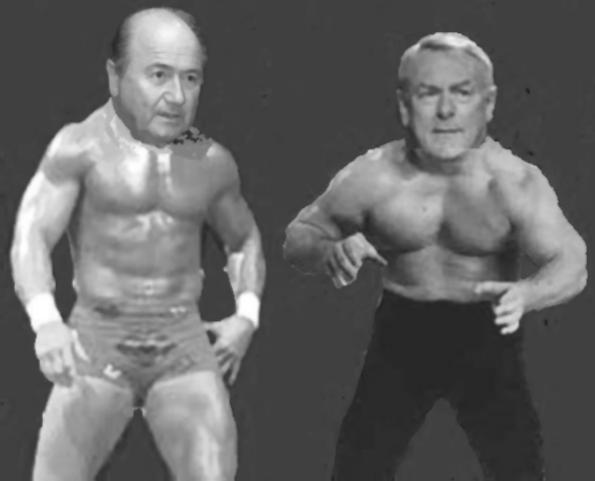
Cage Match: Pound vs Blatter

Amateur digital photo modification

Here's a shootout in the making: two guys who can't keep away from controversy, now getting all hot under the collar at each other.

Dick Pound, head of WADA, and Sepp Blatter, head of FIFA, are having a public dispute about anti-doping policy.

The dispute itself is actually a bit puzzling:

While FIFA has modified its statutes regarding doping and … signed a declaration of intent to fully sanction WADA's code, the sticking point remains WADA's insistence that a two-year ban must be imposed on first offenders. … Blatter said, "You have to take each case on its merits, starting with a warning, to a six months punishment right up to a life ban. You cannot start from a two-year ban."

Today, AFP is reporting that FIFA has dropped the explicit mention of a six-month ban, but still wants to judge each offense on its merits; Reuters thinks that WADA won't be so easily satisfied.

All of the press reports make reference to WADA's "mandatory" two-year ban. The first Reuters article mentions a case where an Italian swimmer named Giorgia Squizzato challenged a WADA-imposed two-year ban at the CAS, with CAS ruling in her favor that the two-year punishment didn't fit her crime.

A few of those facts are wrong, though. First, the WADA code does not insist on a two-year suspension for a first offense, and it does allow for some interpretation on a case-by-case basis. You can see the WADA Code (PDF) here. If an athlete commits a violation but bears "no fault or negligence," then sanctions can be dropped entirely. If an athlete commits a violation but bears "no significant fault or negligence" then suspensions can be reduced to as little as one year.

As for the Squizzato case, you can see the actual CAS decision (PDF) here. Squizzato tested positive for a low concentration of an anabolic agent called clostebol in August, 2004. She did not dispute the test results; she explained that she was using a topical cream to fight a skin infection, and that she was not aware that it contained a banned substance. The Italian federation suspended her on September 30; on December 9, FINA (not WADA) ruled that Squizzato should serve a one-year suspension, to begin on the date of the ruling. FINA ruled that Squizzato bore "no significant fault or negligence," going easy on her because she didn't gain any advantage from the substance, and also due to her relative lack of experience.

Squizzato appealed that decision to the CAS, asking that her suspension be overturned. The CAS panel denied that appeal. They ruled in her favour only in the sense that her suspension was ruled to be effective from September 30 instead of December 9.

So FINA followed the WADA code and handed out a one-year suspension, and the CAS upheld the decision. One of the things this demonstrates is that even under the WADA code, FIFA would have some leeway to hand out suspensions that are less than two years long. I guess that they want more freedom to set penalties than are afforded by the WADA code. In that sense, the Squizzato decision does offer a little support; to quote the panel,

the mere adoption of the WADA Code … by a respective Federation does not force the conclusion that there is no other possibility for greater or less reduction a sanction than allowed by [WADA]. The mere fact that regulations of a sport federation derive from the World Anti-Doping Code does not change the nature of these rules. They are still – like before – regulations of an association which cannot (directly or indirectly) replace fundamental and general legal principles like the doctrine of proportionality a priori for every thinkable case.

At any rate, Pound has been making some aggressive comments in the media, which is nothing new, but he may have met his match this time. Not too many people have the leverage to stand up to Dick Pound, since failure to bow to WADA could result in expulsion from the Olympic Games. FIFA, though, doesn't really need the Olympics as much as the IOC needs FIFA. It will be interesting to watch this develop.

September 10, 2005

Saying Nothing

IOC president Jacques Rogge is a master of speaking while saying nothing. And yet, the press seems to be pretty quick to jump to an unstated conclusion. Here's an SI.com story headlined A second chance? IOC may take another look at softball for 2012 Games. That sounds exciting — I guess they're thinking about revisiting the decision to exclude softball from the Olympic program. Well, not quite. The story reports on an interview Rogge gave to Around the Rings. Here's what Rogge said:

Rogge told Around the Rings that IOC statutes prohibit the Olympic committee's executive board from overturning "a sovereign decision by the IOC session. Our charter is very clear that the [executive board] cannot take an initiative to say 'we want a new vote' because that would open up the door to all kinds of re-votes." But he said there were precedents for the full IOC to reconsider a decision.

So Rogge didn't say anything that SI.com shouldn't have already known, but I guess it's an excuse for a story. It kind of reminds me of this. The man is a genius at getting people to hear what they want him to say.

For what it's worth, I suspect that softball does have a pretty good chance of being on the program for 2012, in the end, but that hasn't changed since this interview came out.

I wish I was an Around the Rings subscriber, though, because the teaser for the Rogge interview is intriguing: "The president of the IOC says rules governing additions to the sports program should be eased." As I predicted at the time of the cuts, Rogge never intended for the Olympic program to be decreased in size, and he wants replacements for baseball and softball.

September 07, 2005

EPO Tests Problematic

The New York Times (registration required) has an interesting article about the new test for EPO in urine samples, which is not a straightforward chemical detection and requires considerable interpretation by a skilled practitioner:

To distinguish recombinant EPO from the natural substance, the scientists used a technique that did not rely heavily on more straightforward chemical tests. To test for EPO, a preparation of urine is placed on the edge of a blotter, then subjected to the pull of an electrical field, leaving deposits in certain patterns that resemble a tiger's stripes. Some bands are more associated with recombinant EPO, some more with the natural substance. But there is considerable overlap as well. Scientists assess the patterns and the intensity of the bands. "There is a fair amount of cross-reactivity with the test, so there are certainly false positives," [Australian research scientist Nicolle] Packer ... said. "There is a lot of argument - and a lot of politics - about whether the test is good."

It should go without saying that if a positive test is going to be used to interrupt or terminate an athlete's career, invalidate past results, and ruin reputations, then the probability of false alarm (false positive rate) has to be very, very low. It doesn't sound to me like the EPO test meets that standard yet.

The story is inspired by the newest Lance Armstrong allegations, but it has broad applicability since EPO abuse for sports doping is thought to be very widespread. I found the article via Transition Game. You might also be interested in Nick's post, which is titled Dick Pound Must Go.

On Doping Rates and Sample Size

Are you ready for more fun with the IOC Programme Commission Report? In case you've forgotten, that's the document that the IOC produced this spring evaluating each of the 28 summer Olympic sports, plus five other recognized sports (Roller Sports, Golf, Rugby, Squash, and Karate), prior to the big programme review and sport elimination vote.

Of course the actual vote had almost nothing to do with the evaluation report, but it has a lot of interesting information in it, anyway. As I previously noted, one of the evaluation criteria is an assessment of each sport's anti-doping effort. At the back of the report is a table that documents the number of tests performed, and the number of confirmed positive tests, for each of the 33 IFs.

Here's a little trivia question for you: out of the 28 summer Olympic sports, plus the five recognized sports, which one had the highest rate of positive tests?

The answer would have to be athletics, right? Athletics reported that 0.64% of tests in 2003 showed doping violations, which is pretty high, but that wasn't the highest reported rate. It wasn't weightlifting (0.50%), cycling (0.49%), or aquatics (0.20%), either.

The winner was Golf, with an astonishing 1.67%. And as far as I can tell, the IF in question (the IGF) has no jurisdiction over the professional golf tours, so these would have been largely amateurs. Actually, three of the proposed sports (Golf, Karate, and Roller Sports) finished in the top 5, and Rugby was 8th. Athletics was 6th, and the third-highest among current Olympic sports. The highest among Olympic sports (and second overall) was Baseball, at 1.24%, followed by Archery, at 0.88%. These are all fairly surprising results, in my opinion. I was even somewhat caught off guard by the high rate in baseball; remember, these are tests administered by the IBAF, which has no jurisdiction over major league baseball and its steroid problems.

So what's behind these surprising results? Is drug use really rampant in amateur golf, at two and half times the rate of athletics?

Well, maybe. But I suspect that there's a more mundane reason for the odd results: small sample size. Whenever you sample a population (athletes) to calculate a rate of incidence (rate of doping), you're in fact making an estimate of the actual rate of incidence. That estimate comes from an underlying probability distribution, which implies a confidence interval associated with the estimate. If we want to convert the measured number of positive tests into a doping rate, we should also note the uncertainty in our estimate. The IOC table gives the percentage of positive tests, which is a legitimate estimate of the rate of doping in a sport; however, it does not address the issue of uncertainty.

In this case, we can estimate the uncertainty in the estimates of the doping rate by making some simplifying assumptions. Let's assume that the actual rate of doping in a given sport is p, and let's further assume that the tests are absolutely perfect — they catch every cheater, and never give any false alarms. (I'll discuss this second assumption a bit more later.)

If we test M athletes from the population, we would expect to find k = λpM positive tests. In fact, of course, even with a perfect test we would not find exactly λ positives every time, due to the random nature of the sample; there is a non-zero probability that we would find k = λ ± 1, λ ± 2, etc. The probability distribution for k is described by the binomial distribution, which is nicely described in this Wikipedia article. We could use the binomial distribution directly to estimate the uncertainty in our estimate, but I'm going to make a few more simplifications until we get to the point where I can do the calculation on the back of the proverbial envelope.

It turns out that if positive tests are "rare," which they are, then the binomial distribution will approach the Poisson distribution (Wikipedia again). The Poisson distribution has the nice property that the mean and the variance are both equal to λ. The variance gives us a measure of the width of the distribution, or in other words, the uncertainty in our sampled estimate.

Now we can make one further simplification. If the the number of samples M is "large," then the Poisson distribution for k is well-approximated by a normal distribution, retaining the mean value (λ) and the variance (also λ). It turns out that in some of our cases the number of samples is not really large enough to completely justify this assumption, but let's go with it — this is rough work anyway. Now we really can work on the back of the envelope — we can say that the "one-sigma" uncertainty on the doping rate is equal to the square root of the number of positive tests, divided by the number of tests.

Figure 1
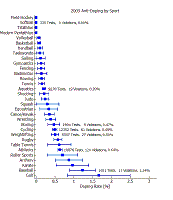
Figure 1 - 2003 positive doping test rates by sport

Figure 1 — 2003 positive doping test rates by sport (click to enlarge).

So for Golf (4 positive tests out of 240), the estimated doping rate is (1.67 ± 0.83)%, whereas for Athletics (120 positive tests out of 18,876), the estimated doping rate would be (0.64 ± 0.06)%;. Here the ± covers the one-sigma uncertainty, which is a roughly 68% confidence interval; to get a 95% confidence interval we could just double the uncertainty.

Figure 1 (inset) shows the estimated doping rates for 2003, including uncertainty, for 32 of the 33 sports (FIFA, which governs Olympic soccer, reported the largest number of tests (20,104) but did not reveal the number of violations). As you can see, the non-Olympic sports generally did not perform a large number of tests, and so their doping rate estimates are very uncertain. Other sports with high but uncertain positive test rates are Baseball, Archery, and Table Tennis. In fact, all of the truly susprising results have relatively large error bars, which tends to support the idea that the results are more due to random chance than any underlying truth.

Speaking of truth, of course we can't translate the positive test rate into a real doping rate unless we believe in the tests themselves. If the tests have a high probability of detection (near 100%), and a low probability of false alarm (near zero), then these numbers are realistic estimates of the incidence of doping among high-performance athletes. Otherwise, false positives and missed detections muddy the picture considerably. Some people will see this graph as evidence that overall doping rates are extremely low; others will conclude that the tests don't work. I've made a few arguments on this topic before, but I know I won't convince everybody, and I don't think we're ever going to know the objective truth.

September 02, 2005

Oh No! They've Cut (men's) Softball!

As noted here earlier, the USOC is attempting to lobby for softball's reinstatement to the 2012 summer Olympics. As part of that effort, a USOC delegation went down to the recent PASO (Pan American Sports Organization) meetings, to lobby IOC members to support their crusade.

If you read the sports news, you might think that things went very, very badly. The AFP (via Yahoo! News) is reporting that PASO, which governs the quadrennial Pan American Games, decided to drop softball from its programme as well. An independent story repeats this statement at SLAM! Sports.

More Pan Am Cuts

Inline (roller) hockey and racquetball have also been dropped from the Pan Am Games for 2007, and a number of non-Olympic events have been added. The Yahoo! News article states that slalom canoe/kayak was also dropped for 2007, but in fact it has never been part of the Pan Am Games.

Also, it's a technical point, but slalom canoe/kayak is not, in Olympic terms, a sport, but rather a discipline of canoe/kayak.

Something's been left out here, though. Softball Canada's web site is reporting very clearly that men's softball has been removed from the programme. The PASO press release announcing the addition of indoor football still lists softball on the programme, and the description of the sport on the Rio 2007 web site states:

Softball is more popular among women, who are the only players to take part in the Pan-american Games.

I'm forced to conclude that two independent news articles reported on the decision to drop softball from the Pan Am Games without making any distinction between men's softball (which has never been in the Olympics) and women's softball (which is apparently still part of the Pan Am Games). There are a few hints in the Slam! article, since it mentions that Canada has won every Pan Am gold medal since 1979. That's only true in men's softball, so perhaps the reader is supposed to guess that the article only applies to men's softball. But both articles link the PASO decision to the earlier IOC decision, which confuses the issue. Isn't it kind of critical to the story to note that women's softball has not been cut from the Pan Am Games? Pretty shoddy reporting, in my opinion.

Anyway, men's softball is definitely on the skids, having recently been dropped from even the Canada Games. (Incidentally, my local paper also reported that cut as if the whole sport had been removed, too, when in fact women's softball is still in the Canada Games. Anybody see a pattern here?) So things look pretty bleak for men's softball, which is OK with me. Really, softball and baseball are similar enough that it's a bit stupid having both in a multisport games. I would actually rather see women's baseball than softball, but the participation numbers don't warrant that switch, and not everybody shares my opinion. So be it.

However, I can actually see one glimmer of a possibility for the future of elite men's softball: get yourself on the Olympic programme. If women's softball can get themselves reinstated as a sport, then they've got their foot in the door. Once a sport is on the programme, they are sometimes able to add disciplines (like aquatics added synchro, gymnastics added trampoline, and cycling is adding BMX). For softball to add a men's discipline will require adding one medal and about 120 athletes to their quota. That won't be easy, but it doesn't require changes to the Olympic Charter, and doesn't require the approval of the IOC delegates at a general assembly. Furthermore, the removal of baseball has created exactly that much room under the cap.

I can imagine some of you asking yourselves: why would women's softball be interested in having men's softball added to the programme? I grant that some of the Olympic spotlight would be unfairly diverted from the women's game (as illustrated by the news stories I quoted above). I also grant that many male-dominated Olympic sports have made only token efforts to include a women's discipline. But this isn't just about doing men's softball a favour. If softball could pull this off — and I have no idea if they are even thinking about it — it would also help them stay on the Olympic programme, in my opinion. That's because it would, in the long term, broaden their base of international participation. Furthermore, including men's softball would serve to further distance the Olympic sport from baseball and its multitude of image problems.

August 30, 2005

Boxing, On The Ropes

The Associated Press reported last week that the IOC has withheld $9M in payments to the AIBA.

Normally, the IOC distributes millions of dollars (gathered largely from sponsorship revenue) to the Olympic sport IFs. For most sports, this is a major source of revenue — 62.7% for the AIBA. In this case, the IOC has decided to freeze payments "due to general judging issues that remain unresolved since the Athens Olympics," according to IOC spokesperson Giselle Davies. Although the results from Athens are not in question, "there was a general observation in Athens that things needed to be improved." IOC president Jacques Rogge signed a letter saying the funds will remain frozen until AIBA provides a clear timeline and planned actions.

The IOC Programme Commission report (PDF) had this to say about the judging situation:

Senior AIBA officials have had discussions with the IOC regarding possible changes to the judging system, open scoring and selection of referees and judges. To date (March 2005), the AIBA has not provided any concrete information on the possible changes or when they would be implemented.

Actually, the Programme Commission Report makes it pretty clear (in as neutral a tone as possible) that the AIBA is run by a bunch of idiots, so perhaps this isn't very surprising. Among other highlights:

The AIBA states that it has a four-year strategic planning process in place but there is no indication as to how the plan is prepared, how often and who is consulted.
Summary of the three main development programmes run by the AIBA between 2001 and 2004: No response given.

And here is the AIBA's own press release (PDF) covering one of the IOC-AIBA "discussions" on the judging issue, held in May of 2005:

AIBA strongly hopes that the selection [of referees and judges] for the next Olympics will be definitely better than in the past years.

I'm guessing that the IOC wants them to move beyond a "strong hope" and come up with an actual plan.

August 26, 2005

One Sport, One Vote

The vault has been opened! The envelope has been unsealed, and the IOC has released the sport vote totals from the programme review at their 117th session. Well, for one sport, anyway.

As I hoped, softball agreed to have their vote total released to all IOC members, so the IOC Executive agreed to let them have it. The result is astonishing. The sport was knocked out of the 2012 Olympics by a single vote. Actually, you might say by just half a vote; the result was 52-52, with one abstention.

The USOC and the International Softball Federation plan to work to have the decision revisited. Peter Ueberroth, Chairman of the USOC, claims that at least four IOC members were confused at the time of the vote, believing that they were voting against baseball. Now that's a well-informed voter!

I have been wanting to compare my detailed predictions with the actual vote totals. One result isn't much to go on, but maybe more will follow now that the cat is out of the bag. In the meantime, I have to admit that 52 votes is a lot more than I dreamed softball would get, although I did acknowledge that the method would underestimate team sport totals.

Things to Do in London

It looks like Denis Oswald is going to be spending a lot of time in London.

Oswald, an IOC member from Switzerland and president of the ASOIF, has been appointed chairman of the coordination commission for the 2012 summer Olympics and will oversee preparations for the IOC. He held the same position for the 2004 games in Athens.

Oswald was quoted as saying, "I am confident that London has all the ingredients for success — from a technically sound plan to widespread popular support." I am sure that the British will be gratified to hear that. Of course, the last time Oswald was in the news, he was quoted as saying this:

When it comes to rugby I'm not a specialist but people within the sport tell me that rugby sevens is something of a joke.

Fortunately, he won't have to worry about that conflict, since Rugby didn't get added to the Olympic programme after all.

August 23, 2005

Got Any Spare Change?

This story is, well, just priceless.

Canada, as many of you know, has a $1 coin and a $2 coin, the paper versions of these denominations having been phased out years ago. Both changes met with widespread resistance and denial, but eventually Canadians came to embrace the coins with some affection ("see, we really are different from Americans.") The folks at the Royal Canadian Mint have been hoping to convert Canada's $5 bills to coins for at least ten years now, but haven't found a way to lower public resistance. Apparently some marketing geniuses at the Mint had a brainstorm last winter — let's tell people that we'll give the money we save — maybe a few tens of millions each year — to Canada's Olympic athletes! That's got to be a winner, right?

The Finance Department of the federal government, always up for some found cash, decided to test the political waters frist. They hired Environics Research to conduct some focus groups last May. The results were unsurprising and yet profound:

Participants overwhelmingly rejected the very idea of a $5 coin and dismissed the Olympic-funding idea as ridiculous. "The proposal to direct these savings to the athletes was greeted with notable hostility," Environics said in a June 2005 report, obtained by The Canadian Press.

The CP article lifts the following quotes directly from the Environics report:

  • "Absolutely ridiculous idea."
  • "Give me a break! There are so many other burning issues where the money could be spent."
  • "I'm embarrassed to be Canadian sometimes."
  • "Do you freaking believe this?"

Notable hostility indeed! Even as an avid supporter of Canadian amateur sport, I had to laugh at just how badly the kids at the Mint misjudged public opinion on this one. They sure don't know much about Canadian culture:

And although people said government should support athletes, most thought any savings from a paper-to-coin conversion should go to health care, helping the homeless and social programs.

I don't think that you can get much more Canadian than that, and I mean that in both a good and a bad way. I can't argue with the needs expressed above, and it makes me feel strangely proud that the focus groups weren't calling for a $1-per-person tax cut. I could argue that throwing a few tens or even a few hundred million at health care or "social programs" is not going to make a noticeable difference to anybody's quality of life, and that it would be significant for Canada's Olympic athletes. But I guess that's not really the point. When push comes to shove, Canadians just don't believe that elite sport is all that important. And maybe that's a good thing, in the big picture; I can't even convince myself that doing better at the Olympics is more important than helping the homeless. But is it any wonder, with this attitude, that Canada struggles for every Olympic success?

August 21, 2005

King Of Athletes

I was on my way to writing a few not-very-enlightening comments about the decathlon at the World Athletics Championships, along the lines of "isn't it funny how slow they look running the 400 m, compared to the real runners? What's up with that?"

This reminded me of a famous quote (at least, it was once famous in my house), attributed to Steve Ovett, that the decathlon is nothing more than "nine Mickey Mouse events followed by a slow 1500." I was doing a Google search trying to find a definitive source, when I came upon a left-brain special extraordinaire. It's not out of my left brain, but I wish it was.

The piece is Challenge Decathlon: Barriers on the Way to Becoming the "King of Athletes," by Gunther Tidow. Tidow begins by quantifying the gaps between the world's best decathletes and the world's best single-eventers ("specialists"). There are a couple of nice graphs and some interesting conclusions. Here's an excerpt:

It is a general fact that the superiority of the specialists varies considerably from discipline to discipline. For decades, as far as velocity is concerned, decathletes have come closest to the specialist level in the long jump and in the (hurdles) sprint (93%), while in the throws and in the 1500m decathletes are farthest away from the specialists (ca. 75%) … The comparison between 1980 and 1996 shows … [that] the difference has become smaller in the throws, whereas it has become clearly bigger in the high jump as well as in the 1500m race.

Tidow goes on to attribute this change to improvements in doping control and changes in the decathlon scoring tables. Later on he also tries to explain, physiologically, why the 1500 is the most difficult event for the decathletes to excel in; he rephrases Ovett's quote above to note that "the decathlon consists of nine anaerobic speed-strength disciplines and a primarily aerobic endurance contest."

Progress Or Perish

Just a couple more items from the world athletics championships, and then I'll move on.

In case you missed it, the UK had a disappointing championships, winning three medals and reaching only six individual finals. (Also sucking: Canada, Germany, China, and Kenya.) UK Athletics performance director Dave Collins is looking for a solution, and this story in the Sun suggests one possibility:

What we want to achieve and what the public want are medals and final places at major games. And if athletes are flatlining in terms of progress, then maintaining them in that comfortable situation is unacceptable. Unless they recognise they need to work to reach targets and look to improve, why would I continue to fund them?

This raises an interesting and somewhat thorny issue. Mr. Collins is suggesting that an athlete's funding should be somehow linked to performance progression as opposed to performance per se.

Canadian Athlete Assistance Program (AAP) funding already has similar stipulations. It is possible, in theory, for the best Canadian in any given sport to be removed from the national team because his or her performance is not improving. In practice, however, these selection criteria are very difficult to apply. In effect, it comes down to a choice between athlete A, who is a proven performer, but probably on a downhill slide; and athlete B, who is not yet as good as athlete A, but still improving. It might make perfect economic sense to select athlete B in this circumstance, but it is a very difficult philosophical decision to make.

August 18, 2005

Strategic Failure

As long as I'm on the topic of the recent World Athletics Championships, I'll take the opportunity to rant on one of my pet fan peeves. Although there are always numerous examples to choose from, I'll focus on the men's 5,000 m, where Benjamin Limo of Kenya won the slowest final in World Championship history (results - PDF).

How slow was it, you ask? The winning time was 13:32.55. It goes without saying that this is ridiculously fast for a human being, but it's not quite as obvious that this is very slow for these athletes. Let's look at a few relevant benchmarks:

  • World record: 12:37.35
  • Limo's personal best: 12:54.99
  • Limo's 2005 seasonal best: 12:58.66
  • WC qualifying 'A' standard: 13:21.50
  • WC qualifying 'B' standard: 13:28.00
  • Last qualifier to WC final: 13:22.44
  • Winner: 13:32.55

I should note that the world record holder, Kenenisa Bekele of Ethiopia, did not compete in Helsinki, choosing instead to concentrate on the 10,000 (which he won). Also, I'll point out that weather did not play a role; conditions were good for the final.

So how does this happen? How do you win a world championship final by running slower than you did in the semifinals, slower than the minimum world championship qualifying standard, and almost 5% slower than your own best time this year?

Well, the obvious answer is that you win by running slowly when everybody else runs slowly, too. In athletics this passes for "strategy." Of course, it doesn't matter that much to Benjamin Limo how he wins; obviously, this strategy worked for him.

So maybe a better question is, how does an elite athlete allow himself to lose a world championship final by running so slowly? After all, everybody in the final was capable of running at least 10 seconds faster than Limo did — they'd done it in the heats. The silver medalist, Sileshi Sihine of Ethiopia, had a personal best of 12:47.04 m/s, almost eight seconds faster than Limo's PB and more than forty-five seconds faster than the winning time. The fourth-place finisher, Eliud Kipchoge of Kenya, had a PB even faster than that! Wasn't it a monumental failure of strategy for these men to lose this race?

Ironically, it wasn't even Limo's decision to keep the pace slow, according to this quote from the new world champion:

It was not the kind of pace I needed. I like a race that is 2:40 (per kilometre) high speed. I was in front hoping to push the pace. I wanted someone to assist me. That’s why I had to go hard the last 400m. The World Championships can be anyone’s race. As we lined up for the start of the race I knew anybody can do it. Because you don’t know what kind of pace it is going to be and you don’t know how you are going to run.

Now I can see that "anybody can do it" is something that the fastest runners — like Limo, Sihine, and Kipchoge — would prefer to avoid. But if Limo wanted a faster pace, why didn't he just set it? It's not like 2:40 per kilometre (13:20 pace) would have killed him. He makes it sound like the pace is something that just happens. At any rate, as I said, it worked for him, so no complaints. Elsewhere Sihine was quoted as saying that the slow pace suited his strategy, which was "to wait until the final lap and up the speed." Why he chose that strategy is completely beyond me; given his proven prowess over 5,000 m, why would he want to turn it into a 400 m race?

I get even more puzzled when I see this happen in the heats or semifinals. After all, the last qualifiers are selected based on time, so doesn't it make sense to run the best time you can? And yet it doesn't seem to happen that way.

I'm sure that there are going to be people out there who think that I just don't get it, that I can't understand the strategic considerations that come into play at the highest levels of long-distance running. I think I do get it, actually. I understand that there's a disadvantage to front-running, and I also understand that for a few athletes keeping the pace slow really is their best chance of winning. But I'm always flabbergasted when the whole field decides to coast around for 90% of the race. I'm convinced that this is basically a failure of nerve by the race favourites. They are afraid that if they run as fast as they can they'll pull somebody else around with them and get mowed down in the last lap. But you know what? At least they would have done their best. Sihine and Kipchoge ran slowly and still got mowed down in the last lap. Is that really a less painful way to lose?

August 16, 2005

WR ≠ PB

An athletics quiz: when is a world record not a personal best?

The answer is: in the pole vault, very often.

At the recently-completed world athletic championships in Helsinki, Russian superstar Yelena Isinbayeva broke the world record in the women's pole vault, jumping 5.01 metres.

Breaking the world record is nothing new to Isinbayeva, of course. Here's a list (source) of her world-record outdoor vaults:

Table 1 — Yelena Isinbayeva's World Record Vaults (Outdoors)
DateRecord VaultPrevious Record
2003 JUL 074.82 m4.81 m
2004 JUN 274.87 m4.83 m
2004 JUL 254.89 m4.88 m
2004 JUL 304.90 m4.89 m
2004 AUG 244.91 m4.90 m
2004 SEP 034.92 m4.91 m
2005 JUL 054.93 m4.92 m
2005 JUL 164.95 m4.93 m
2005 JUL 225.00 m4.95 m
2005 AUG 125.01 m5.00 m

As you would expect from such a dominant performer, Isinbayeva also holds the indoor world record in the pole vault at 4.89 metres. She's been making the same kind of progress there (source):

Table 2 — Yelena Isinbayeva's World Record Vaults (Indoors)
DateRecord VaultPrevious Record
2004 FEB 154.83 m4.81 m
2004 MAR 064.86 m4.85 m
2005 FEB 124.87 m4.86 m
2005 FEB 184.88 m4.87 m
2005 FEB 264.89 m4.88 m
2005 MAR 064.90 m4.89 m

You don't have to be an expert to see that Isinbayeva is only toying with the world record. This past winter she broke the world indoor record four times in as many weekends, each time by exactly one centimetre. She's held the outdoor record for about a year, and has raised the record by 12 cm in eight very small steps. The only way you can break the world record with this kind of regularity is if you are still well below your maximum capacity.

So why would an athlete do that? Since she had already secured the world championship, why didn't Isinbayeva ask for the bar to be set at 5.15 in her final attempt in Helsinki, so that she could have a true test of her ability? The answer is very simple: breaking the world record is worth a lot of money for Yelena Isinbayeva.

In addition to $60,000 for winning the competition, Isinbayeva earned $100,000 from the IAAF and its sponsors for breaking the world record. This BBC story claims that Isinbayeva earns $100K every time she breaks the world record, presumably from Russia. I think that this claim is probably incorrect, but there is no doubt that the incentives are considerable. Many of the top European meets offer cash prizes in the tens of thousands of dollars for world records, to encourage the athletes to give their best efforts and to add to the excitement of the competition.

Olympic champion Tim Mack suggests that "she’s probably jumping 5.20 in practice." If that's a reasonable estimate, then she might have 19 more world outdoor records, and perhaps a similar number of indoor records, even if she doesn't improve at all. That adds up to a lot of money. It's no wonder she chooses to set each new record by the smallest possible margin.

The pole vault and the high jump are both susceptible to this kind of world record manipulation for a couple of reasons. Most importantly, the score is determined not by the height of the jump but by the height of the bar. This gives competitors extremely precise control of their results. Second, the competition proceeds by multiple attempts and a process of elimination. This means that a dominant performer can wait until all of his or her competitors are defeated before attempting the world record; there is then no danger that any other competitor will break the record, and therefore no reason to push it out of reach.

I don't mean to denigrate Isinbayeva in any way. She is clearly the best female pole vaulter the world has ever seen, and her accomplishments are unlikely to be matched any time soon. But I would like to see a world record that truly reflects her abilities, and we aren't seeing that right now.

One way to make the records more "honest" is to have tougher competition. The only reason Isinbayeva (and Sergei Bubka before her) can get away with this strategy is that she is head and shoulders above the rest of the field. If she had a real rival, then both of them would be forced to compete at their limits.

That's not really a solution that the IAAF can implement, though. Another idea would be to change the world record incentives for these events. For example, the incentive could scale according to the margin of the record-breaking attempt (e.g., pay ten times more for a ten-centimetre break than for a one-centimetre break). Another idea would be to offer the bonus only for certain milestones reached (5.10 m, 5.20 m, and so on).

August 04, 2005

CBC Radio Does Amateur Sport

Wednesday on CBC radio's Maritime Noon, the phone-in topic was "What's the best way to support amateur athletes?" You can access a RealAudio recording of the program here (August 3 - 53 minutes). There was a lot of discussion of grass-roots development and various provincial programs, which I don't talk a lot about here, and I found it interesting.

The guest list was quite impressive: Ken Bagnell, president of the Canadian Sport Centre Atlantic and member of the Canadian Sport Review Panel; Nicole Smith, the Executive Director of Sport New Brunswick; and 1998 Olympic bobsleigh gold medallist David 'Eli' MacEachern.

The panel worked well together; MacEachern provided the elite athlete's perspective, Smith concentrated on grass-roots and provincial programs, and Bagnell held court on the national sport system in Canada. Bagnell in particular, and not for the first time, showed himself to be very well-informed and articulate. He had all the facts at his fingertips and explained all of the issues clearly.

I was also struck by the high quality of input from callers; this was definitely not your usual weekday audience. Peter Stoffer, sitting MP and NDP critic for amateur sport, called in, as did Ed McHugh, president of Basketball Nova Scotia. Even a couple of old friends of mine called in.

I have to hand it to host Costas Halavrezos for a well-assembled show. I wonder, though, why he did not disclose that his daughter is on the Nova Scotia Canada Games team? If that created any bias on his part, it wasn't obvious to me, but I still found it curious that he didn't mention his own family's involvement in amateur sport.

August 01, 2005

Early Withdrawals … Fearing Penalties?

There's something funny going on at the 2005 world athletics championships. A lot of big stars are pulling out due to illness and injury.

The list of no-shows so far includes:

I don't know if this is an unusually large number of withdrawals, but it seems like it is. I am quite certain that some of the athletes on the list above are genuinely injured or sick. But I still wonder if some of this activity is a reaction to the very agressive anti-doping programme that will be conducted by the IAAF:

The 2005 edition of these World Championships … will see more than 850 tests conducted, … easily the largest testing programme ever conducted at an IAAF World Championships. … Approximately 350 competitors will be blood screened as they enter the athlete’s village, while during the championships themselves, close to 500 tests will be collected … Also in competition, about 100 blood tests will be carried out for the detection of Blood Transfusion, Hemoglobine Based Oxygen Carriers (Hbocs) and other substances.

The competition begins on Saturday.