April 29, 2006

Centralize This

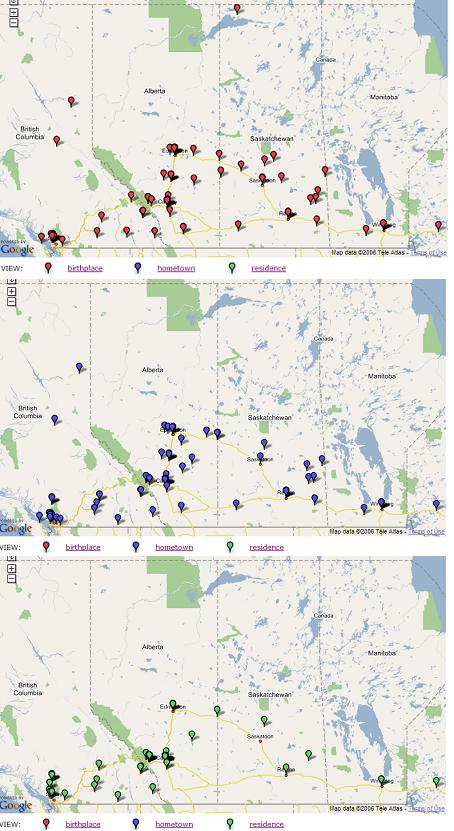
I've been working for some time on a hobby project to make my own Google Map. Just for fun, I've been trying to mash together a Google Map of the world and the COC 2006 Olympic Team Handbook.

I know that the Olympic boat sailed long ago, but I'm not really a web programmer, and it took me this long to get it working the way I wanted it! I do have a real job, believe it or not. Anyway, here it is. Be patient when trying to change from birthplace to hometown to residence; it takes a few seconds to place all the markers. I haven't tested it using Firefox yet, but I will tomorrow. If there are any Safari users out there who want to provide feedback, feel free.

If you're looking for a deep point to this (beyond that most human desire, to say "Look what I have created"), I'll see if I can point out just one interesting observation. Further exploration is up to you.

Centralization of Olympic Athletes in the Canadian West

The image above shows the birthplaces (top, red), hometowns (middle, blue) and residences (bottom, green) of Canada's 2006 Olympic athletes for the western provinces. There are many fewer athletes resident in the rural west than are born there. Where are they all going? It's hard to see in the image above, but here's a hint: try using my Google Map to zoom in on Calgary.

April 25, 2006

Organized Sports

Canadian sporting hero Silken Laumann has written a book. I should know better than to judge a book by its press release, but as the father of two kids under five, the headline in the Ottawa Citizen certainly caught my eye: Take your kids out of sports, top rower Silken Laumann says.

Of course, after reading the rest of the article, it seems that Ms. Laumann's position is considerably more nuanced (surprise, surprise). Here's an excerpt from Child's Play:

I am certainly not suggesting that we stop all organized sports and activities, but I am advocating that we pull back in order to create the time for families to be active together. Let's not make physical activity too complicated. Let's rejoice in the fact that our kids want to move and encourage them to jump a little more, wrestle a little more, run outside roaring.

Allow me to superimpose that thought — and the objectives of Laumann's organization, Silken's Active Kids — with some quotes from the Long Term Athlete Development Plan for Rowing, available from Rowing Canada Aviron (draft version here). Here's what Laumann's own "organized sport," and many others across Canada, have to say about young kids and sport:

Stage 1: Active Start
Age: 0 to 6 years
Objective: Learn fundamental movements and link them together into play.
Key Outcomes: Fun and movement skills.
Physical activity should be fun and a natural part of a child’s daily life, not something required.Active play is the way young children are physically active.
Rowing does not have a direct role to play during the Active Start stage other than to support organizations that promote physical activity.

Stage 2: FUNdamentals
Age: females 6 to 8, males 6 to 9
Objective: Learn fundamental movement skills and build overall motor skills.
Key Outcomes: At the end of this stage, children will

  • be competent in the fundamental movement skills.
  • know how to swim.
Skill development in the FUNdamentals stage should be well structured and FUN, with the emphasis on participation. Children should be encouraged to participate in a variety of sports and physical activity in order to develop fundamental movement skills:
  • Agility, Balance, Coordination, and Speed (ABCs)
  • Kinesthetics, Gliding (“run”), Buoyancy, Striking with a body part (KGBs)
  • Running, Jumping,Throwing (RJTs)
  • Catching, Kicking, Striking with an implement (CKs)
In addition, children should learn water safety and how to swim.
Rowing does not have a direct role to play during the FUNdamentals stage other than to support organizations that promote physical activity and the development of fundamental movement skills.

April 21, 2006

Scene of the Crime

I'm away for the weekend, back at the scene of my former glory personal best in Gainesville, Georgia, the Poultry Capital of the World:

Georgia Poultry Park has a 25-foot tall Georgia marble monument topped by a 36-inch bronze rooster, featuring poultry industry information on six plaques at its base.

The Canadian National Team Trials are not being held at Poultry Park, but at Clarks Bridge Park, a much more scenic locale.

April 17, 2006

WADA Statistics 2005

A couple of weeks ago WADA released a summary of their anti-doping test results for 2005. The rate of positive tests saw a sharp increase, from 1.03% (19/1848) in 2004, to 1.96% (61/3114) in 2005.

I have written before about the fact that these numbers, as reported, never include error bars — estimates on the uncertainty in the real rate of doping.

As I noted in that post, if we assume that the rate of positive tests is an accurate measurement of the doping rate in the athlete population, it's actually fairly simple to calculate the uncertainty that goes with that measurement. Using that algorithm, the 2004 rate becomes (1.03 ± 0.24)%, and the 2005 rate is (1.96 ± 0.25)%. The increase is almost four standard deviations, so it's clearly significant.

WADA had their own explanation for the increase:

The 2005 figures include several elevated T/E ratios [a urine parameter used in testosterone testing] over 4, which were not reported in previous years when the threshold was 6, partially accounting for the increased number of AAFs [Adverse Analytical Findings] in 2005. However, there is a significant increase in other AAFs, such as those for steroids. One reason for this may be WADA’s increasingly targeted approach to testing.

WADA is suggesting, then, that the increase in the rate of positive tests is not due to an increase in the rate of doping; it's because of an increase in the effectiveness of the testing program. In short, WADA has succeeded in testing more cheaters. We can take that suggestion under consideration; it's difficult to prove the case either way.

I should (again) point out that the measured doping rate is still extremely low. I think it is far below the rate that most people would guess, if you asked them what percentage of elite athletes use performance-enhancing drugs. Although I would have to assume that the measured rate is an underestimate of the actual rate, I think the common wisdom exaggerates the prevalence of doping.

I've come to realize, however, that this is almost like arguing over religion; some people will never be convinced. A lack of positive tests simply proves, for those sports fans, that the testing program is ineffective. It's the old axiom that "absence of evidence is not evidence of absence." And if the positive test rate ever reached zero, it would only prove that testing is 100% ineffective. So to those people, I have to ask: what kind of proof would change your opinion? Perhaps you'd be convinced by around-the-clock surveillance?

Even if an athlete is tested every day, somebody will suggest that we don't know what he's doing in his bathroom after showering and maybe that's when he injects undetectable steroids. … OK, fine, says the athlete. Put a Web cam on me for six months before the Olympics and feed it straight to a small panel of testers at USADA. Then they will know what I'm doing in my bathroom. Better yet, attach a USADA rep to my hip for six months before the Olympics. Let him check the trash every day. Let him frisk my visitors.

April 14, 2006

Leg Up

I'm not disabled. I just don't have any legs. — Oscar Pistorius, 2005

It's been more than a year since I wrote about South African sprinter Oscar Pistorius. He's in the news again this week, as he prepares to defend his 100 m and 200 m titles at the Visa Paralympic World Cup in May.

Pistorius, you will recall, is missing both of his legs below the knee. His personal best over 400 m, which is also a world record, is 47.34 seconds. That time ranked him fifth in South Africa in 2005 — not fifth among disabled runners, but fifth among all runners.

His goal is to compete in the 2008 Olympics. He figures he needs two seconds of improvement, or maybe a little more, to qualify for the South African team. Now, two seconds is a long way in 400 m; but there are two things working in his favour here. The first is that he is only 19 years old, and the second is that he has only been running since January 2004. It will be interesting to watch his progress over the next few years. It will also be interesting to watch how the IAAF handles his case.

I love photo finishes — there is something that appeals to me about the weird dimensionality of the photos. Because I find them fascinating, and to demonstrate Pistorius' current level, I constructed a composite photo depicting all of the finishers in the men's 400 m at the 2005 World Championships in Helsinki.

Men's 400m, 2005 World Championships (click to enlarge)

The composite includes all seven heats, three semifinals, and the final, although a few of the slowest finishers were not included in the photos. The guy in the red box is Pistorius — based on his personal best 47.34.

(Incidentally, the guy way over there on the right is Jeremy Wariner. He just turned 22.)

April 11, 2006

Canada's 2006 Performance, Part 3

In Part 1 of this post, I reviewed some predictions of Canada's medal performances at the 2006 winter Olympics. In Part 2, I discussed the overall performance of the team by sport, and assessed progress toward achieving the goals of the Own the Podium 2010 program. In this final segment, I want to take a quick look at two other aspects of the Canadian team's performance.

Conversion

Way back when I started this blog, my first "left-brain special" was an analysis of Canada's performance at the 2004 summer Olympic Games; specifically, the number of 2003 World Champions and World Championship medallists who won Olympic medals in 2004. What I found was that Canada did very poorly in that regard, converting only one out of every three medal favourites. I took a similar measure for five other countries and found that 2003 World Championship medals were converted to Olympic medals at about a 60% rate, and 2003 World Champions won Olympic medals about 90% of the time.

The Own the Podium 2012 plan, which I discussed in Part 2, makes a similar point. The 2002 "success rate" is quoted as 27%, with a goal of 50% by 2010. I don't know exactly what those numbers are based on, but it has something to do with the percentage of Canadian medal favourites who actually win medals at the Olympics. To the best of my knowledge it is based on results at World Championships and World Cups, but I don't know the details of the algorithm.

The COC did release a lot of information on past results, and 2006 performances. This document contains some very interesting breakdowns of Canada's performance, including a table showing the number of top-5 finishes at the 2001 and 2005 World Championships, compared to the number of Olympic medals in 2002 and 2006. In 2001, Canada had 27 top-5 World Championship results; by 2005, Canada had increased that number to 41. In both cases Canada's year-after Olympic medal total was about 60% of this number. If the percentage is meant to increase as a result of Own the Podium, it hasn't worked so far. On the other hand, Canada's results are similar to the world's other winter powers; among the top 12 medal-winning nations in 2006, only Austria, Switzerland, Sweden, and Korea exceeded 70%.

At any rate, that statistic isn't really about "conversion," since it doesn't address medal favourites specifically. Since I don't have access to the COC's definition of success rate, I'll have to repeat my own. Table 1 below shows the athletes and teams that won World Championship medals in 2005, with their 2006 results.

Table 1 — Canadian conversion from 2005 World Championship medals to 2006 Olympic medals (source: COC).
Athlete or TeamEvent2005 Placing2006 Placing
Emily Brydon Women's Alpine Combined 3 13
Leuders/Brown 2-man Bobsleigh 1 2
Canada-1 4-man Bobsleigh 3 4
Sara Renner Women's Cross Country Sprint 3 16
Canada Men's Curling 1 1
Jeffrey Buttle Men's Figure Skating 2 3
Steve Omischl Men's Freestyle Aerials 1 20
Jeffrey Bean Men's Freestyle Aerials 2 19
Marc-André Moreau Men's Freestyle Moguls 2 4
Canada Men's Hockey 2 7
Canada Women's Hockey 2 1
Jeff Pain Men's Skeleton 1 2
Jasey-Jay Anderson Men's Snowboard PGS 1 20
François Boivin Men's Snowboardcross 2 10
Justin Lamoureux Men's Snowboard Halfpipe 2 21
Maëlle Ricker Women's Snowboardcross 3 4
Kristina Groves Women's Speedskating 3000m 3 8
Canada Women's Speedskating Team Pursuit 2 2
Clara Hughes Women's Speedskating 5000m 3 1
Cindy Klassen Women's Speedskating 1500m 1 1
Cindy Klassen Women's Speedskating 3000m 1 3
Jeremy Wotherspoon Men's Speedskating 500m 3 9
Canada Men's Short Track Relay 1 2
Canada Women's Short Track Relay 1 2
François-Louis Tremblay Men's Short Track 500m 1 2
TOTAL MEDALS 25 12

There were 25 Canadian entries that went into the 2006 Olympics as defending World Championship medallists. Of these, 12 won medals, for a conversion rate of 48%. That's better than what I found at the 2004 summer Olympics, but it's tough to compare the summer and winter data directly. Eight out of ten Canadian World Champions managed to win medals, which is also significantly better than I observed in the 2004 results. I can't compare to other countries, or to Canada in 2002, without a lot more leg work than I am willing to do right now. However, it looks to me like Canada's success rate has improved somewhat.

Beyond Medals

Finally, a while back one of my commenters wrote that counting "top 8" finishes might be a better measure of NOC strength than counting medals. I responded that unfortunately that information is not easy to come by. The COC report that I mentioned above spells it all out completely.

Figure 1

Figure 1: click to enlarge

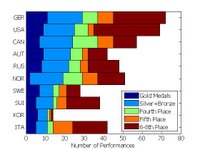
Figure 1 — National performance from the 2006 winter Olympic games. The stacked bars show gold medals, total medals, top-4, top-5, and top-8 finishes (click to enlarge).

The figure at right lays out the gold medals, total medals, top-4, top-5, and top-8 finishes for the top 10 medal-winning countries. There are a few interesting things here. First, Canada did indeed have more fourth-place finishes than any other country (13). Canada finished tied with Germany for most top-4 (37) and top-5 (45) finishes.

Korea had very few finishers in 4th to 8th position — three, compared to eleven medallists — indicating a lack of overall depth. This is of course supported by the fact that 10 of 11 medals came in a single sport. Austria and Sweden show the same effect to a lesser degree, whereas Norway's overall depth is revealed by the large number of top-8 finishes, in spite of the poor showing in the medal tables.

April 07, 2006

More Money In

More from the IOC Executive Board meeting: the IOC expects to bring in more and more money for the rights to broadcast the Olympics:

The IOC's Asian negotiations come after the conclusion of negotiations with U.S. and European broadcasters, who Carrion says paid rates more than 30 percent higher for the 2010 and 2012 games than they did in previous contracts. … The amounts the IOC pulls in keep climbing. Even without the Asian markets, TV rights sales so far for the 2010 and 2012 Games have exceeded $2.9 billion, eclipsing the $2.5 billion for the Turin Games and Beijing Games.

On the surface, the most surprising revelation here is that NBC agreed to pay $2 Billion for the US broadcast rights, a 35 percent increase over what they paid for 2006/2008. It was widely reported that NBC did very poorly on their ratings for the 2006 coverage. So what would make them up their bid this much?

First, of course, NBC will be hoping to make most of its money back on the summer Olympics, not the winter Olympics, so the bad ratings for the winter Olympics aren't necessarily critical. Second, the negotiated rights aren't just for television; they include internet multimedia, too, and NBC saw record traffic on their web site in February.

A little research, though, reveals the real reason for the disconnect: NBC made their bid for 2010/2012 long before the 2006 Games — in fact, even before they knew the identity of the 2010 or 2012 host cities!

So the offer from NBC reflected their best guess at potential advertising revenue more than two years ago. If the 2006 ratings indicate a real decrease in viewer interest, it will be a couple of years before we see the impact on the bid price.

As for the rising IOC revenues, the increase from US rights accounts for half a billion dollars of the bump. Even discounting that, it looks like the price for worldwide broadcast rights will show a significant increase over the four-year cycle.

April 06, 2006

Misreading Rogge (Again)

The IOC executive board is meeting in Seoul this week. In between sessions, president Jacques Rogge had this to say about baseball's possible inclusion on the Olympic programme for 2016:

We still have issues about doping. Progress has been made but not to the level where the Olympic family would accept it.

The Associated Press report makes it sound like Rogge has set a condition for baseball's reinstatement, and the Globe and Mail headline echos the opening paragraph: "Rogge: Baseball needs to address doping prior to reinstatement."

Of course, Rogge very carefully did not say that baseball would be back in if it cleans up its doping problem; and we all know that he cannot say that. Barring a change to the Olympic Charter, the decision on the sports programme will be made by a vote of the IOC members, not by Jacques Rogge. He's free to speculate about what might swing the vote in baseball's favour, but he really can't make any promises — or any threats, for that matter.

I've said it before, and I'll say it again: Rogge has a gift for this kind of thing.

April 05, 2006

Canada's 2006 Performance: Part 2

In my last post I presented a recap of my own predictions of Canadian medals at the 2006 winter Olympics, and compared them to the predictions from Sports Illustrated and the Associated Press. Today I would like to look at the Canadian medal performances with an eye to the future.

A little more than a year ago, the COC initiated a performance improvement plan called Own the Podium 2010. The program aims to have Canada win more medals than any country at the 2010 winter Olympics in Vancouver. I'm going to repeat a few of the key assumptions of OTP2010 here (emphasis mine):

  • Canada needs to win approximately 35 medals to succeed at becoming the top medal winner at the Olympic Winter Games in 2010.
  • Canada can win 35 medals in 2010 if it increases the number of potential medallists (from 160 currently identified to 211) and its success rate (from 27% in Salt Lake City to 50% in Vancouver).
  • Canada has the potential to increase the number of potential medallists in the sports of speed skating, short track, freestyle skiing, snowboard and bobsleigh. It takes eight to 12 years to develop Olympic athletes in the other sports.
  • Canada's success rate can be improved through increased Games preparation, technology, research and development, and human performance research.

As an interim goal, the COC stated that Canada could finish third in the medal table in 2006, an objective that was achieved last month.

So what can we say about the progress towards a winning performance in 2010? First of all, it probably won't take 35 medals to top the medal table, unless there is a significant increase in the number of medals awarded. A mere 30 medals would have been enough in 2006, and the general trend is that the top nations are winning less and less of the medal share.

That changes things a bit. In March of last year, I considered the chances of Canada winning 35 medals, and dismissed it as an impossible goal:

I'll be accused of being "too Canadian" for saying so, but: there's almost zero chance that this is going to happen in five years.

Should I change my mind about that?

Figure 1

Figure 1: click to enlarge

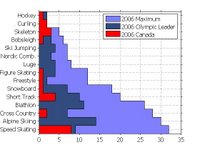
Figure 1 — Medals totals from the 2006 winter Olympic games. The three areas show the maximum possible number that could be won by a single country; the maximum number won by any single country; and the number won by Canada (click to enlarge).

My previous analysis was based on a look at the total number of medal events in each sport, and the likelihood of Canadian success. The figure inset shows the data for 2006, including the maximum possible number of medals that could be won in each sport, the number won by the leading country in 2006, and the number won by Canada. The maximum possible allows for multiple medals in a single event, and takes into account the NOC quotas in place for 2006, which can be accessed through the Torino 2006 web site. Of course, in most sports it is completely unrealistic to imagine that one country could win all of the available medals. The number won by the leading country in 2006 is probably a better indicator of what's possible. So in the plot, where there is a big gap between Canada's performance (red) and the world leader (dark blue), that indicates some room to move up in 2010.

A year ago I provided my recipe for getting to 35 medals. Here it is again, with comments from 2006:

  • Cover all the bases in ice hockey and curling (4 medals) — in 2006, Canada won three medals, missing out in men's hockey. Expect Canada to be a medal favourite for all four events again in 2010.
  • Make sure you pick up a handful of medals in figure skating, freestyle, and snowboard (4 medals) — in 2006, Canada won one medal in each discipline for a total of three. Some bad luck probably cost a couple of medals in freestyle and snowboard. On the other hand, Jeffrey Buttle could very easily have missed out. I think that 4-6 medals is probably a realistic goal for 2010.
  • Become the world's best speed skating nation, for long and short track (15 medals) — in 2006, Canada won 12 medals in the two sports combined, more than any other country. The men's team in long track didn't win an individual medal, and could do better. On the other hand, the women's team had a dream Olympics that will be difficult to repeat no matter how strong the program is. The short track team might improve if they can make some gains on Korea (10 medals). Getting three more medals, overall, would be a great accomplishment.
  • Become a top-two nation in cross-country skiing (6 medals) — in 2006, Canada won two medals, more than ever before. One of those, a gold, came from 22-year-old Chandra Crawford. Beckie Scott, Canada's most successful cross country skier, has now retired, but Crawford and Sara Renner should continue. After the Olympics, 23-year-old Devon Kershaw won Canada's first men's World Cup medal in decades. The men's team has also added 25-year-old Russian immigrant Ivan Babikov. Babikov, racing for Russia, finished 13th in the 30 km pursuit in Turin.
  • Become a top-two nation in alpine skiing (6 medals) — in 2006, Canada did not win a medal. The team continues its upward trend, however, with 3 fourth-place finishes from a relatively young team.

I don't think that I would change this recipe a whole lot. Certainly Canada has proven that some medals are available in bobsleigh and skeleton, but it remains to be seen if this four-medal performance can be repeated. A year ago I wrote:

There are Canadian contenders in bobsleigh and skeleton, but that talent pool is aging and not very deep.

I wasn't wrong about the age of the talent pool, certainly — Pierre Leuders is 35, Lascelles Brown is 31, Jeff Pain is 35, and Duff Gibson, at 39, is the oldest athlete ever to win an individual gold medal at the winter Olympics. Melissa Hollingsworth-Richards is only 26, so she might continue to improve. But if our sliders are going to win four medals in 2010, it will be because of the next crop of athletes in the system. The OTP2012 highlights quoted above imply that these athletes don't need as much development time as in other sports, so maybe there is fresh blood circulating through Bobsleigh Canada Skeleton as we speak. But the other point I should make is that there aren't that many medals to win in these sports, and nobody won more than four in 2006. There is not going to be a big increase, certainly, in the number of medals won in bobsleigh and skeleton.

Which all leaves us just about where we were a year ago, I think. In order to come out on top, Canada is going to have to win at least half a dozen medals, combined, in alpine and cross country skiing. That will get the total up to the low 30s, and that will probably be enough. Can it happen? At this point I am inclined to say yes. It isn't a sure thing, but it looks to me like the trend is pointing in the right direction, and it isn't the stretch I thought it was a year ago.

I have just a few more thoughts about the 2006 results, including a few comments about the Canadian "success rate." But I'll save those for part 3, and I'll see if I can find a few other interesting things to post about before I get to that.

April 03, 2006

Canada's 2006 Performance: Part 1

I've got a few odds and ends I wanted to tie up from the 2006 Winter Olympics, including my very early predictions about Canada's performance in 2010. First I would like to recap predictions for 2006, and see how I did and where I went wrong.

My prediction of 21.1 medals for Canada was based on assigning probabilities for the first, second, and third medal for each of the 84 events. I allowed seven different probabilities: 0, 10%, 25%, 50%, 75%, 90%, and 100% (the last of these I used only once). I admitted that I didn't do very much research, assuming that my overestimates and underestimates would more or less balance out, because I was making such a large number of guesses. Canada ended up winning 24 medals.

Figure 1

Figure 1: click to enlarge

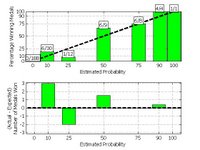
Figure 1 — Comparison of predicted and actual medals won by Canada at the 2006 Torino Winter Olympic Games (click to enlarge).

It's always useful to check your assumptions, so I took a look at the number of medals actually won by Canadians that I put into each of these seven categories. (I am going to conveniently ignore, throughout this discussion, the fact that I listed names beside some of the probabilities; I'll just assume that when a Canadian won a medal, it was the Canadian I estimated for.)

It turns out that I didn't do too badly in assigning the original probabilities, and I did very well at assessing probability for the most likely winners. The figure in the inset at right shows the actual actual percentage of winners in each of the seven categories, and the difference between the actual number of winners and the expected number of winners. For the 100%, 90%, and 75% assignments, I was as close as I could possibly be; all of the five chances I put at 90% or more won medals, and six out of eight at 75% (the exceptions were in men's hockey and women's bobsleigh).

I was also exactly right about the no-hopers; not one of the entries I assigned a zero probability won a medal. The total number of correct predictions (188) looks impressive, but of course many of those were completely obvious, so it is difficult to assess how much credit I can take for my "perfect" score.

My biggest systematic error seems to have come in the 10% category, where I put 30 Canadian athletes or teams. Six of those (20%) won medals. If I assume that I had the 10% probability correct at the outset, the likelihood of getting exactly six medals from this group is less than 1 in 20; the likelihood of six or more medals is about 1 in 14. A more likely explanation is that I underestimated the chances for this group. I am not sure what further conclusion I can draw from that, but it might help guide my future predictions.

I would like to score myself against the COC's medal predictions, but I don't have any of the details. As far as I know, they didn't release any breakdown of their prediction to the public; I did see some articles claiming that "the COC has Pierre Leuders down for two medals" and the like, but I think they wisely held that kind of thing fairly close to the vest. I know that they got closer on the total (predicting 25), and they probably did better on the individual events, too, since they have a team of researchers tracking performances throughout the season.

It's kind of fun, though, to score myself against the professionals, so I took a closer look at the predictions from Sports Illustrated and the Associated Press. Of course there is no fair way to do this comparison, since both publications predict medals on a "True of False" basis, whereas I tried to attach a confidence level to each one. (I should also point out that these two sources attempted the prediction for every medal in every event, not just for a single country.) But just for fun, let's count all of my entries with 50% or higher as "True." That gives me a prediction of 22 medals instead of 21.1; SI predicted 21, and the AP predicted 24.

Table 1 — Comparison of expert predictions for Canada at 2006 Winter Olympics
SourcePredicted MedalsCorrectly Predicted WinIncorrectly Predicted WinUnpredicted Win
Now That's Amateur 22 17 5 7
Associated Press 24 16 8 8
Sports Illustrated 21 13 8 11

So by this scoring system — which is somewhat biased in my favour — I had more correct predictions than either publication, and fewer missed as well, even though my predicted total was not as close as the AP's.

Part 2 of this post will look at the 2006 Canadian medals by sport, and assess progress with respect to the goals of the Own The Podium 2010 program.

March 26, 2006

Strange Balco Twist

American sprinter Chryste Gaines is currently serving a two-year suspension by the Court of Arbitration for Sport for taking THG, a designer steroid created and distributed by BALCO. She never tested positive, but was put away by the testimony of fellow US sprinter Kelli White. White was also a BALCO client, and tested positive for a banned substance at the 2003 World Championships. A third US sprinter, Marion Jones, has also been implicated in the BALCO scandal. Like Gaines, Jones has never tested positive. BALCO founder Victor Conte claimed during an interview on 20/20 that he provided performance-enhancing drugs to Jones, and watched her inject them.

At the 2002 US Championships, Jones, Gaines, and White finished first, second, and third in the women's 100m.

Last week, an old friend who sometimes goes by the name WM-K1-91 sent me this story from the New York Times. The story is about how the new book Game of Shadows implicates two New York Yankees in the steroid scandal that has now completely engulfed Barry Bonds.

Either you know a lot about Game of Shadows already, or you don't care much about baseball anyway. But my friend pointed out this fascinating snippet from near the end of the NY Times article:

The sprinter Chryste Gaines, who preceded Marion Jones as a client of Balco's, gave permission to Conte to work with Jones as long as Gaines got a cut of what Jones paid. Conte eventually paid Gaines $7,350.

If this allegation is true, then it provides some pretty interesting insight into the mind of the cheater. If Gaines and BALCO had some kind of exclusivity agreement, why would Gaines agree to waive it in exchange for money? Three possibilities occur to me:

  • Her motivation for cheating was primarily financial. She was willing to give up a (relative) performance advantage as long as she was appropriately compensated.
  • She had the high-performance athlete's natural superiority complex and believed that she didn't need an artificial advantage — she could beat Jones as long as they were on an equal footing.
  • She believed or knew that Jones was doping anyway, or would be, so she might as well get her cut.

The first of these flies in the face of what I believe about the reasons that athletes cheat — and in fact seems to contradict what Game of Shadows reveals about Bonds' motivations, too — but it seems the most plausible explanation in this particular case.

March 21, 2006

Soldiers in a Larger War

On this day twenty-six years ago, the American President made the official announcement confirming that the USA would not attend the 1980 Summer Olympics in Moscow. President Carter had set a February 20 deadline for the Soviet Union to pull its troops out of Afghanistan and avoid a boycott.

Carter engaged in extensive arm-twisting to gain support from other nations. Some governments, like those of Great Britain and Australia, supported the boycott but allowed the athletes to decide for themselves whether to go to Moscow. No such freedom of choice was allowed U.S. athletes, as Carter threatened to revoke the passport of any athlete who tried to travel to the USSR. In the end, 65 nations turned down their invitations to the Olympics; probably 45 to 50 did so because of the U.S.-led boycott. (from www.olympic.org)

Carter is an intelligent man. He must have known, when he set out on this course, that the USSR would not back down because of controversy over a sporting event — even one as important to them as the Olympics. The Soviets did not withdraw from Afghanistan until 1989.

Carter also must have realized that the Soviets would retaliate; after all, isn't that what the Cold War was all about? The US First Strike could only lead to the Mutually Assured Destruction of the 1980 and 1984 Olympic Games.

Map of 1976, 1980, and 1984 boycotts from Wikipedia

Maybe the fact that the boycott was made over a hopeless cause is irrelevant. Maybe the principle, President Carter's stand for what he believed in, was enough justification for the sacrifice. Certainly many people felt that way at the time. (Of course principles, like political administrations, change. The fact that Afghanistan is today occupied by a US-led army is a twist worthy of Orwell.)

One thing I know for certain: the 1980 boycott was a tragedy for sport. The world's best athletes were robbed of an opportunity to meet on the playing field, not once, but twice. Those individuals who were brave enough to publicly oppose the boycott, like Canada's Diane Jones Konihowski, suffered even worse.

To the IOC and the international Olympic movement, these athletes simply do not exist. But in Canada, they hover in a sort of twilight zone. Although the COC joined the boycott on April 22, 1980, they still named 212 athletes (and a flagbearer) to the Olympic team. All of those athletes can be found in the COC's athlete database, distinguished by the soldier's identification: a Name; a Serial Number (database id); and finally a Rank, which is universally denoted by the three letters DNP.

March 18, 2006

Rick Say Anything, Any Time

Canada's Rick Say is at it again at the 2006 Commonwealth Games. Say, you may remember, made headlines at the 2004 Olympics when he had this to say after a disappointing fifth-place finish in the men's 4×200m freestyle swimming relay:

I'm pissed off, I'm disappointed. This is crap.

Now, I don't have any problem with athletes speaking bluntly about their own performances. It's refreshing, frankly, to hear somebody say something more meaningful than the usual platitudes. They shouldn't have to pretend to be positive all the time.

But tonight I watched the same event at the Commonwealth Games in Melbourne. The race was a real barnburner, with England, Scotland, Australia and Canada exchanging the lead several times. The Canadians were hoping for a victory, based on a second-place finish at the 2005 World Championships. Unfortunately, they finished fourth today. In the post race interview for Canadian television, the swimmers expressed disappointment. At least two of them said that they felt responsible for the loss, and that they should have done better. Say — standing right next to his three teammates — had the last word. I'm paraphrasing here, but the essence of Say's statement was:

I'm really happy with my swimming here. But we didn't really put our best team forward. You can't expect to win if you're not committed to it.

Translation: I'm pretty good, but you can't expect me to win with these three clowns. Say was apparently unhappy about the selection of Brian Johns for the team (not the first selection decision he has disagreed with at this competition).

An old coach used to advise us: don't piss in your own tent. It's one thing to say that you performed poorly, or even to say that your team performed poorly. But implying that you could have won if you'd been swimming with somebody else, well, that's bad sportsmanship. Sometimes those thoughts are really better off unexpressed.

In Spectacular Fashion (take our word for it)

It isn't too often these days that Canada enters an ice hockey game as a decided underdog. But that happened today in the sledge hockey gold medal game at the Paralympics. Canada took on top-ranked and defending Paralympic champions Norway, and defeated them 3-0. It is Canada's first ever Paralympic gold in hockey.

I can't really make any personal observations on this one, since I had no opportunity to watch; the CBC coverage in the Maritimes has been extremely sparse. I see from the broadcast schedule that there will be Paralympic coverage on three Saturdays in April, so maybe I'll see a condensed version of the game then.

March 17, 2006

Let's Pretend It's All About Sport

RICK HANSEN: "My dream back [at the 1984 summer Olympics] was that one day our athletes with a disability would have equal recognition. Today, as Canada's best competes at the ninth Paralympic Winter Games that dream remains unfulfilled. My challenge to Canadians is to see our team and indeed all the participants recognized as athletes first."

MARY ORMSBY: "You can't force people to care. You can't guilt them into cheering for athletes in sports for which they have no passion. Otherwise, we'd spend all our leisure time watching cricket and precision skating and ringette."

AMATEUR: Mr. Hansen, did you get that? We Canadians have no passion for skiing, curling, or hockey. Please stop trying to force us to care. (Also, apparently somebody is trying to make me feel guilty about not watching cricket. If it's you, please stop that also.)

MR. HANSEN: "In many ways, our acceptance of our athletes with a disability have broader socio-cultural implications, reflecting our acceptance of people with a disability in the offices, factories and boardrooms of our nation. Certainly more must be done before true equality is achieved. However, great strides have been made."

MS. ORMSBY: "There's no conspiracy. There's no deliberate attempt to ignore the country's disabled in Italy while more compelling news, such as the Maple Leafs' playoff battle, dominates sports coverage."

AMATEUR: I know, I'm totally pumped about the fact that the Leafs are going to miss the playoffs. But, uh, Mr. Hansen didn't actually say anything about a conspiracy. I like your straw man, though.

MS. ORMSBY: "These Games do not have the same worldwide involvement as the Olympics in numbers of countries and participants and therefore its heft as an event of true international scope and gravitas is diminished. There are 486 Paralympians from 39 countries in Turin, while more than 2,500 athletes from 84 nations attended the Olympics."

AMATEUR: Oh yeah, I can see your point. I knew there must be a logical reason that the Paralympics don't get more attention: not enough international scope and gravitas. And it also explains why the world junior hockey championship tournament is such a washout with Canadian audiences: there were only ten countries, and fewer than 250 athletes! No wonder those poor kids never get any credit for their success.

MS. ORMSBY: "In addition, events are divided into separate categories, a layered approach making it difficult to figure who's the true champion — is it the blind skier or the standing class skier? Or the sitting class skier?"

AMATEUR: I hate that, when you've got a layered approach that makes it difficult to figure out who's the true champion. Like the BCS system in US college football. That's a total audience killer, isn't it?

MS. ORMSBY: "Disabled sport in general also suffers from a dearth of competition. The best example of this is the remarkable success of Canadian wheelchair athlete Chantal Petitclerc. At 36 years old — an age when many athletes' best days are behind them — Petitclerc currently holds every world record from the 100 metres to the 1,500, strongly suggesting her competitive fields are shallow."

AMATEUR: FactualPS and analytical — I'm starting to like you more. Unfortunately, these facts are irrelevant to the argument! Ice hockey also suffers a dearth of competition compared to, say, soccer. A couple of years ago Canada simultaneously held the titles of men's Olympic champion, women's Olympic champion, men's world champion, women's world champion, men's junior world champion — and probably two or three more that I'm not even aware of. Think that could happen in soccer? Think again. And yet, Canadians as a group would rather watch hockey! Funny, isn't it?

MR. HANSEN: "When I participated in Los Angeles I wanted to prove to myself and to the world that being in a wheelchair would not limit my ability to achieve my goals. Today, our Paralympic athletes will once again prove that anything is possible when you believe in a dream. I would urge all Canadians that as our Paralympic athletes capture medals in Turin, their achievements are celebrated with the same kind of enthusiasm afforded to Cindy Klassen and others."

MS. ORMSBY: "Rick Hansen believes that Canadians are wrong not to embrace every Paralympic medallist with the same fervour accorded speed skater Cindy Klassen because that prevents athletes with disabilities achieving 'equal recognition.' But that philosophical stand confuses crusading for the cause with logic. You cannot create the illusion that the Paralympics are on par with the Olympics and suggest that not believing this constitutes prejudice."

AMATEUR: I don't think Mr. Hansen is the one who is confused. We're talking about sports fandom here; how does logic enter into the discussion? It's easy to prove that the Paralympics are not "on par with" the Olympics; I can similarly prove that the Winter Olympics are not "on par with" the Summer Olympics, and that the NCAA basketball tournament is not "on par with" soccer's world cup. But so what? I enjoy all of those events, and they are all capable of inspiring joy, anguish, and admiration. The connection to a sporting event is based, fundamentally, on emotion, and not on logic.

Mr. Hansen is "urging" us, as Canadian sports fans, to give our Paralympians the same recognition that we give to our Olympians. Ms. Ormsby makes it sound like just another appeal for an obscure sport; like if I wrote here that everybody should pay more attention to flatwater kayaking. Then we could have a little debate about the merits of the sport, compared to others that are more popular; we could throw some numbers around, and make comparisons, and talk about what we like and don't like in a sport.

Ms. Ormsby wants to pretend that our national lack of interest in the Paralympics is just like that, I guess. That we all really, truly, don't even think about the fact that the athletes are disabled. We just don't care as much about the Paralympics because the competition is not as broad, or as deep; or the events are too complicated to follow; or skiing's just not our cup of tea and we'd rather watch cricket. And maybe that's true. So then, what's our excuse for the way disabled people get treated in other walks of life?

I'll give the last word to the two columnists:

MS. ORMSBY: "in this country of many choices, where Canadians choose to send Olympians and Paralympians around the globe to compete, we don't need to be told whom to cheer."

MR. HANSEN: "Then, let's begin building a truly Canadian model of inclusiveness for 2010 which ensures that the Games and the benefits of hosting them are applied equally to all our athletes."

PS L-girl did the homework that I did not do, and has discovered that this claim of five world records is actually not factual. My mistake.
March 16, 2006

Halifax 2014: Our Common Wealth

Note: Since the original publication of this post, I have corrected the spelling of Bruce DeVenne's name.

A couple of months back, Halifax (my home town) won the right to be Canada's bid city for the 2014 Commonwealth Games. (Incidentally, the 2006 Commonwealth Games are going on right now. What? You hadn't heard? Yes, I'm sure.) A delegation of prominent Nova Scotians — three of whom I know quite well — is in Melbourne now, lobbying and observing the preparations and staging.

Inevitably, there is also a group of local citizens mobilizing to prevent the Games from coming to Halifax. Yesterday on CBC Radio's Information Morning I heard one of them interviewed. Bruce DeVenne has launched a new web site, StopTheHRMGames.com. (For non-locals, HRM stands for Halifax Regional Municipality.)

When I heard the interview, I assumed that Bruce DeVenne was the anonymous author of HalifaxNoWay.com, but it turns out I had the wrong anti-hosting web site. Stopthehrmgames.com is still only half-baked and there is not much content yet, although Mr. DeVenne has collected some interesting historical data. HalifaxNoWay.com has been operational longer, and although the site appears to be a bit borked right now, there is a lot more original content, and it is more coherently presented.

My own thoughts on the issue are also only half-baked, but to get in the spirit of things I thought I would share them anyway. I certainly don't want to get into a war of web sites over any issue, let alone one as local as this, but I have a feeling that I will be writing more about it over the next months (before the host selection) and years (if Halifax is selected).

So here's my naive view of the issue, as it relates to the taxpayer. Currently, the anti- side in this debate is entirely focused on cost, eager to tally up every cent of taxpayer money that might be spent on anything related to the Commonwealth Games. There are three types of costs associated with hosting a competition on this scale. There are the costs of building the required infrastructure; the costs of winning, planning, organizing, and staging the competition itself; and the costs of maintaining the infrastructure after the games are over.

If we consider, as Mr. DeVenne does, the sum total of these costs as the "cost" of the Commonwealth Games, the major part of the burden will be borne by the local taxpayer. Anybody who denies this is a dreamer, in my opinion, and ignoring historical reality — hosting a major Games is not free. But the question that Mr. Devanney and the anti-lobbyists ignore is this: what do you get for your money?

To stave off (a small part of) the criticism I am about to get from my economist friends, I'm not talking about some mythical long-term economic benefit, like a future flood of tourists drawn to Halifax by the Commonwealth Games. I think that kind of "Boom Vision" planning has been pretty well discredited already. But we're not just throwing the money away, either; we're buying something. And when you're deciding whether or not to buy something, cost is only half of the equation.

So we need to ask ourselves, and our politicians, some key questions related to the three categories of costs.

  • Can the direct costs of winning, planning, organizing, and staging the Commonwealth Games be balanced by the direct revenue generated from ticket sales, corporate sponsorship, broadcast rights, etc.? Should we expect a net loss? A net gain? In this case I would include taxes collected from out-of-town spectators as direct revenue, although we should be careful to consider only the marginal increase in tourism due to the Commonwealth Games.
  • Can we, as a municipality, afford the costs of building the necessary infrastructure? Do we want to? Is there something else we should be spending our money on instead? A complicating factor here is that building the infrastructure might be a "good deal" if we do it as preparation for a major Games. A new sports stadium constructed for the Commonwealth Games will get subsidized by the federal and provincial governments, and by corporate sponsors, whereas a new sports stadium otherwise might not.
  • Can we, as a municipality, afford the costs of maintaining and operating that infrastructure after the Games are over? Again, do we want to? Is there something else we should be spending our money on?

The first question is relatively easy to answer, if we believe that it is possible to accurately forecast expenses and revenues. I think it is reasonable to expect that Halifax can break even or make a profit on the Games themselves. Many other cities have done it — remember, I'm leaving the major infrastructure costs out of this — and we should expect it, too.

On the second and third questions, reasonable people will disagree, because this is a matter of values and priorities. Bid committee CEO Scott Logan has referred to the necessary spending as an "investment," but that's sort of like calling your new car an "investment." We're putting some of our money into a depreciating asset that will cost still more money to own. Let's just be honest about that. But it doesn't logically follow that we shouldn't spend that money — just like it doesn't logically follow that you shouldn't buy that car you've been saving up for. We do need to ask ourselves how much we are going to pay, and what we are going to get in return; and then we, as a democratic society, need to decide if that is something that we should do with everybody's tax money.

To some people, every public dollar spent on sport is a dollar wasted. And those people, as members of our community, deserve to be heard; but I disagree with them. I think that sport is important. I also think that hosting the Commonwealth Games will give Halifax an opportunity — one we will not otherwise have — to build some sport and civic infrastructure that is sorely needed. Those developments will make Halifax a better place to live, and I am willing to pay for that.

March 10, 2006

A Disclosure

I discovered this week that I am a member of the Canadian Olympic Committee.

Now, you might find it surprising that one can become a member of the COC and not know it. I am what is called an A Member of the COC, which means that I was appointed by a National Sport Federation. I assumed that appointment in December, when I took on a new volunteer position with my favourite NSF. You will not find my name on the COC's lists of members, yet, and I was not aware that COC Membership was one of the responsibilities that went with the job. Let's just call it a pleasant surprise.

Now: back in the comments here, I explicitly denied being a member of the COC. I hope we can avoid a federal commission to determine what I did and didn't know at the time, but that statement was false when I made it. I apologize.

Otherwise, in all posts going back to December 2005, please substitute "we" for "they" and "us" for "them" when I have referred to the COC. Going forward, this circumstance will probably not change much about this blog. I have been mostly supportive of the COC, anyway, and I am sure that there is room for informed debate.

March 07, 2006

The Italian Job: Doping Scandal 2006

In the months before the 2006 Winter Olympic Games, there was a political dispute between the IOC and the Italian government over control of anti-doping efforts in Torino. Sports doping is a criminal offense in Italy, which is at odds with current IOC policy. The IOC and WADA have been working to have anti-doping regulations adopted in national laws, through the UNESCO International Convention Against Doping in Sport. That convention, however, follows the philosophy of the WADA Code, specifying only sports-related sanctions for doping.

In keeping with that philosophy, the IOC resisted the idea of having the Italian police involved in Olympic anti-doping activities. The dispute was only resolved about two weeks before the Opening Ceremonies. In essence, the IOC lost the battle, acknowledging that there would be no legal exemptions for Olympic participants, but maintaining control over dope testing. The Italian health ministry was given a seat on the anti-doping commission, which normally includes the IOC and WADA.

While Jacques Rogge was working to keep the Italian criminal justice system away from his Olympics, he was bragging about new "police-style" intelligence gathering in the fight against doping:

Some athletes will be targeted for testing based on tip-offs from what IOC medical director Dr. Patrick Schamasch described as a network of mostly anonymous informers around the world. "More and more we are using the same procedures as the police," he said. Just as police forces have profilers of serial killers, Schamasch said the IOC is compiling a "cheater's profile" to single out potential drug offenders. Rogge said the testers are also zeroing in on athletes who show a suspicious improvement in their level of performance. "Whenever there is a big surge in the performance that we don't consider as being normal, or a reasonable progression, then we target the athlete," he said.

Some of these "police-style" techniques were apparently on display in the days leading up to the 2006 Games, including ambush drug tests being conducted by the Torino Organizing Committee (TOROC):

Posing as an Italian couple and big fans of two-time gold-medalist Hermann Maier, sample collectors dispatched by the Torino Organizing Committee entered the athletes' village Thursday and convinced both Maier's coach and his agent to help them get an autograph and perhaps take a picture alongside the Olympic champion. Once they located Maier, the two announced they were doping officials, hustled Maier into a nearby clinic, extracted blood and urine samples and then — you can't make this stuff up — the woman actually planted a kiss on his cheek.

In the event, the 905 tests conducted prior to, during, and after the 2006 Winter Olympics ― with or without intelligence gathering ― turned up only one positive test. Russian biathlete Olga Pyleva tested positive for a stimulant that probably has little or no performance-enhancing effect in biathlon. Of course, she will still face a two-year ban from competition. On top of that, Italian authorities have announced a judicial inquiry into her case.

That positive test, though, became a minor subplot of the doping story at the 2006 Winter Olympics. Of the 904 tests that didn't turn up any adverse findings, ten in particular received special scrutiny. Ten members of Austria's nordic ski team — cross-country and biathlon — were surprised by a late-night raid at their residence on February 18 and taken for drug testing. The Italian police then searched their residences, seizing a number of suspicious items.

Let us, for the moment, leave the Italian police out of this story; we'll come back to that. The actions of the IOC in this case are within the rules in place for the 2006 Olympics. Those rules state that:

  • The NOC must tell the IOC where all athletes are training, competing, and residing for the duration of the Olympic Games (paragraph 5.5);
  • The IOC can select athletes for Doping Control based on any fact it deems relevant, at its sole discretion (paragraph 5.6);
  • All athletes shall be subject to doping control initiated by the IOC at any time or place, with no advance notice. Such doping control may include testing for all prohibited substances and all prohibited methods (paragraph 5.1); and
  • Mere possession of a prohibited substance or prohibited method is an anti-doping rule violation (paragraph 2.6).

So here, as near as I can determine, is the sequence of events in this particular intelligence-gathering operation. Doping control officers working for WADA learned that former coach Walther Mayer was in Italy with the Austrian nordic team. Mayer had been previously banned from the Olympics because of his suspected role in performing blood transfusions at the 2002 Olympics. WADA tipped off the IOC about Mayer's presence, and the IOC initiated an unannounced (no advance notice) test for ten of the members of the Austrian nordic teams.

Accounts differ about how the police got involved. At any rate, the Italian ministry of health would have known about the targeted testing, and the reports of Mayer's presence, because of their seat on the anti-doping commission.

It turns out that the Italian police had authority in this case that the IOC did not; there is nothing in the Olympic doping rules that allows the IOC to search athletes' residences, or seize their property. Law enforcement authorities confirmed that the seized materials included "blood analysis equipment," syringes, vials of distilled water, asthma medication, and "other substances." In addition, Mayer's presence in Italy was confirmed when he crashed his car into a police roadblock.

That's a pile of circumstantial evidence, and there's more where that came from. Without more details, it proves nothing, in my opinion, but it still smells bad. We shall see whether the evidence constitutes proof of "possession of a prohibited method" in the eyes of WADA and the IOC. They have announced that they will launch a disciplinary hearing, and that they will consider all of the evidence collected by Italian police. Recall that this is the same organization that made a show of trying to secure exemptions to Italian law prior to the Olympics. Now, faced with an embarrassing scandal and an absence of positive tests, they have decided that perhaps police raids and criminal investigations are not so bad after all.

I suspect that it will be difficult to tie the seized materials to any particular athlete or athletes, and even to prove that the equipment was used (or intended for use) in a prohibited method. It may come down to an argument about the burden of proof.

This leads to some difficult questions about WADA's new investigative approach to anti-doping. Most of the discussion, to date, has been framed in terms of testing. The IOC and WADA are claiming that informants, profiling, and data mining will enable them to make their drug testing program more effective. We know, though, from the Tim Montgomery / Chryste Gaines case, that the fight against doping has already moved beyond testing. We know that a positive test is not required to prove a doping violation; Dick Pound himself calls that idea "preposterous" and "nonsensical." In the Montgomery case, the CAS ruled that two athletes had violated anti-doping rules based on their alleged confessions to a third athlete. So what does that mean about the IOC's new network of informants — and about their intelligence in general? Would the testimony of an anonymous snitch be enough to pursue sanctions? What about suspicious telephone conversations? Association with known cheaters? How much (or how little) circumstantial evidence is enough? If the case against the Austrian athletes goes forward, some of these issues will come before the Court of Arbitration for Sport in the next few months.

It seems to me that we have come to a new crossroads in the effort to reduce doping in sport. The anti-doping authorities see themselves as law enforcement agencies. But what kind of law enforcement agency do we, as sports fans, want them to be?

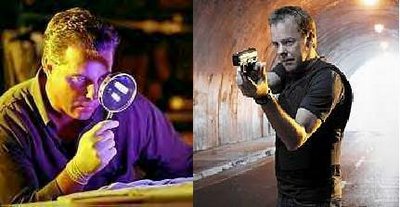
Evidence only knows one thing: the truth. It is what it is. — Gil Grissom, CSI
Where is the Nerve Gas? I'm gonna cut your right eye, then I'm gonna cut your left eye and I'm gonna keep cutting you until I get the information I need. Where is the nerve gas? — Jack Bauer, 24

Is anti-doping "police" work the kind that strikes preemptively and recklessly, assumes guilt, and uses any means necessary to enforce the rules? Or is it the kind that requires conclusive evidence of guilt and respects the rights of the innocent above all else?

I think you know where I stand. I've said it before, and I'll say it again: the vast majority of Olympic athletes are not cheaters. In my opinion, a false conviction is far more tragic than a cheater who escapes detection. After all, for all the apocalyptic talk about the end of sport as we know it, we're still talking about cheating at sports. It isn't terrorism, or organized crime, and we don't need to trample the rights of the innocent to catch the guilty.

I would never argue that we should surrender the fight by making doping legal, and I don't think we should go easy on proven cheaters. Cheating is bad, and doping is the worst kind of cheating. But let's make sure that anti-doping tactics are appropriate to the crime.

Further Reading

March 01, 2006

I Am Aster … So Play Safe

Aster, Prone, With Rifle

Anticipating the start of the 2006 Paralympic Winter Games, I wandered over to the official web site and was greeted by this image. That's Aster, the lovable cartoon mascot of the Torino Paralympics, prone on the snow with a rifle.

I know that this is supposed to depict biathlon, but does this give anybody else the creeps? It's not as creepy as the 400 brides at the Olympic closing ceremonies, but it's disturbing, don't you think?

I also wonder about the design of the mascot itself. Is it just an accident that the Paralympic mascot is named Aster and looks just like an asterisk? As in a parenthetical annotation that provides further explanation? e.g. Paralympic gold medallist, 2006, long distance biathlon*.

And of course, the term "asterisk" in sports almost always has a negative connotation: see Olympic gold medallist, 2004**. I know, I know, Aster is a snowflake, or an ice crystal, or something. But am I the only one who notices these things?


*LW10 class

**Due to judging error

February 28, 2006

One More Note on the Medal Tables

Last week I pointed out the discrepancy between what I called the "European" and "American" medal tables. The former ranks the countries by the number of gold medals won, whereas the latter ranks the countries by total number of medals, using gold medals as a tiebreaker. I should have pointed out that to many people these would be called the "right" and "wrong" medal tables, respectively.

There is a myth that the "ranking-by-gold-medals" method is the official, sanctioned way to keep the list. You will even find this myth on the official Torino 2006 web site:

The Olympic rules lay out that the Final Rank should be based on the overall number of gold medals won.

That, of course, is incorrect; as readers of this blog know already, the Olympic Charter states clearly that the Olympic Games are competitions between athletes in individual or team events and not between countries. In addition to Rule 6, I draw your attention to Rule 60, which could not be more clear on the subject:

The IOC and the [Organizing Committee of the Games] shall not draw up any global ranking per country.

Now, it is true that the IOC publishes medal tables, and it is also true that the tables are sorted by the number of gold medals. However, as you will see in the disclaimer here,

The International Olympic Committee (IOC) does not recognise global ranking per country; the medal tables are displayed for information only.

Therefore, we are free to rank the national Olympic committees as we see fit. I tend to agree with WM-K1-91 and DrJohnEvans in the comments here, that using the total number of medals gives a better idea about the relative success of the NOCs. In fact, it would be even better to keep track of fourths, fifths, etc. Alas, that information is not so easily obtained. On that note, I have seen it reported a few places that Canada had more fourth-place finishes than any other country. One wit from CBC radio, reporting on the alpine skiing results, opined that Canada "Owned pretty much all the territory right up to and surrounding the Podium." Funny stuff.