September 11, 2006

Justin Gatlin and WADA Code Article 10.5

This week I am taking a look at three recent high-profile doping cases in the United States, where they stand now, and what's likely to happen next. In each case I'll frame the athlete's case in terms of the WADA Code (PDF) and associated anti-doping rules. Each of the cases is being handled somewhat differently and each offers an interesting case study to a particular aspect of anti-doping rules in sport.

This is part 1 of the three-part series, concerning the case of sprinter Justin Gatlin.

Justin Gatlin is an American sprinter in athletics, Olympic and world champion and co-holder of the world record (pending IAAF review) in the men's 100 m. At an in-competition test this past spring, Gatlin tested positive for testosterone or its metabolites. He has maintained his innocence in the case and had previously proclaimed himself "clean" on numerous occasions.

Gatlin is coached by Trevor Graham, who has a long (although circumstantial) record of association with doping. Graham had never been sanctioned for an anti-doping rule violation before this case. Gatlin had previously been punished for an anti-doping rule violation in 2002, after he tested positive for a banned prescription medication (an amphetamine) at an in-competition test.

Late last month, the USADA announced that it had reached an agreement (PDF) with Justin Gatlin, in which Gatlin "agreed to the accuracy of the laboratory results from his sample collected by USADA on April 22, 2006. Gatlin has further agreed that his positive test constitutes a doping violation and has promised to cooperate in the effort to eradicate the use of drugs from sport." For its part, "in exchange for Gatlin's promise to cooperate, and in recognition of the exceptional circumstances of his prior violation," USADA agreed that the maximum period of suspension for this violation would be eight years.

Gatlin reserved the right to appeal the eight-year ban to the American Arbitration Association (AAA). He quickly announced that he intends to do so and expects to have his ban further reduced:

I have put my faith in a system that I believe will clear my name and that I believe will allow me to compete again … I expect when that process is concluded that this entire matter will be resolved favourably … I have never knowingly used any banned substance, nor have I allowed anyone to administer one to me … Cheating, in any form, is completely contrary to who I am as an athlete and a person.

The IAAF then reminded everybody that it reserves the right to review any decision handed down by the AAA, and to appeal the decision to the CAS if necessary.

In other words, we're quite a long way from the final word in Mr. Gatlin's case, and there are a number of different ways it could go. I should say right now that I'm not privy to the evidence that Gatlin will present at his arbitration hearing, and I can only go by the public statements of the various players up to this point. I still think it's instructive to consider whether the actions of USADA are consistent with the WADA Code (the IAAF follows a consistent set of rules), and whether Gatlin has a reasonable chance of having his ban reduced.

As part of the announced agreement, Gatlin has effectively confessed to a violation of Article 2.1 of the Code, "The presence of a Prohibited Substance or its Metabolites or Markers in an Athlete's bodily Specimen." In this case, the Prohibited Substance is exogenous testosterone, and according to the USADA, Gatlin has waived his right to contest the fact that it was in his bodily specimen.

Since we know Gatlin's violation, we can move directly to the question of sanctions. Sanctions for doping offenses are discussed in Article 10 of the code. Specifically, the length of Gatlin's suspension from competition is covered by Article 10.2, "Imposition of Ineligibility for Prohibited Substances and Prohibited Methods." Article 10.2 states that the period of ineligibility imposed for a first violation of Article 2.1 shall be two years, and the period of ineligibility imposed for a second violation of Article 2.1 shall be a lifetime. It then goes on to say that the athlete shall have the opportunity in each case "to establish the basis for eliminating or reducing this sanction as provided in Article 10.5."

Gatlin served only a one-year suspension for his first violation of Article 2.1, and has now been handed an eight-year suspension for his second violation. Therefore, we can conclude that Article 10.5, "Elimination or Reduction of Period of Ineligibility Based on Exceptional Circumstances," was invoked in both cases. From Gatlin's public statements, it seems clear that he will attempt to have the period of ineligibility for his second offense reduced even further by arguing exceptional circumstances. Article 10.5, therefore, is now at the heart of the Gatlin case.

Article 10.5 outlines three different means whereby a period of ineligibility may be reduced or eliminated:

  • Article 10.5.1 states that the period of ineligibility will be eliminated if an athlete can establish that he bears no fault or negligence for the violation.
  • Article 10.5.2 states that the period of ineligibility may be reduced if the athlete can establish that he bears no significant fault or negligence for the violation.
  • Article 10.5.3 states that an anti-doping organization may reduce the period of ineligibility if the athlete has provided substantial assistance which "results in the discovery or establishment of an anti-doping rule violation by another person." That rule violation may involve possession, trafficking, or administration to an athlete of a prohibited substance or method.

There are three other important points that are contained in Article 10.5, each of which bears on the agreement between USADA and Justin Gatlin, and on what might happen in the months to come.

1. Gatlin's eight-year suspension is the minimum allowed, unless he is completely exonerated. The USADA announcement describes Gatlin's punishment as a "maximum period of suspension" of eight years, implying that the actual period of ineligibility might be less than eight years. Article 10.5 of the Code clearly states that where a sanction is reduced under Articles 10.5.2 or 10.5.3, the reduced period of ineligibility may not be less than one-half of the minimum period of ineligibility otherwise applicable. When that minimum period is a lifetime, then the reduced sanction may not be less than eight years. The only way to reduce the sanction further is by invoking Article 10.5.1. If Gatlin can prove no fault or negligence for his doping violation, he will serve no suspension at all. Eight years to life, or nothing; these are the only options allowed under the Code.

2. The exceptional circumstances of Gatlin's prior violation can have no role in determining the period of ineligibility for his second violation. In its public statements, USADA has claimed that Gatlin's ban was reduced from a lifetime to eight years because he agreed to cooperate with their anti-doping efforts, and because of the exceptional circumstances of his first violation. The former justification may be allowed by Article 10.5.3, but the second is clearly not allowed under the WADA Code.

When a period of ineligibility is eliminated under Article 10.5.1, the doping offense is not counted as a first violation when determining the period of ineligibility for any future violations. In other words, the athlete's slate is wiped clean, at least when it comes to determining the lengths of suspensions, so your next violation would result in a two-year ban. It is important to note that this same consideration is not applied when a sanction is reduced under Articles 10.5.2 or 10.5.3.

It's clear that Gatlin successfully argued that he bore no significant fault or negligence for his first offense (you can read the AAA decision (PDF) in that case here). Described in terms of the current WADA Code, the IAAF applied Article 10.5.2 in determining Gatlin's sanction, and gave him the minimum sentence allowed. They did not, however, agree that Gatlin bore no fault or negligence — they did not apply Article 10.5.1. As I noted above — and as the IAAF stated at the time (PDF, p.2) — under the WADA code this finding has no impact on determining the period of ineligibility imposed for the second violation.

3. Gatlin faces an extremely heavy burden of proof going forward. At the present time, there is no reason for Gatlin to pursue a defense of no significant fault or negligence, since the USADA has already agreed to reduce his sentence to the eight-year minimum allowed under that article. Gatlin's only viable strategy is to argue that he had no fault or negligence for the violation as described in Article 10.5.1. If he is successful in that defense, then his sanction will be eliminated completely.

The chances of that happening are very slim. First of all, the WADA Code states that in order to successfully have a sanction reduced under Articles 10.5.1 (no fault or negligence) or 10.5.2 (no significant fault or negligence) the athlete must establish how the Prohibited Substance entered his or her system. That's difficult enough, but it's conceivable that Gatlin has a story ready. Perhaps he has some evidence to support Trevor Graham's theory that a disgruntled massage therapist sabotaged him on the day in question, or perhaps he has some evidence to present against Graham himself. Since he has promised to cooperate with USADA, it's reasonable to assume that he has something to bargain with.

However, I don't believe that either of these two hypothetical examples would get him off the hook. Here is some text excerpted from the notes to Article 10.5 of the WADA Code (emphasis mine):

To illustrate the operation of Article 10.5, an example where No Fault or Negligence would result in the total elimination of a sanction is where an athlete could prove that, despite all due care, he or she was sabotaged by a competitor. Conversely, a sanction could not be completely eliminated on the basis of No Fault or Negligence in the following circumstances: (a) a positive test resulting from a mislabeled or contaminated vitamin supplement …; (b) the administration of a prohibited substance by the Athlete's personal physician or trainer without disclosure for the Athlete …; and (c) sabotage of the Athlete's food or drink by a spouse, coach, or other person within the athlete's circle of associates. … However, depending on the unique facts of a particular case, any of the referenced illustrations could result in a reduced sanction based on No Significant Fault or Negligence.

It seems clear that Gatlin cannot satisfy Article 10.5.1 by proving that his positive test was his coach's fault, even if Gatlin did not know what Graham was doing at the time. It also seems doubtful that he could use the massage therapist as an excuse. It is a basic principle of the WADA Code that the athlete is partially responsible for the actions of those he chooses to surround himself with; if a doping violation results from their actions, the athlete's fault is reduced but not eliminated.

In Gatlin's case, a reduction of fault doesn't get him any further ahead than he is right now, which is serving an eight-year ban from competition.

It's possible that this might go in completely the opposite direction, although I doubt it. The IAAF and WADA might question whether Gatlin's agreement to cooperate is anything more than a convenient escape mechanism for USADA. The wording in Article 10.5.3 is quite specific: Gatlin must now provide assistance that results in the discovery or establishment of an anti-doping rule violation by another person. Gatlin's sanction cannot be reduced based on a promise to cooperate; it can be reduced based on the result of that cooperation. It remains to be seen whether he can deliver on his side of the agreement. I think it's unlikely that the IAAF would appeal an eight-year ban on the grounds that Gatlin hasn't actually cooperated; the practical difference between eight years and a lifetime is almost zero, and an appeal would make USADA look pretty bad. And if Gatlin is successful in arguing no fault or negligence, then his previous agreement to cooperate becomes irrelevant, anyway.

The USADA's agreement with Gatlin does smell a bit bad, in my opinion. Had they simply banned him for life, what would have happened next? Well, pretty much what's happening now. If Gatlin really has any evidence against anybody, then he'll have to present it to the appeals panel. If he wants his ban reduced, he has to argue that somebody else was responsible for his positive test; furthermore, he has to prove who it was, and how they did it. By presenting evidence against this hypothetical other person (or persons), Gatlin might succeed in having his ban reduced to as little as eight years. He might, of course, succeed in having his sanction eliminated altogether — but his chances, and his strategy, would be essentially the same as they are right now. Either way, USADA gets their evidence, and Gatlin serves whatever sentence the appeals panel feels is appropriate.

In fact, the only thing USADA appears to get out of this deal — other than the opportunity to make Gatlin somebody else's problem — is the concession from Gatlin that his positive test constitutes a doping violation. On the surface there wouldn't seem to be much doubt about that, but the point is not conceded by the athlete in every case.

But that's a subject best left for part 2.

September 07, 2006

Lose To Win

I trust in God
I love my country
And will respect its laws
I will play fair
And strive to win
But win or lose
I will always do my best
   — the Little League Pledge

The Ethics Scoreboard has a fascinating story from the qualification rounds of the Little League World Series of baseball (thanks to Geoffrey Rapp at Sports Law Blog for the tip).

The Ethics Scoreboard article gives a good summary of the sequence of events, but I'll see if I can summarize the larger issue in a few words. Under the rules of Little League baseball, every player on the team must play in any game, or else the team forfeits the game. In baseball, the length of a game is not fixed; it is not a fixed length of time, and it is not even a fixed number of outs, because a team will not take its last at-bat when it is already winning. The "Mercy Rule" in effect in many Little Leagues is a further aggravating factor.

The upshot is this: under certain circumstances, a team can lose a game by forfeit if it scores or prevents the opposition from scoring; or conversely a team might win a game by forfeit if it deliberately allows or deliberately fails to score runs. So under the rules of the game, striving to win is sometimes the opposite of doing your best.

In this case, the team in the field was trying to allow a run, and the team batting was trying not to score one! Unethical behaviour? Sure. A very bad set of rules? Definitely that too.

You simply cannot have a rule that rewards competitors for playing to lose. Don't get me wrong — I like the idea that everybody gets to play, and I applaud the sentiment underlying that rule. I also understand that winning isn't everything. But really, it wouldn't be that hard to tweak things a bit. For example, let the coach satisfy the participation rule by putting players in the field for an inning. Or, if it's about playing and not about winning or losing, why not let the kids play the full six innings, no matter who's winning?

September 06, 2006

Mark Graham, 1973-2006

Mark Graham, a member of the 1992 Canadian Olympic team, was killed by a US warplane in Afghanistan on Monday. He was 33 years old.

Name: Mark Anthony Graham
Rank: 13th, 4×400m relay
Rank: Private, 1st Battalion, Royal Canadian Regiment
Serial Number: 35941 Serial Number: 32
The goal of Olympism is to place sport at the service of the harmonious development of man, with a view to promoting a peaceful society concerned with the preservation of human dignity. … The Olympic Games are competitions between athletes in individual or team events and not between countries.
the Security Council … may take such action by air, sea, or land forces as may be necessary to maintain or restore international peace and security. … The Members of the United Nations shall join in affording mutual assistance in carrying out the measures decided upon by the Security Council.

September 02, 2006

Beta

I'm switching to the new Beta version of Blogger. If you get surprised by some formatting issues, now you know the reason.

POSTSCRIPT: Well, that was interesting.

I think I've more or less got back to where I want to be, give or take a few small formatting tweaks. Here are a few comments for anybody else out there who's thinking of trying it.

    Pros:
  • The ability to label (categorize) posts. It will take some work to go back and categorize all the old ones, but it's a nice feature.
  • A slicker 'Archive' widget (see sidebar).
  • The ability to easily add an RSS feed from another source into your blog, which I have taken advantage of to get rid of some clumsy JavaScript that I was using. See Latest Doping News in the sidebar, and e-mail me if you are interested in the details of what I did. It's still a bit screwy at the moment but should iron itself out with time.
  • Greater ease of customization, e.g. more transparent management of link lists etc.
  • The new Blogger also provides an Atom feed of post comments. I am not making that available, see below.
    Cons:
  • First, if you want to take advantage of any of the above, you'll need to discard your old Blogger template, including any customizations you have made. That takes some time, but is not difficult for the most part.
  • However, if you don't want to use Blogger's comments, you've got some work ahead of you. I think I've managed it for HaloScan so e-mail me if you need a hand.
  • I also had a bit of trouble with the StatCounter code so if you use that I might also be able to help.
  • The new templates are quite a lot more difficult to decipher if you want to do something non-standard using the Edit HTML method. But hey, hacking wouldn't be fun if it was easy!

Verdict: If you're offered the chance to switch to Beta, and the only template modifications you've made are your link lists, and if you're willing to add each one of those links by hand into the new widget, then I'd say go for it. Otherwise, don't do it unless you feel pretty good about your Markup Language skills.

September 01, 2006

China Olympic Coxswain Competition

Somewhere there are some coxswains fuming over this, I'll bet:

The position doesn't require brawn, speed or years of training — just a healthy set of lungs and a good sense of direction. China's Olympics rowing team is searching for coxswains: two diminutive people with big voices who will steer the men's and women's teams of eight rowers in the 2008 Beijing Olympics.

The news here is not that China's looking for Olympic coxswains, but how they're planning to do it. The national broadcaster, CCTV, is launching a reality game show to find one man and one woman to join the Olympic team.

Most everyone (including Flash) is having a good laugh at this, and it is a pretty bizarre idea. But you know, maybe it's not that outrageous. I am not a rower myself, but I think it's safe to say that selection of coxswains for Olympic teams is always somewhat less objective than selection of rowers. Here's what Rowing Canada Aviron has to say on the subject in its 2006 selection document:

Coxswains interested in being considered for any team will be selected by the National Program Coach and High Performance Director based on the following criteria: (1) Athlete and coach input on ability; (2) Past racing experience and results; (3) Compatibility with athletes in a selected crew; (4) Willingness to support the coach’s direction.

That sounds a lot like "send us your resume and we'll set up an interview if we're interested." I am sure that the National Program Coach and the High Performance Director work very hard to ensure that the best candidates are chosen for the job, but the qualities they are looking for are pretty tough to measure.

That doesn't mean that they're trivial, of course. The way this story is being presented in the western media, it sounds like a coxswain just has to be small and loud, which is pretty insulting to coxswains. And it may turn out that the show is just as insulting, or worse. But that's going to depend pretty strongly on the details of the process.

I'm also curious about just how open the competition will be. When North Americans think of "reality shows," we usually assume that participation is restricted to amateurs or novices. Actual pop stars can't audition for American Idol, and professional chefs can't compete on Hell's Kitchen. Even sports-based reality shows like Making the Cut or Ultimate Fighter are built around collections of never-were's and almost-could-have-been's.

The tone of the WSJ piece (and this one from the CBC) makes it sound like China Olympic Coxswain Competition is going to have a similar format:

The reality show, however, will be looking for competitors who are at least 16 years old, said Nathan Jones, the international-relations manager for the program to The Sunday Times in the U.K. They should also weigh under 100 pounds and be in good health, he said, but otherwise there are few restrictions. “Everyone from the lowest peasant to old grannies can apply and can potentially be in the running for a gold medal, ” said Jones.

It's clear that they're making an open casting call, but I wonder if China's current coxswains will be part of the competition. It's not like they haven't been successful. The Chinese women's eight, with coxswain Zheng Na, finished fourth at the 2006 World Championships. Zheng Na also steered and cajoled the crew to a fourth place finish at the 2004 Olympic games. Surely, if the Chinese are serious about getting the best possible coxswain, Zheng Na needs to be included?

Now if China really wanted to push the envelope, they should try picking the rowers this way.

Back when I was in university, I dated a member of the UBC varsity women's rowing team. (In fact, I married a member of the UBC varsity women's rowing team, but this story is about a different rower.) She had started rowing in 1990, at the age of 19. In 1994 she started racing for Canada. In 1996, she won an Olympic silver medal in the eight. She added a bronze in 2000.

My point is that becoming an Olympic rower is so easy that anybody can do it.

No, wait, that's not it. My point is that people — athletic, driven, exceptional people with an incredible capacity for hard work — can become Olympic rowers even if they have no rowing experience until well into adulthood. There aren't too many sports that can make that claim.

Given that fact, it's not so far-fetched to imagine that a reality show that casts a wide net for potential candidates might actually turn up an Olympic athlete or two. If I was in charge of the rowing program in a totalitarian regime where the rights of the athletes were only of minor concern, I might consider it.

What would kill the idea, as far as selecting rowers is concerned, is that the transformation from novice to Olympian takes more than a couple of years. That's mostly because of the aforementioned hard work; you can't develop the physiological abilities of a world-class rower without an enormous training volume. That part of the process is too slow for TV, I'm afraid.

Meanwhile, the Chinese think that they can train a world-class coxswain in two years, if they start with the right material. Can they do it? I guess we're going to find out.

August 29, 2006

In the Wind

This weekend CBC Sports broadcast the ICF World Flatwater Championships from Szeged, Hungary. The broadcast was not live — competition was held the weekend before — but that's about the only complaint I can come up with about the coverage. Commentators Scott Russell and Scott Logan did a very good job putting things in context. They made a few factual slip-ups, but you would have to be a real know-it-all to point those out. Best of all, we got to see every final Canada was in — two and a half hours in all.

The local organizing committee should also be commended for giving the championship some good exposure. There were two things that I wanted to mention in particular. The first was the use of some unusual camera angles during the races. There was one mobile overhead camera in particular that gave a few fabulous shots from right on top of the boats. It provided some very dynamic views of the athletes as they passed by during the races.

The second item that was very cool was the event web site. If you go to the Results page and click on "Download Full Results," you can download a CD Image file of all of the race results — heats, semis, and finals, including all of the finish photos. The .iso file can be burned onto a CD and you will then have a web-browser-ready database of all of the race results.

Speaking of race results, there were lots of interesting things that happened at the World Championships this year. I won't talk too much about the Canadian team results, except to say congratulations to the team and all you sports fans should be ashamed of yourselves for the attention you don't give our amateur athletes.

Kidding, I'm kidding. But since I have all those results on CD now, let me try to dig something interesting out of the data. Specifically, I wanted to take a look at the influence that the wind conditions had on some of the races, since that point was raised a few times by Russell and Logan during the broadcast.

Flatwater canoe-kayak races are seeded from the middle out, just like swimming races and athletic sprints. The course has nine lanes, and the (nominally) fastest crews are put in the middle lanes, with the (nominally) slower boats in the outside lanes. When everything works properly, you get a photo finish that looks like this:

Finish photo from 2006 world flatwater canoe-kayak championships, showing typical pattern of lanes

In Szeged, lane 1 is furthest from the judges' tower, at the top of the photo, and lane 9 is closest, at the bottom. If we look at the ensemble of all races at the World Championships, including preliminary rounds, we can see that the seeding is generally pretty good:

Position of finish versus lane: all races at 2006 world flatwater canoe-kayak world championships

This picture is arranged to mimic the photo finish above; position of finish goes from first place on the right, to ninth place at left, and the lanes go from 1 at the top to 9 at the bottom. The brightness of the image at each point represents the percentage of competitors racing in each lane who finished in each position. The green numbers on the right-hand edge show the percentage of competitors in each lane who finished first in their race. The green curve shows the average position of finish for each lane (1-9) for all 220 races.

You might wonder exactly how this seeding works. For the first round of races, known as heats, competitors are seeded based on prior season results (World Cups etc.). As you can imagine, this is not really an exact science, but the people who do the ranking are pretty effective. Seeding for the semifinals is based on performance in the heats, so the athletes self-seed themselves for the second round. That works even better:

Position of finish versus lane: heats and semis at 2006 world flatwater canoe-kayak world championships

In this picture, the top image includes the 103 heats, and the bottom image shows the 68 semifinals. You can see that the seeding in the heats and semifinals is a very good predictor of performance. In these preliminary rounds, more than 60% of winners come from lane 5, and only a few from lanes 1, 8, or 9.

In fact, over two and a half days and 171 races, there wasn't a single winner from lane 9. And then came the afternoon of Saturday, August 19.

The finals don't go quite as strongly according to seed as the preliminary rounds, even when everything goes right. That's because the separation between the fastest and slowest paddlers shrinks when you get to the final. It's also because the seeding has a random component to it. For example, in men's K-1 there are four semifinals, and the winners go into the four middle lanes; only one of them can have lane 5, and that selection is made in a pseudo-random manner so that athletes can't easily choose their lane for the final.

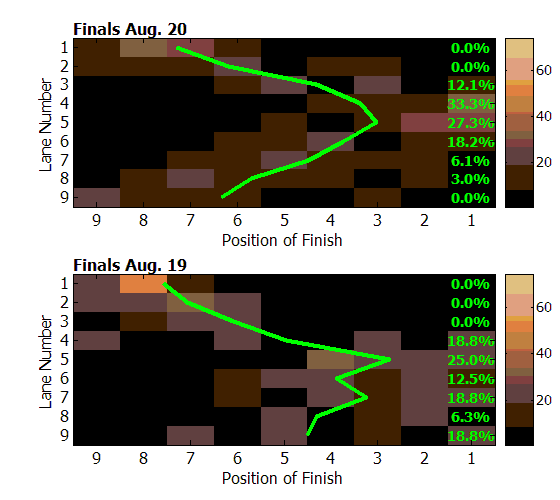
But on average, you would still expect my probability diagrams to be fairly symmetric around lane 5, even if they're not as strongly peaked as they are for the semis. The upper image in the plot below shows the statistics for the 33 finals held on Sunday, August 20 (all 500 m and 200 m finals). I wasn't there in person, but from the broadcast it looked like pretty ideal conditions on Sunday — flat calm or slight headwind. There is not a strong asymmetry in the expected position of finish, which supports the idea that the wind conditions were fair.

Position of finish versus lane: finals at 2006 world flatwater canoe-kayak world championships

On Saturday afternoon, though, it was pretty clear that some lanes were better than others. The lower plot shows the statistics for the 16 finals (A and B finals) held on Saturday afternoon. As you can see, the distribution of finishes was significantly altered. Competitors in the near lanes had enhanced performances relative to competitors in the far lanes. There were even three winners out of lane 9, one in a 'B' final and two in championship finals.

From the broadcast it appeared that there was a significant cross-headwind during the 1000 m finals. Again, it's difficult to assess the conditions from the pictures on TV, but the statistics seem to show a pretty clear advantage for the high-numbered lanes, where the Szeged course is more sheltered by the shore and the grandstand. My point here is not to make excuses for anybody, nor to discount the two world championships earned by paddlers in lane 9. Canoe-kayak is not like swimming, where most environmental factors can be rigorously controlled. That's just the nature of our sport; sometimes the conditions work in your favour, sometimes they work against you, and hopefully most of the time it's neutral.

August 22, 2006

All Those Who Have Achieved a World Record …

… please step forward. Not so fast, Mr. Gebreselassie!

From the guilty-until-proven-innocent-department, here's a little fact (courtesy of the People's Daily — read past the part about the Gatlin case) that I did not know about world records in athletics:

"We are very specific. Any record from 100m to 100km must have been tested for EPO. This has been the case for two years now, but it seems that not all the laboratories know about it," said [secretary general of the IAAF Pierre] Weiss.

According to the same article, the IAAF has refused to ratify at least three world record performances in 2006 because the testing laboratory failed to test an athlete's urine for EPO. You heard that right; not for a failed test, but for a failure to perform the test properly.

The section concerning world records in the IAAF Rulebook is seven pages long. Athletes are required to submit an application form, signed by numerous officials who certify the course, conditions, equipment, etc. A doping control officer also has to certify that a sample was collected from the athlete and sent to the laboratory for analysis.

The most recent record to be rejected was for the men's 25 km road race, where Ethiopia's legendary Haile Gebreselassie recorded a time of 1:11.37 in the Netherlands earlier this year. That accomplishment will not stand as a world record, thanks to bureaucratic incompetence.

August 20, 2006

World or Olympic Champion?

King Kaufman, one of my favourite sportswriters, writes about his lack of interest in the ongoing Basketball World Championships:

Because of the alchemy of what we care about, the Olympics are thrilling in a way the exact same competition is not if it's not the Olympics. The difference is the rings. … In the big picture, sports are important. Anything that can draw crowds of 20,000 or 50,000 or even 100,000 on a regular basis and that gets its own section in every newspaper and several TV networks to itself is pretty important. But individual games are only important to the extent that we collectively buy into the fiction that they're important. The fact that so many of us care which of two metal rings a ball goes through more times on a given night is significant. It says something about us as a society. But the actual ball going through the actual hoop is just nonsense. All of the meaning comes from us. We, and by we I mean me, but I don't think I'm off on an island here, don't put much meaning in these international tournaments, except the Olympics.

King is speaking as a sports fan here and trying to explain why certain events draw much more interest than others, even though the sporting competition may be exactly the same. I think he's hit the nail on the head; the truth is, there isn't really any "reason" behind it at all. Certain sporting events are more important because the world pays attention, and the world pays attention because the events are more important. There's not much point in arguing that people "should" pay attention to the world championships the same way that they do the Olympics.

But I don't think King's right when he says that all the meaning comes from us, the fans. For the athletes participating, there is intrinsic meaning in the competition that has nothing to do with the number of fans in the seats or the number of reporters in the press box.

Don't get me wrong. I'm not here to argue that athletes believe that a world championship is just as important as an Olympic championship. For most sports that are in the Olympics, the Olympic championship is the pinnacle of achievement, and of course that has everything to do with the fact that the whole world is paying attention.

But almost nobody pays attention to the World Championships in many of those same sports. So if all the meaning came from the fans, then the world championship would be very nearly meaningless. And to an athlete, of course, it isn't. After all, the Olympic champion is still only the best in the world. Can there be a more meaningful title? One of my experienced teammates used to describe the Olympics as a World Championship held in the middle of a World's Fair; in other words, the most meaningful possible competition, surrounded by a festival of meaningless hyperbole.

Successful amateur athletes derive meaning from sports through their performances, and not through the attention of others. In fact, athletes care a great deal about their performances even when nobody is watching at all. I lived with three of my teammates for four years and every training session had meaning in that household. Some of the most memorable moments of my entire career came during those training sessions! Even a pickup basketball game would be remembered and performances dissected into moments of glory and shame.

That's not to say that athletes don't want recognition for what they do. In Canada this is a very common lament: the Canadian public only pay attention to amateur sports every four years, and the athletes toil in anonymity the rest of the time. The media get their fair share of the blame for this attitude, too. I am all in favour of constructive efforts to increase public awareness of amateur sport — efforts like CanSport.com — but I don't like it when the lack of interest is treated as some kind of moral failure of the Canadian people.

And if the Olympic Games didn't draw the dominant part of the public's attention, what do you think would happen to sports funding in this country? Sport Canada's excellence funding strategy is based entirely on the Olympic Games. In 2004-05 Sport Canada provided more than $51M to national sport organizations (NSOs) for Olympic and Paralympic sports, and is starting to give an increasing fraction of that money to sports that have a good chance of Olympic success. In contrast, non-Olympic NSO's received less than $2.6M (about 1/20th). You can win fistfuls of medals in the Pan American Games, Commonwealth Games, and Jeux de la Francophonie, but if your sport isn't in the Olympics, even the federal government isn't that interested. (It's interesting to think about what this means about the reasons that governments support amateur sport, but that's a topic for another day.) If public interest was more evenly spread out, instead of being so concentrated on the Olympic Games, I suspect that sport funding would also show more balance. And of course that would be to the detriment of the Olympic sport NSOs.

POSTSCRIPT Speaking of constructive efforts to increase awareness, the 2006 ICF World Flatwater Championships just wrapped up in Szeged, Hungary. Lots of Canadian crews did very well (including our K-4 heros), so you will be able to see some highlights next weekend on CBC Sports Saturday.

August 19, 2006

More Than One Way Into the Olympics

Mark Keast wrote a piece in the Toronto Sun last week about the IDBF World Dragon Boat Club Crew Championships held in Toronto last weekend. The article was titled "Olympic hopes a long shot" and described some of the hurdles that the sport of dragon boat faces in gaining inclusion in the Olympics.

I wanted to point out that there are some interesting facts missing from the discussion about dragon boat racing in the Olympics. Here's what Keast wrote:

Haslam [executive president of IDBF] thinks it will take at least 20 years to get into the Olympics. The sport needs recognition as an Olympic federation first. Before that, it needs 75 national federations around the world under its umbrella. Dragon boating currently has around 60, Haslam said.

Indeed, the IDBF has a lot of hurdles to clear before it can get dragon boat into the Olympics. Even if it can gain recognition as an IF, the IDBF will still have to get the sport elected onto the list of Olympic sports; as we've seen before, the Olympic Charter says that this requires two-thirds support of the IOC membership, and that's a very tough standard to meet.

What the article doesn't mention, however, is that there's another possibility for dragon boat.

The sport of drachenbootrennen was in fact already included in the 2005 World Games. If you've never heard of the World Games, its a competition that the IOC supports as a sort of audition for the Olympics. Triathlon and taekwondo are both sports that entered the summer Olympic programme after a try-out at the World Games.

But you might ask yourself how a sport gets a place in the World Games when the IOC doesn't recognize its IF. That's the part that Mr. Haslam of the IDBF didn't mention: the IOC already recognizes the International Canoe Federation as the IF responsible for dragon boat.

And the ICF is not just a recognized IF — it also has two disciplines already on the summer Olympic programme. If the ICF decided that they wanted to add dragon boat as a new discipline of the sport of canoe-kayak, it would only require approval of the IOC Executive. The IOC members wouldn't get to vote on the idea, at least not directly. So if dragon boat really wants into the Olympics, then going in through the ICF would significantly reduce some of the political hurdles.

Of course, it would increase some others. Mainly, the dragon boat lobby would have to deal with the internal politics of the ICF. Those two Olympic disciplines I mentioned (flatwater and slalom) would not be too keen to give up any of their events to dragon boats, and the ICF is probably not strong enough to wrestle extra medals from the IOC's quota. Trying to strike out as an independent IF allows the sport of dragon boat to be, well, independent, with an IF that is looking out for its interests alone.

So although the ICF has an "official" responsibility for dragon boat's Olympic destiny, that's currently not worth very much. The IDBF-sanctioned competitions are much better attended, and more prestigious, and the ICF World Championships are a poor cousin to the IDBF event. Without a credible World Championship, the ICF couldn't get dragon boat into the Olympics even if it did want to, and without recognition by the IOC, the IDBF can't either. It isn't entirely clear whether the IDBF will ever be recognized. The Sun article makes it sound like it's a simple matter of having 75 member national federations, but the existence of the ICF within the IOC will complicate matters. At any rate, the acrimony between the two federations doesn't help either side, and trickles down to the competing national federations as well.

I'm not arguing that the sport of dragon boat would be "better off" under the ICF umbrella. But I do think that this is an interesting example of the politics of Olympic sport. I will be watching to see how this power struggle plays itself out as competitive dragon boat racing continues to grow.

August 11, 2006

The Best Rider With Two X Chromosomes

Michelle Dumaresq and the 100% Pure Woman Canadian Champion

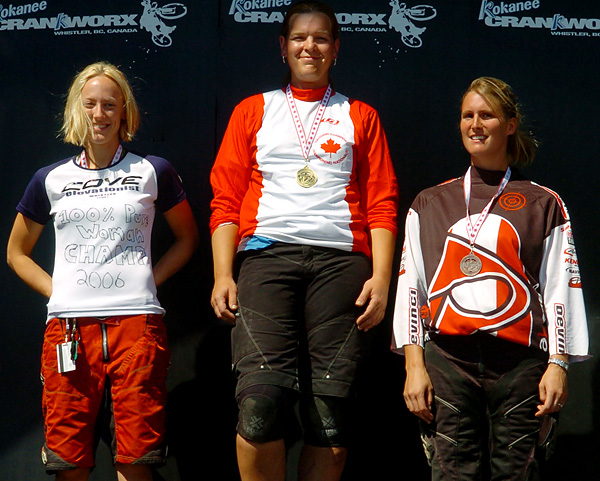
Canadian mountain biker Danika Schroeter has been suspended for three months for inappropriate behaviour at the Canadian downhill championships. The women's title was won by Michelle Dumaresq, her third. Schroeter finished in second place, losing to Dumaresq by one second. For the medal presentation (pictured at right), Schroeter wore a sponsor's white t-shirt with the words "100% Pure Woman Champ 2006" scrawled on the front.

Schroeter's claim of 100% purity might be a bit puzzling if you don't know the back story here, and you might assume that she's making an allegation about doping. But Schroeter isn't claiming to be more virtuous than Dumaresq; she's claiming to be more female. You see, Michelle Dumaresq does not have two X chromosomes. She was born a male, and underwent sex-reassignment surgery (SRS) in 1996.

This is not a secret. The IOC now allows individuals who have had SRS to compete under the reassigned sex under certain circumstances (more on that later). The international governing body for cycling, the UCI, has adopted those same rules for international competitions (including downhill, even though it is not an Olympic discipline). And the Canadian Cycling Association naturally uses the same eligibility criteria as the UCI. Michelle Dumaresq has been open about her sex reassignment since she started competing in 2001, and her participation in women's mountain biking is perfectly legal. In fact, it would almost certainly be illegal to try to stop her.

Dumaresq's story is pretty fascinating, actually, and worth a read. Here's a long piece in Outside Online, describing how she was "discovered" Free-riding in BC in 1999, and her subsequent struggle to gain acceptance from her Canadian rivals. She has also been covered several times in Sports Illustrated, and you can read her story in her own words here. She is also the subject of a recent Canadian documentary film titled (did you guess?) One Hundred Percent Woman.

Of course Dumaresq's openness about her sex reassignment creates an incredibly complex and difficult issue for her competitors. Namely, is it fair that a sex-reassigned female is allowed to compete against athletes who were born women? I talked about it with my wife, who was a varsity rower in university, and her opinion was that Dumaresq's advantages were unfair. I suspect that the majority of female athletes would instinctively agree, and from Schroeter's verbal comments I do not get the sense that she feels more resentment about it than most. Many of Dumaresq's Canadian teammates have been less than warm to her, to say the least. According to those who know Schroeter (including her father), Schroeter and Dumaresq are at least respectful acquaintances, if not friends. By all accounts, Schroeter has struggled with this issue without getting personal, until now.

And, wouldn't you know it, it turns out that there's a 100% Pure Man behind this circus. Schroeter's boyfriend, John Starcevic (also a downhill racer), has confessed to setting Schroeter up in Whistler. After Starcevic posted an apology to "anyone who was offended" on a Canadian Cyclist forum, an editor posted this e-mail he had received from Starcevic. I added the emphasis, and deleted a few irrelevant bits, but the rest of this is 100% Pure manly man:

befor you guys and gals start beaking off about something you know nothing about you should learn the facts. Danika nor her sponsers knew anything of the shirt. If you were there you would have seen that i, a male name:John Starcevic ran on stage and put the shirt on her. I caught her off Gaurd and told her to take off her jersey, when she Questioned me i told her to just do it. I basically betrayed the six years of trust that we had built up. She was extreamly embarrest and angry. I chose to use her to make my stand. it is pathetic how fast people will jump on someone with out knowing the facts. … [more about how Schroeter is being unfairly blamed] … as far as knowlage on Transgenders you read a quote and its the truth to you. What have you done on your own to find info on transgenders. I have gone to see Michelle do her speach on why she chos her path, I have talked to other transgenders with well over half believing what Michelle is doing is wrong. I have also Scedualed appointment and talked to other specialists on the subject most who said they nor anyone else could prove if a transgender had an advantage or a disadvantage. … [tangent about how poorly the Canadian Cycling Association treats the downhill discipline] … I hope you are happy that after all the embarresment i put Danika threw you jumped all over her befor knowing the facts.
Joe Louis and the 100% Pure white heavyweight champion of the world

It seems that Mr. Starcevic has spent a considerable amount of time and effort researching the issue, and he should be commended for that — but I can't help asking myself why he cares so much. It's not like he has to compete against Dumaresq. Except for attention. And as far as making a stand goes, that usually requires putting your own reputation and status at risk. Not your girlfriend's. At any rate, I don't think that this particular act is a valid political statement, although some would like to frame it that way. You play the game in the categories that are provided; you don't get to make up your own categories just so that you can call yourself a champion.

But I'd like to leave this incident behind, and get back to the bigger issue of fairness. The root of the problem here is that the categories we use in sports are binary. Either you're a woman, or you're a man. Real life, unfortunately, doesn't really follow that model.

When I went to the Olympics in 1996, all female competitors had to submit to a gender verification test. A buccal swab was taken from each athlete and subjected to a DNA-based test for detection of Y-chromosomal material. I was struck by the statistics I found in this excellent article about the history of gender verification in sport. In 1996, samples were taken from 3387 female athletes. Eight of those — more than 1 in 500 — "failed" their gender test. All eight of the women were certified as females and permitted to compete at the Olympics. In other words, their gender verification test results were ruled to be false positives.

Seven of these eight women had androgen insensitivity syndrome. I'm not a medical doctor, but from what I understand, a person with Complete Androgen Insensitivity Syndrome (CAIS) is born with normal female external genitalia even though she has XY sex chromosomes. She develops as a female because a mutation in the androgen receptor gene makes her insensitive to the effects of testosterone. There are other medical conditions that can lead a "born female" athlete to test positive for Y chromosomal material, but AIS appears to be the most common.

Jesse Owens and the 100% Pure Aryan Olympic champion

This doesn't have anything to do with Danika Schroeter, really, except to underline the often-ignored fact that it is not trivial to define a test that categorizes everybody as either a woman or a man. A woman with CAIS may have inguinal testes, but her body has no ability to use the testosterone that they produce. Other people have partial AIS, meaning that they have "overmasculinized" external female genitalia, and some people with partial AIS have "undermasculinized" external male genitalia. Michelle Dumaresq went through puberty with testes, but hasn't had them for ten years, and in fact receives the female hormones artificially that Danika Schroeter's body produces naturally.

So what percent pure woman do we assign to all these cases?

Obviously, by 1996 rules, Michelle Dumaresq would test positive for male genetic material in the IOC's gender verification test. But it turns out that 1996 was the last summer Olympic games where gender verification testing was performed. At the end of 2003, an ad-hoc committee convened by the IOC Medical Commission issued a consensus on the issue of sex reassignment and sporting competition. The statement (PDF) and accompanying Expanatory Note (PDF) included the following recommendations:

  • Any individuals undergoing SRS before puberty should be regarded as members of the reassigned sex.
  • Any individuals undergoing SRS after puberty should be eligible for competition as members of the reassigned sex if: surgical changes have been completed, including gonadectomy at least two years ago; legal recognition of the reassigned sex has been granted by the authorities; and hormonal therapy appropriate for the assigned sex has been administered in a verifiable manner and for a sufficient length of time to minimise gender-related advantages.
Mark Tewksbury and the 100% Pure heterosexual Olympic champion

You might read the committee's report and interpret it as an argument that gender-related advantages completely disappear over time — perhaps as short as two years' time. It doesn't really say that, though; it talks about "minimizing" the advantages. Going through puberty as a hormonal male means that boys, on average, grow up bigger and stronger. It also means that they get treated like boys throughout their childhood, which might lead to a big difference in athletic ability as an adult. It seems unlikely to me that either of these advantages is completely erased by SRS.

But even if we admit that Michelle Dumaresq has an advantage over her competitors, so what? The fact is that some humans have physical and psychological advantages over others. Is the unfairness of Dumaresq's advantage so overwhelming that she should be barred from competing against other women? What would be fair to Michelle Dumaresq? As you think about that, consider this: Michelle Dumaresq gets beaten in races all the time. By 100% Pure women. Who were never men. In fact, outside of Canada, she has never been on an international podium. Her best-ever finish in a World Cup downhill was a ninth-place finish in 2005. I would argue that whatever "unfair" advantage she retains from having been a man ten years ago is small compared to the "natural" advantages that all elite athletes have over the general population. I would bet that Danika Schroeter is taller, stronger, and more aggressive than the average woman, too — and that's part of the reason why she's a good downhill racer.

Let's look at this another way. Let's consider SRS as a performance-enhancing method. Would it be banned under the WADA Code? As we know, WADA uses a two-out-of-three criterion for determining whether a substance or method is prohibited. If it is performance-enhancing, then it is prohibited if it is either (a) bad for your health, or (b) contrary to the spirit of sport. SRS, unless it was done specifically for the purpose of joining and winning sporting competitions, doesn't fall into either of these categories.

And even if it was determined that SRS was contrary to the spirit of sport, what would be a just punishment? Just suppose that Michelle Dumaresq had been born a woman, but was given testosterone injections all through puberty and into her twenties. And suppose that she admitted that to the CCA, so that they suspended her for a doping violation. What would happen to her? Well, in two years — an interesting coincidence, no? — she would be eligible for competition again. And she wouldn't be told that she had to race with the men.

August 08, 2006

Por Falta de Água

The Pan American championships for canoe-kayak slalom are being moved to Madawaska, Ontario, por falta de água — for lack of water.

The competition had been scheduled to be held in September, on Brazil's Itaipu Whitewater Canal. The Itaipu canal was opened in May of this year on a part of the outflow from the massive Itaipu Hydroelectric Dam.

The Amazon River basin is entering its second consecutive year of severe drought, and reservoirs are at 25% of capacity. Last week the Brazilian government declared a state of emergency across the region.

Rivers and lakes have become sand and mud. Millions of fish rot in the sun. Boats are stranded. A massive fire rages out of control along Brazil's eastern coastline. Hundreds of towns receive emergency deliveries by the Brazilian Air Force, including water-purifying chemicals to counter the threat of disease. The Amazon rain forest is drying out as the worst drought on record lingers into its second year. … Scientists do not consider the Amazonian drought to be temporary or local. Scientist Carlos Nobre, of Brazil's National Institute of Space Research (INPE), said, "This drought has no parallel in the last 103 years" since the water levels began to be measured.

The Pan American event will be held on August 19 and 20 in conjunction with the Canadian national championships.

"It's ironic that I heard about the Amazon drought because an email about a sports event" said 18 year old Sara Potvin-Bernal of Chelsea, Quebec, one of the kayak athletes looking forward to the National Championships, and now to the PanAms. "With all the war news dominating headlines right now, it seems hardly anyone has noticed that the Amazon ecosystem is in the middle of a collapse."

August 06, 2006

Landis' Goose Is Cooked

It looks like Floyd Landis will soon be Tour de France champion no more.

Landis' B sample confirmed a very high ratio (11/1) of testosterone to epitestosterone. Furthermore, both his A and B samples were subjected to carbon isotope ratio testing, and came back positive for the presence of exogenous (synthetic) testosterone in the urine.

The carbon isotope ratio test is quite definitive. The New York Times ran a nice description of the test last week, when rumours leaked out that Landis' A sample had been positive. The test measures the ratios of two different naturally occurring isotopes of carbon in urinary testosterone. 13C and 12C are chemically identical, but can be distinguished by their mass, for example, in a mass spectrometer. Since bodies get their carbon supply from food, the actual ratio of 13C to 12C in the body is slightly influenced by diet. However, it should be the same for any chemical that the body produces. The test procedure controls for this effect by using some other hormone in the urine as a reference:

The test determines whether the testosterone in the athlete's urine has less carbon-13 than another naturally occurring hormone in the urine, like cholesterol. The test is considered positive when the carbon isotope ratio — the amount of carbon-13 compared to carbon-12 — is three or more units higher in the athlete's testosterone than it is in the comparison hormone. It is evidence that the testosterone in the urine was not made by the athlete's body.

Landis' slim hopes will now rest on the defense that either his body was tampered with (somebody slipped him a dose of testosterone without his knowledge, a.k.a. the Trevor Graham defense), or his sample was tampered with. From my own experience, I can tell you that there are a number of safeguards in place to prevent tampering between the collection point and the laboratory. After that, I can't say very much.

Of course, it is always possible that somebody at the lab intentionally or inadvertently contaminated Landis' sample. Conspiracy theories will continue to thrive, I am sure. It is also possible that the isotope ratio test result is simply a statistical false positive — it would be foolish to claim that any detection tool has a false positive rate equal to zero. The long and the short of it, though, is that Landis has failed the tests under the rules that the UCI plays by, and he will be unable to prove contamination unless he finds somebody who wants to confess. This isn't like an American-style court of law, where Landis only has to raise a reasonable doubt. The burden of proof in this defense is very high, indeed almost impossible to meet.

The doping case against Floyd Landis has been an opportunity to learn more, and write more, about the anti-doping procedures that WADA and its labs use for detecting testosterone. A few weeks ago, before the Landis and Gatlin positives, I looked at the testing statistics for 2005 and decided that the current testosterone test has a significant false positive problem. I have learned a bit more about the issue by following Landis' case. I still believe that most of the "positives" for testosterone in those statistics are false alarms; however, I now understand that most of those cases do not result in doping sanctions, which mitigates somewhat my concern about the test threshold. I'm going to look at the WADA numbers again, as well as some references that other bloggers turned up because of the Landis case, and see if I can refine my conclusions.

I still think that the media, in general, did a poor job reporting the facts of this story. Unfortunately, most of the off-the-cuff conclusions that the press jumped to have turned out to be correct! There are unlikely to be any lessons learned on that front.

Furthermore, I still am not comfortable with the way Landis' case has been handled by the UCI or by Landis' team (Phonak). As I wrote back here, Landis was being tried in the press before due process had been completed; before the results of the isotope ratio test had been provided to him (and perhaps before it had even been performed), and before the B sample results had been confirmed. As Landis himself has pointed out, Justin Gatlin's case was handled using a very different set of rules. And even though the process eventually confirmed Landis' guilt, that doesn't excuse what happened.

August 03, 2006

Fluffy White Stuff

One of Canada's most famous athletes is suing CTV, and it has nothing to do with the broadcast rights for the 2010 Olympics.

Ross Rebagliati, who won an infamous gold medal at the 1998 Winter Olympics, has taken issue with the characters and plotlines in Whistler. One of the characters on the show, which is set in Whistler, BC, is Beck MacKaye, who won the first-ever snowboarding gold medal in Olympic history.

At a press conference announcing the suit, Rebagliati stated that "The similarities between my personality and the central 'Whistler' program character Beck MacKaye are overwhelming and a clear misappropriation."

The executive producer of the show responded that "You know, lots of people ski, lots of people snowboard, a lot of them look the same. That's where it ends."

Mmmm hmmm. I won't pretend to know enough to predict how all this might come out in court (or settlement), and I'm not sure I can see any harm being done to Mr. Rebagliati here, but I will say this: every time I see a promotional spot for Whistler, I think of Ross Rebagliati. Maybe it's just me.

August 01, 2006

Has it Been Ten Years Already?

I happened to run across an interview with Donovan Bailey on the National last week, and as I was watching I realized that the whole point of the interview was the tenth anniversary of Bailey's Olympic championship in the 100m. That means that it has also been ten years since I stopped being a competitive athlete.

One of my most vivid memories of the 1996 Olympics is actually of Donovan Bailey winning a gold medal. His win in the 100 m came prior to my own competition, and although I recall watching it on television, the memory is somewhat muted. But his role as the anchor of the 4×100m relay lifted me out of my seat. That event was held on the evening of August 3, 1996, the same day as my own final race. I watched it with the rest of the team at the house we rented near Gainesville during the Olympics.

Photo by Anita Patrick

In a moment of reflection, I dug my old training diary out of the basement. Most of it is of interest only to me, so I'll spare you the details, but one thing struck me as I read through the entries for the last few months. After all the years of training and competition, I was still learning new things, and we were still learning new things as a crew. That continued right through the week of the Olympics — I had post-race notes from the heat that were about things to do differently in the semi-final.

Another thing that comes through in the entries from 1996 is that I was still having a lot of fun in the sport, and in particular I really felt good about that last few months.

So why did I quit when I did? I guess part of the answer is that there's just more to life. Of the sixteen athletes on the flatwater canoe-kayak team in 1996, nine of them retired at the end of the season or soon after. Of those I've kept in touch with even a little bit, one is an orthopedic surgeon, one a firefighter, one a chiropractor, and one an engineer. Of course, there are others who have found that their greatest rewards are still as paddlers; three of my 1996 teammates are still on the national team today.

Mainly, I retired because I wasn't enjoying the grind of training any more. Taking a leave of absence from school and spending four months in warm-weather training camp in Florida, that's fun. Touring around Europe on the World Cup circuit, that's fun too. And the lead-up to the Olympics, yeah, that's a lot of fun. But to get to the fun parts, you've got to put in a lot of slogging. Actually, it shouldn't feel like slogging, and when it does, I think that's a good sign that it's time to move on.

Another thing, which I'd forgotten until I started re-reading my training diary, is that being part of a team is hard work. It took a lot of effort, from all of us, to stay positive and pointed in the same direction. I do think that we had still more to learn, but we would have had to fight for every additional inch. And I know that I'd lost some of the will for that fight.

July 30, 2006

Testosterone, Too

Free Floyd Landis: I wish I had thought of that title, but it's a new blog that promises to address the issues surrounding the testosterone test as the Landis story unfolds over the coming weeks and months. The author, "Free Floyd," has already done a nice job discussing the testosterone testing protocol and the T/E ratio threshold.

This weekend American track star and world record co-holder Justin Gatlin was informed that he had tested positive for testosterone or its precursors at an in-competition test on April 22. Naturally, this is being linked to the Landis case in the media (and now I'm doing it, too). But there are a couple of important differences. First, judging by the statements of Dick Pound, it sounds like this has already been judged to be a doping violation — in other words, unlike the Landis case, the complete laboratory investigation has been completed before the public announcement of the test result.

The B sample is positive, they've gone through that whole exercise. What remains now is for the appropriate penalty to be handed out by the US Anti-Doping Agency and that will be reviewed by the IAAF, and by WADA if we're not satisfied that the right result has been achieved.

I can't really speak to exactly what was done with Gatlin's sample in the laboratory. In light of the announcement, I hope that a "reliable analytical method (e.g. IRMS)," as WADA puts it, was performed on either his A or his B sample, and came back positive for exogenous testosterone.

The other difference between the two cases is that while Landis' supporters are searching for a physiological excuse for the positive test, Gatlin's coach has immediately determined, with full certainty, that his was an inside job:

We are 100 percent sure who it is. The individual that did it, it's an individual that we fired and we went back and hired … he came to the [April 22] Kansas relay and was [upset] with Justin.

Gatlin is coached by Trevor Graham, who is the former coach of (dum, da-dum-dum) Tim Montgomery and Marion Jones. Graham has confessed to being the man who kick-started the investigation that led to the BALCO scandal, by anonymously sending the USADA a syringe filled with THG. Nine of his current or former athletes have tested positive and/or been charged with doping offenses.

Gatlin has already been suspended once for using a banned stimulant. In that case he was eventually found to have "no significant fault or negligence" as he had a legitimate medical need for the medication. His two-year ban was reduced to just over a year, but he was specifically warned by the IAAF that any repeat offense would result in a lifetime ban. A case of sabotage, if it could be proven, might be the only thing that can save him from that fate.

And since Graham is 100 percent sure who the culprit is, then the proof should be forthcoming any day now.

July 27, 2006

Floyd Landis Story Incomplete

By now most sports fans will have heard the news that Floyd Landis tested positive for testosterone after Stage 17 of the Tour de France.

I have a tendency to be long-winded, and I am going to be long-winded again on this subject. But there are two points that should be made up front here:

  • Landis has had a drug test with an abnormal T/E ratio. That is not the same thing as a doping sanction. Regardless of the outcome of the B sample test, Landis may not have violated anti-doping rules.
  • Landis apparently did not test positive with an elevated level of testosterone.

Now, if you want to read some real journalism on this story, skip ESPN and try the Boulder Report

This is not proof of exogenous testosterone

Testosterone is classified as an Endogenous Anabolic Androgenic Steroid (AAS). "Endogenous" substances are those produced naturally in the body. Using exogenous — that is, from outside one's own body — sources is against the rules. Here's the relevant section of the WADA Prohibited List:

Where an [AAS] is capable of being produced endogenously, a Sample will be deemed to contain such a Prohibited Substance where the concentration of such Prohibited Substance or its metabolites or markers and/or any other relevant ratio(s) in the Athlete's Sample so deviates from the range of values normally found in humans that it is unlikely to be consistent with normal endogenous production. A Sample shall not be deemed to contain a Prohibited Substance in any such case where the Athlete proves that the concentration of the Prohibited Substance … is attributable to a physiological or pathological condition.

… When a laboratory has reported a T/E [Testosterone to Epitestosterone] ratio greater than four (4) to one (1) and any reliable analytical method (e.g. IRMS [Isotope Ratio Mass Spectrometer]) applied has not determined the exogenous origin of the substance, further investigation may be conducted by a review of previous tests or by conducting subsequent test(s), in order to determine whether the result is due to a physiological or pathological condition, or has occurred as a consequence of the exogenous origin of a Prohibited Substance. … When an additional reliable analytical method (e.g. IRMS) has not been applied and a minimum of three previous test results are not available, the relevant Anti-Doping Organization shall test the Athlete with no advance notice at least three times within a three-month period. …

Landis' team, sponsored by Phonak, has issued a statement that it received notice Wednesday from the UCI that Landis "showed a disproportionately high ratio of testosterone to epitestosterone." Some sources are reporting the result as a T/E ratio of 11/1. So as noted above, that's step one in the process. Landis will now have his B sample tested. That's quite likely to show exactly the same problem as the A sample. But that is not the end of the story for Landis — it's only step one. The mere presence of an elevated T/E ratio is not enough to confirm a doping offense.

Was Landis' testosterone actually elevated?

It's being widely (although not loudly) reported, including at the Boulder Report article I cited above, that Landis' abnormally high T/E ratio was due to an extremely low level of epitestosterone (small E) and not a high level of testosterone (big T). That might seem like a subtlety, but it's an important fact if it's confirmed. If Landis had a lower-than-normal concentration of testosterone, then he clearly wasn't using that particular prohibited substance, was he? In fact it sounds like Landis has a good chance of proving that his elevated T/E ratio was endogenous in origin. In that case, he'll be exonerated. Of course, his moment of glory already lies in tatters. Which brings me to my third point …

And what happened to due process (again)?

Floyd Landis — and any athlete — deserves better than this. As I noted back here, in 2003 fewer than 15% of A Sample Adverse Analytical findings in cycling led to doping sanctions. We're actually a long way from a doping sanction against Floyd Landis in this case.

So why, given these facts, and the process outlined in WADA's own rules, did the UCI feel that it was a good idea to announce yesterday that an "unidentified rider" had "tested positive?" And why does Dick Pound again feel the need to open his mouth?

The guys who came second, third, fourth, fifth and sixth at last year's event have been busted in the [Spanish investigation], and now the winner of this year's event is busted in the race itself.

Right. Except that Floyd Landis has not yet been "busted" (and neither have the other five riders Pound mentions, but that's another story). It's one thing for the media to jump the gun on this story, and to miss the subtleties of the process still to come — they've got advertising to sell. But shouldn't Dick Pound, the head of the world's anti-doping law enforcement agency, have enough restraint to let due process run its course?

July 26, 2006

Punishment Scales in Chinese Table Tennis

Another Chinese table tennis player is in trouble. Three-time Olympic medallist Kong Linghui crashed his car into a taxi while under the influence of alcohol last week. The police gave him a modest fine and revoked his drivers' license, but Kong's punishment is probably not over yet.

The Chinese table tennis association said, through a spokesman, that "no timetable had been set" for team discipline. How bad will it be? It says here that it's going to be bad.

Consider a few examples from history:

  • Chen Qi's crime: he threw his racket and kicked a chair after losing a match to another Chinese player. His sentence included a public apology, loss of salary, military boot camp, and forced labour.
  • In 2004, four lovestruck (lust-filled?) athletes were removed, at least temporarily, from the national team. Female players Li Nan, Bai Yang, Fan Ying, and male player Hou Yingchao allegedly were engaged in "romantic affairs" with each other, and with other athletes on the team.
  • Qiu Yike was banned from all domestic and international competition for a year after he stayed out late drinking with friends.

As I pointed out in my post on the Chen case, the Chinese take a, well, pragmatic approach to these punishments when it comes to competition. Chen, the 2004 Olympic doubles gold medallist, had his drawn-out discipline interrupted to allow him to compete for China at the World Championships. Bai Yang's boyfriend and Fan Ying's lover were not disciplined in the anti-affair house cleaning. The two men who escaped punishment were Ma Lin, Chen's eventual doubles partner in Athens, and Wang Hao, the 2004 silver medallist in singles (and coincidentally, the man who sparked Chen Li's unsportsmanlike outburst). Chinese officials freely admitted that the two men were too important to send home:

Li, the association official, acknowledged that higher-ranked players were treated leniently. "We let the more important person (in the couples) stay because they have the heavier burdens and responsibilities," Li said.

And although Qiu is known as a very promising player, he is not yet one of the top players on the Chinese team, and is only 21 years old.

Poor Kong, a few years ago, might also have escaped serious discipline, or might at least (like Chen) have been allowed to continue with his competitive career. Alas, his days of heaping glory upon China are behind him now:

"He had already decided to quit from major tournaments and become a player-coach," the official said, which had effectively ruled him out of playing Olympic table tennis at Beijing in 2008.

On the one hand, that means that a ban or a suspension is more or less meaningless. However, as we saw from the Chen case, the table tennis association has a wide array of other techniques at its disposal. Who knows what public embarrassment they'll dream up for Kong?

July 23, 2006

Who's Driving on the Road To Excellence?

I've got my hands on a copy of the Road to Excellence Business Plan, released by the COC in April of this year. From a quick skim I can see that the document has lots of interesting stuff in it, and I'm looking forward to diving into it in more detail.

The report was authored by Dr. Roger Jackson, who was hired in 2005 to lead the COC's summer sport excellence program. At the time, I wondered if Jackson was too much an insider — too much part of the "old boys" network — to drive the kind of changes that would be needed to effect improvement in the Canadian sport system. One anonymous commenter chimed in that Jackson was a "blue blazer old school amateur chariots of fire type."

It turns out that in January of this year, Jackson was hired as the CEO of the Own the Podium 2010 "high performance unit," which was established to lead and manage the winter sport excellence program (I've written aboout Own the Podium most recently here).

The Road to Excellence stresses the importance of "incorporating the summmer sports into the same high performance leadership structure as is now in place for the winter sports." In other words, Own the Podium 2010 will become something called Podium, which will ultimately lead and manage all high performance sport programs in Canada — summer and winter. I'm not exactly sure where Jackson himself would fit into that plan; whether he would become the CEO of Podium, remain as a sort of vice-president on the winter side, or move over to the summer side.

About a month ago, George Gross had an article in the Toronto Sun speculating about the person that might be called upon to lead the planned improvement in summer sports. Now the fact that George Gross had Alex Baumann's name in mind may or may not mean anything. Gross certainly has the ear of the highest powers in the COC, so he may have Baumann's name from a reliable source. On the other hand, he's very careful not to say that in the article, and Baumann's name naturally pops up almost any time there's an opening in high-performance sport.

From the tone of the article, and from what's not being said, I'd guess that Baumann is at least on the short list. And if I can continue continue my quick and shallow analysis, he'd fit the requirements very well. He's young (42), and his still-remembered successes as an athlete would bring instant credibility. He's spent the past decade working his way up through the Australian sports system — so he's experienced and an outsider. That's a combination that's not easy to find.

July 19, 2006

NOC Hostages in Iraq

On Saturday the head of the Iraqi Olympic Committee and a number of other top amateur sport officials were taken hostage in Baghdad:

… the kidnappers blindfolded and handcuffed all people in the room, police said. Police Lt. Thaer Mahmoud said Ahmed al-Hijiya, president of the committee, was taken around 1:30 p.m. local time along with other employees as they attended a conference in Karradah, a Shiite neighborhood in Baghdad. Others seized included the deputy head of the Olympic committee, Ammar Jabbar al-Saadi; the chairman of the Taekwondo Federation, Jamal Abdul-Karim; and the chief of the Boxing Federation Union, Bashar Mustafa, police added.

This followed a number of even more horrific incidents involving athletes and officials over the past few months; the coach of the national wrestling team was killed on Friday, with one of his athletes escaping the would-be kidnappers. The head of the national karate association was found floating in the Tigris on July 10. Fifteen members of a taekwondo team were kidnapped on May 17.

On Sunday, six of the most recent hostages were released, including four bodyguards. Reports on Wednesday stated that four more had been found alive.

The chair of the Iraqi Olympic Committee is still in custody, if he is still alive. The Committee's spokesman, Emad Nassir Hussain, was shot in the leg, but not taken by the gunmen. He credits the fact that he was left for dead, rather than abducted, to the time he spent on an exchange program to the US. In a telephone conversation with a USOC staff member, Hussain stated:

You may have saved my life. You told me to never wear a suit. I was wearing a T-shirt, a red-and-white T-shirt I bought in California. The gunman just wanted the guys in suits. I guess they thought I cleaned the place.

A quick Google for Hussain's name turned up the following quote from 2004, where the spokesman describes the horror that was the Iraqi Olympic Committee under the old regime:

During the former regime, international sports gained a dark reputation after Iraq's Olympic Committee and soccer federation was put under the control of Saddam Hussein's son Udai in 1984. At the Olympic committee's headquarters in Baghdad, Udai was said to have torture rooms and had the reputation of being unforgiving for gaffes on the field. When athletes lost, they were punished through acts of violence and humiliation. For women that often meant rape. The result was years of women shying away from taking part in competitive sports, said Emad Nassir Hussain, the Iraqi Olympic Committee spokesman.
     —cited Chicago Tribune, 28 July 2004

July 17, 2006

WADA Statistics 2005, Part 3

In Part 2 of this post, I discussed the statistics of anti-doping tests conducted by WADA from 2003 to 2005. Specifically, I showed the positive test rates for 2003, 2004, and 2005 for all summer and winter Olympic sports, plus a few selected other sports. As I noted in that post, there was a significant increase in the positive test rate in 2005 compared to the previous two-year period. In the first part of this discussion, which was several months ago, I discussed WADA's publicly-stated hypothesis that the year-over-year increase was due to an increase in the effectiveness of their testing, and not due to an increase in the rate of cheating.

In this post, I want to explore the statistics of the increase in more detail. My goal here is to provide a crude test of the hypothesis that the effectiveness of anti-doping programs increased between 2004 and 2005.

Measured positive test rate changes

The figure above shows some of the key data summarizing that increase. The upper plot shows the positive test rates for the period 2003-2004, and for 2005, for all of the sports. The sports are arrayed on the vertical axis, although the names are not shown in this plot — see Figure 1 from Part 2 for more detail. The positive test rate, defined here as the number of A-sample adverse analytical findings divided by the total number of tests, is displayed on the horizontal axis. The error bars on the positive test rate are calculated on the basis of the total number of tests performed. Large error bars mean there were few tests performed, and small error bars mean that there were many tests (see this post for details).

The lower plot shows the change in the positive test rate (2005 rate minus the 2003-04 rate) plotted as a function of the 2003-04 positive test rate. As I noted last time, the curve is consistent with the hypothesis that the increase is the same for all sports, having a mean value of 0.53%.

Now it is interesting to note that almost all of this 0.53% increase can be attributed to a single banned substance: testosterone. The number of adverse analytical findings for testosterone in 2004, in all sports, was 392. The number of adverse analytical findings for testosterone in 2005, in all sports, was 1132. An increase of 740 positive tests, out of 146,539 total tests, would result in an increase in the positive test rate of 0.50%. That's an interesting coincidence.

It also turns out that the test for testosterone was changed between 2004 and 2005. Specifically, the threshold for the testosterone test was lowered:

The 2005 figures include several elevated T/E ratios [a urine parameter used in anti-drug tests] over 4, which were not reported in previous years when the threshold was 6, partially accounting for the increased number of AAFs in 2005. (source, PDF)

Now, lowering your failure threshhold is guaranteed to accomplish two things: it will increase your probability of detecting cheaters, and it will increase your probability of "catching" innocent athletes by mistake. The degree of each change will depend on how many cheaters are below the current threshhold, and how many non-cheaters are above the new one. To be honest, I don't know the details of those distributions, but the observations we do have (provided by WADA) might be of some help in assessing the change. I don't have the testing breakdown by sport by substance, so I'll have to look at the global data for all banned substances.

To quantify this a little bit further, I'll assume that within each sport, a fraction DS of the population of tested athletes are using banned substances, where DS is different for each sport. I'll assume that when one of those cheating athletes is tested, there is a probability Pd (the probability of detection) that the test will give an adverse analytical finding, and that Pd is the same for all forty sports. (In other words, drug testing, overall, is equally effective in all sports. I don't think that's really true, but I'll do my best to gloss over that fact when I'm finished.) Finally, I'll assume that when any athlete (clean or dirty) in any sport is tested, there is a probability Pfp that the test will generate a false positive.

Under these assumptions, when N athletes are tested, the expected number of positive tests will be given by:

      A = N (Pfp + Pd DS) ,

and the positive test rate will be simply A/N. Since we're talking about positive tests for all banned substances combined, the probabilities and rates in the equation above have to be averaged over all banned substances as well.

I've run some simulations using this equation to try to estimate the effect of changing the probabilities Pd and Pfp. I set N equal to the number of tests actually performed, using the 2005 numbers as a basis, and then ran multiple Monte Carlo simulations to estimate the statistics of the distribution of the number A of observed positives. The underlying doping rates DS are unknown, but once the values of Pd and Pfp are specified, then the doping rates have to be set to match the observed positive test rates for 2003-04; from there I can simulate the effect of changing either Pd, or Pfp, or both, while holding the DS fixed.

If drug testing was more effective in 2005 than it was in 2004, I can model that as an increase in Pd for all sports. To make things simple, I'll assume for the moment that the probability of false positives is zero. I don't really have any idea what to use as the value for Pd in 2003-04, but for starters I'll assume that the probability of catching a doping athlete with a drug test was 25%.

If that probability increased to 36.5% in 2005, then the simulated positive test rates would be as shown in the figure below:

Simulated positive test rate changes

The upper plot shows the simulated positive test rates for the two proposed values of Pd, where the doping rates DS are set to match the 2003-04 observations, and then held constant for the 2005 simulation. The error bars on the positive test rates indicate the standard deviations of the Monte Carlo runs, and the red circles indicate the means.

The increase in Pd was chosen to match the mean observed increase of 0.53% in all sports, indicated by the dashed blue line on the lower plot. The same result is obtained from any similar proportional change in the probability of detection. In other words, an increase from 25% to 36.5% looks exactly the same as an increase from 65% to 95%, or from 10% to 14.5%.

As you can see, if the probability of detection is increased for all sports, then the greatest increase in the positive test rate should be in sports with the highest positive test rates, and the sports with very low positive test rates show the smallest increase. The expected increase is proportional to the initial positive test rate. That doesn't actually match the observed changes very well. In general the sports with the highest positive test rates showed little or no change in 2005 compared to 2003-04.

But what if, instead of increasing Pd, we simulated an increase in Pfp, the false positive rate? Then the picture looks quite different:

Simulated positive test rate changes

The figure above shows the effect of increasing the false positive rate in all sports from zero to 0.53%. In this case, the positive test rate is increased uniformly for all sports, regardless of the underlying doping rate. (I used a probability of detection of 25% for the simulation, but that parameter turns out to be irrelevant to the increase.)

Modelling the 2005 increase as an increase in the false positive rate looks like it matches the observations quite a bit better than an increase in the detection rate. Given the sample uncertainty, as I stated at the outset of this post, the observed increase is consistent with a uniform change in all sports.

One small problem with this theory is that the postulated false positive rate is pretty high. If Pfp = 0.0053 for all sports in 2005, then that should set a lower threshold on the observed positive test rates. Both luge (0%) and softball (0.37%) came in under the limit in 2005, but the number of tests involved was very small. With 178 tests in luge, we would have expected 0.94 positive tests, whereas none were observed. In softball, 542 tests should lead to 2.87 positives, whereas two were observed. So we're talking about less than one "missing" positive test in each case — I don't think we can rule out a false positive rate of 0.53% quite yet, and I think we have to at least consider the possibility that the false positive rate increased significantly in 2005.

Of course the assumptions I've used in my analysis are pretty simplistic; certainly all sports don't have the same kind of doping problem, and therefore their anti-doping programs are not all the same either. But my conclusions are based on a comparison of broad trends, and don't really depend critically on that assumption, I don't think. For a future analysis, it would be really nice if I could study the positive test rate changes for testosterone by itself, since I think that the increase in positive test rates was largely due to the changes in the testosterone test. Unfortunately, WADA doesn't provide that breakdown.

Some people might also reject my very first assumption, which was that athlete behaviour (specifically doping rates) didn't change between 2004 and 2005. What if they did change? Well, assuming that the tests were consistent from year to year, the observed changes in positive test rates suggest that the rate of doping increased more or less uniformly across the board. I can't really tell the difference between that event and a change in the false positive rate.

I have to live with the limitations of the analysis, which means that there's no "smoking gun" here. But everything I've looked at in the 2003-2005 statistics suggests that the increase in the positive test rate in 2005 came largely at the expense of athletes that weren't cheating in the first place.