August 11, 2006

The Best Rider With Two X Chromosomes

Michelle Dumaresq and the 100% Pure Woman Canadian Champion

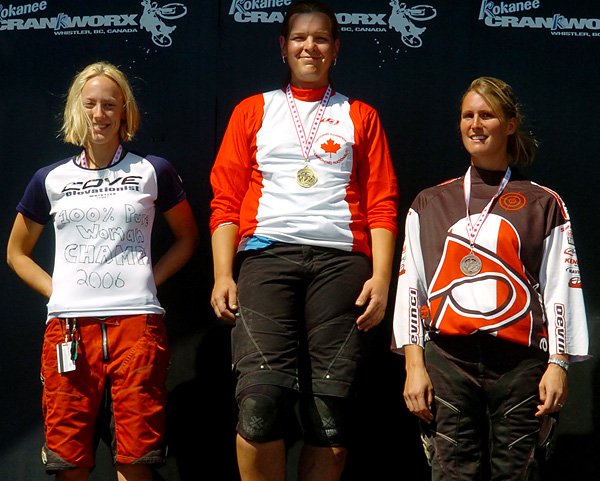
Canadian mountain biker Danika Schroeter has been suspended for three months for inappropriate behaviour at the Canadian downhill championships. The women's title was won by Michelle Dumaresq, her third. Schroeter finished in second place, losing to Dumaresq by one second. For the medal presentation (pictured at right), Schroeter wore a sponsor's white t-shirt with the words "100% Pure Woman Champ 2006" scrawled on the front.

Schroeter's claim of 100% purity might be a bit puzzling if you don't know the back story here, and you might assume that she's making an allegation about doping. But Schroeter isn't claiming to be more virtuous than Dumaresq; she's claiming to be more female. You see, Michelle Dumaresq does not have two X chromosomes. She was born a male, and underwent sex-reassignment surgery (SRS) in 1996.

This is not a secret. The IOC now allows individuals who have had SRS to compete under the reassigned sex under certain circumstances (more on that later). The international governing body for cycling, the UCI, has adopted those same rules for international competitions (including downhill, even though it is not an Olympic discipline). And the Canadian Cycling Association naturally uses the same eligibility criteria as the UCI. Michelle Dumaresq has been open about her sex reassignment since she started competing in 2001, and her participation in women's mountain biking is perfectly legal. In fact, it would almost certainly be illegal to try to stop her.

Dumaresq's story is pretty fascinating, actually, and worth a read. Here's a long piece in Outside Online, describing how she was "discovered" Free-riding in BC in 1999, and her subsequent struggle to gain acceptance from her Canadian rivals. She has also been covered several times in Sports Illustrated, and you can read her story in her own words here. She is also the subject of a recent Canadian documentary film titled (did you guess?) One Hundred Percent Woman.

Of course Dumaresq's openness about her sex reassignment creates an incredibly complex and difficult issue for her competitors. Namely, is it fair that a sex-reassigned female is allowed to compete against athletes who were born women? I talked about it with my wife, who was a varsity rower in university, and her opinion was that Dumaresq's advantages were unfair. I suspect that the majority of female athletes would instinctively agree, and from Schroeter's verbal comments I do not get the sense that she feels more resentment about it than most. Many of Dumaresq's Canadian teammates have been less than warm to her, to say the least. According to those who know Schroeter (including her father), Schroeter and Dumaresq are at least respectful acquaintances, if not friends. By all accounts, Schroeter has struggled with this issue without getting personal, until now.

And, wouldn't you know it, it turns out that there's a 100% Pure Man behind this circus. Schroeter's boyfriend, John Starcevic (also a downhill racer), has confessed to setting Schroeter up in Whistler. After Starcevic posted an apology to "anyone who was offended" on a Canadian Cyclist forum, an editor posted this e-mail he had received from Starcevic. I added the emphasis, and deleted a few irrelevant bits, but the rest of this is 100% Pure manly man:

befor you guys and gals start beaking off about something you know nothing about you should learn the facts. Danika nor her sponsers knew anything of the shirt. If you were there you would have seen that i, a male name:John Starcevic ran on stage and put the shirt on her. I caught her off Gaurd and told her to take off her jersey, when she Questioned me i told her to just do it. I basically betrayed the six years of trust that we had built up. She was extreamly embarrest and angry. I chose to use her to make my stand. it is pathetic how fast people will jump on someone with out knowing the facts. … [more about how Schroeter is being unfairly blamed] … as far as knowlage on Transgenders you read a quote and its the truth to you. What have you done on your own to find info on transgenders. I have gone to see Michelle do her speach on why she chos her path, I have talked to other transgenders with well over half believing what Michelle is doing is wrong. I have also Scedualed appointment and talked to other specialists on the subject most who said they nor anyone else could prove if a transgender had an advantage or a disadvantage. … [tangent about how poorly the Canadian Cycling Association treats the downhill discipline] … I hope you are happy that after all the embarresment i put Danika threw you jumped all over her befor knowing the facts.
Joe Louis and the 100% Pure white heavyweight champion of the world

It seems that Mr. Starcevic has spent a considerable amount of time and effort researching the issue, and he should be commended for that — but I can't help asking myself why he cares so much. It's not like he has to compete against Dumaresq. Except for attention. And as far as making a stand goes, that usually requires putting your own reputation and status at risk. Not your girlfriend's. At any rate, I don't think that this particular act is a valid political statement, although some would like to frame it that way. You play the game in the categories that are provided; you don't get to make up your own categories just so that you can call yourself a champion.

But I'd like to leave this incident behind, and get back to the bigger issue of fairness. The root of the problem here is that the categories we use in sports are binary. Either you're a woman, or you're a man. Real life, unfortunately, doesn't really follow that model.

When I went to the Olympics in 1996, all female competitors had to submit to a gender verification test. A buccal swab was taken from each athlete and subjected to a DNA-based test for detection of Y-chromosomal material. I was struck by the statistics I found in this excellent article about the history of gender verification in sport. In 1996, samples were taken from 3387 female athletes. Eight of those — more than 1 in 500 — "failed" their gender test. All eight of the women were certified as females and permitted to compete at the Olympics. In other words, their gender verification test results were ruled to be false positives.

Seven of these eight women had androgen insensitivity syndrome. I'm not a medical doctor, but from what I understand, a person with Complete Androgen Insensitivity Syndrome (CAIS) is born with normal female external genitalia even though she has XY sex chromosomes. She develops as a female because a mutation in the androgen receptor gene makes her insensitive to the effects of testosterone. There are other medical conditions that can lead a "born female" athlete to test positive for Y chromosomal material, but AIS appears to be the most common.

Jesse Owens and the 100% Pure Aryan Olympic champion

This doesn't have anything to do with Danika Schroeter, really, except to underline the often-ignored fact that it is not trivial to define a test that categorizes everybody as either a woman or a man. A woman with CAIS may have inguinal testes, but her body has no ability to use the testosterone that they produce. Other people have partial AIS, meaning that they have "overmasculinized" external female genitalia, and some people with partial AIS have "undermasculinized" external male genitalia. Michelle Dumaresq went through puberty with testes, but hasn't had them for ten years, and in fact receives the female hormones artificially that Danika Schroeter's body produces naturally.

So what percent pure woman do we assign to all these cases?

Obviously, by 1996 rules, Michelle Dumaresq would test positive for male genetic material in the IOC's gender verification test. But it turns out that 1996 was the last summer Olympic games where gender verification testing was performed. At the end of 2003, an ad-hoc committee convened by the IOC Medical Commission issued a consensus on the issue of sex reassignment and sporting competition. The statement (PDF) and accompanying Expanatory Note (PDF) included the following recommendations:

  • Any individuals undergoing SRS before puberty should be regarded as members of the reassigned sex.
  • Any individuals undergoing SRS after puberty should be eligible for competition as members of the reassigned sex if: surgical changes have been completed, including gonadectomy at least two years ago; legal recognition of the reassigned sex has been granted by the authorities; and hormonal therapy appropriate for the assigned sex has been administered in a verifiable manner and for a sufficient length of time to minimise gender-related advantages.
Mark Tewksbury and the 100% Pure heterosexual Olympic champion

You might read the committee's report and interpret it as an argument that gender-related advantages completely disappear over time — perhaps as short as two years' time. It doesn't really say that, though; it talks about "minimizing" the advantages. Going through puberty as a hormonal male means that boys, on average, grow up bigger and stronger. It also means that they get treated like boys throughout their childhood, which might lead to a big difference in athletic ability as an adult. It seems unlikely to me that either of these advantages is completely erased by SRS.

But even if we admit that Michelle Dumaresq has an advantage over her competitors, so what? The fact is that some humans have physical and psychological advantages over others. Is the unfairness of Dumaresq's advantage so overwhelming that she should be barred from competing against other women? What would be fair to Michelle Dumaresq? As you think about that, consider this: Michelle Dumaresq gets beaten in races all the time. By 100% Pure women. Who were never men. In fact, outside of Canada, she has never been on an international podium. Her best-ever finish in a World Cup downhill was a ninth-place finish in 2005. I would argue that whatever "unfair" advantage she retains from having been a man ten years ago is small compared to the "natural" advantages that all elite athletes have over the general population. I would bet that Danika Schroeter is taller, stronger, and more aggressive than the average woman, too — and that's part of the reason why she's a good downhill racer.

Let's look at this another way. Let's consider SRS as a performance-enhancing method. Would it be banned under the WADA Code? As we know, WADA uses a two-out-of-three criterion for determining whether a substance or method is prohibited. If it is performance-enhancing, then it is prohibited if it is either (a) bad for your health, or (b) contrary to the spirit of sport. SRS, unless it was done specifically for the purpose of joining and winning sporting competitions, doesn't fall into either of these categories.

And even if it was determined that SRS was contrary to the spirit of sport, what would be a just punishment? Just suppose that Michelle Dumaresq had been born a woman, but was given testosterone injections all through puberty and into her twenties. And suppose that she admitted that to the CCA, so that they suspended her for a doping violation. What would happen to her? Well, in two years — an interesting coincidence, no? — she would be eligible for competition again. And she wouldn't be told that she had to race with the men.

August 08, 2006

Por Falta de Água

The Pan American championships for canoe-kayak slalom are being moved to Madawaska, Ontario, por falta de água — for lack of water.

The competition had been scheduled to be held in September, on Brazil's Itaipu Whitewater Canal. The Itaipu canal was opened in May of this year on a part of the outflow from the massive Itaipu Hydroelectric Dam.

The Amazon River basin is entering its second consecutive year of severe drought, and reservoirs are at 25% of capacity. Last week the Brazilian government declared a state of emergency across the region.

Rivers and lakes have become sand and mud. Millions of fish rot in the sun. Boats are stranded. A massive fire rages out of control along Brazil's eastern coastline. Hundreds of towns receive emergency deliveries by the Brazilian Air Force, including water-purifying chemicals to counter the threat of disease. The Amazon rain forest is drying out as the worst drought on record lingers into its second year. … Scientists do not consider the Amazonian drought to be temporary or local. Scientist Carlos Nobre, of Brazil's National Institute of Space Research (INPE), said, "This drought has no parallel in the last 103 years" since the water levels began to be measured.

The Pan American event will be held on August 19 and 20 in conjunction with the Canadian national championships.

"It's ironic that I heard about the Amazon drought because an email about a sports event" said 18 year old Sara Potvin-Bernal of Chelsea, Quebec, one of the kayak athletes looking forward to the National Championships, and now to the PanAms. "With all the war news dominating headlines right now, it seems hardly anyone has noticed that the Amazon ecosystem is in the middle of a collapse."

August 06, 2006

Landis' Goose Is Cooked

It looks like Floyd Landis will soon be Tour de France champion no more.

Landis' B sample confirmed a very high ratio (11/1) of testosterone to epitestosterone. Furthermore, both his A and B samples were subjected to carbon isotope ratio testing, and came back positive for the presence of exogenous (synthetic) testosterone in the urine.

The carbon isotope ratio test is quite definitive. The New York Times ran a nice description of the test last week, when rumours leaked out that Landis' A sample had been positive. The test measures the ratios of two different naturally occurring isotopes of carbon in urinary testosterone. 13C and 12C are chemically identical, but can be distinguished by their mass, for example, in a mass spectrometer. Since bodies get their carbon supply from food, the actual ratio of 13C to 12C in the body is slightly influenced by diet. However, it should be the same for any chemical that the body produces. The test procedure controls for this effect by using some other hormone in the urine as a reference:

The test determines whether the testosterone in the athlete's urine has less carbon-13 than another naturally occurring hormone in the urine, like cholesterol. The test is considered positive when the carbon isotope ratio — the amount of carbon-13 compared to carbon-12 — is three or more units higher in the athlete's testosterone than it is in the comparison hormone. It is evidence that the testosterone in the urine was not made by the athlete's body.

Landis' slim hopes will now rest on the defense that either his body was tampered with (somebody slipped him a dose of testosterone without his knowledge, a.k.a. the Trevor Graham defense), or his sample was tampered with. From my own experience, I can tell you that there are a number of safeguards in place to prevent tampering between the collection point and the laboratory. After that, I can't say very much.

Of course, it is always possible that somebody at the lab intentionally or inadvertently contaminated Landis' sample. Conspiracy theories will continue to thrive, I am sure. It is also possible that the isotope ratio test result is simply a statistical false positive — it would be foolish to claim that any detection tool has a false positive rate equal to zero. The long and the short of it, though, is that Landis has failed the tests under the rules that the UCI plays by, and he will be unable to prove contamination unless he finds somebody who wants to confess. This isn't like an American-style court of law, where Landis only has to raise a reasonable doubt. The burden of proof in this defense is very high, indeed almost impossible to meet.

The doping case against Floyd Landis has been an opportunity to learn more, and write more, about the anti-doping procedures that WADA and its labs use for detecting testosterone. A few weeks ago, before the Landis and Gatlin positives, I looked at the testing statistics for 2005 and decided that the current testosterone test has a significant false positive problem. I have learned a bit more about the issue by following Landis' case. I still believe that most of the "positives" for testosterone in those statistics are false alarms; however, I now understand that most of those cases do not result in doping sanctions, which mitigates somewhat my concern about the test threshold. I'm going to look at the WADA numbers again, as well as some references that other bloggers turned up because of the Landis case, and see if I can refine my conclusions.

I still think that the media, in general, did a poor job reporting the facts of this story. Unfortunately, most of the off-the-cuff conclusions that the press jumped to have turned out to be correct! There are unlikely to be any lessons learned on that front.

Furthermore, I still am not comfortable with the way Landis' case has been handled by the UCI or by Landis' team (Phonak). As I wrote back here, Landis was being tried in the press before due process had been completed; before the results of the isotope ratio test had been provided to him (and perhaps before it had even been performed), and before the B sample results had been confirmed. As Landis himself has pointed out, Justin Gatlin's case was handled using a very different set of rules. And even though the process eventually confirmed Landis' guilt, that doesn't excuse what happened.

August 03, 2006

Fluffy White Stuff

One of Canada's most famous athletes is suing CTV, and it has nothing to do with the broadcast rights for the 2010 Olympics.

Ross Rebagliati, who won an infamous gold medal at the 1998 Winter Olympics, has taken issue with the characters and plotlines in Whistler. One of the characters on the show, which is set in Whistler, BC, is Beck MacKaye, who won the first-ever snowboarding gold medal in Olympic history.

At a press conference announcing the suit, Rebagliati stated that "The similarities between my personality and the central 'Whistler' program character Beck MacKaye are overwhelming and a clear misappropriation."

The executive producer of the show responded that "You know, lots of people ski, lots of people snowboard, a lot of them look the same. That's where it ends."

Mmmm hmmm. I won't pretend to know enough to predict how all this might come out in court (or settlement), and I'm not sure I can see any harm being done to Mr. Rebagliati here, but I will say this: every time I see a promotional spot for Whistler, I think of Ross Rebagliati. Maybe it's just me.

August 01, 2006

Has it Been Ten Years Already?

I happened to run across an interview with Donovan Bailey on the National last week, and as I was watching I realized that the whole point of the interview was the tenth anniversary of Bailey's Olympic championship in the 100m. That means that it has also been ten years since I stopped being a competitive athlete.

One of my most vivid memories of the 1996 Olympics is actually of Donovan Bailey winning a gold medal. His win in the 100 m came prior to my own competition, and although I recall watching it on television, the memory is somewhat muted. But his role as the anchor of the 4×100m relay lifted me out of my seat. That event was held on the evening of August 3, 1996, the same day as my own final race. I watched it with the rest of the team at the house we rented near Gainesville during the Olympics.

Photo by Anita Patrick

In a moment of reflection, I dug my old training diary out of the basement. Most of it is of interest only to me, so I'll spare you the details, but one thing struck me as I read through the entries for the last few months. After all the years of training and competition, I was still learning new things, and we were still learning new things as a crew. That continued right through the week of the Olympics — I had post-race notes from the heat that were about things to do differently in the semi-final.

Another thing that comes through in the entries from 1996 is that I was still having a lot of fun in the sport, and in particular I really felt good about that last few months.

So why did I quit when I did? I guess part of the answer is that there's just more to life. Of the sixteen athletes on the flatwater canoe-kayak team in 1996, nine of them retired at the end of the season or soon after. Of those I've kept in touch with even a little bit, one is an orthopedic surgeon, one a firefighter, one a chiropractor, and one an engineer. Of course, there are others who have found that their greatest rewards are still as paddlers; three of my 1996 teammates are still on the national team today.

Mainly, I retired because I wasn't enjoying the grind of training any more. Taking a leave of absence from school and spending four months in warm-weather training camp in Florida, that's fun. Touring around Europe on the World Cup circuit, that's fun too. And the lead-up to the Olympics, yeah, that's a lot of fun. But to get to the fun parts, you've got to put in a lot of slogging. Actually, it shouldn't feel like slogging, and when it does, I think that's a good sign that it's time to move on.

Another thing, which I'd forgotten until I started re-reading my training diary, is that being part of a team is hard work. It took a lot of effort, from all of us, to stay positive and pointed in the same direction. I do think that we had still more to learn, but we would have had to fight for every additional inch. And I know that I'd lost some of the will for that fight.

July 30, 2006

Testosterone, Too

Free Floyd Landis: I wish I had thought of that title, but it's a new blog that promises to address the issues surrounding the testosterone test as the Landis story unfolds over the coming weeks and months. The author, "Free Floyd," has already done a nice job discussing the testosterone testing protocol and the T/E ratio threshold.

This weekend American track star and world record co-holder Justin Gatlin was informed that he had tested positive for testosterone or its precursors at an in-competition test on April 22. Naturally, this is being linked to the Landis case in the media (and now I'm doing it, too). But there are a couple of important differences. First, judging by the statements of Dick Pound, it sounds like this has already been judged to be a doping violation — in other words, unlike the Landis case, the complete laboratory investigation has been completed before the public announcement of the test result.

The B sample is positive, they've gone through that whole exercise. What remains now is for the appropriate penalty to be handed out by the US Anti-Doping Agency and that will be reviewed by the IAAF, and by WADA if we're not satisfied that the right result has been achieved.

I can't really speak to exactly what was done with Gatlin's sample in the laboratory. In light of the announcement, I hope that a "reliable analytical method (e.g. IRMS)," as WADA puts it, was performed on either his A or his B sample, and came back positive for exogenous testosterone.

The other difference between the two cases is that while Landis' supporters are searching for a physiological excuse for the positive test, Gatlin's coach has immediately determined, with full certainty, that his was an inside job:

We are 100 percent sure who it is. The individual that did it, it's an individual that we fired and we went back and hired … he came to the [April 22] Kansas relay and was [upset] with Justin.

Gatlin is coached by Trevor Graham, who is the former coach of (dum, da-dum-dum) Tim Montgomery and Marion Jones. Graham has confessed to being the man who kick-started the investigation that led to the BALCO scandal, by anonymously sending the USADA a syringe filled with THG. Nine of his current or former athletes have tested positive and/or been charged with doping offenses.

Gatlin has already been suspended once for using a banned stimulant. In that case he was eventually found to have "no significant fault or negligence" as he had a legitimate medical need for the medication. His two-year ban was reduced to just over a year, but he was specifically warned by the IAAF that any repeat offense would result in a lifetime ban. A case of sabotage, if it could be proven, might be the only thing that can save him from that fate.

And since Graham is 100 percent sure who the culprit is, then the proof should be forthcoming any day now.

July 27, 2006

Floyd Landis Story Incomplete

By now most sports fans will have heard the news that Floyd Landis tested positive for testosterone after Stage 17 of the Tour de France.

I have a tendency to be long-winded, and I am going to be long-winded again on this subject. But there are two points that should be made up front here:

  • Landis has had a drug test with an abnormal T/E ratio. That is not the same thing as a doping sanction. Regardless of the outcome of the B sample test, Landis may not have violated anti-doping rules.
  • Landis apparently did not test positive with an elevated level of testosterone.

Now, if you want to read some real journalism on this story, skip ESPN and try the Boulder Report

This is not proof of exogenous testosterone

Testosterone is classified as an Endogenous Anabolic Androgenic Steroid (AAS). "Endogenous" substances are those produced naturally in the body. Using exogenous — that is, from outside one's own body — sources is against the rules. Here's the relevant section of the WADA Prohibited List:

Where an [AAS] is capable of being produced endogenously, a Sample will be deemed to contain such a Prohibited Substance where the concentration of such Prohibited Substance or its metabolites or markers and/or any other relevant ratio(s) in the Athlete's Sample so deviates from the range of values normally found in humans that it is unlikely to be consistent with normal endogenous production. A Sample shall not be deemed to contain a Prohibited Substance in any such case where the Athlete proves that the concentration of the Prohibited Substance … is attributable to a physiological or pathological condition.

… When a laboratory has reported a T/E [Testosterone to Epitestosterone] ratio greater than four (4) to one (1) and any reliable analytical method (e.g. IRMS [Isotope Ratio Mass Spectrometer]) applied has not determined the exogenous origin of the substance, further investigation may be conducted by a review of previous tests or by conducting subsequent test(s), in order to determine whether the result is due to a physiological or pathological condition, or has occurred as a consequence of the exogenous origin of a Prohibited Substance. … When an additional reliable analytical method (e.g. IRMS) has not been applied and a minimum of three previous test results are not available, the relevant Anti-Doping Organization shall test the Athlete with no advance notice at least three times within a three-month period. …

Landis' team, sponsored by Phonak, has issued a statement that it received notice Wednesday from the UCI that Landis "showed a disproportionately high ratio of testosterone to epitestosterone." Some sources are reporting the result as a T/E ratio of 11/1. So as noted above, that's step one in the process. Landis will now have his B sample tested. That's quite likely to show exactly the same problem as the A sample. But that is not the end of the story for Landis — it's only step one. The mere presence of an elevated T/E ratio is not enough to confirm a doping offense.

Was Landis' testosterone actually elevated?

It's being widely (although not loudly) reported, including at the Boulder Report article I cited above, that Landis' abnormally high T/E ratio was due to an extremely low level of epitestosterone (small E) and not a high level of testosterone (big T). That might seem like a subtlety, but it's an important fact if it's confirmed. If Landis had a lower-than-normal concentration of testosterone, then he clearly wasn't using that particular prohibited substance, was he? In fact it sounds like Landis has a good chance of proving that his elevated T/E ratio was endogenous in origin. In that case, he'll be exonerated. Of course, his moment of glory already lies in tatters. Which brings me to my third point …

And what happened to due process (again)?

Floyd Landis — and any athlete — deserves better than this. As I noted back here, in 2003 fewer than 15% of A Sample Adverse Analytical findings in cycling led to doping sanctions. We're actually a long way from a doping sanction against Floyd Landis in this case.

So why, given these facts, and the process outlined in WADA's own rules, did the UCI feel that it was a good idea to announce yesterday that an "unidentified rider" had "tested positive?" And why does Dick Pound again feel the need to open his mouth?

The guys who came second, third, fourth, fifth and sixth at last year's event have been busted in the [Spanish investigation], and now the winner of this year's event is busted in the race itself.

Right. Except that Floyd Landis has not yet been "busted" (and neither have the other five riders Pound mentions, but that's another story). It's one thing for the media to jump the gun on this story, and to miss the subtleties of the process still to come — they've got advertising to sell. But shouldn't Dick Pound, the head of the world's anti-doping law enforcement agency, have enough restraint to let due process run its course?

July 26, 2006

Punishment Scales in Chinese Table Tennis

Another Chinese table tennis player is in trouble. Three-time Olympic medallist Kong Linghui crashed his car into a taxi while under the influence of alcohol last week. The police gave him a modest fine and revoked his drivers' license, but Kong's punishment is probably not over yet.

The Chinese table tennis association said, through a spokesman, that "no timetable had been set" for team discipline. How bad will it be? It says here that it's going to be bad.

Consider a few examples from history:

  • Chen Qi's crime: he threw his racket and kicked a chair after losing a match to another Chinese player. His sentence included a public apology, loss of salary, military boot camp, and forced labour.
  • In 2004, four lovestruck (lust-filled?) athletes were removed, at least temporarily, from the national team. Female players Li Nan, Bai Yang, Fan Ying, and male player Hou Yingchao allegedly were engaged in "romantic affairs" with each other, and with other athletes on the team.
  • Qiu Yike was banned from all domestic and international competition for a year after he stayed out late drinking with friends.

As I pointed out in my post on the Chen case, the Chinese take a, well, pragmatic approach to these punishments when it comes to competition. Chen, the 2004 Olympic doubles gold medallist, had his drawn-out discipline interrupted to allow him to compete for China at the World Championships. Bai Yang's boyfriend and Fan Ying's lover were not disciplined in the anti-affair house cleaning. The two men who escaped punishment were Ma Lin, Chen's eventual doubles partner in Athens, and Wang Hao, the 2004 silver medallist in singles (and coincidentally, the man who sparked Chen Li's unsportsmanlike outburst). Chinese officials freely admitted that the two men were too important to send home:

Li, the association official, acknowledged that higher-ranked players were treated leniently. "We let the more important person (in the couples) stay because they have the heavier burdens and responsibilities," Li said.

And although Qiu is known as a very promising player, he is not yet one of the top players on the Chinese team, and is only 21 years old.

Poor Kong, a few years ago, might also have escaped serious discipline, or might at least (like Chen) have been allowed to continue with his competitive career. Alas, his days of heaping glory upon China are behind him now:

"He had already decided to quit from major tournaments and become a player-coach," the official said, which had effectively ruled him out of playing Olympic table tennis at Beijing in 2008.

On the one hand, that means that a ban or a suspension is more or less meaningless. However, as we saw from the Chen case, the table tennis association has a wide array of other techniques at its disposal. Who knows what public embarrassment they'll dream up for Kong?

July 23, 2006

Who's Driving on the Road To Excellence?

I've got my hands on a copy of the Road to Excellence Business Plan, released by the COC in April of this year. From a quick skim I can see that the document has lots of interesting stuff in it, and I'm looking forward to diving into it in more detail.

The report was authored by Dr. Roger Jackson, who was hired in 2005 to lead the COC's summer sport excellence program. At the time, I wondered if Jackson was too much an insider — too much part of the "old boys" network — to drive the kind of changes that would be needed to effect improvement in the Canadian sport system. One anonymous commenter chimed in that Jackson was a "blue blazer old school amateur chariots of fire type."

It turns out that in January of this year, Jackson was hired as the CEO of the Own the Podium 2010 "high performance unit," which was established to lead and manage the winter sport excellence program (I've written aboout Own the Podium most recently here).

The Road to Excellence stresses the importance of "incorporating the summmer sports into the same high performance leadership structure as is now in place for the winter sports." In other words, Own the Podium 2010 will become something called Podium, which will ultimately lead and manage all high performance sport programs in Canada — summer and winter. I'm not exactly sure where Jackson himself would fit into that plan; whether he would become the CEO of Podium, remain as a sort of vice-president on the winter side, or move over to the summer side.

About a month ago, George Gross had an article in the Toronto Sun speculating about the person that might be called upon to lead the planned improvement in summer sports. Now the fact that George Gross had Alex Baumann's name in mind may or may not mean anything. Gross certainly has the ear of the highest powers in the COC, so he may have Baumann's name from a reliable source. On the other hand, he's very careful not to say that in the article, and Baumann's name naturally pops up almost any time there's an opening in high-performance sport.

From the tone of the article, and from what's not being said, I'd guess that Baumann is at least on the short list. And if I can continue continue my quick and shallow analysis, he'd fit the requirements very well. He's young (42), and his still-remembered successes as an athlete would bring instant credibility. He's spent the past decade working his way up through the Australian sports system — so he's experienced and an outsider. That's a combination that's not easy to find.

July 19, 2006

NOC Hostages in Iraq

On Saturday the head of the Iraqi Olympic Committee and a number of other top amateur sport officials were taken hostage in Baghdad:

… the kidnappers blindfolded and handcuffed all people in the room, police said. Police Lt. Thaer Mahmoud said Ahmed al-Hijiya, president of the committee, was taken around 1:30 p.m. local time along with other employees as they attended a conference in Karradah, a Shiite neighborhood in Baghdad. Others seized included the deputy head of the Olympic committee, Ammar Jabbar al-Saadi; the chairman of the Taekwondo Federation, Jamal Abdul-Karim; and the chief of the Boxing Federation Union, Bashar Mustafa, police added.

This followed a number of even more horrific incidents involving athletes and officials over the past few months; the coach of the national wrestling team was killed on Friday, with one of his athletes escaping the would-be kidnappers. The head of the national karate association was found floating in the Tigris on July 10. Fifteen members of a taekwondo team were kidnapped on May 17.

On Sunday, six of the most recent hostages were released, including four bodyguards. Reports on Wednesday stated that four more had been found alive.

The chair of the Iraqi Olympic Committee is still in custody, if he is still alive. The Committee's spokesman, Emad Nassir Hussain, was shot in the leg, but not taken by the gunmen. He credits the fact that he was left for dead, rather than abducted, to the time he spent on an exchange program to the US. In a telephone conversation with a USOC staff member, Hussain stated:

You may have saved my life. You told me to never wear a suit. I was wearing a T-shirt, a red-and-white T-shirt I bought in California. The gunman just wanted the guys in suits. I guess they thought I cleaned the place.

A quick Google for Hussain's name turned up the following quote from 2004, where the spokesman describes the horror that was the Iraqi Olympic Committee under the old regime:

During the former regime, international sports gained a dark reputation after Iraq's Olympic Committee and soccer federation was put under the control of Saddam Hussein's son Udai in 1984. At the Olympic committee's headquarters in Baghdad, Udai was said to have torture rooms and had the reputation of being unforgiving for gaffes on the field. When athletes lost, they were punished through acts of violence and humiliation. For women that often meant rape. The result was years of women shying away from taking part in competitive sports, said Emad Nassir Hussain, the Iraqi Olympic Committee spokesman.
     —cited Chicago Tribune, 28 July 2004

July 17, 2006

WADA Statistics 2005, Part 3

In Part 2 of this post, I discussed the statistics of anti-doping tests conducted by WADA from 2003 to 2005. Specifically, I showed the positive test rates for 2003, 2004, and 2005 for all summer and winter Olympic sports, plus a few selected other sports. As I noted in that post, there was a significant increase in the positive test rate in 2005 compared to the previous two-year period. In the first part of this discussion, which was several months ago, I discussed WADA's publicly-stated hypothesis that the year-over-year increase was due to an increase in the effectiveness of their testing, and not due to an increase in the rate of cheating.

In this post, I want to explore the statistics of the increase in more detail. My goal here is to provide a crude test of the hypothesis that the effectiveness of anti-doping programs increased between 2004 and 2005.

Measured positive test rate changes

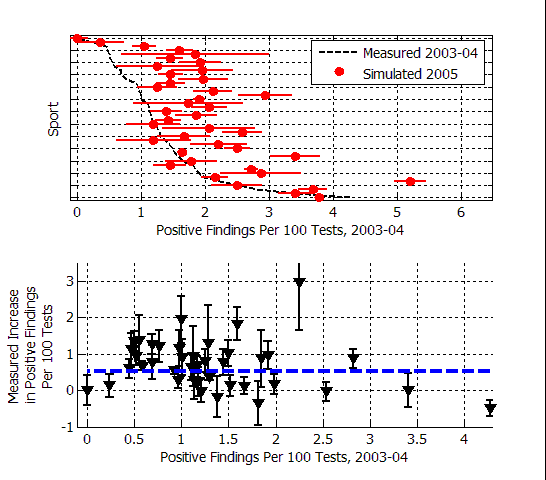
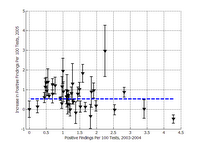
The figure above shows some of the key data summarizing that increase. The upper plot shows the positive test rates for the period 2003-2004, and for 2005, for all of the sports. The sports are arrayed on the vertical axis, although the names are not shown in this plot — see Figure 1 from Part 2 for more detail. The positive test rate, defined here as the number of A-sample adverse analytical findings divided by the total number of tests, is displayed on the horizontal axis. The error bars on the positive test rate are calculated on the basis of the total number of tests performed. Large error bars mean there were few tests performed, and small error bars mean that there were many tests (see this post for details).

The lower plot shows the change in the positive test rate (2005 rate minus the 2003-04 rate) plotted as a function of the 2003-04 positive test rate. As I noted last time, the curve is consistent with the hypothesis that the increase is the same for all sports, having a mean value of 0.53%.

Now it is interesting to note that almost all of this 0.53% increase can be attributed to a single banned substance: testosterone. The number of adverse analytical findings for testosterone in 2004, in all sports, was 392. The number of adverse analytical findings for testosterone in 2005, in all sports, was 1132. An increase of 740 positive tests, out of 146,539 total tests, would result in an increase in the positive test rate of 0.50%. That's an interesting coincidence.

It also turns out that the test for testosterone was changed between 2004 and 2005. Specifically, the threshold for the testosterone test was lowered:

The 2005 figures include several elevated T/E ratios [a urine parameter used in anti-drug tests] over 4, which were not reported in previous years when the threshold was 6, partially accounting for the increased number of AAFs in 2005. (source, PDF)

Now, lowering your failure threshhold is guaranteed to accomplish two things: it will increase your probability of detecting cheaters, and it will increase your probability of "catching" innocent athletes by mistake. The degree of each change will depend on how many cheaters are below the current threshhold, and how many non-cheaters are above the new one. To be honest, I don't know the details of those distributions, but the observations we do have (provided by WADA) might be of some help in assessing the change. I don't have the testing breakdown by sport by substance, so I'll have to look at the global data for all banned substances.

To quantify this a little bit further, I'll assume that within each sport, a fraction DS of the population of tested athletes are using banned substances, where DS is different for each sport. I'll assume that when one of those cheating athletes is tested, there is a probability Pd (the probability of detection) that the test will give an adverse analytical finding, and that Pd is the same for all forty sports. (In other words, drug testing, overall, is equally effective in all sports. I don't think that's really true, but I'll do my best to gloss over that fact when I'm finished.) Finally, I'll assume that when any athlete (clean or dirty) in any sport is tested, there is a probability Pfp that the test will generate a false positive.

Under these assumptions, when N athletes are tested, the expected number of positive tests will be given by:

      A = N (Pfp + Pd DS) ,

and the positive test rate will be simply A/N. Since we're talking about positive tests for all banned substances combined, the probabilities and rates in the equation above have to be averaged over all banned substances as well.

I've run some simulations using this equation to try to estimate the effect of changing the probabilities Pd and Pfp. I set N equal to the number of tests actually performed, using the 2005 numbers as a basis, and then ran multiple Monte Carlo simulations to estimate the statistics of the distribution of the number A of observed positives. The underlying doping rates DS are unknown, but once the values of Pd and Pfp are specified, then the doping rates have to be set to match the observed positive test rates for 2003-04; from there I can simulate the effect of changing either Pd, or Pfp, or both, while holding the DS fixed.

If drug testing was more effective in 2005 than it was in 2004, I can model that as an increase in Pd for all sports. To make things simple, I'll assume for the moment that the probability of false positives is zero. I don't really have any idea what to use as the value for Pd in 2003-04, but for starters I'll assume that the probability of catching a doping athlete with a drug test was 25%.

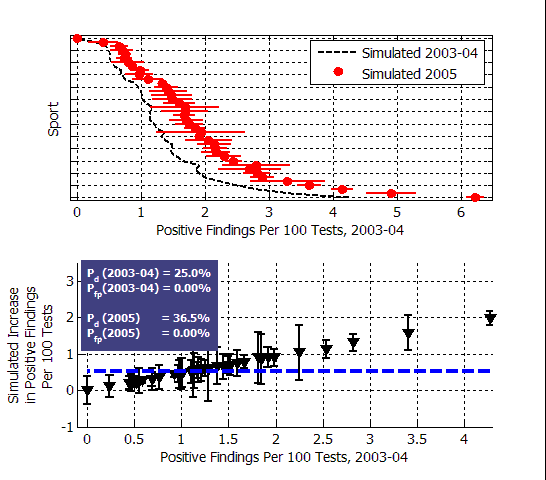
If that probability increased to 36.5% in 2005, then the simulated positive test rates would be as shown in the figure below:

Simulated positive test rate changes

The upper plot shows the simulated positive test rates for the two proposed values of Pd, where the doping rates DS are set to match the 2003-04 observations, and then held constant for the 2005 simulation. The error bars on the positive test rates indicate the standard deviations of the Monte Carlo runs, and the red circles indicate the means.

The increase in Pd was chosen to match the mean observed increase of 0.53% in all sports, indicated by the dashed blue line on the lower plot. The same result is obtained from any similar proportional change in the probability of detection. In other words, an increase from 25% to 36.5% looks exactly the same as an increase from 65% to 95%, or from 10% to 14.5%.

As you can see, if the probability of detection is increased for all sports, then the greatest increase in the positive test rate should be in sports with the highest positive test rates, and the sports with very low positive test rates show the smallest increase. The expected increase is proportional to the initial positive test rate. That doesn't actually match the observed changes very well. In general the sports with the highest positive test rates showed little or no change in 2005 compared to 2003-04.

But what if, instead of increasing Pd, we simulated an increase in Pfp, the false positive rate? Then the picture looks quite different:

Simulated positive test rate changes

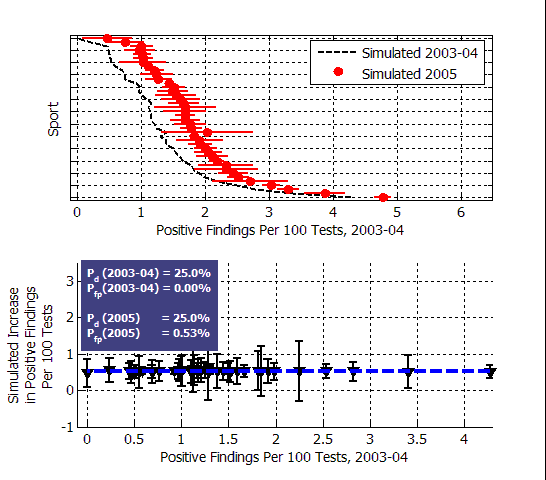
The figure above shows the effect of increasing the false positive rate in all sports from zero to 0.53%. In this case, the positive test rate is increased uniformly for all sports, regardless of the underlying doping rate. (I used a probability of detection of 25% for the simulation, but that parameter turns out to be irrelevant to the increase.)

Modelling the 2005 increase as an increase in the false positive rate looks like it matches the observations quite a bit better than an increase in the detection rate. Given the sample uncertainty, as I stated at the outset of this post, the observed increase is consistent with a uniform change in all sports.

One small problem with this theory is that the postulated false positive rate is pretty high. If Pfp = 0.0053 for all sports in 2005, then that should set a lower threshold on the observed positive test rates. Both luge (0%) and softball (0.37%) came in under the limit in 2005, but the number of tests involved was very small. With 178 tests in luge, we would have expected 0.94 positive tests, whereas none were observed. In softball, 542 tests should lead to 2.87 positives, whereas two were observed. So we're talking about less than one "missing" positive test in each case — I don't think we can rule out a false positive rate of 0.53% quite yet, and I think we have to at least consider the possibility that the false positive rate increased significantly in 2005.

Of course the assumptions I've used in my analysis are pretty simplistic; certainly all sports don't have the same kind of doping problem, and therefore their anti-doping programs are not all the same either. But my conclusions are based on a comparison of broad trends, and don't really depend critically on that assumption, I don't think. For a future analysis, it would be really nice if I could study the positive test rate changes for testosterone by itself, since I think that the increase in positive test rates was largely due to the changes in the testosterone test. Unfortunately, WADA doesn't provide that breakdown.

Some people might also reject my very first assumption, which was that athlete behaviour (specifically doping rates) didn't change between 2004 and 2005. What if they did change? Well, assuming that the tests were consistent from year to year, the observed changes in positive test rates suggest that the rate of doping increased more or less uniformly across the board. I can't really tell the difference between that event and a change in the false positive rate.

I have to live with the limitations of the analysis, which means that there's no "smoking gun" here. But everything I've looked at in the 2003-2005 statistics suggests that the increase in the positive test rate in 2005 came largely at the expense of athletes that weren't cheating in the first place.

July 11, 2006

WADA Statistics 2005, Part 2

Last September I wrote about the statistics of anti-doping tests. More recently WADA released the statistics for out-of-competition tests they conducted in 2005. As I noted at that time, there was a statistically significant rise in the percentage of positive tests in 2005 compared to 2004.

Last month, WADA released their annual report covering all tests conducted by WADA-accredited labs. That includes all in-competition and out-of-competition tests conducted by the various IFs, as well as those conducted by WADA directly. That's a huge number of tests, and the archives include detailed results for 2003 and 2004 as well. I'm going to spend a couple of posts looking at these numbers in more detail.

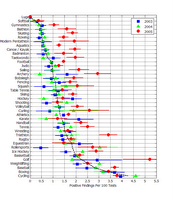
In Figure 1 (inset), I have plotted the positive test rate (number of positive tests divided by the total number of tests). The results are shown for each of the three years for all Olympic sports, and the five summer sports that are on the "short list" for inclusion in the Olympics. The total number of tests was more than 145,000 in 2005.

Figures

Figure 1 - Positive test rates 2003-2005

Figure 1 — positive test rates at WADA-accredited labs in 2003, 2004, and 2005 (click to enlarge).

Figure 2 - Positive test rate changes in 2005

Figure 2 — changes in the positive test rate in 2005 compared to the average for 2003-04 (click to enlarge).

Back in September I discussed how the sample size (number of tests) can be used to estimate the uncertainty in the measurement. Similar error bars are shown in Figure 1.

At the time I explained that calculation, I sort of glossed over the meaning of those error bars. I'm going to talk about changes in positive test rates, and in the next part of this post I'm going to speculate about reasons why those test rates changed in 2005, so I should be a bit more careful about that point here. What the error bars represent is the statistical distribution of positive test rates that you would measure if you repeated the ensemble of tests many times using different (but equivalent) random samples of athletes. If the tests don't change, and the behaviour of the athletes doesn't change, then the error bars should also represent the year-to-year variation in positive test rates.

As was the case with the much smaller sample I discussed in April, there was a statitsically significant increase in the positive test rate in 2005 compared to 2004 and 2003. The overall rate, averaged for the 40 sports, was (1.51 ± 0.36)% in 2003, (1.67 ± 0.35)% in 2004, and (2.10 ± 0.38)% in 2005.

It's also interesting to look at the increase on a sport-by-sport basis. Figure 1 demonstrates that the increase is roughly constant for all sports, although there are of course some exceptions. Figure 2 explores this in a little bit more detail, showing the difference between the 2005 positive test rate and the average of the 2003-04 positive test rates. Where the change is positive — as most of them are — it indicates more positive tests in 2005. The blue dashed line is the average change, which is 0.53%. When we take the error bars into account, the changes are consistent with the assumption that the positive test rate has increased uniformly for all sports.

If you squint, you might even convince yourself that the increase has been greatest for sports with low positive test rates, and less for sports with the highest catch rates. In the next part of this post, I'll talk a little bit more about what kinds of changes might lead to that kind of distribution.

Speaking of sports with high positive test rates, something struck me when I was comparing the 2003 results from my September post to the 2003 curve from this post. Namely, the 2003 rates reported by WADA are significantly higher than those reported by the IFs for the IOC report that was the basis of my earlier post. This is true across the board, but I particularly noticed cycling and triathlon.

Cycling was, by WADA's measure, the dirtiest of all 40 sports in 2003, with 486 positive tests out of 12,352 total (3.93%). In the IOC report, the UCI noted a total of 61 positives out of 12,352 tests (0.49%). The ITU similarly reported no positives out of 1664, whereas WADA's accredited labs counted 23 positives.

So what gives? It turns out there's a subtle difference in what's being reported. The IOC report counts "Number of tests reported that resulted in anti-doping rule violations," whereas WADA counts "A sample adverse analytical findings." The WADA reports footnote that fact, stating:

These figures may not to be [sic] identical to sanctioned cases, as the figures given in this report may contain findings that underwent the Therapeutic Use Exemption (TUE) approval process. In addition, some adverse analytical findings also correspond to multiple measurements performed on the same athlete, in the case of longitudinal studies on testosterone.

This of course leads to a natural consideration of false positives, which I will also touch on in the next part of this post. But there's an interesting piece of data in the WADA results that sheds some light on the issue. The sport of Luge has not had a single positive test in three years (458 tests). This lets us put an upper bound on the false positive rate — the probability that an innocent athlete will have an adverse analytical finding by random chance. Based on the results from luge over the past few years, it can't be much more than 1 in 500 or 0.2%. Of course, if it's really that high I would be pretty dismayed — that would mean that about 290 tests (0.002 × 145000) were false positives in 2005 alone.

July 07, 2006

Gert Fredriksson, 1919-2006

I once had a Hungarian coach (who I have written about before) who used to teach us about kayaking in his own unique language. As part of that language there was a particular phrase that he used almost as a litany when discussing the historical stars of our sport. Whenever he mentioned the name of one of the greats — Helm, Parfenovich, Barton, Gyulai, Holmann — it was always followed by the responsorial psalm, "You know, he was many times World Champion."

A contemporary of Coach K—'s, Gert Fredriksson of Sweden, died Wednesday at the age of 86.

Gert Fredriksson from www.olympic.org

Fredriksson won six gold, a silver, and a bronze medal in flatwater kayaking over four Olympic games (1948-1960), which makes him the most decorated man in the history of Olympic canoeing. He also won seven World Championships outside of the Olympics. No other man has ever won more than his thirteen combined Olympic and World titles. He holds the unofficial records for the largest margin of victory in any Olympic canoe or kayak race, and for the largest margin of victory in any race that is still contested at the Olympics. When he won his final Olympic championship, he was nearly 41 years old.

Gert Fredriksson, 21 November 1919 - 5 July 2006.

You know, he was many times World Champion.

July 05, 2006

Brian Williams Leaves CBC Sports

This story is a few weeks old, and L-girl already brought it up in the comments back here, but I thought I'd better mention it. Brian Willams* has left CBC Sports. Williams is now working for Rogers/CTV, who have the rights to the Canadian Olympic broadcasts for 2010 and 2012.

(*Note to American readers: I don't mean this guy.)

So, short-term good news: we won't have Brian Williams to kick around in 2008 (which is still a CBC property). OK, that's not really fair. I know that lots of people really like Brian Williams, and his absence will be seen as a loss for CBC Sports. He's just not my cup of tea.

Just like when Chris Cuthbert left, there's gossip going around that CBC Sports boss Nancy Lee didn't handle the situation with the utmost of delicacy. In this case I'm not sure many bosses would have done differently — Williams had, after all, already accepted a job with CTV when he was fired.

As long as we're talking about CBC Sports, I'll mention the Final Report on the Canadian News Media, authored by the Standing Senate Committee on Transport and Communication. The Standing Committee has recommended, among other things, that CBC should get out of the business of broadcasting professional sports and the Olympics:

This Committee believes that the CBC should greatly reduce its broadcasting of professional sports (e.g., hockey games) and the Olympics since these are activities that will be covered by other broadcasters in both official languages. In addition, broadcasts of professional sports are readily available everywhere in Canada via cable and satellite.

Sport is, of course, part of Canadian culture. Professional sports are increasingly carried by specialty channels and this trend will continue. This tendency, evident in the United States, is also occurring in Canada. It has already had an impact on the CBC French language service, which has lost its rights to NHL hockey to a specialty channel (RDS). Similarly, the CBC lost its bid for the 2010 and 2012 Olympics. In the near future, the CBC may well lose the English-language rights for the NHL to a private sector service. This reality needs to be recognized and dealt with in a way that does not interfere with the mandate of Canada’s national public broadcaster.

I should point out that the committee has also recommended that the government provide "realistic and stable funding" on a "long-term basis," with the goal of removing advertising from CBC Television. I suppose that in the fantasy land where this funding recommendation comes true, getting out of the revenue-generating sports business might be good for Canadian sport as a whole. It would probably mean more exposure for lower-profile sports, and support for projects that only a public broadcaster can do. That exposure — subsidized by the Canadian taxpayer — would indirectly lead to more private-sector revenue for amateur sport.

I found the link to the report via The Tea Makers, a good blog written by an anonymous CBC employee. Ouimet supports the concept of cutting sports, but argues that the private broadcasters should be the ones paying to keep the CBC out of the competition.

As a big fan of the Olympics, I'd be sorry to see the CBC stop bidding. In my experience, they do a better job of covering the Games than any private broadcaster I have seen. But that doesn't mean, necessarily, that CTV or some other private entity couldn't do a good job. They just haven't shown it so far, and I'm not sure why that is. Maybe part of the answer is that CBC Sports just has more expertise, developed through years of experience. If CBC Sports really got out of the business, then a lot of talented people — on-screen and off — would migrate to the private broadcasters eventually.

It's kind of amusing, though, to read suggestions that CBC should get out of the hockey business. Even if they didn't have the NHL or the winter Olympics, hockey is just too much part of Canadian culture for the CBC to ignore. We still might end up with a program lineup entirely and completely dedicated to shows about hockey.

July 01, 2006

I'll Stop the HRM Games, Because I Know What's Good For You

A few months ago, I posted my thoughts on my hometown's attempt to win the right to host the 2014 Commonwealth Games. During that discussion, I mentioned a professional-looking anti-bid website called Halifax No Way, and another, um, less professional one called the Stop the HRM Commonwealth Games Site (or perhaps it's called "Index," I'm not quite sure).

The proprietor of the latter is one Bruce DeVenne of Lower Sackville. Mr. DeVenne found my blog and left a couple of comments to my post, which you can read for yourself. Our conversation continued by e-mail, and was quite civil, but I don't think that I managed to change his mind one iota. Mr. DeVenne continues to sing a one-note tune about the cost of hosting the Games. I've already expressed my thoughts on that argument, and I'll leave it at that.

Recently I paid a visit to Halifax No Way to see what was new in the anti-Games camp. From what I had seen before, they had presented a balanced view of the risks inherent in the bid, and fair criticism of the bid process.

Unfortunately, Halifax No Way is off the air. I was intrigued, though, by this disclaimer on their front page:

Take Note: The owners of this site are not associated with Bruce DeVenne nor do they support his effort to block Halifax from winning the bid to host the 2014 Commonwealth games.

Oh. I thought these were Mr. DeVenne's allies?

A little digging turned up more of the story. Mr. DeVenne has been frequenting (and I mean frequenting) at least one Scottish message board. This thread starts off with Glaswegians happily anticipating their own city's bid; Mr. DeVenne chimes in on about page 10. Soon thereafter, he's joined by several pro- and anti-bid voices from Nova Scotia, and the Scottish audience is treated to a debate on the merits of the Halifax bid.

Mr. DeVenne's strategy seems to be to undermine the Halifax bid by providing ammunition and encouragement to Glasgow's supporters. He posts quite a bit of material arguing in favour of Glasgow, and lots that is derogatory (although completely public as far as I can see) about the Halifax bid. He also ends up arguing quite a bit in opposition to the idea of hosting, period, which might undermine his goal, but I guess he can't entirely keep his true opinions to himself.

Now, I don't have any problem with people who think that Halifax cannot or should not host the Commonwealth Games. As I argued before, I'm not saying that it's a slam dunk — all I want is an argument that is framed in the proper terms. And if Mr. DeVenne thinks that he can convince his fellow citizens not to support Halifax's bid, well that's his right. The people of Halifax have the right to choose whether their tax dollars should be used to pursue this adventure.

But every opinion poll that has been conducted so far has shown overwhelming support for the bid. Mr. DeVenne's own on-line petition against the bid has garnered only 135 signatures, and there is no telling how many of those people are really on his side — as he told me himself, "The pro side has some people who aren't the brightest bulbs on the tree they are filling in pro games messages in the comment boxes but then voting to kill the games. People have to learn to read what they are signing."

This is all a bit hypocritical coming from a man who likes to portray himself as the little guy fighting city hall. In the absence of significant bid opposition from the public, he's decided that he'd better take matters into his own hands — the majority be damned. He'll stop the HRM games one way or another, because he knows what's good for us … I guess even better than we know ourselves.

June 28, 2006

Following the Money, 2006

More than a year ago I wrote a series of posts titled "Following the Money" that examined the breakdown of Sport Canada's overall contributions to all recipients, and the percentages allocated to Olympic sports. I went looking for the 2003-2004 and 2004-2005 numbers on the Sport Canada website so that I could update the charts I did then.

Regular readers and people who work in the Canadian sport system will know that Canada's sport funding partners have recently made a change in their funding strategy. The old strategy, sometimes described as "a mile wide and an inch deep," was to distribute funds to a large number of sports in more or less equal measure. The "inch deep" part of that metaphor comes from the recognition that the total number of dollars available is fairly small, so a wide distribution means less for everybody — and perhaps not enough for anybody.

The new strategy adopted by Sport Canada and the Canadian Olympic Committee is intended to target funds where they will give the most benefit and are being best used. For high-performance funding, that means giving more money to sports with a high probability of future Olympic success. A few weeks ago I wrote about the Canadian Sport Review Panel's allocations for summer sport high-performance funding and assessed how the highest-ranked sports have done. Here I want to take a look at funding in the broader picture and take a look at the new strategy in the context of the past decade.

Figure 1

Figure 1 — Sport Canada funding contributions, 1995-2005 (click to enlarge).

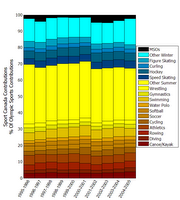
Figure 1 (inset) shows the updated chart of Sport Canada contributions, divided into more or less the same categories as last time. I made a few minor adjustments; for example, I made Olympic and Paralympic sports into a single category. For the most part, that's because it's actually not easy to separate them. National Sport Federations (NSFs) like Athletics Canada get funding for Olympic and Paralympic programs, but the Sport Canada summaries just provide totals.

The first conclusion we can draw is that the Sport Canada budget has seen a strong increase — about 160% — over the past decade. Aside from the International Events category, which tends to wax and wane depending on which events Canada is hosting in any given year, every category has seen a steady increase. The Olympic/Paralympic Sports category represents the total funding given to NSFs for Olympic and Paralympic sports, plus a few multi-sport organiations (MSOs) dedicated to high-performance sport, such as the Canadian Olympic Committee and Canadian Paralympic Committee. That amount has increased from $21M to $51M since 1995-96. The contribution to the Athlete Assistance Program, which goes directly into the hands of national team athletes, has similarly increased from $10M to $20M.

That's all very good news for Canada's elite athletes, and for sport in general.

Figure 2

Figure 1: Distribution of Olympic sport funding, 1995-2005

Figure 2 — Sport Canada funding distribution for Olympic and Paralympic sports, 1995-2005 (click to enlarge).

Figure 2 (inset) shows more detail about the Olympic/Paralympic Sports category, and the results were somewhat surprising to me.

Here the plot shows the distribution of funds to Olympic and Paralympic sport organizations. Each bar shows the Sport Canada contribution as a percentage of the total in the Olympic/Paralympic Sport category each year. (Recall that the total has increased from $21M in 1995-96 to $51M in 2004-05.) What this should show us, then, is whether any recipient or group of recipients has been recieving a bigger or smaller piece of the (growing) pie.

I've identified specifically a small number of NSFs for summer and winter sports in the chart. For summer sports, I singled out the NSFs responsible for the twelve top-ranked CSRP sports on my previous report card. Remember that these eleven NSFs fielded teams that won eleven of Canada's 12 medals in Athens, and the CSRP is predicting that they will be responsible for 17 of 20 medals in Beijing. For winter sports, I have broken out the four NSFs responsible for the Own the Podium program's top-priority sports.

The surprising results show that these "have" sports have not significantly changed their share of the total contribution. The eleven summer sports in question took in 33.1% of the total Olympic/Paralympic funding in 1995-96, and 35.6% in 2004-2005. The high point of 36.8%, curiously, was 2000-01, which also saw a big increase in the total funding. The top four winter sport NSFs saw 14.2% of the total in 1995-96, and 14.5% in 2004-05. The highest percentage (16.0%) was allocated in 1997-98.

There has been a slight shift towards winter sports overall of about 2%, with the decrease coming out of summer sports.

So what does this all mean? Is targeted funding just a myth?

Well, maybe. There are a couple of confounding factors here. The first is that several of these "high-priority" NSFs have somewhat split personalities. For example, Canoe Kayak Canada gets funding for sprint canoe-kayak, which is a CSRP 1A sport, and for slalom canoe-kayak, which is in category 4. The Sport Canada contribution represents the total for everything, so an increase in sprint funding might be masked by a decrease in slalom funding.

A more fundamental difficulty with these numbers is that they represent contributions for domestic programs, including grass roots development, and not just for high performance sport. In many cases the high-performance budget dwarfs other contributions, but in other cases it does not.

However, the results still surprised me. I expected to see the top-priority sports taking a bigger share of the pie over the last two funding cycles. I think what we're seeing here is the fact that Sport Canada has mostly avoided having to make the tough decisions because of the overall increase in its budget. When there's more money to go around, they can increase budgets for the high-priority sports without having to make a lot of painful cuts elsewhere. It will be interesting to see how the targeting strategy plays out when budgets start shrinking again.

June 23, 2006

Happy Olympic Day!

This week at the IOC Executive Meeting, there was no announcement about the scheduling of swimming finals at the 2008 Olympics. Or rather, there was an announcement that the decision will be delayed for two months.

The IOC also signed a new agreement with the International Paralympic Committee. The agreement runs through 2016 and ensures that the Paralympics will continue to be held in the same host city as the Olympics, as they have been since 1988. The IOC also approved substantial increases in funding for the Paralympics in 2014 and 2016.

The big news of the week was that the list of candidate cities for the 2014 Winter Olympics has been shortened to three.

Salzburg, Austria, Sochi, Russia, and Pyeongchang, South Korea have been selected from the field of seven to complete a full Candidature File and host an evaluation visit.

Geography — physical geography — plays a big role in the Winter Olympics, so the selection of the right location is pretty important. Looking at the Report by the IOC Candidature Acceptance Working Group (PDF, or get a PDF of the conclusions only), it seems pretty clear that the Executive made the right choice.

As long as I'm talking about bidding again, the USOC is working on the selection of its candidate city for 2016, entertaining five pitches from San Francisco, Los Angeles, Chicago, Houston, and Philadelphia.

I've got an early prediction on this one, by the way, if you're interested. The US candidate is a near lock for 2016, as long as the USOC doesn't make a stupid choice. This is primarily a function of geography — political geography. The Europeans will be shut out, since London has 2012, and the Americans haven't hosted the Summer Olympics since 1996.

There's one wild card in this prediction, and that's South Africa. Although Durban has not formally decided to bid, I think that might make for an interesting race. Durban will have some facilities in place because of the 2010 World Cup, and there is building political momentum behind a first-ever African hosted Olympics. Rogge himself has encouraged African countries to bid. The president of the South African NOC, Sam Ramsamy, hails from Durban, and is a member of the IOC Executive — a privilege that no American currently holds.

June 18, 2006

The Times of Finals

There's an international uproar brewing over the schedule of events in Beijing in 2008. You may have read about it at Timed Finals, where Scott Goldblatt has been doing an excellent job following the story and laying out the issues.

The outline of the story is this: NBC has suggested that the finals in swimming (and perhaps a number of other high-profile events) should be rescheduled from late afternoon to early morning. That would mean that they could be broadcast live in United States primetime, meaning a bigger audience and more advertising revenue for NBC.

As Scott also reported, a few Australian sources are today stating that this is a done deal — the IOC is "set to announce" that the swimming schedule in Beijing will be modified in accordance with NBC's request.

My prediction is that this announcement will not materialize, at least not for a week or so. That's because the IOC Executive Board meeting doesn't start until Wednesday, and concludes on Friday. It's possible that the Board has made a decision already, or that sources inside the IOC already know how it's going to turn out, but the stories I have read are not all that convincing. My guess is that the decision has not yet been made, and statements to the contrary are just speculation fueled by outrage at the possibility.

But let's back up a few steps. First of all, who really has jurisdiction over the scheduling of competitions? The Olympic Charter, Rule 49, deals with the Technical responsibilities of the IFs [International Federations] at the Olympic Games:

1. Each IF is responsible for the technical control and direction of its sport at the Olympic Games; all elements of the competitions, including the schedule, field of play, training sites and all equipment must comply with its rules. For all these technical arrangements, the OCOG [local organizing committee] must consult the relevant IFs. The holding of all events in each sport is placed under the direct responsibility of the IF concerned.

2. The OCOG must ensure that the various Olympic sports are treated and integrated equitably.

3. As to the schedule and daily timetable of events, the final decision lies with the IOC Executive Board.

Rule 49 starts out giving all responsibility for the technical arrangements to the IF (meaning FINA, in this case). Of course, it makes a lot of sense to let FINA set the competition schedule, since their resident technical committees have much more sport-specific expertise than BOCOG or the IOC. On top of that, though, somebody has to be responsible for rationalizing the schedules for all the sports — allocating days to sports, avoiding venue conflicts, and even making minor schedule adjustments to ensure that concurrent finals are avoided as much as possible. My reading of the intent of Rule 49 is that this is the responsibility given to the IOC Executive; not overhauling the daily schedule, but making sure that the swimming schedule as defined by FINA fits within the overall Games programme.

However, the letter of Rule 49 clearly gives the Executive the power to modify the FINA-sanctioned competition schedule as dramatically as they want to, and for any reason they choose, even if that modification has a significant impact on the athletic competition.

I don't really have an opinion on whether swimming a final in the morning is better or worse than swimming a final in the afternoon, or whether it gives anybody a particular advantage. I'll defer to Scott and the other experts on that question. However, there is no doubt that this change will have an impact on the competition.

In many Olympic swimming events, athletes have to compete in event finals on the same day as heats or semi-finals. Rescheduling finals to the morning, therefore, means reshuffling an already-crowded schedule, and will lead to new and unanticipated conflicts. Some swimmers who compete in multiple events will now be faced with the prospect of racing a flat-out personal best in the morning — and then turning around to race in qualifying heats later that same day. This is not a big issue for the superstars, who cruise through the advancement anyway, but will have an effect on athletes who need their best performances just to reach the finals.

At any rate, I am not qualified to decide whether racing finals in the morning instead of the afternoon is a good thing or not — but the IOC Executive members are not qualified, either, and certainly NBC Sports executives are not. I agree with Scott and most of the people who are covering this story that modifying the competition schedule to suit NBC is a bad idea.

Of course NBC has a lot of influence with the IOC, and there is no getting around that. The US television broadcasters pay enormous sums to the IOC for the rights to broadcast the Olympic games. NBC paid more than $3.5 billion for the rights to the 2000, 2002, 2004, 2006, and 2008 games; they added another $2 billion for 2010 and 2012. That's somewhere between half and two-thirds of the money that the IOC takes in for TV and multimedia rights. It's not surprising that NBC's opinions and requests carry a great deal of weight with the IOC.

NBC might also have a legitimate feeling that they overpaid for the 2008 contract. An oddity of the bid process, as I pointed out before, is that the IOC tenders the Olympic broadcast rights before the bidders know the identity of the host city. NBC signed the contract for the 2008 games sometime in 1998. Beijing was not selected as host city until 2001. The heads of NBC Sports know that the Beijing Olympics will not be as lucrative as, say, a Toronto Olympics, because the time differences will mean a lot of tape-delayed broadcasts. I don't think it's surprising or unethical that they are trying to use their financial power to make the best (for them) of a bad situation.

It's interesting, though, to ask yourself this: why does the IOC sell television rights before selecting a host city? This article proposes one answer:

Neal Pilson, a former CBS Sports president who advised the IOC on this year's rights deals, says that … "The decision [on the host city] is made on the merits, not based on U.S. television interests. … The reason why bidding took place before the selections was to take that factor (US television money) out of the games selection process."

In other words, the IOC doesn't want the IOC delegates selecting the host city to be swayed by the potential impact on broadcast revenue. They get NBC to sign on the dotted line first, and then ask the delegates to select the host city "on the merits."

That's all very noble and everything, and if I believed that the host city election was an important IOC function with some kind of integrity that needed protecting, then I guess it would be a good idea to keep NBC out of it.

It turns out that I don't believe any such thing. But putting my own views aside for now, let's think about the logic of this situation. In order to limit NBC's influence on the host city election, the IOC forces them to bid on the 2008 Olympics without knowing where they will be held. Then the IOC chooses Beijing, which has the completely predictable outcome of making NBC unhappy. So to make NBC slightly less unhappy, they're willing to allow some influence on the schedule of the competition.

So in other words, although it would be wrong to let NBC influence the selection of the host city, it's OK to let NBC influence the sporting competition itself.

Does that seem backwards to anybody else?

June 14, 2006

UltraAmateur Sport

A few months ago I agreed to become a member of the organizing committee for the Medavie Blue Cross Canoe Challenge. The Canoe Challenge is a charity event that has raised over a million dollars (Canadian) for the IWK Health Centre Foundation and Ronald McDonald House Atlantic.

The Canoe Challenge is an interesting example of a very popular kind of event, the sport-based charity fund raiser. The basic structure of the sport-based charity fund raiser is as follows. Individuals or teams sign up for a sporting event in support of a good cause. They go out to their communities looking for sponsorship. They bring their sponsorship money to the sporting event. They "compete" against other individuals or teams. There are token prizes for winning the competition, and more substantial incentives for raising the most money.

If you're trying to raise money this way, it's good to round up as many participants as you can possibly squeeze in. As a rule, charity events are based on sports that are either very popular among adults, or relatively simple to master. No, scratch that. The sport doesn't need to be mastered; in fact, being an expert is really contrary to the basic spirit of the event. The sport does have to be simple to pick up, though. Ideally, most people can do it without any serious preparation. Slow-pitch softball, volleyball, dragon boat racing … these are all good candidates for a charity sporting event.

War Canoe racing at the Canadian national (club) championships

And that's what makes the Canoe Challenge an interesting example: paddling in a war canoe is actually quite difficult. Most adults trying it for the first time are extremely uncomfortable, and the chance of capsizing is fairly high. For those of you who don't know what I'm talking about, here's a picture of war canoe done well (this was not taken at the Canoe Challenge).

There are fourteen paddlers, plus a coxswain, in a boat. The paddlers kneel on one knee and use large paddles to generate a great deal of power. When the boat is full, there isn't much room to move. The boats are not particularly streamlined, but much more so than a dragon boat or a typical recreational canoe. They are also relatively fragile. The event is raced almost exclusively in Canada, over 500 or 1000 m, which takes approximately two or four minutes. The boats themselves are loosely derived from the War Canoe of the North American First Nations.

The War Canoe is so difficult, in fact, that the Dartmouth event is (to my knowledge) the only charity war canoe race held anywhere in the world. Lake Banook is the logical host site for this unique event; the lake is home to three competitive flatwater canoe clubs, and the Halifax regional municipality contains five more. The relationship between the Canoe Challenge and these supporting sport organizations is another interesting aspect of the event. Due to the technical nature of the sport, the organizers lean heavily on the canoe clubs for equipment and expertise. The clubs derive a small financial benefit from their involvement, but on balance they feel that their contributions are not fully recognized. One symptom of the divide between the two groups is evident in the name of the event — Medavie Blue Cross has quietly rebranded the 2006 version as the Canoe Challenge, dropping the unfriendly-sounding "War" that identifies the type of boat.

This year's (War) Canoe Challenge was held on Saturday in miserable weather. Each team was entitled to two practices in the weeks leading up to the event. Only about two-thirds of the teams availed themselves of the opportunity, meaning that ten crews showed up on Saturday having never been in the boat. For the challenge, the crews were limited to twelve paddlers, and the coxswains — who need very specialized skills — were provided by the organizers. Each team races twice over 200 m, with the top teams by aggregate time advancing to a final.

As the organizer of the sporting competition central to the event, I would give it a "B" grade. After a slow start, the races ran roughly as scheduled. About half a dozen crews capsized, but nobody got hurt. About the same number of crews declined to participate in their second race, although that number would have been lower if the weather had been more pleasant. I think the competitors mostly enjoyed themselves, in spite of the conditions. The equipment made it through mostly unscathed.

I also introduced a few new ideas, which I think were quite successful. One of those involved Olympians Canada. Five representatives of the Most Exclusive Club in the Nation participated as honorary coaches for the five teams that raised the most money. I think that this really added something unique to the event. The Olympians threw themselves into their roles with great relish and became enthusiastic members of their assigned teams. Well, four of them did, anyway — I had too much on my plate to really do a good job in my coaching role.

The teams raised $116,000 for the two beneficiaries.

June 04, 2006

More Wishful Thinking and Free Publicity

Last week there was another one of those stories that pop up from time to time, the ones that claim "sport X wants to be in the Olympic Games!" Of course sport X is a pastime that may or may not even be a sport, which means that the story gets quickly propagated as an "odd news" bit and gets a bunch of free publicity as a result. The last one I saw was poker.

Last week's version has it that gaming (video gaming) is "pushing" for "Olympic recognition." I know I am only fueling this ridiculous story by publishing the link, but I can't help myself.

[Ted] Owen, who runs the Global Gaming League (GGL), a media company focused on the lifestyle and culture of gaming, is currently talking with the Chinese government in hopes of bringing competitive video gaming to the 2008 Games as a demonstration sport. … Owen, though, said he believes gaming's worldwide appeal - especially to a younger audience - could be the biggest boost to the Games since snowboarding. "People aren't watching [the Olympics] as much anymore," he argued. "You need to bring younger viewers back if you want to keep making money. To do that, you need to embrace non-traditional sports. They did it with snowboarding — and look how the popularity of that has surged in the Games. Video games deserve to be seen as a non-traditional sport. … They would bring something to the Games that [that age group] engages in and everyone understands."

There are so many things wrong with this whole thesis that I don't know where to start. I think I'll just stick to the administrative impossibilities:

  • The official sports for 2008 are cast in stone at this point. The programme for 2012 was selected last summer. You may remember that. There was quite a lot of publicity about it.
  • Ted Owen thinks that "The only reason they [the IOC] haven't done an exhibition sport in the past several years is no one has brought a good one to them." He is incorrect. The IOC placed a moratorium on demonstration sports at the winter or summer Olympics starting in 1996. There will not be any demonstration sports in 2008.
  • The GGL is not recognized as an international federation (IF) by the IOC and therefore has no standing (unlike other Olympic outsiders like DanceSport, Mountaineering and Climbing, and Wushu). Getting recognized is not trivial — among other things, the GGL would be required to "apply the Olympic Movement Anti-Doping Code and conduct effective out-of-competition tests." I'm not trying to cast any aspersions on gamers here, I just don't really think that the GGL has thought carefully about all of the burdens that go along with being on the inside of the Olympic movement.

I try not to get into discussions of whether "sport X" is or is not a sport, or "deserves" to be in the Olympics. Most people who do so end up making idiots of themselves rather quickly. Here's Exhibit A. Jason includes a list of sports that have "as little or less merit as being regarded as official sports." I assume he means that they deserve to be in the Olympics even less than gaming. I personally don't buy that argument for even one of the sports (actually disciplines or events, in some cases) on his list. But regardless, if you want to get your sport into the Olympics, surely you've got to have a more compelling argument than that.